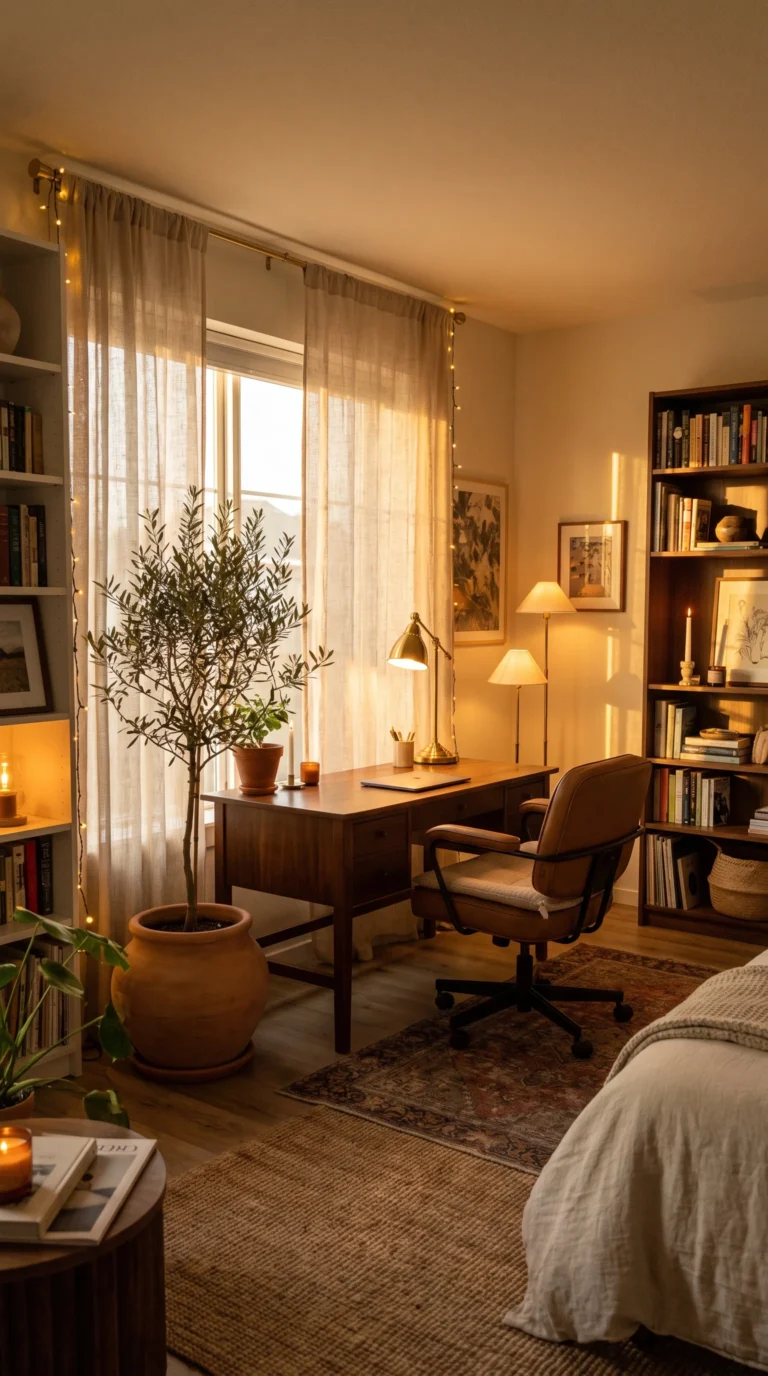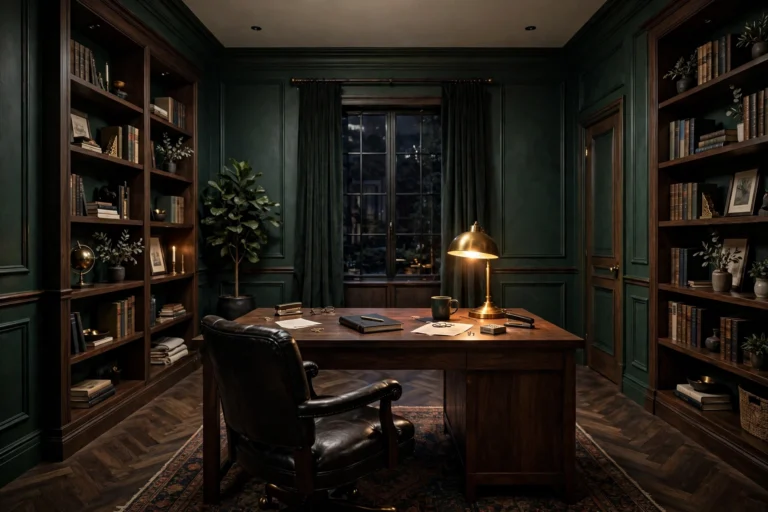
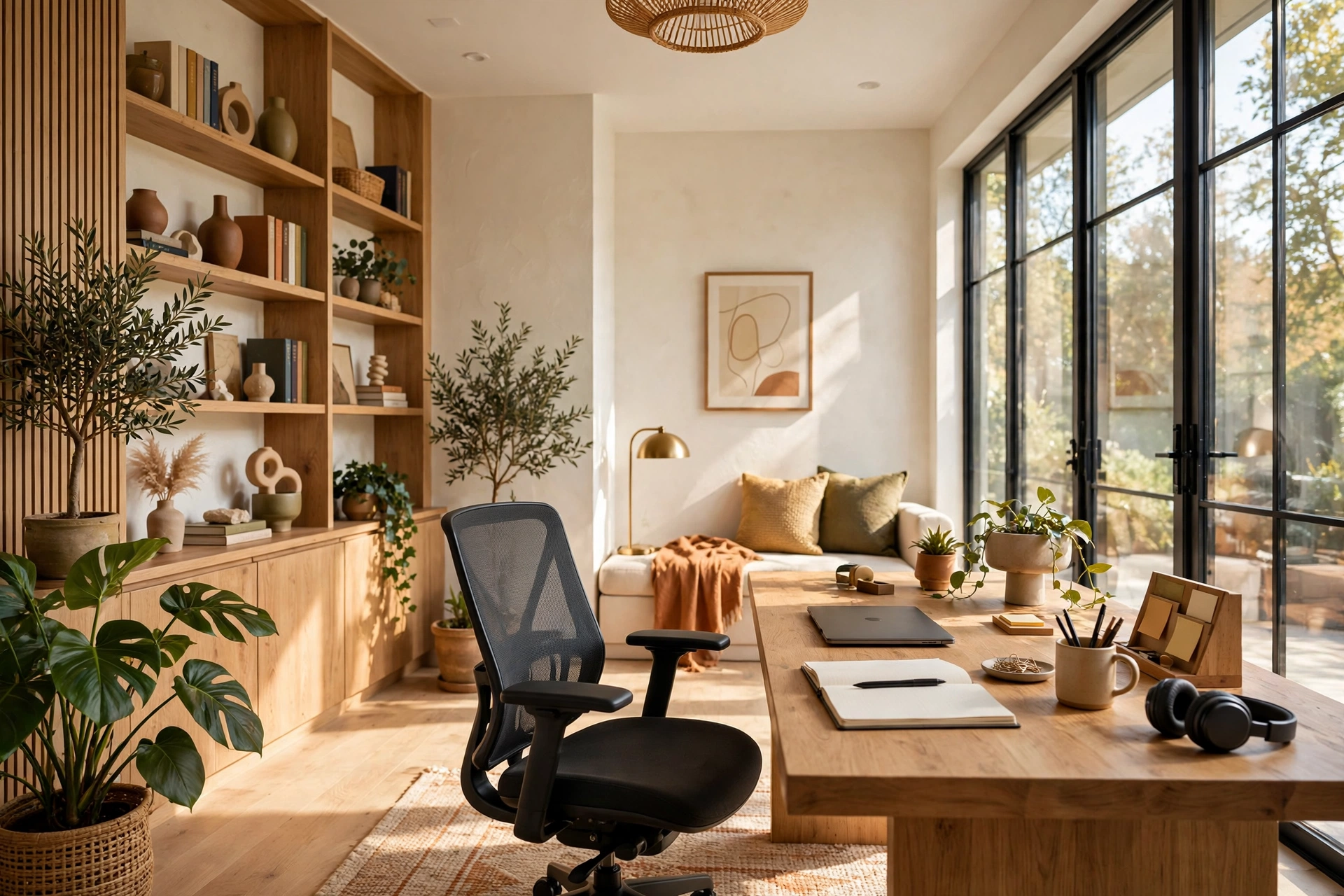
20 Home Office Decor Ideas That Make You Actually Want to Work
Introduction
A home office should be the easiest room in the house to love, yet for most of us it is the room we avoid. It starts as a desk squeezed into a corner, a chair borrowed from the dining table, and a tangle of cables nobody wants to look at. Then one day you realize you spend more waking hours in that corner than anywhere else in your home, and it deserves the same care as the living room or the bedroom. The good news is that a workspace does not need a renovation to feel inspiring; it needs a few deliberate choices about light, layout, and the things you look at all day.
The ideas below work whether your office is a dedicated room, a spare-bedroom corner, or a desk tucked into the living room. They are ordered from the biggest impact to the finishing touches, so you can start with the desk and the light and build up from there. Every idea is budget-friendly at its core, and most of them can be done in a single weekend with things you can order online or pick up in one shopping trip.
Below are twenty home office decor ideas that turn a dull work corner into a space you actually look forward to sitting in, from desk placement and lighting to plants, shelving, and video-call-ready styling. The checklist after idea three will help you plan your refresh before you buy anything, and the comparison table after idea five sums up cost and effort at a glance. Whether you work from home full time or just need a corner for bills and emails, you will find a starting point here that fits your space and your budget.
1. Start with a Desk That Fits the Work You Actually Do
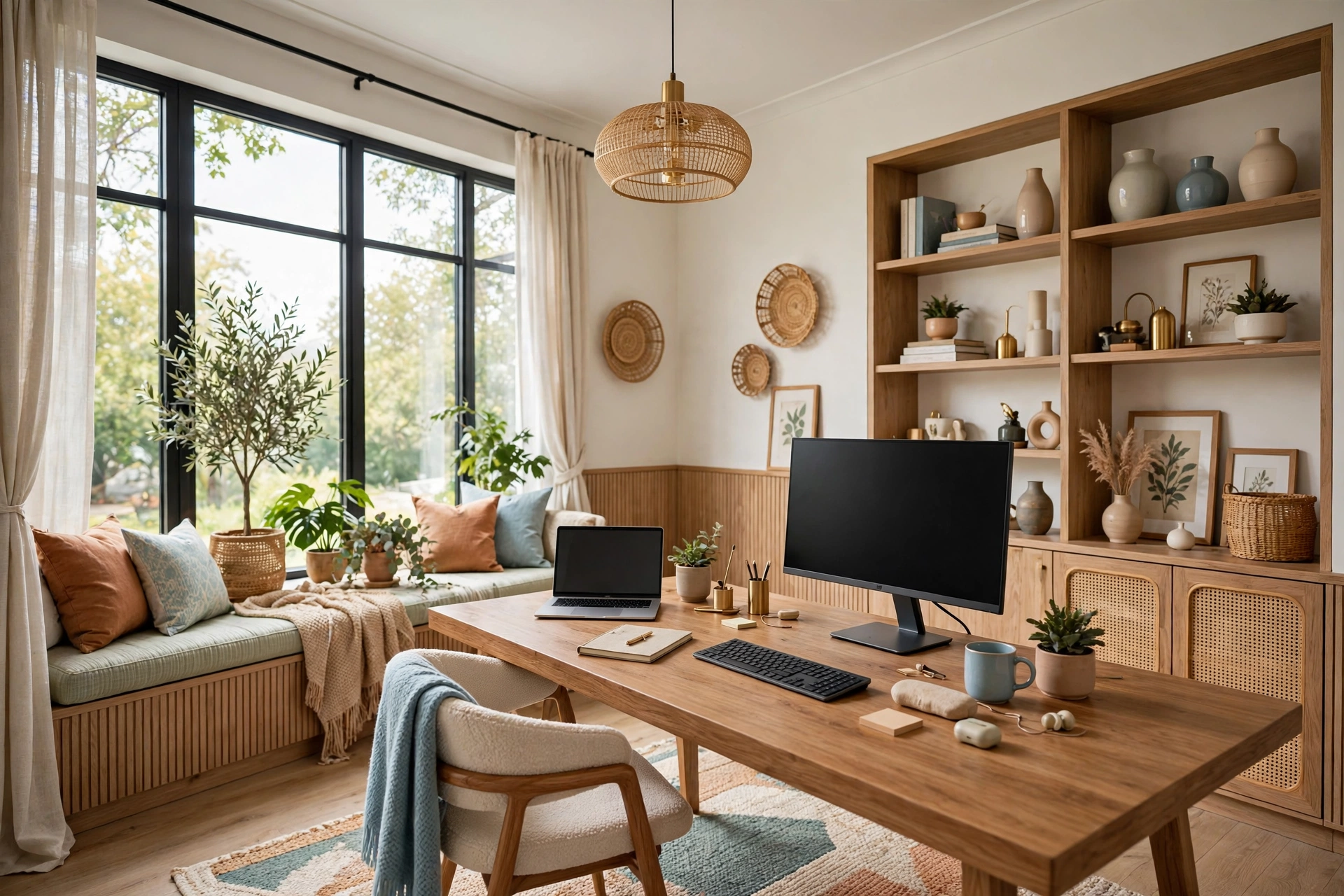
The desk is the anchor of every home office, so choose it for the work you really do, not the work you imagine. A writer needs a wide, clear surface and almost no storage. A designer or crafter needs depth for a monitor, a tablet, and materials spread out. If you mostly answer emails on a laptop, a slim console desk leaves the room feeling open while still giving you a proper place to sit. Measure your equipment before you shop: a monitor, keyboard, and notebook need at least 120 centimeters of width to feel comfortable, and a desk that is too shallow will have you hunching over the keyboard all day.
The material and finish set the tone for the whole room, so pick something you love looking at. A warm walnut or oak top softens a white room and hides dust far better than a glossy black surface. White or light-wood desks make a small room feel bigger and bounce the light around, which matters when your office is a corner of another room. If your budget is tight, a simple solid-wood tabletop on two drawer units gives you a custom desk for less than a branded one, and you get storage built in. Whatever you choose, keep the top mostly clear: a desk that starts clean stays productive, and a desk buried under clutter quietly drains your focus every morning.
2. Put Your Desk Near Natural Light
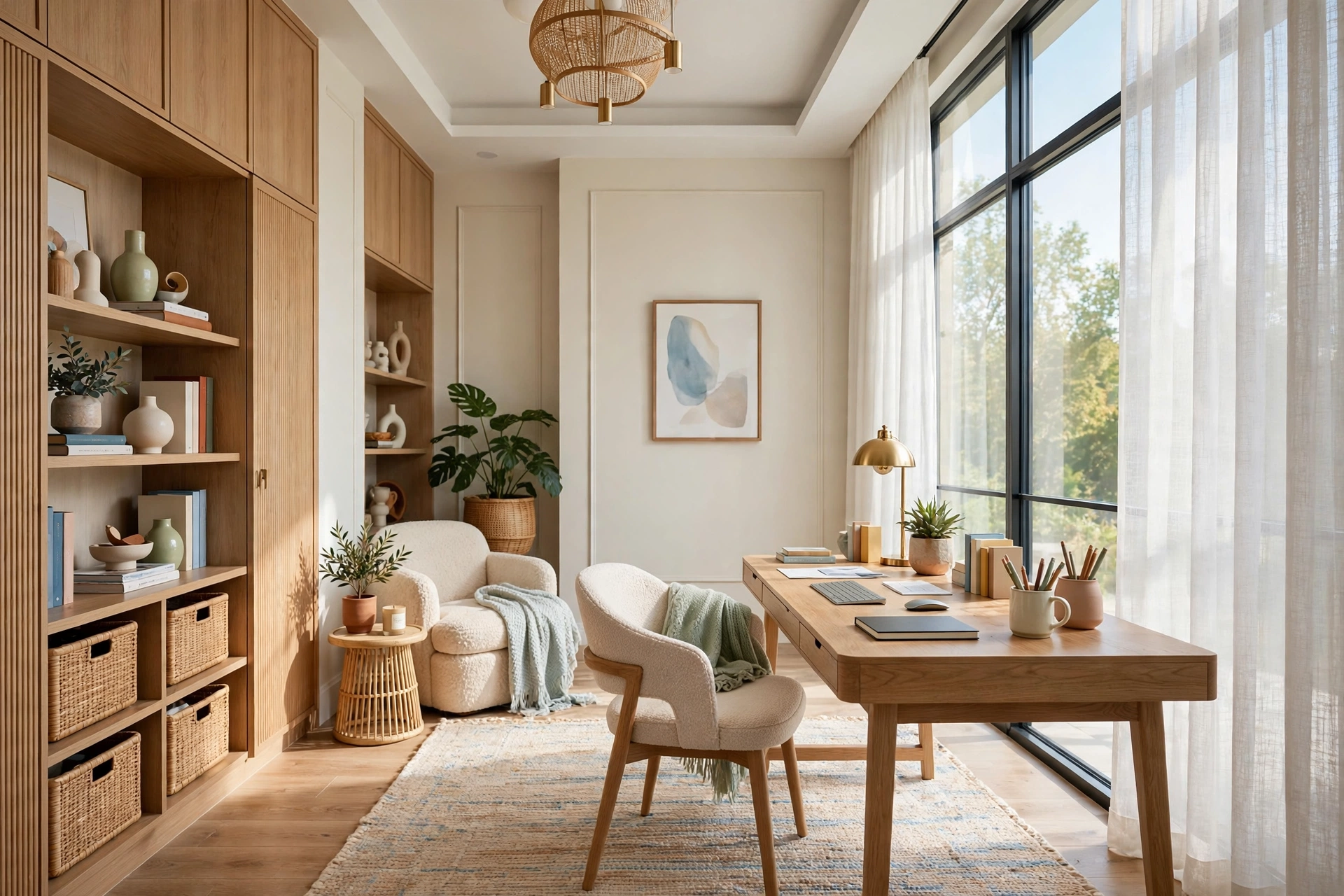
Light is the single cheapest upgrade a home office can get, and it costs nothing at all. Place your desk beside or facing a window so daylight falls across your work instead of behind your screen, where it creates glare. A side-on position is the sweet spot: you get the view and the brightness without squinting, and your face is evenly lit on video calls. If the only window is behind you, a sheer curtain softens the backlight so you do not appear as a silhouette on camera.
The way you arrange furniture around the window matters as much as the desk itself. Keep tall shelves and bookcases off the window wall so they never block the light, and choose a light-colored desk or rug near the window to bounce brightness deeper into the room. In a room with almost no natural light, a daylight-temperature desk lamp aimed at the wall behind your monitor mimics the effect surprisingly well. And do not underestimate the view: even a window that looks onto a garden wall or a quiet street gives your eyes somewhere to rest between tasks, which is exactly what a productive workspace needs.
💡 Pro Tip: if your desk must face a wall, hang a mirror or a large framed print on it at eye level. It gives your eyes a focal point during breaks and stops the wall from feeling like a cubicle.
3. Choose a Chair That Supports Long Workdays
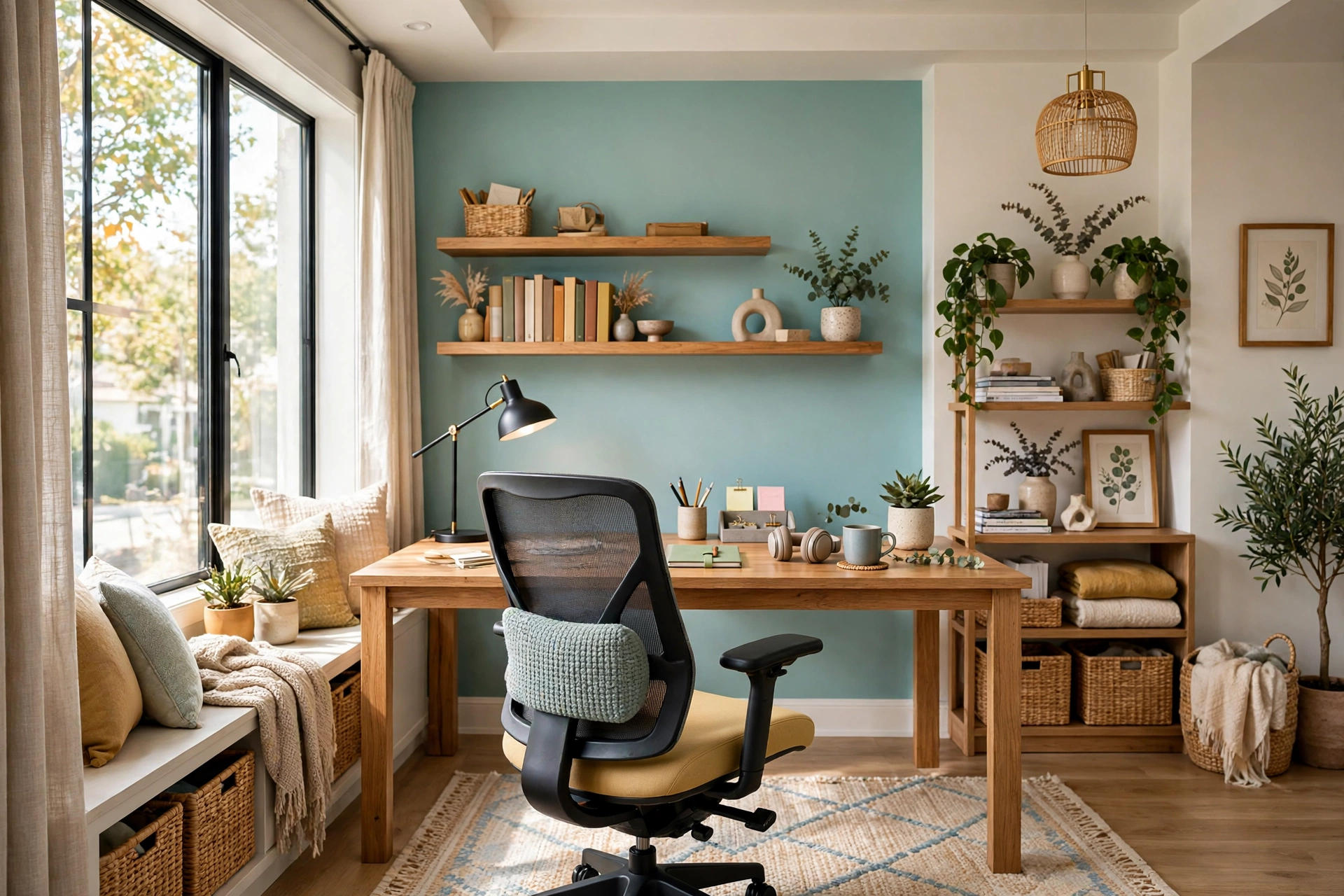
You will sit in this chair for thousands of hours a year, so it deserves more thought than any other purchase in the room. A good office chair supports your lower back, lets your feet rest flat on the floor, and keeps your elbows at roughly ninety degrees when you type. You do not need a gaming chair or a designer label; a simple ergonomic task chair with adjustable height and lumbar support does the job, and many excellent ones cost less than a weekend of takeout.
Style matters too, because the chair is one of the biggest visual objects in the room. A chair in a warm neutral, soft leather, or woven fabric looks like furniture rather than office equipment, which helps the office blend into the rest of your home. If your office is in the living room, a chair that looks good from behind is worth prioritizing, since that is the view everyone else sees. Add a small lumbar cushion in a color that matches your rug or curtains, and the chair becomes part of the decor instead of an eyesore you tolerate. Your back will notice the difference within a week, and so will your work.
Home Office Decor Ideas Quick-Start Checklist
- ✅ Measure your desk wall, window, and door swing before buying any furniture.
- ✅ Pick a desk size that fits your real equipment, not the setup you wish you had.
- ✅ Place the desk side-on to the window for daylight without screen glare.
- ✅ Choose a chair with adjustable height and lumbar support, then test it for a full workday.
- ✅ Decide your color palette first, so every later purchase matches the scheme.
- ✅ Plan one cable-management solution before the first device is plugged in.
- ✅ Leave one surface completely clear: a clean landing spot keeps clutter from spreading.
4. Build a Gallery Wall That Inspires You
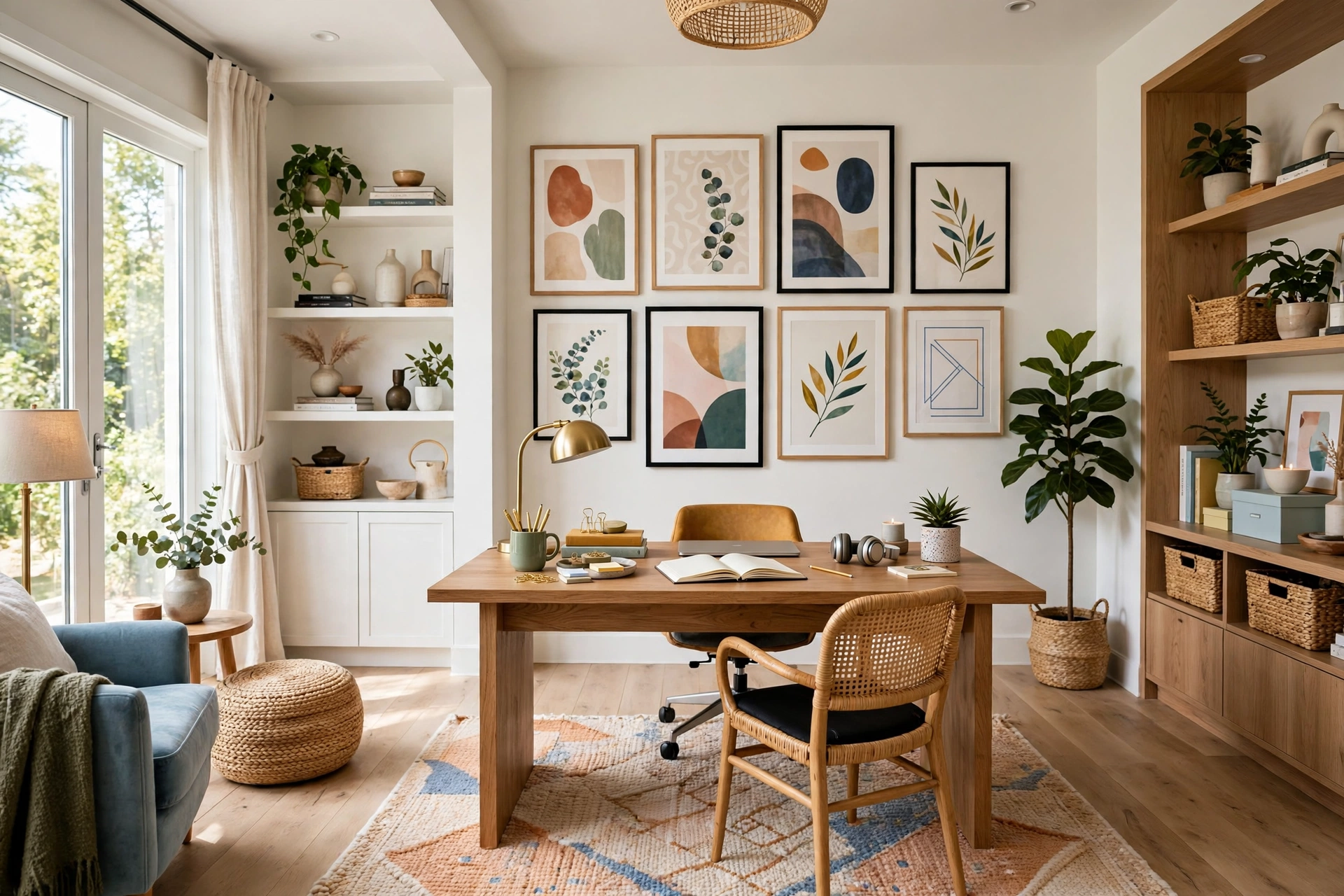
A blank wall behind or beside your desk is wasted inspiration. A gallery wall turns it into the most personal part of the room: framed prints, a favorite quote, a photo from a trip, a postcard, a small piece of art your child made. The trick is treating it as a collection rather than a random assortment. Pick one unifying element, matching frames, a single color running through every piece, or a consistent mat width, and the wall reads as deliberate even when the art itself is wildly different.
Start with the biggest piece at eye level and build outward, leaving even gaps of five to eight centimeters between frames. Paper templates taped to the wall let you test the layout without a single nail hole, which is a lifesaver in a rental. Mix in one or two non-frame elements for depth: a small woven wall hanging, a wooden letter, or a tiny shelf holding a plant. Keep the gallery above or beside the desk rather than directly in your line of sight while working, so it inspires you when you look up without pulling your attention away while you type. If your office is a corner of the living room, the same small space decorating ideas that work in studios apply here: keep the footprint tight and let the wall do the decorating work.
5. Add a Rug to Define the Work Zone

A rug is the fastest way to tell your brain that this corner is the office, especially when the desk shares a room with the sofa or the bed. The rug creates a boundary you can feel underfoot, and it instantly makes the space look finished. Choose a low-pile rug so your chair rolls easily, and size it so the desk and chair both sit fully on it, with at least thirty centimeters of rug behind the chair for when you push back. A rug that is too small looks like a mat; one that fits the zone looks like a room.
Pattern and color do real work here. A soft, muted pattern hides crumbs and dust between vacuums, and a warm tone under the desk balances the cool light of a monitor. In a small space, a light rug with a subtle border keeps the room feeling open, while a bold pattern can anchor a large, plain room that otherwise feels empty. If your office is on hard flooring, the rug also softens sound, which your video-call colleagues will appreciate. Layer a smaller textured rug over a larger flat one if you want the cozy, collected look, but keep the top layer clear of the chair wheels.
Quick Comparison: Home Office Decor Ideas by Cost and Effort
6. Use Floating Shelves for Storage and Style
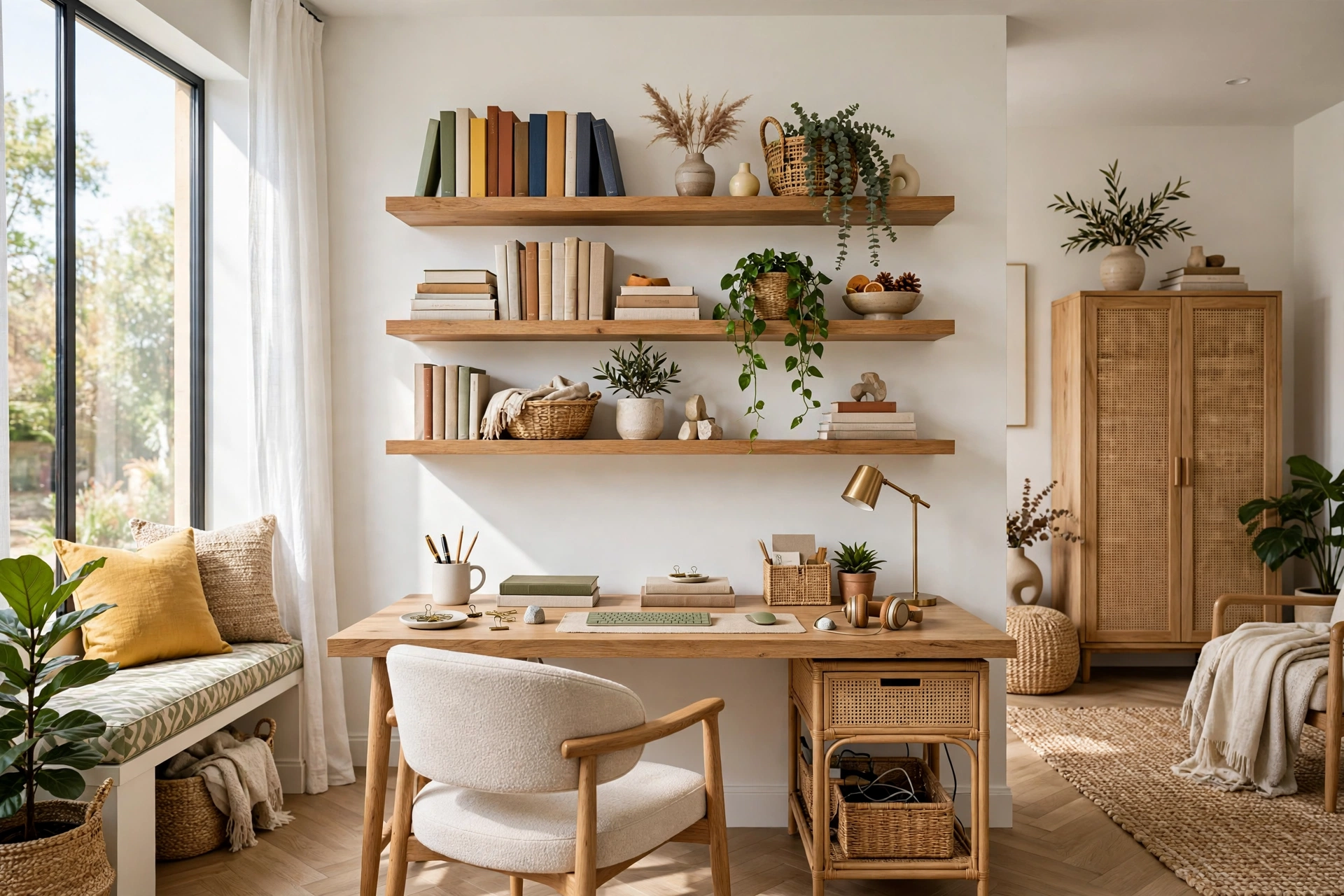
Floating shelves are the home office’s best friend because they give you storage without eating floor space. One or two shelves above or beside the desk hold books, binders, plants, and the pretty objects that make the room yours, while the desk stays clear for actual work. A simple organization system beats a pretty one that collapses in a week, so give every shelf a job: the lower shelf for the things you reach for daily, the upper shelf for the things you want to see but rarely touch.
Style the shelves like a shop display rather than a storage unit. Group items in odd numbers, vary the heights, and leave breathing room between groups so the eye can rest. A stack of books on its side, a small framed photo leaning against the wall, a trailing plant spilling over the edge, and a woven basket hiding cables or chargers will look intentional rather than cluttered. Keep the shelf color consistent with the desk or the wall trim so it blends in, and never load a shelf so heavily that it bows. If you rent, heavy-duty adhesive strips or a leaning ladder shelf give you the same look without drilling a single hole.
7. Bring in a Plant (or Three)
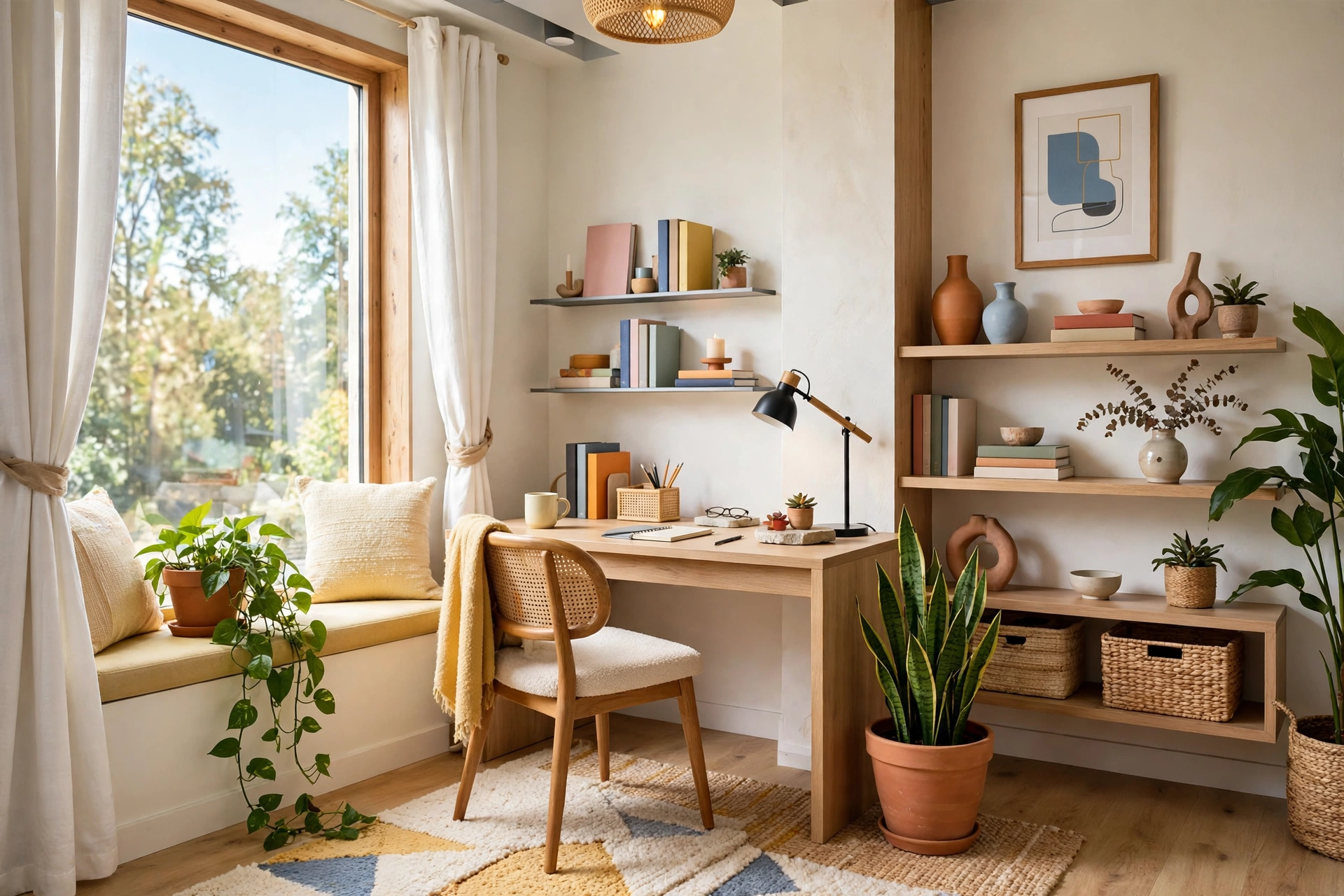
Plants are the easiest way to make a workspace feel alive, and they ask for almost nothing in return. A pothos trailing from a shelf, a snake plant in the corner, or a small succulent on the desk softens every hard edge in the room and gives your eyes something green to rest on between tasks. Studies have long linked plants with better mood and focus at work, but you do not need a study to feel it: a room with a living thing in it simply feels better to sit in for eight hours.
Match the plant to the light you actually have. Snake plants and ZZ plants survive low light and forgotten watering, which makes them perfect for a busy workweek. A pothos near a window grows fast and trails beautifully from a high shelf, tying the whole wall together. Keep the pots simple, terracotta, ceramic, or woven baskets, so the green is the star and the pots do not compete with your decor. One large plant in the corner does more than five tiny ones crowded on the desk, where they just become one more thing to dust around. If your office has no window at all, a good faux plant gives the same softening effect with zero maintenance, and nobody on a video call will ever know.
⚠️ Warning: water and laptops are a bad combination. Keep watering cans and recently watered pots away from the desk, and use a saucer under every plant that sits within arm’s reach of your devices.
8. Layer Warm, Focus-Friendly Lighting
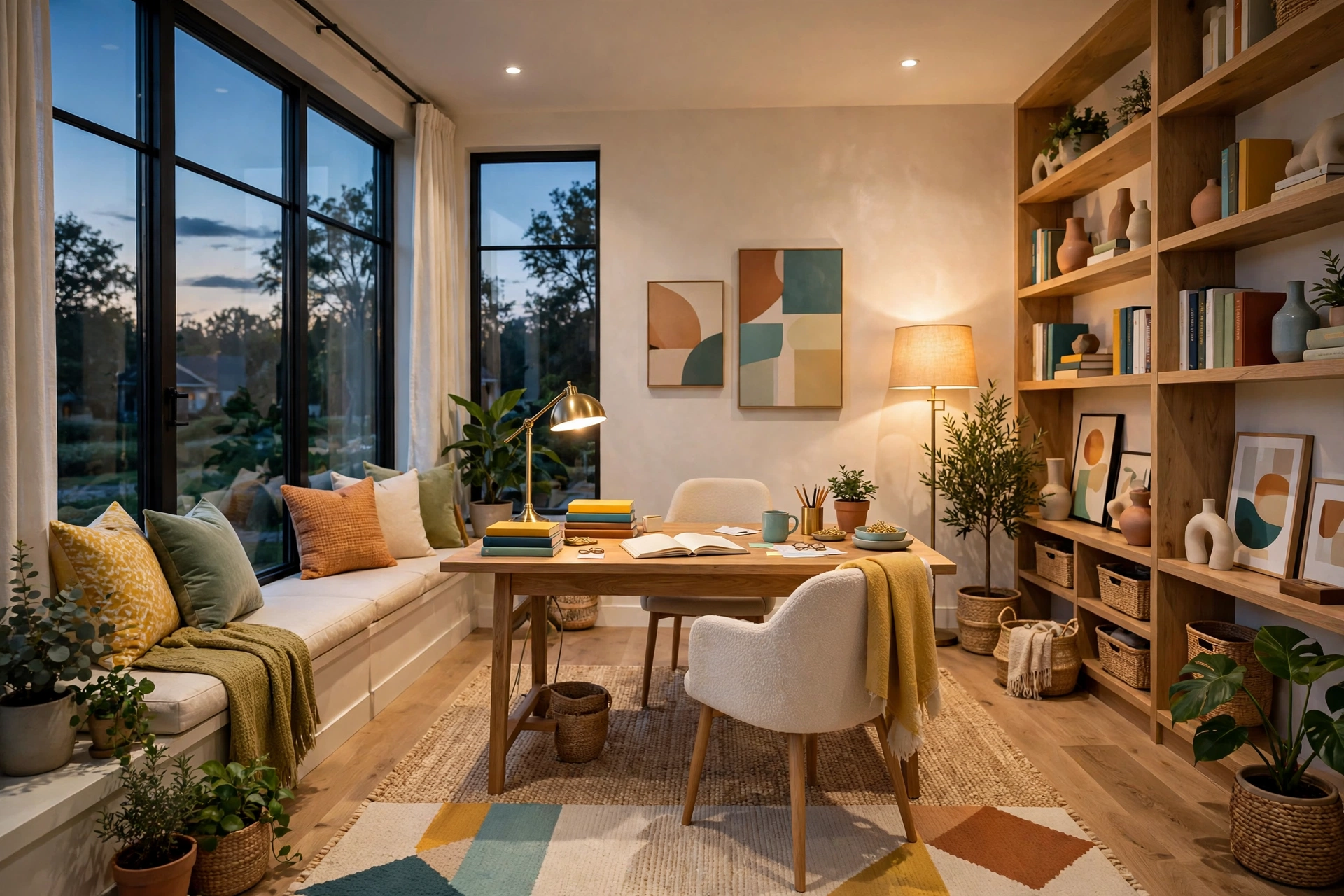
One ceiling light is never enough for a workspace. Good office lighting comes in layers: daylight from the window, a desk lamp for focused work, and a warm ambient light for the evenings. A desk lamp with an adjustable arm lets you aim light exactly where you need it, and a warm-white bulb, around 2700 to 3000 Kelvin, keeps the room feeling cozy rather than clinical. Cool white light might feel productive, but it makes a home office look like a hospital corridor by seven in the evening.
Add a second layer behind or beside you for video calls: a small lamp on a shelf or a floor lamp in the corner fills in shadows so your face is evenly lit. A string of warm fairy lights along a shelf or a salt lamp on a side table adds a soft glow that makes late work sessions far more pleasant. If your desk faces a wall, a slim LED light bar mounted under a shelf washes the wall with even light and frees up desk space at the same time. The rule is simple: you should never be working in a single pool of light surrounded by darkness, because that is what causes eye strain and headaches by mid-afternoon.
9. Create a Cable-Free, Clutter-Free Desktop
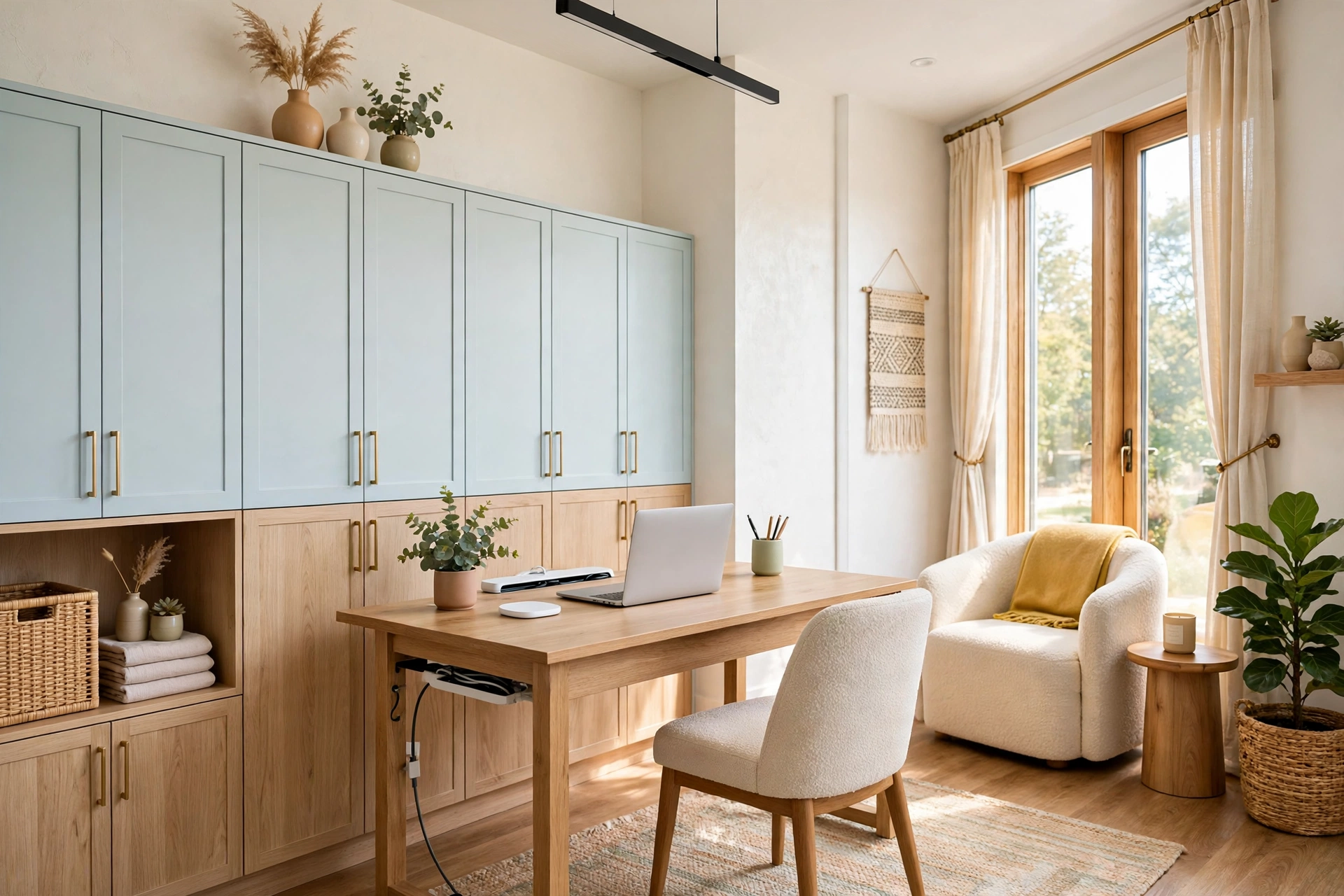
Nothing kills the look of a beautiful desk faster than a nest of cables. The fix is unglamorous but transformative: route every cable through a single tray or channel under the desk, use one power strip instead of three, and label the plugs you actually unplug. A cable tray screwed or stuck under the desktop hides the mess completely, and a short cable sleeve groups the cords that run to the monitor into a single tidy line. The whole job takes twenty minutes and costs less than lunch.
Then protect the clear surface you just created. Give every object on the desk a home: pens in a cup, papers in a single tray, chargers in a drawer. The one-in, one-out rule works wonders here; every new object that arrives on the desk means one leaves. A small tray or a beautiful box on the desk catches the daily clutter, keys, headphones, a notebook, so it never spreads across the whole surface. At the end of each workday, spend sixty seconds resetting the desk to clear. You will walk in the next morning to a workspace that feels like a fresh start instead of yesterday’s mess.
10. Add a Pinboard or Vision Board

A pinboard above the desk is where the practical and the personal meet. Pin the things you need to see every day: the week’s priorities, a project timeline, a deadline list, and then mix in the things that keep you going, a photo, a quote, a swatch of the next project’s colors. Unlike a phone reminder, a pinboard is always visible, which makes it surprisingly effective at keeping the important things in front of you.
Choose a board that suits the room. A natural cork board warms up a white wall, a fabric-covered board in linen or velvet looks soft and deliberate, and a slim metal grid with clips suits a modern, minimal office. Keep it edited: a pinboard crammed with six months of old notes becomes wallpaper, not a tool. Once a month, clear everything off and pin back only what still matters. If your office doubles as a guest room or a living-room corner, a framed pinboard looks like art when it is tidy and like a noticeboard when it is not, so the monthly reset earns its keep twice over.
💡 Pro Tip: a pinboard only works if you can reach it without standing up. Mount it just above the desk at eye level when seated, so pinning a note takes two seconds instead of becoming a chore you skip.
11. Choose a Calming, Productive Color Palette

Color quietly decides how a workspace feels, and the wrong palette can make even a beautiful room hard to work in. The classic 60-30-10 color rule keeps the palette balanced: sixty percent a dominant neutral for walls and large furniture, thirty percent a secondary color for the rug, curtains, and chair, and ten percent an accent color for the small things you can swap in a season. Soft sage, warm greige, dusty blue, and creamy white are the workhorses of home offices because they feel calm without feeling sleepy.
The accent is where your personality shows up. A deep forest green on one wall, terracotta in the cushions and art, or mustard in a desk lamp can energize the room without overwhelming it. Avoid painting the whole room a loud, saturated color; it looks exciting in a photo and exhausting by the third workday. If you rent and cannot paint, the palette arrives through the rug, the chair cushion, the curtains, and the art instead, which is more than enough. Whatever palette you choose, repeat each color at least three times around the room so it reads as a scheme rather than a coincidence.
12. Add a Bookshelf That Doubles as Decor

A bookshelf in a home office is storage, decor, and a video-call backdrop all at once. Fill it with the books you actually reference, a few beautiful objects, and one or two plants, and it becomes the most interesting wall in the room. The trick is the same as with floating shelves: group items, vary heights, and leave empty space. A shelf packed edge to edge with binders looks like an archive; a shelf with breathing room looks like a library.
If you have a small office, a tall, narrow bookcase uses vertical space without eating floor area, and it draws the eye upward, which makes the room feel taller. Style the shelves in a loose rhythm: a stack of books lying flat, then a row standing upright, then a decorative object or a plant. Keep the colors of the book spines in a loose family if you can, turning the most clashing covers to face the wall. And if your bookshelf sits behind you on video calls, it is worth styling deliberately, because it is the background your colleagues see every day. A tidy, interesting bookshelf says more about you than any virtual background ever will.
13. Make a Coffee or Tea Station Within Reach

Every productive workspace needs a small ritual, and a coffee or tea station turns a break into something you look forward to. A tiny tray on a side table or a shelf near the desk holds a mug, a small French press or kettle, and a jar of tea bags, and it keeps you from wandering to the kitchen every hour and losing your train of thought. The station also adds a cozy, lived-in layer to the room that a purely functional desk never will.
Keep it compact and intentional. A wooden tray contains the whole setup and protects the furniture underneath, while a small plant or a candle on the same tray makes it look styled rather than improvised. Choose a mug you love, because you will hold it a dozen times a day, and keep the station stocked so it never becomes an empty tray collecting dust. If your office is a corner of a shared room, a rolling cart works beautifully as a coffee station: it tucks away when guests come over and rolls to your side when the workday starts. If a living room makeover on a $500 budget is possible, a home office coffee corner is easy, and it pays for itself in focus.
14. Hang Curtains That Frame the Room

Curtains are the most underrated home office upgrade. They soften the hard lines of a desk and a monitor, add color and texture at exactly the height your eyes rest, and control the light that hits your screen. Hang them high and wide: the rod should sit fifteen to twenty centimeters above the window frame, and the panels should extend past the sides so the window looks bigger and the curtains never block the light when open. Floor-length curtains make a small room feel taller, while a café-length panel suits a tiny office nook.
Fabric choice matters more than pattern. A linen-look curtain in a warm neutral filters light beautifully and suits almost every office palette, while a heavier velvet panel in a deep color adds drama and muffles sound in a large, echoey room. Sheer curtains are perfect when you want privacy without losing daylight, which is exactly what a street-facing office needs. Keep the curtain color in the same family as the rug or the chair so the room reads as one scheme, and steam out the creases once after hanging; wrinkled curtains undo all the polish in a single glance.
15. Use a Room Divider to Separate Work and Home

When your office shares a room with your living space, the hardest part of working from home is switching off. A room divider solves that with a single piece of furniture. A folding screen, a tall bookcase turned sideways, or a curtain on a ceiling track creates a visual boundary that tells your brain the workday has a place, and more importantly, an edge. At five o’clock, you can close the screen and the office disappears, which is the closest thing to leaving the office that remote work offers.
Choose a divider that matches the room rather than fighting it. A light wooden slat divider or a woven rattan screen adds texture and lets light through, so the office never feels boxed in. A tall open bookcase works double duty as storage on the office side and display on the living side. If your space is truly tiny, even a curtain on a tension rod or a tall plant in a large pot creates a psychological boundary that helps you focus. The divider does not need to reach the ceiling to work; it needs to be tall enough to block the view of the desk from the sofa, and that is usually about shoulder height when you are sitting down.
📌 Important: keep a clear path around it so the room still flows, and never block a doorway or a window with it. A divider that traps you in a corner makes the office feel like a penalty box.
16. Add Personal Touches Without the Clutter

A home office should feel like yours, not like a showroom or a cubicle, and the difference is a handful of personal objects chosen with intent. One framed photo, a souvenir from a trip, a favorite mug, a small sculpture, or a piece of art you made yourself turns a generic desk into your desk. The rule is three personal objects, visible but not competing: one on the desk, one on a shelf, and one on the wall. Any more and the room tips from personal into cluttered.
Rotate them with the seasons if you like, the same way you would in the living room. A dried flower arrangement in autumn, a bright print in summer, a candle in winter keeps the office feeling fresh without a shopping trip. The key is that every personal object earns its place by making you smile when you glance at it, not by filling a gap. If you are not sure whether an object belongs, take it away for a week; if you miss it, it belongs. If you forget it existed, it was clutter wearing a sentimental label.
17. Invest in a Good Monitor Setup (or Laptop Stand)

Your screen is where your eyes live all day, so its position is an ergonomic decision and a decor decision at the same time. The top of the screen should sit at or just below eye level, about an arm’s length away, so you are not looking down at a laptop for eight hours. A laptop stand or a monitor arm lifts the screen to the right height and frees up the desk space underneath for a notebook or a plant, which instantly makes the desk look tidier.
If you use two monitors, angle them slightly inward like an open book rather than flat side by side, which reduces neck turning. A monitor light bar that clips to the top of the screen washes the desk with even light without taking up any space, and it looks far better than a bulky lamp. Hide the monitor’s cables in the same tray as the rest, and choose a monitor with a slim bezel and a neutral finish so it blends with the desk rather than dominating it. A well-placed screen setup does not just save your neck; it makes the whole desk look like it was designed, not assembled.
18. Try a Standing Desk Converter

A standing desk converter is the budget-friendly way to test standing work without replacing your desk. It sits on top of your existing desk and lifts your monitor and keyboard to standing height with a lever or a crank, then drops back down when you want to sit. The best ones are stable at full height, wide enough for a monitor and a keyboard side by side, and smooth enough that you actually use them instead of leaving them in one position forever.
Start small: stand for twenty minutes every hour, or for the first task of the morning and the last call of the afternoon. A small anti-fatigue mat underfoot makes standing far more comfortable, and a pair of supportive shoes beats standing in socks on a hard floor. The converter itself should look decent, since it is a large object on your desk; choose one in white, light wood, or black to match the rest of the setup. If you find yourself standing more than sitting after a month, that is your signal to invest in a full standing desk. If not, the converter still earned its place as a flexible, ergonomic option.
19. Keep a “Close the Day” Ritual Corner

The hardest part of a home office is not starting work; it is stopping. A small ritual corner gives the end of the day a physical action: a shelf or a tray where the laptop closes, the notebook shuts, the pen goes back in its cup, and the desk lamp switches off. It sounds trivial, but a repeatable closing routine is what separates people who work from home happily from people who feel like they never leave the office.
Style the corner so it feels like a reward rather than a chore. A small tray with a candle, a favorite book, or a tiny plant marks the spot, and lighting the candle as you shut the laptop becomes the signal that work is done. Keep a short tomorrow list on a notepad in the same corner: three priorities for the next morning, written down before you close up, so you never carry the whole day in your head overnight. A tidy desk at the end of the day is also a gift to your future self, who walks in tomorrow to a clean start instead of yesterday’s unfinished business.
20. Style the Background for Video Calls

Your video-call background is the one part of your home office that the whole world sees, so it deserves the same attention as the desk itself. The simplest winning setup is a tidy shelf or a gallery wall behind you, a plant in the corner, and soft light on your face. Avoid sitting with a window directly behind you, which turns you into a silhouette, and avoid a messy bed or a drying rack in the frame. A clean, intentional background reads as professional without trying too hard.
If your background is a plain wall, one large framed print and a small plant on a stool fill the frame beautifully. If it is a bookshelf, style the shelves at head height with a few books and one object, and keep the rest tidy. Test the background with your actual camera before an important call, because a webcam sees the room differently than your eyes do: it flattens depth and exaggerates clutter. Sit in your chair, open the camera, and look at what is behind you. Move one object, shift the plant, and suddenly the background looks like a magazine shot instead of a spare room. That two-minute check is the cheapest decor upgrade in this entire list.
Common Home Office Decor Mistakes
Mistake 1: Pushing the Desk Against a Blank Wall
A desk facing a blank wall feels like a punishment, and it is the most common home office mistake. You stare at paint all day, your video-call background is a door or a bed, and the room feels smaller than it is. Pull the desk out, angle it toward the window or the room, and give yourself something worth looking at. Even a desk facing into the room with a rug underneath feels more open than a desk shoved into a corner.
Mistake 2: Buying Furniture Before Measuring
A desk that is five centimeters too wide blocks a door, a bookshelf that is too deep eats the walkway, and a chair that does not fit under the desk never gets pushed in. Measure the wall, the door swing, and the chair’s footprint before ordering anything, and tape the outline on the floor with painter’s tape so you can live with the size for a day. Furniture returns are expensive and exhausting; a tape measure is free.
Mistake 3: Ignoring Lighting Until Your Eyes Hurt
One overhead light, a monitor, and eight hours of screen time is a recipe for headaches. Layer the light from the start: daylight, a desk lamp, and a warm ambient light for evenings. If you are squinting by three in the afternoon, the lighting is wrong, not your eyesight. Fix it before you buy another cushion or print.
Mistake 4: Letting Cables Take Over the Desk
Cables multiply quietly until the desk looks like a server room. A tray under the desk, a single power strip, and a weekly cable check keep them invisible. The moment you can see more than one cable from your chair, it is time for a five-minute tidy. A clean desk is not a luxury; it is the difference between starting work calmly and starting it annoyed.
Mistake 5: Filling Every Surface at Once
The urge to decorate everything on day one is strong, and it always ends in clutter. Start with the desk, the chair, and the light, then add one layer at a time and live with it for a week. A room that grows slowly looks collected and personal. A room decorated in a single shopping trip looks like a furniture showroom, and it never quite feels like yours.
Frequently Asked Questions
1. How much does it cost to decorate a home office?
A comfortable home office refresh costs between $100 and $500, depending on what you already own. The biggest wins, desk placement, lighting, and a rug, are often free or under $100. Spend the most on the chair and the desk, because you use them every day, and save on decor by shopping secondhand or repurposing pieces from other rooms.
2. What is the best color for a home office?
Soft, muted colors work best: warm white, sage green, dusty blue, or warm greige keep you calm and focused without feeling dull. Use the 60-30-10 rule to balance a dominant neutral with a secondary color and one accent. Avoid very bright or saturated colors on large surfaces, since they can feel tiring over a full workday.
3. How do I set up a home office in a small space?
Choose a slim desk or a wall-mounted fold-down desk, use vertical storage like floating shelves, and define the zone with a rug. Keep the footprint tight and let the wall do the decorating work with a gallery or a pinboard. A chair that tucks fully under the desk keeps the space usable when you are not working.
4. Where should I put my desk in a home office?
Side-on to a window is ideal: you get natural light without screen glare, and your face is evenly lit on video calls. Avoid facing a blank wall if you can, and avoid sitting with a window directly behind you. If the room has no window, place the desk facing into the room with a lamp behind the monitor.
5. What should I put on my desk?
Less than you think: your computer, a lamp or light bar, a pen cup, a notebook, and one personal object. Everything else belongs in a drawer, on a shelf, or in a tray. A clear desk is easier to work at and easier to reset at the end of the day, which is half the battle.
6. How do I hide cables in my home office?
Use a cable tray or channel under the desk, a single power strip, and short cable sleeves to group cords together. Route everything behind or under the desk so nothing is visible from your chair. Label plugs you unplug often, and do a five-minute cable check once a week to stop the tangle from coming back.
7. How can I make my video call background look professional?
Tidy the area behind you, add one framed print or a styled shelf, a plant in the corner, and soft light on your face. Avoid windows directly behind you and clutter in the frame. Test the background with your own camera before important calls, since a webcam exaggerates mess that your eyes ignore.
Conclusion
A home office that you actually want to work in is not about spending a fortune or copying a magazine spread. It is about a desk that fits your work, light that does not hurt your eyes, a chair that supports you, and a handful of personal touches that make the room yours. Start with the big decisions, desk, chair, and light, then add the layers one at a time: a rug, a gallery wall, a plant, a coffee corner. Each small change makes the next workday slightly better, and those small improvements compound into a room you look forward to entering.
The best home office is the one that fits your life, not someone else’s photos. Take the ideas that solve your actual problems, skip the ones that do not, and give yourself permission to let the room evolve. A workspace that grows with you will always feel more inspiring than one decorated in a single weekend, and the work you do in it will be better for it.