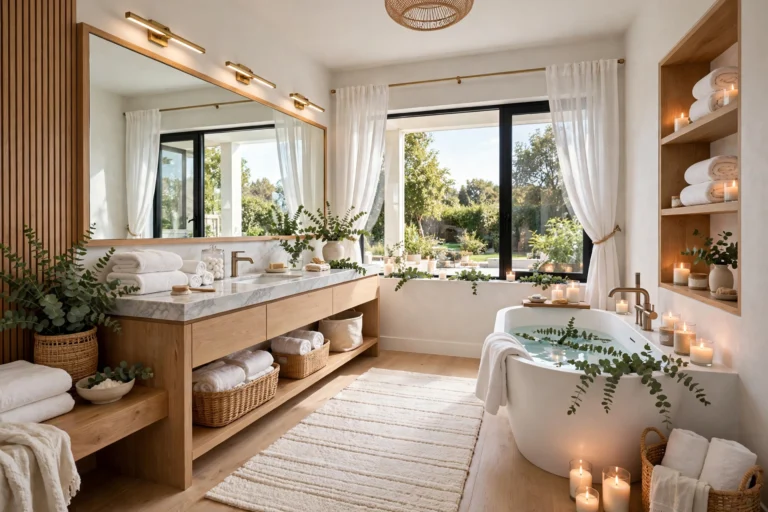

15 Best Shower Curtains for Small Bathrooms That Make Them Look Bigger
Introduction
A shower curtain is the biggest piece of fabric in most bathrooms, and in a small bathroom it can easily be the biggest visual obstacle too. A heavy, dark, busy curtain chopped at the wrong height makes the whole room feel like a closet, while the right curtain does the opposite: it stretches the walls, bounces light around, and makes a compact bathroom feel calm and generous. The difference between the two is rarely price. It is color, length, fabric, and how the curtain hangs.
The good news is that a shower curtain is one of the cheapest swaps in home decor. For the cost of a takeout dinner, you can change the entire feeling of your bathroom in ten minutes, no tools and no landlord permission required. That is why it belongs near the top of any list of small bathroom decor ideas: the curtain covers a large share of the wall, so every choice you make about it shows up immediately in how big the room feels.
This guide rounds up fifteen shower curtain styles that genuinely work in small bathrooms, with honest notes on what each one does for light, space, and everyday practicality. Some are nearly invisible, some add pattern without shrinking the room, and a few use clever hanging tricks to make the ceiling look taller. Pick the one that matches your bathroom’s light and your tolerance for laundry, and your small bathroom will start feeling bigger the same afternoon.
1. Clear Vinyl Curtains That Practically Disappear

A clear shower curtain is the closest thing to having no curtain at all. Because you can see straight through it to the tiled shower wall, the eye reads the shower area as part of the room instead of a blocked-off box, and the bathroom instantly feels wider. In a bathroom where the tub wall is the farthest wall from the door, that extra perceived depth can make the whole room feel a foot longer.
Clear vinyl works best when the shower itself looks decent. If your tiles are clean and the grout is in good shape, the curtain frames them like a window. If the shower is stained or the fixtures are dated, a clear curtain puts all of that on display, so give the tub a deep clean first. Choose a heavy-gauge vinyl rather than the thinnest bargain option: thick vinyl hangs straight, resists clinging to your legs, and does not billow inward when the water is running.
Maintenance is simple. A quick wipe with a diluted vinegar solution once a week keeps it from clouding, and most clear vinyl curtains are cheap enough to replace every few months without guilt. Pair it with a pretty outer curtain in a light color if you want privacy plus the spacious feeling — the clear liner does the seeing-through work while the outer layer adds softness.
💡 Pro Tip: Hang a clear curtain on the inside of the tub and a fabric curtain on the outside. You get the see-through depth when the fabric curtain is open, and full privacy when it is closed.
2. Classic White Waffle-Weave Curtains
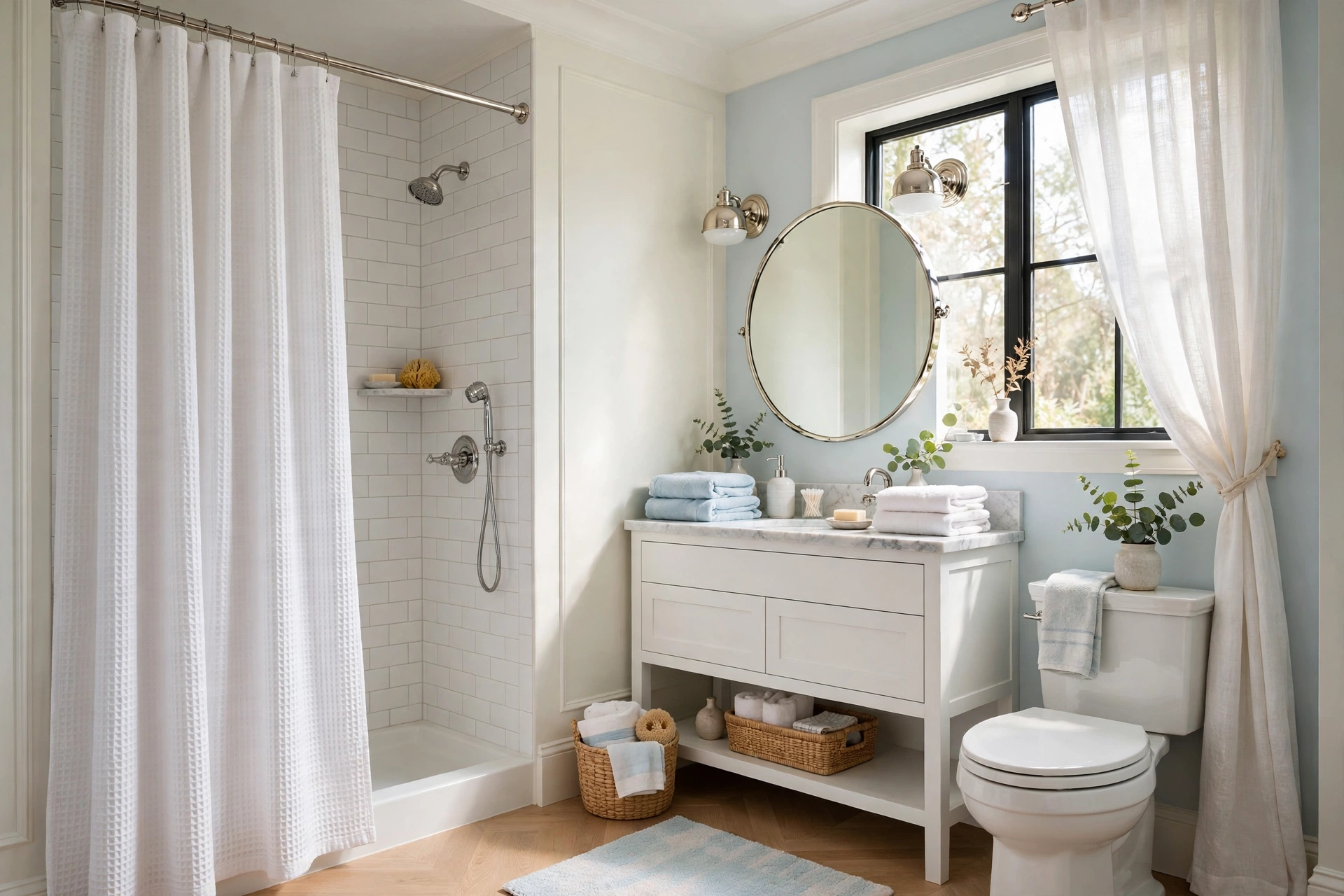
A white waffle-weave curtain is the small-bathroom workhorse: bright, textured, and forgiving. The waffle texture catches light and casts tiny soft shadows, which gives the curtain visual interest without any pattern that could chop up the wall. White reflects light back into the room instead of absorbing it, so a windowless bathroom feels noticeably brighter the moment it goes up.
Waffle-weave fabric has another advantage over flat cotton: it hides wrinkles and water spots. A flat white curtain shows every fold and splash, while the raised grid of the weave breaks up the surface so minor marks disappear. Most waffle-weave curtains are machine washable, which matters in a small bathroom where the curtain sits close to the tub and gets splashed daily.
Look for a cotton or cotton-blend weave with a bit of weight to it. Very light waffle curtains can billow inward during a shower, but a mid-weight fabric with a weighted hem hangs straight and stays put. If your bathroom has chrome fixtures, the crisp white weave pairs beautifully; if it has warm brass or black fixtures, the texture still works, because white is neutral enough to sit quietly next to any metal finish.
3. Vertical Stripe Curtains That Stretch the Walls
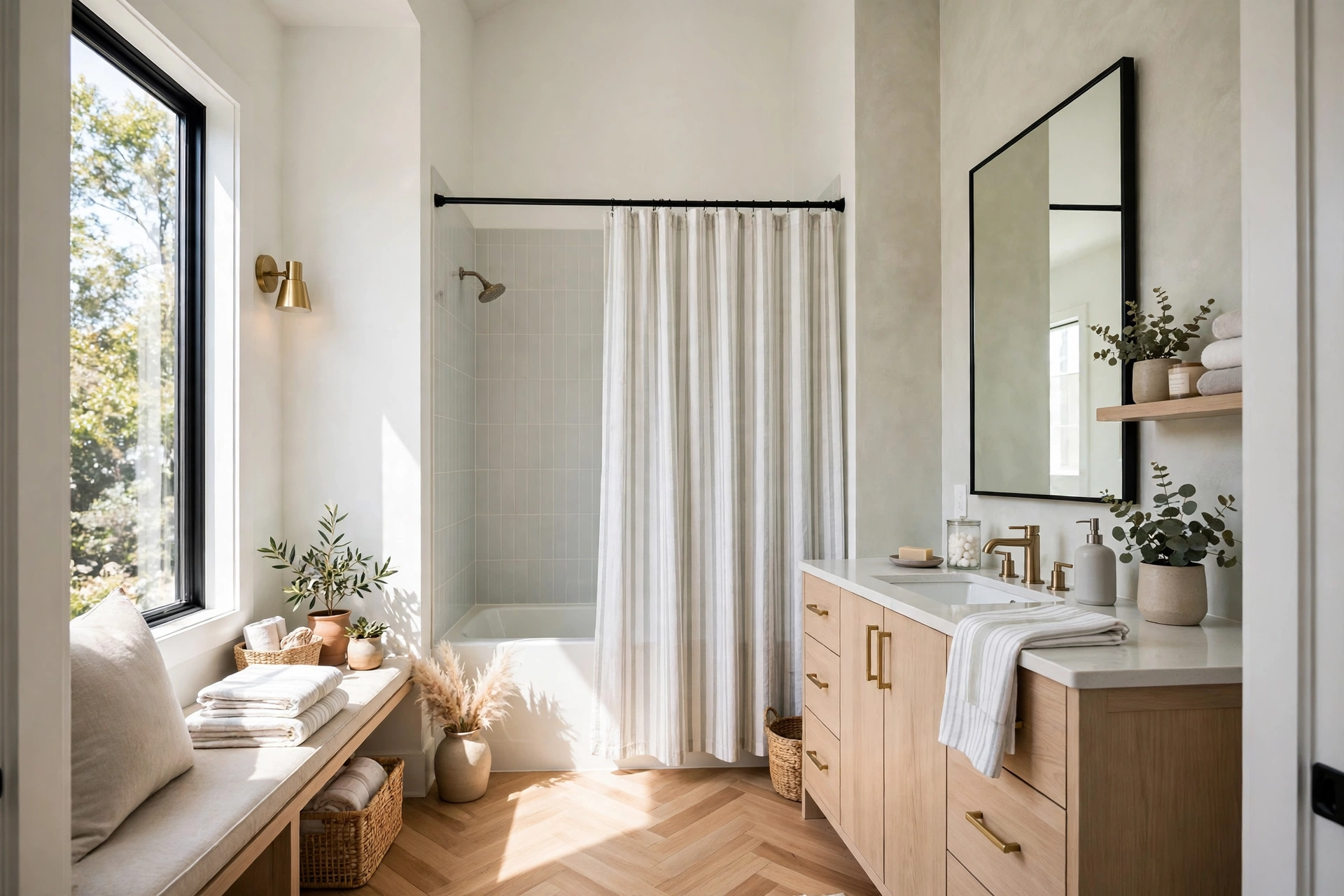
Vertical stripes are the oldest visual trick in decorating, and they work on shower curtains exactly the way they work on clothing: the eye follows the lines upward, and the ceiling reads taller than it is. In a small bathroom with a standard eight-foot ceiling, a curtain with thin vertical stripes can make the room feel noticeably loftier, especially when the stripes run the full length of the curtain without a horizontal break.
The key is keeping the stripes subtle. Thin stripes in two close tones — white and pale gray, cream and soft sage, white and light blue — give you the height effect without the boldness that makes a small room feel busy. Wide, high-contrast stripes do the opposite: they shout, and the room feels smaller because the pattern dominates everything else in it. Soft, narrow, low-contrast stripes are the sweet spot.
Match the stripe colors to something already in the room, like the wall paint or the towels, so the curtain feels intentional rather than random. And hang the curtain rod as high as the ceiling allows, a few inches below the ceiling if possible, so the stripes get maximum vertical run. That combination — high rod, long stripes, pale colors — is one of the most reliable ways to make a small bathroom feel taller.
Shower Curtain Quick-Start Checklist
- ✅ Measure your tub or shower width and height before ordering, including the rod height
- ✅ Choose a light color or a clear curtain to keep the room feeling open
- ✅ Hang the rod as high as possible and let the curtain fall to the floor or just above the tub edge
- ✅ Pick machine-washable fabric if you want low-maintenance upkeep
- ✅ Use a liner inside and a decorative curtain outside for privacy plus style
- ✅ Match the curtain to your wall color or towels so the room reads as one calm space
- ✅ Check the hem weight so the curtain hangs straight instead of billowing inward
4. Light-Colored Linen-Look Curtains

A linen-look curtain brings the relaxed texture of natural fabric into the bathroom without the high maintenance of real linen. The slightly slubbed, woven surface reads as expensive and calm, and in pale shades like oatmeal, soft white, or light stone it keeps the room bright. Unlike a flat solid curtain, the texture gives the eye something to enjoy up close without adding visual clutter from across the room.
Real linen wrinkles aggressively and shrinks in the wash, which is why a polyester or cotton-blend linen look is the smarter buy for a bathroom. Modern linen-look fabrics mimic the weave convincingly, dry quickly, and survive the washing machine. They also resist mildew better than pure natural fibers, which matters in a humid small bathroom where air circulation is limited.
The style works across almost every bathroom aesthetic: it suits a spa bathroom with wooden accents, a modern bathroom with matte black fixtures, and a coastal bathroom with pale blue walls. Keep the color pale and the fabric slightly textured, and let the curtain do the quiet luxury work while brighter accessories — a plant, a patterned hand towel — provide the accent.
5. Sheer Curtains That Let the Light Through

A sheer shower curtain is the brightest option of all, because it does not block light — it filters it. In a bathroom with a window in or near the shower, a sheer curtain lets daylight pour through while still giving you privacy from the rest of the room. Even in a windowless bathroom, a sheer curtain lets the vanity light and ceiling light pass through, so the shower area never becomes a dark cave.
Sheer curtains come in white, frosted, and lightly patterned versions. A plain white sheer is the most space-expanding choice, because it reads as almost nothing at all. A frosted sheer adds a little more privacy while still transmitting plenty of light. Either way, always use a waterproof liner behind it — a sheer curtain alone will soak through and stay damp, which invites mildew in a small, humid bathroom.
The trade-off is privacy. A sheer curtain obscures shapes but does not hide them completely, so it suits households where the bathroom door locks and everyone is comfortable, or bathrooms where the shower is the only bathing spot and the curtain is mainly a splash guard. If full privacy matters, layer the sheer curtain outside a standard liner and close both when showering.
Quick Comparison: Shower Curtains by Cost and Effort
6. Extra-Long Curtains Hung High for Taller Ceilings

Hanging a shower curtain higher than the standard rod height is a renter-friendly trick with an outsized payoff. Most shower rods sit just above the showerhead, but moving the rod up to within a few inches of the ceiling and using an extra-long curtain — 84 inches instead of the standard 72 — makes the walls read taller because the curtain’s vertical line runs almost floor to ceiling. The eye follows that long unbroken line upward and assumes the room is taller than it is.
This works best with a lightweight fabric that drapes well, because a heavy curtain at that length can look ponderous. A soft cotton, a waffle weave, or a linen-look fabric in a pale color all drape gracefully at 84 inches. Make sure the curtain still falls inside the tub by at least a few inches, or water will escape onto the floor. If your showerhead is high, keep the liner at standard length inside and let only the decorative outer curtain run long.
Measure twice before ordering. Measure from the new rod position to the floor, subtract a couple of inches so the hem clears the tub edge or grazes the floor, and check that the curtain length you buy matches. An extra-long curtain that pools on the floor looks sloppy and stays damp; one that ends exactly at the tub rim looks tailored and deliberate.
7. Curtains That Match the Wall Color

A shower curtain in the exact color of your bathroom walls is a camouflage trick: the curtain stops reading as a separate object and starts reading as a continuation of the wall. The visual boundary between shower and room dissolves, and the bathroom feels like one continuous space instead of two cramped zones. This is especially effective in bathrooms painted in soft colors like pale gray, warm white, sage, or dusty blue.
The match does not have to be perfect to work, but it should be close. Bring a paint chip or a photo of the wall to the store, or order a few swatches online before committing. A curtain one shade lighter than the wall is usually the safest bet, because it reads as the same color in different light rather than a mismatch. Avoid curtains with a contrasting border or a bold pattern in this role — the whole point is for the curtain to blend, and any strong contrast breaks the illusion.
This approach shines in bathrooms where the walls are already a color you love. If your walls are a builder-grade beige you hate, painting them a soft shade you actually like and then matching the curtain is a weekend project that transforms the room for very little money. Pair the matched curtain with towels in a slightly deeper tone of the same color family for a layered, intentional look.
📌 Important: If your walls are white, a bright-white curtain can look slightly gray or yellow next to them. Compare the curtain fabric against the wall in daylight before you commit, or choose a warm white that flatters the paint.
8. Small-Scale Pattern Curtains That Add Charm Without Clutter

Pattern is not forbidden in a small bathroom — it just needs to be the right scale. Small-scale patterns, like tiny dots, mini florals, delicate geometric repeats, or fine gingham, read as texture from a distance and only reveal their detail up close. That means the curtain adds personality without visually chopping the wall into busy fragments the way a large-scale print does.
The rule of thumb is simple: the smaller the bathroom, the smaller the pattern. A tiny repeating motif keeps the curtain feeling light, while a bold oversized floral or a wide tropical leaf print can overwhelm a compact room and make the shower area feel like it is closing in. Small patterns also hide water spots and minor stains better than solid colors, which is a practical bonus in a bathroom that gets used every day.
Keep the pattern’s colors pale and limited to two or three tones, with white or cream as the base. A small navy-and-white dot or a soft gray mini-floral gives you charm and contrast without darkness. If the rest of your bathroom is plain — plain tiles, plain towels, plain walls — a small-scale patterned curtain is the perfect single accent that makes the room feel designed rather than default.
9. Fabric Curtains With a Weighted Hem

A weighted hem is the difference between a shower curtain that hangs like a photograph and one that flaps around like a sail. Many fabric curtains come with a sewn-in weighted hem or small magnetic weights at the bottom, and that extra weight pulls the fabric straight down so it stays inside the tub, stays clear of your legs, and presents a clean vertical line. In a small bathroom, that clean line matters: a curtain that billows inward makes the shower feel smaller and the room feel messier.
Weighted hems also make the curtain look more expensive. A curtain that hangs straight and still reads as tailored, while a lightweight curtain that waves in the shower steam reads as temporary. If your favorite curtain does not have a weighted hem, you can add one: sew a few washers into the hem, use clip-on curtain weights, or choose a curtain with a magnetic bottom that grips the tub. All three fixes cost very little.
Pair a weighted-hem curtain with a smooth-gliding rod and rings that move easily, so opening and closing it feels effortless. A curtain that fights you every morning is a curtain you will stop closing properly, and a half-open curtain in a small bathroom always looks untidy. The weighted hem plus smooth hardware combination keeps the shower area looking neat with almost no effort.
10. Frosted or Textured Semi-Sheer Curtains

A frosted semi-sheer curtain sits in the sweet spot between a clear curtain and a solid one: it lets through most of the light while blurring shapes enough for real privacy. The frosting scatters light softly instead of blocking it, so the shower area glows rather than going dark, and the bathroom keeps its bright, open feeling. For households that want privacy without giving up light, this is often the best single choice.
Frosted curtains come in a few varieties: vinyl with a frosted finish, fabric with a frosted print, and textured PEVA that looks like sea glass. The vinyl and PEVA versions are waterproof on their own and wipe clean easily, while fabric frosted curtains need a liner behind them. Textured versions — with a subtle bubble, rain, or pebble pattern embossed into the material — add visual interest and hide water spots better than a flat frosted surface.
Choose a frosted curtain in white or a very pale tint rather than a smoky gray or amber, because darker tints absorb the light you are trying to preserve. And keep the rest of the bathroom light too: a frosted curtain works hardest in a bathroom with white fixtures and pale walls, where every bit of scattered light bounces around and makes the room feel airy.
💡 Pro Tip: A frosted curtain is the best compromise if you share the bathroom. It gives genuine privacy while keeping the shower bright, so nobody has to choose between modesty and light.
11. Bold Bottom Border Curtains for a Grounded Look

A curtain that is mostly light with a bold border along the bottom edge gives you the best of both worlds: the pale upper portion keeps the room bright and open, while the dark or patterned border at the bottom adds definition and style. Because the bold color sits low, near the tub, it grounds the curtain visually without darkening the upper half of the room where the light matters most.
This design works particularly well in bathrooms with a dark floor or a dark vanity, because the bottom border echoes that darker tone and ties the room together. A navy border with a white upper curtain, a deep green border with a cream top, or a black-and-white striped border on a white curtain all create a polished, intentional look. The border also hides the water stains and soap splashes that collect at the bottom of a curtain, which is where they always appear first.
Keep the border relatively narrow — six to ten inches is plenty. A border that covers half the curtain defeats the purpose, because the dark portion climbs into the light zone and the room starts to feel smaller. The ideal ratio is about three-quarters pale fabric to one-quarter border, with the border sitting just above or just below the tub rim where it reads as a deliberate design line.
12. Double Curtain Layers for Style and Function

Layering two curtains — a waterproof liner inside and a decorative fabric curtain outside — is the most flexible setup for a small bathroom. The liner handles the water, the outer curtain handles the look, and you can open or close each layer independently. Open the outer curtain during the day and the liner keeps the room feeling open; close both for a shower and you have full privacy and full splash protection.
The layering trick also lets you use fabrics that would never survive alone in a shower. A beautiful cotton, linen-look, or even a light velvet-look curtain can live on the outside of the tub as long as the liner inside catches the water. That opens up far more style options than a single waterproof curtain allows, and it means you can change the outer curtain seasonally — a bright floral in summer, a warm plaid in winter — without touching the liner.
Use a double rod or a double-hook system so both layers hang cleanly without crowding each other. The two layers should be the same length or the outer one slightly longer, so the liner does not peek out below the decorative curtain. When both layers are closed, the small gap between them also helps air circulate, which keeps the liner drier and slows mildew — a real benefit in a small bathroom with limited ventilation.
13. Hookless Snap-In Curtains for a Clean, Modern Look

Hookless shower curtains replace the traditional rings with built-in snap connectors or a split ring design that attaches directly to the rod. The result is a cleaner top edge with no visible hooks, no gaps between rings, and no metal hardware breaking up the curtain’s line. In a small bathroom, that uninterrupted top edge makes the curtain read as one smooth panel, which feels calmer and more spacious than a curtain chopped into segments by rings.
Hookless curtains are also genuinely easier to use. Removing the curtain for washing is a matter of unsnapping it rather than unhooking a dozen rings, and putting it back takes seconds. Many hookless designs include a built-in liner that snaps in with the outer curtain, so the whole assembly comes off as one piece for the wash. That ease matters in a small bathroom, where you are more likely to wash the curtain regularly if the process is painless.
Look for hookless curtains with a fabric top and a snap-in liner in a light color. The clean top edge pairs well with a modern or minimalist bathroom, and the snap system works with any standard rod. One caution: check that the snaps align with your rod diameter, because a mismatch can make the curtain sit crooked. Most standard rods are compatible, but a quick measurement before ordering saves a return.
14. Deep-Color Curtains Used the Right Way

A dark shower curtain is not automatically wrong for a small bathroom — it just needs to be used deliberately. A deep navy, forest green, or charcoal curtain can add drama and make a small bathroom feel like a jewel box rather than a closet, but only when the rest of the room is light enough to balance it. White walls, a white tub, pale tiles, and bright lighting give a dark curtain something to contrast against, and the contrast makes the room feel designed rather than dark.
The trick is to keep the dark curtain as the single dark element in the room. If the walls are dark, the floor is dark, and the curtain is dark, the bathroom becomes a cave. But one dark curtain against an otherwise bright room acts like an accent wall: it adds depth and draws the eye, which actually makes the room feel more interesting and therefore larger. Pair it with light towels, a pale bath mat, and a bright mirror to keep the balance.
Use a dark curtain when you want the bathroom to feel moody and luxurious — a spa bathroom look, for instance — and keep it closed only during showers. Leaving a dark curtain open during the day, pushed to one side, preserves the open feeling while still showing off the color. If your bathroom has no window and weak lighting, skip the dark curtain and choose a pale one instead; darkness needs light to play against.
⚠️ Warning: A dark curtain in a windowless bathroom with a single dim bulb will make the shower feel like a cave. Add a brighter bulb or a second light source before choosing a deep color.
15. Machine-Washable Everyday Curtains for Real Life
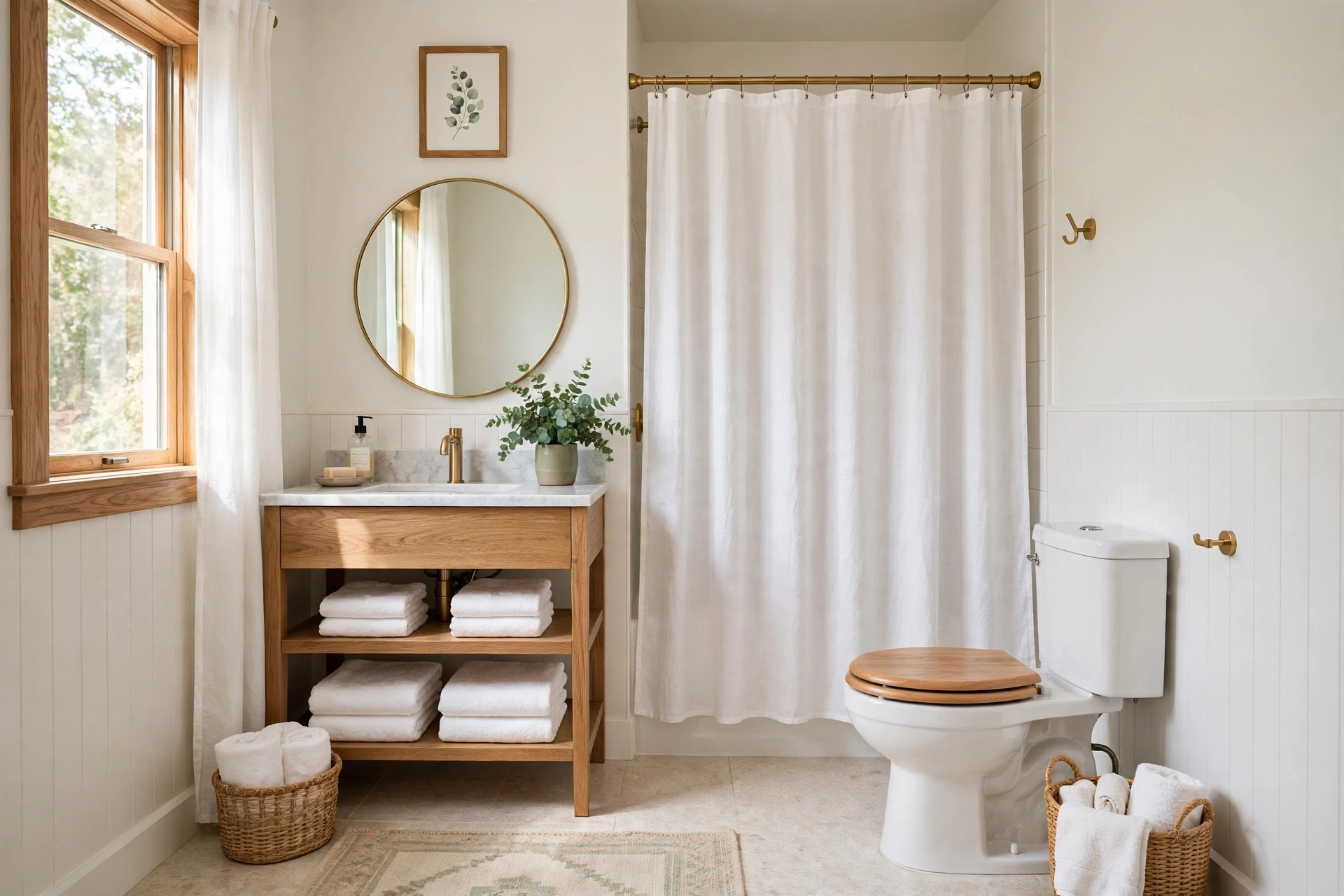
The best shower curtain for a small bathroom is often the one you will actually wash. In a compact bathroom, the curtain sits close to the tub, the steam, and the splashes, so it gets dirty faster than in a large bathroom — and a grimy curtain makes the whole room look dingy no matter how nice the rest of the decor is. A machine-washable fabric curtain that you can toss in the washer once a month will look better over a year than a beautiful dry-clean-only curtain that slowly yellows.
Most polyester, cotton-blend, and waffle-weave curtains are machine washable: wash on gentle with mild detergent, add a cup of white vinegar to the rinse to cut soap scum and mildew, and hang to dry rather than tumble drying. Avoid fabric softener, which coats the fibers and reduces water resistance. A quick monthly wash plus a weekly wipe of the liner keeps the curtain fresh and the bathroom smelling clean.
When shopping, check the care label before falling in love with the pattern. If the label says machine washable, you have found a curtain that fits real life. Keep a spare liner on hand so you can wash the outer curtain without leaving the shower unprotected, and your small bathroom will stay bright, clean, and inviting all year round. A tidy curtain helps, but if clutter is the real issue, here is how to organize a small bathroom with zero counter space, and these bathroom shelf decor ideas keep toiletries off the counter for good.
Common Small Bathroom Shower Curtain Mistakes
Mistake 1: Choosing a Dark, Heavy Curtain for a Windowless Bathroom
A dark curtain absorbs the little light a windowless bathroom has, and a heavy fabric blocks what is left. The shower becomes a dark box, and the bathroom feels half its size. If your bathroom has no window, choose the lightest curtain you can live with — white, clear, sheer, or frosted — and save dark colors for rooms with real daylight.
Mistake 2: Hanging the Rod Too Low
A rod hung at standard height with a standard-length curtain leaves a gap of bare wall above it, which chops the wall visually and makes the ceiling feel lower. Hang the rod as high as the ceiling allows and use a longer curtain, and the whole wall reads taller. This one change costs nothing and makes a bigger difference than almost any curtain choice.
Mistake 3: Buying the Wrong Size
A curtain that is too narrow for the tub leaves gaps at the sides where water escapes, and a curtain that is too short leaves a gap at the bottom that looks unfinished. Measure the tub width and add at least twelve inches for fullness, then measure from the rod to the tub edge for length. A curtain that fits properly hangs straight, stays inside the tub, and looks tailored instead of improvised.
Mistake 4: Skipping the Liner
A decorative fabric curtain without a waterproof liner will soak through, stay damp, and grow mildew in a small, humid bathroom. Always use a liner behind any fabric curtain, even one labeled water-resistant. The liner is cheap, invisible when the curtain is closed, and it is the single best defense against the musty smell that makes small bathrooms feel unclean.
Mistake 5: Ignoring the Hem and the Hardware
A curtain that billows inward, drags on the floor, or sticks on rusty rings makes the whole bathroom look neglected, no matter how pretty the fabric is. Choose a weighted hem, smooth-gliding rings, and a sturdy rod. These small hardware details are what separate a bathroom that looks designed from one that looks thrown together.
Frequently Asked Questions
1. What color shower curtain makes a small bathroom look bigger?
White, clear, and very pale colors make a small bathroom look bigger because they reflect light and do not create a visual wall. A white waffle-weave, a clear vinyl, or a sheer curtain all keep the room bright. If you want color, choose a pale tint of it — soft blue, pale sage, or light gray — rather than a saturated version.
2. Should a shower curtain match the walls or contrast with them?
Matching the curtain to the wall color makes the room feel larger, because the curtain blends into the wall and the shower area reads as part of the room. Contrasting curtains can look stylish, but they create a visual boundary that makes a small bathroom feel smaller. If you love contrast, keep it in a narrow bottom border rather than the whole curtain.
3. How long should a shower curtain be for a small bathroom?
The curtain should reach from the rod to just inside the tub, usually 72 inches for a standard rod height or 84 inches if you have hung the rod high near the ceiling. The hem should sit a few inches inside the tub so water stays in, but it should not pool on the floor. Measure from your rod to the tub edge before ordering.
4. Do I need a liner with a fabric shower curtain?
Yes, always. A fabric curtain alone will absorb water, stay damp, and develop mildew, especially in a small bathroom with limited airflow. Use a waterproof vinyl or PEVA liner inside the tub and the decorative fabric curtain outside. The liner is inexpensive and keeps the fabric curtain dry and fresh.
5. Are clear shower curtains a good idea for small bathrooms?
Clear curtains are one of the best choices for making a small bathroom feel bigger, because you can see through them to the shower wall and the room reads as one continuous space. They work best when the shower tiles and fixtures look clean. Pair a clear liner with a light fabric outer curtain if you want privacy as well as openness.
6. How often should I wash a shower curtain?
Wash a fabric shower curtain about once a month, and wipe the liner weekly with a diluted vinegar solution. In a small bathroom the curtain gets splashed and steamed more than in a large one, so regular washing matters. Machine-washable curtains make this easy, and a quick wash keeps the bathroom looking and smelling fresh.
7. Can a patterned shower curtain work in a small bathroom?
Yes, if the pattern is small-scale and the colors are pale. Tiny dots, mini florals, and fine geometric repeats read as texture from a distance and add charm without overwhelming the room. Avoid large-scale bold prints, which dominate a compact space and make the shower area feel like it is closing in.
Conclusion
A shower curtain is a small purchase with an outsized effect on how a bathroom feels. In a small bathroom, where every inch counts, the right curtain can add light, height, and calm for the price of a dinner out — and the wrong one can undo all the other good choices in the room. The fifteen styles in this guide all share the same principle: keep it light, keep it long, and let the curtain work with the room instead of against it.
Start with the simplest change that fits your bathroom. If you have a window, try a sheer or frosted curtain and let the daylight in. If your bathroom is windowless, go white or clear and hang the rod high. For a full makeover on a budget, see our guide to a bathroom refresh under $100, and if you rent, these rental bathroom decorating ideas work without landlord permission. Whichever style you choose, measure carefully, use a liner, and wash the curtain regularly. Do those few things well, and your small bathroom will feel bigger, brighter, and more inviting every single morning.