
7 Bathroom Decor Mistakes That Make a Clean Bathroom Look Dirty
Introduction
You scrubbed the sink, wiped the mirror, mopped the floor — and yet the bathroom still looks dirty. It is one of the most frustrating feelings in a home, because the room is objectively clean and your eyes refuse to believe it. Guests walk in and the room reads as neglected, even though you spent your Saturday morning on your knees with a sponge. The problem is rarely your cleaning. It is the decor decisions sitting on top of the clean surfaces, quietly telling everyone who walks in that this room is grimy.
Bathrooms are judged differently from every other room in the house. They are small, bright, and full of hard surfaces, so every stain, streak, and visual shortcut is on display at close range. A dingy grout line reads as dirt. A graying towel reads as a towel that was never washed. A cluttered counter reads as a room nobody maintains. Your eye does not separate “decor choice” from “cleanliness” in a bathroom — it adds them together and delivers one verdict, and that verdict is what guests remember.
The good news is that every mistake on this list is cheap and fast to fix, and most of them cost nothing at all. This guide walks through the seven bathroom decor mistakes that make a clean bathroom look dirty, in the order your eye notices them, with the fix for each one. If you only have a weekend, start at the top. And if you are planning a wider refresh, our guide to a bathroom refresh under $100 shows how these same fixes fit into a full-room reset — but even tackling two or three items below will change how the room reads the next time someone opens the door.
1. Letting the Grout Go Dingy

Grout is the single biggest reason a clean bathroom looks dirty, and it is the mistake almost everyone makes first. Tile can be spotless, the fixtures can gleam, and the room will still read as grimy if the grout lines running between the tiles are gray, yellowed, or blotchy. Grout is porous, so it absorbs soap, hard-water minerals, and the faint discoloration of daily use, and because it forms a grid across the largest surfaces in the room, your eye reads the grid before it reads anything else. A bathroom with dingy grout looks dirty from the doorway, no matter how recently it was mopped.
The fix starts with a deep clean, not a renovation. A paste of baking soda and water, worked into the lines with an old toothbrush, lifts most surface discoloration in an afternoon, and a dedicated grout cleaner handles the stubborn lines around the tub and the floor edges where water pools. Once the grout is clean, seal it. A penetrating grout sealer costs a few dollars, takes an hour to apply, and keeps the lines from reabsorbing stains for a year or more — it is the difference between grout you clean once and grout you fight every month. If some lines are stained past saving, a grout colorant or pen refreshes them to a uniform white or light gray in a single pass, and the room instantly looks newly tiled.
💡 Pro Tip: Seal your grout once a year, the same weekend you flip the clocks. Sealed grout wipes clean with a damp cloth, while unsealed grout needs a scrub brush every time — and the five minutes of sealing saves hours of cleaning across the year.
2. Keeping a Yellowing or Mildew-Spotted Shower Curtain
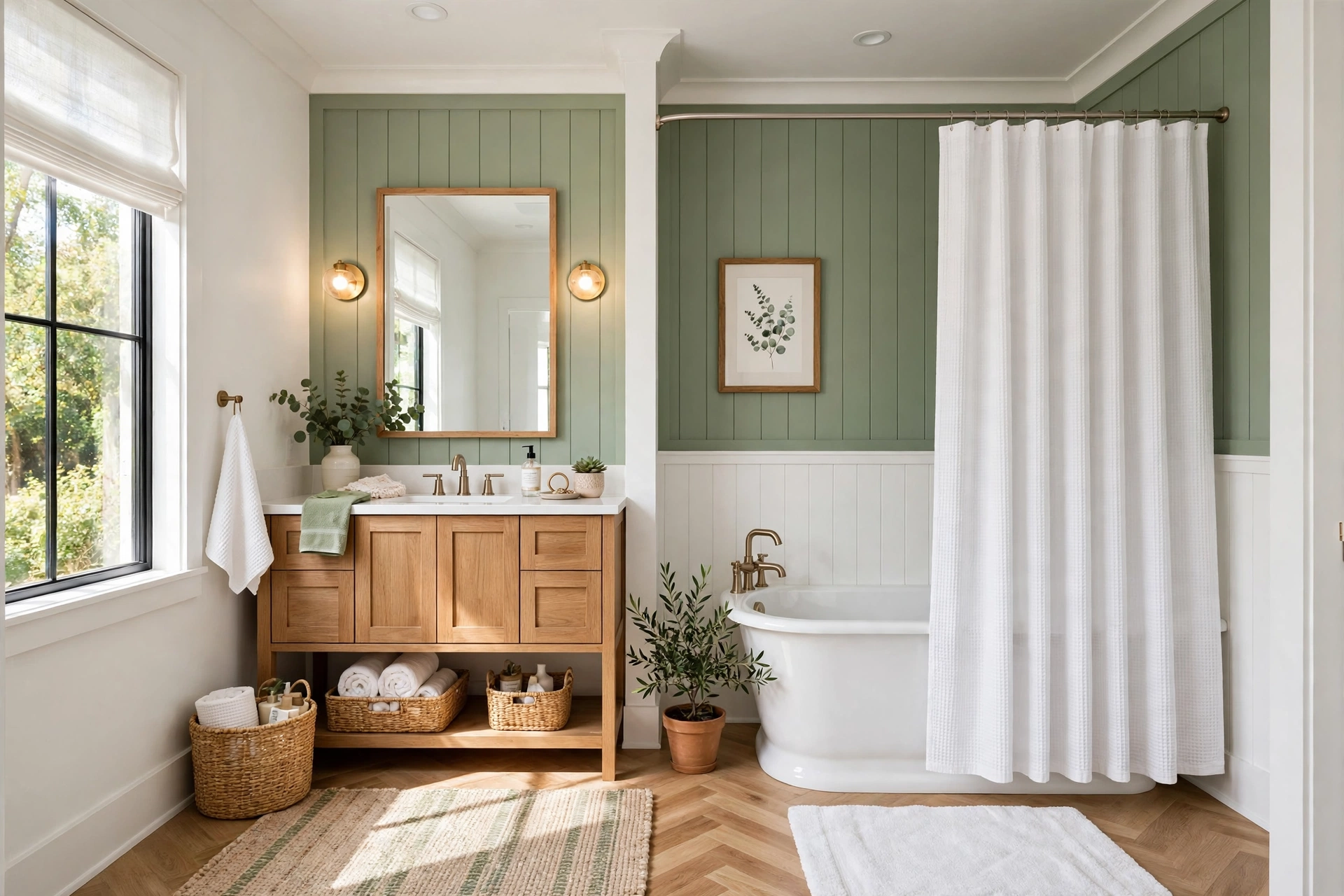
Nothing in a bathroom says “dirty” faster than a shower curtain with yellowed edges, pink mildew spots along the hem, or a liner that has gone cloudy. The curtain hangs at eye level, fills a whole wall, and sits in the wettest spot in the room, so it is the first thing your eye lands on and the last thing it forgives. A curtain that has gone dingy makes the entire shower read as unwashed, even when the tiles behind it are spotless — and because the curtain is fabric or vinyl rather than tile, people subconsciously assume it cannot be cleaned, only replaced.
The fix is mostly maintenance, and it is easier than most people think. A fabric outer curtain goes straight into the washing machine on a gentle cycle with a cup of white vinegar, and it comes out looking new. The liner — the part that actually gets wet — should be replaced every few months, because a fresh liner costs a few dollars and is the cheapest visual upgrade in the whole bathroom. If you want the problem to stay solved, switch to one of the best shower curtains for small bathrooms: a weighted-hem curtain that hangs straight and dries evenly, and leave the curtain pulled mostly closed after showers so air circulates and the liner dries instead of staying folded and damp.
⚠️ Warning: Never mix bleach with other cleaners when tackling mildew on a liner or curtain — the fumes are dangerous. Use one product at a time, ventilate the room, and rinse thoroughly before the next shower.
3. Leaving the Countertop Cluttered

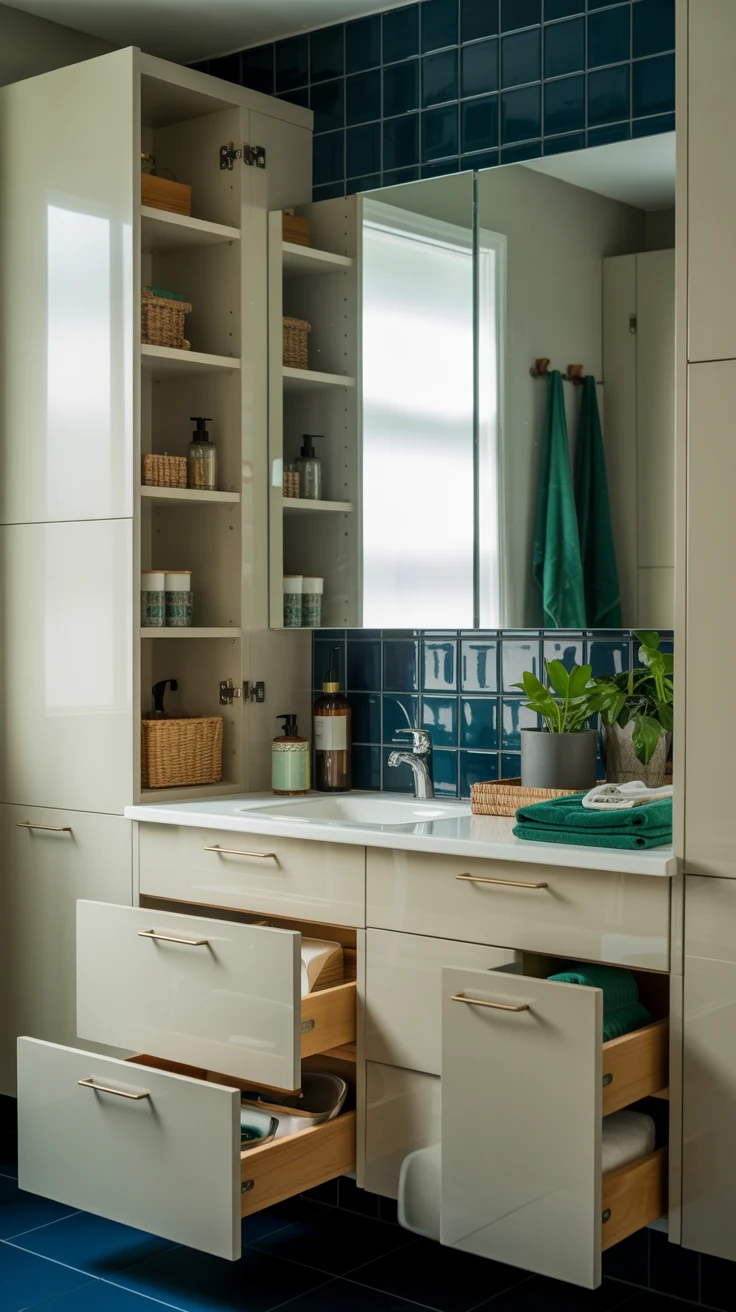
A bathroom counter covered in bottles, brushes, cords, and half-used products reads as dirty even when every surface underneath has just been wiped. Clutter and grime share the same visual language: both make a surface look uncared for, and in a small bright room your eye cannot tell the difference between a crowded counter and a dirty one. The counter is the most-used surface in the bathroom and the one closest to eye level at the sink, so it sets the tone for the whole room. Ten bottles on a counter make the room feel messy five minutes after cleaning; three bottles on a tray make it feel like a hotel.
The fix is a rule, not a purchase: everything on the counter must earn its place, and everything that earns a place lives inside a boundary. A single tray, a small basket, or a wooden box corrals the daily essentials — toothbrushes, soap, and the two or three skincare products you actually use every day — and everything else goes into a drawer or a cabinet. Our guide to how to organize a small bathroom with no counter space is built around exactly this idea, and its core rule is the one that matters here: if it does not fit on the tray, it does not live on the counter. Clear the counter completely once, wipe it down, then put back only what fits the tray. The room will look cleaner the moment you step back, and it will stay that way because putting things away now takes two seconds instead of a decision.
📌 Important: The one-in, one-out rule protects the fix. For every new product that enters the bathroom, one old product leaves — otherwise the counter fills up again within a month, no matter how good the tray system is.
Bathroom Decor Mistakes Quick-Start Checklist
- ✅ Deep-clean the grout lines, then seal them so they stay bright for a year
- ✅ Wash the fabric shower curtain and replace a cloudy or spotted liner
- ✅ Clear the counter completely, then put back only what fits on one tray
- ✅ Swap graying or mismatched towels for one matching set in a single color
- ✅ Squeegee the mirror and the glass after every shower so spots never build up
- ✅ Match the light bulbs to warm white (2700K) and keep every fixture the same finish
4. Displaying Graying, Mismatched Towels

Towels are the softest thing in a bathroom and the easiest way to make it look dirty. A stack of graying white towels, a faded navy hand towel next to a bright pink bath towel, or a frayed towel draped over the rail all send the same message: this room is worn out and nobody is maintaining it. Towels occupy a large visual area — hanging on rails, folded on shelves, draped over the tub — and because they are fabric, your eye reads their condition as the room’s condition. Gray towels in a white bathroom are the textile equivalent of dingy grout.
The fix is a matching set in one color, and it is one of the cheapest changes on this list. Two bath towels, two hand towels, and two washcloths in a single calm color — white, warm gray, sage, or soft terracotta — instantly make the room look coordinated and cared for. White towels are the most forgiving choice because they can be washed hot with a little oxygen bleach to stay bright, while colored towels should be washed separately so they do not fade each other. Retire the grayed and frayed towels to cleaning rags rather than keeping them on display, and fold or roll the good set the same way every time so the stack itself looks intentional.
5. Living With a Water-Spotted, Undersized Mirror

A mirror does two jobs in a bathroom: it reflects light and it reflects the room, and a bad mirror fails at both in a way that reads as dirt. Water spots, toothpaste splatter, and streaks on the glass are visible from across the room, and because the mirror is the brightest surface in the bathroom, every mark on it catches the light. An undersized mirror makes it worse, because a small mirror over a wide vanity leaves a large expanse of blank wall that reads as unfinished, and the small reflection it does give back is a cropped, shadowy version of the room.
The fix has two parts, and both are quick. First, clean the mirror properly: a microfiber cloth with a little glass cleaner or diluted vinegar, wiped in one direction, removes spots without leaving the haze that paper towels cause. Second, size the mirror to the vanity — the mirror should be a few inches narrower than the vanity, not dramatically smaller, and its center should sit at eye level. If you are choosing a new mirror, our guide to the best bathroom vanity mirrors for small spaces walks through the size rules and the shapes that work best, and the simplest rule in it is the one worth remembering: when you are torn between two sizes, choose the larger one, because a generous mirror doubles the light in the room while a small one shrinks it.
💡 Pro Tip: Keep a small squeegee or a microfiber cloth on a hook beside the mirror and wipe it after your morning routine. Thirty seconds a day prevents the water spots from ever building up, and the mirror stays invisible — which is exactly what a good mirror should be.
Quick Comparison: These 7 Bathroom Mistakes by Cost and Effort to Fix
6. Harsh, Yellow Lighting That Makes White Fixtures Look Dingy

Light is the lens everything in the bathroom is seen through, and the wrong light makes clean fixtures look dirty. A single bare overhead bulb with a cool white or daylight color temperature casts hard shadows, flattens every surface, and turns white porcelain slightly blue-gray, while an old yellowed fixture cover adds a nicotine-colored cast that makes the whole room look stained. The effect is especially cruel on white tiles and white grout, which pick up whatever color the light gives them — under yellow light, a spotless white bathroom looks like it has not been cleaned in months.
The fix costs less than ten dollars and takes five minutes. Swap the bulbs for warm white ones, around 2700K, and match every bulb in the room to the same temperature, because mixing a cool bulb with a warm one makes the room feel subtly wrong in a way nobody can diagnose. If the fixture has a yellowed plastic cover or a missing glass shade, replace the cover too — universal shades cost a few dollars and are the fastest way to remove the yellow cast. And if you want the room to feel genuinely fresh, add one low light source: a small battery candle on a shelf or a dimmable vanity light softens the room in the evening and makes the white surfaces glow instead of glare. For the full mood, our guide to how to create a spa bathroom at home shows how warm, layered light is the single change that makes a bathroom feel like a retreat rather than a utility room.
7. Mismatched Bottles and Overstuffed Open Shelves

Open shelving and shower niches are where a bathroom’s clutter goes on display, and a dozen mismatched bottles in different colors, shapes, and label styles read as mess even when the shelf itself is dusted and organized. Every bottle is a different color — neon shampoo, amber medicine, white lotion, black deodorant — and together they form a noisy strip of visual clutter that your eye files under “untidy.” The same is true of open shelves crammed edge to edge: a shelf filled to the brim looks organized for exactly one day, then becomes impossible to use without knocking things over, and the room reads as chaotic rather than cared for.
The fix is decanting and editing, in that order. Move everyday products into a small set of matching refillable bottles — amber glass, white ceramic, or simple pump bottles in one finish — and the shower niche instantly calms down, because the eye sees one intentional set instead of twelve competing labels. Then edit the shelves: leave twenty percent of every shelf empty on purpose, keep three to five objects per shelf, and move the spares and backups into a closed cabinet. If your shelves still feel busy, our small bathroom decor ideas guide shows how a few matching baskets and one color story turn open storage from a clutter display into a design feature. The rule for open storage is simple: it should look like a display, and a display has breathing room.
📌 Important: Decant only the products you use daily. Backups, medicines, and rarely used items belong behind a closed door — the fastest way to make open shelves look clean is to give them less to hold.
More Sneaky Bathroom Mistakes to Watch For
Mistake 1: Ignoring the Caulk Line Around the Tub and Sink
Cracked, peeling, or blackened caulk is the detail that quietly ruins an otherwise clean bathroom, because it sits exactly where your eye expects a crisp white line. A tube of silicone caulk costs a few dollars and the job takes under an hour: remove the old bead completely, let the gap dry, and apply a smooth new line with painter’s tape on both sides for a professional edge. Fresh white caulk makes the whole room look newly installed.
Mistake 2: Keeping a Bath Mat That Never Gets Washed
A bath mat absorbs water every single day, and a mat that is never washed becomes the one item in the room that actually is dirty — gray, flat, and faintly musty. Choose a washable cotton rug you can toss in the machine, wash it monthly, and shake it out weekly. A clean mat is the final detail that makes a bathroom feel finished, and it is the first thing your feet notice every morning.
Mistake 3: Mixing Metal Finishes Across the Room
Chrome faucet, brass towel ring, matte black showerhead, and nickel cabinet pulls in one small room look accidental, not eclectic. Pick one metal finish and repeat it on every visible fitting, including the drain cover and the toilet paper holder. Matching finishes are the cheapest signal that a room was designed rather than assembled, and mismatched ones are the fastest way to make it look thrown together.
Mistake 4: Buying Decor Before Deep-Cleaning
New towels and art cannot rescue a bathroom with dirty grout and a stained shower curtain. Clean first, decorate second — the cleaning is free, and it changes what you actually need to buy. Most people discover after a deep clean that half the decor they were about to purchase was never needed, because the room already looked good once the grime was gone.
Frequently Asked Questions
1. Why does my bathroom look dirty even though I clean it every week?
Because the things that read as dirt are usually decor, not grime: dingy grout, a yellowed shower curtain, graying towels, and a cluttered counter all signal “unclean” to your eye even when the surfaces underneath are spotless. Fix those four items first — they cost almost nothing — and the room will finally look as clean as it is.
2. What is the fastest fix for a bathroom that looks dirty?
Deep-clean the grout and replace the shower curtain liner. Those two changes take an afternoon, cost under twenty dollars together, and transform the two largest visual surfaces in the room. After that, clear the counter to a single tray and swap in matching towels.
3. Does grout color really make a bathroom look dirty?
Yes — grout is the grid your eye reads first, and dark or blotchy lines make the whole floor and shower read as stained. Light, uniform grout looks clean even when it is not perfect, and sealing it once a year keeps it that way. If your grout is stained past cleaning, a grout colorant restores it in one pass.
4. How often should I replace a shower curtain liner?
Every three to six months, or sooner if it develops pink mildew spots or a cloudy film that will not wash off. Liners are cheap, and a fresh one is the fastest visual upgrade in the bathroom. Wash the fabric outer curtain monthly on a gentle cycle with vinegar to keep it bright.
5. What color towels make a bathroom look cleanest?
White, because white towels can be washed hot and stay bright, and a matching white set makes the room look like a hotel. If white feels too stark, choose one soft color — warm gray, sage, or soft terracotta — and keep every towel in that single family. The matching matters more than the color itself.
6. Can lighting really make a clean bathroom look dirty?
Absolutely. Cool white or daylight bulbs make white fixtures look blue-gray, and a yellowed fixture cover adds a stained cast to the whole room. Warm white bulbs at 2700K, matched across every fixture, make white porcelain glow instead of looking dingy — and replacing a yellowed cover costs only a few dollars.
7. Are open shelves a bad idea in a bathroom?
No, but they need discipline. Open shelves look clean when they hold a few matching items with breathing room — three to five objects per shelf, one color story, twenty percent empty. They look dirty when they are crammed with mismatched bottles. Decant daily products into matching bottles and move the rest behind a closed door.
Conclusion
A bathroom that looks dirty is rarely a bathroom that is dirty. It is a bathroom where the grout has gone gray, the curtain has yellowed, the towels have faded, and the counter has filled up — a slow accumulation of small visual shortcuts that add up to one loud message. The encouraging part is that none of these mistakes needs a renovation, a contractor, or a big budget. They need an afternoon, a toothbrush, a washing machine, and a few matching towels.
Start with the two fixes your eye notices first: clean and seal the grout, and replace the shower curtain liner. Then clear the counter to a single tray and put a matching towel set on the rail. Walk out of the room, come back in five minutes, and look at it the way a guest would — the bathroom will finally look as clean as it has been all along, and keeping it that way is now a five-minute weekly habit instead of a weekend project.