
7 Small Apartment Decorating Mistakes Beginners Make (and How to Fix Them)
Introduction
Moving into your first small apartment is equal parts exciting and overwhelming. You have a blank space, a limited budget, and a head full of inspiration from social media — but somewhere between the move-in boxes and the first grocery run, the decorating decisions start to feel risky. Most beginners make the exact same handful of mistakes, and the good news is that every single one of them is fixable without spending a fortune or starting over.
The mistakes below are the ones I see again and again in small apartments: furniture shoved against every wall, rugs that float like postage stamps in the middle of the room, curtains hung so low they shrink the windows, and lighting that makes the whole place feel like an interrogation room. None of these come from bad taste — they come from decorating instincts that work fine in bigger homes but backfire in compact ones. Small spaces simply play by different rules.
In this guide, I’ll walk you through the seven most common apartment decorating mistakes beginners make, explain exactly why each one makes your space feel smaller and less comfortable, and show you the simple fix for every one. Most of these corrections cost little or nothing — rearranging what you already own, hanging what you have at the right height, or swapping one undersized piece for the right-sized one. By the end, your apartment will look bigger, feel calmer, and finally match the vision in your head. If you came here looking for tiny apartment decorating ideas that actually work in real rentals, you’re in the right place — these seven fixes are where every good small-space makeover starts.
1. Pushing All Your Furniture Against the Walls

The instinct is completely understandable: when a room is small, your first move is to clear as much floor as possible by pressing every piece of furniture flat against the walls. It feels logical — more open floor must mean a bigger-feeling room, right? Unfortunately, the opposite happens. When everything hugs the perimeter, the middle of the room becomes a dead, empty void, and the walls read as a crowded ring of furniture. Instead of looking spacious, the room looks like a waiting area.
The fix is one of the most counterintuitive tricks in small-space design: float at least one piece of furniture away from the wall. Pull your sofa even six to eight inches off the wall and suddenly there’s breathing room — a shadow line that gives the wall depth. Angle a chair slightly, or let a slim console sit behind the sofa with a lamp on it. That small gap tricks the eye into reading the room as larger because it suggests there is more space than there actually is. Designers call this “creating air,” and it’s free.
This works especially well when you pair it with smart furniture arrangement in a small living room: group seating around a focal point like a window or a rug instead of lining the walls like bleachers. Even in a true shoebox, floating the coffee table’s companion chair at a slight angle breaks the boxy feeling. The key is intentionality — every piece should look placed, not parked.
💡 Pro Tip: You don’t need to float everything. In a small room, floating just the largest piece — usually the sofa — is enough to change how the whole space reads. Keep walkways clear (about 30 inches minimum) and the room will feel open, not cramped.
2. Buying Furniture Before Measuring Your Space

Nothing derails a small apartment faster than a sofa that won’t fit through the door, a bed that swallows the bedroom, or a dining table that leaves no room to pull out the chairs. Beginners often shop with their hearts — they fall in love with a piece online or in the showroom, where everything looks reasonably sized under high ceilings and wide aisles, and only discover the problem on delivery day. Oversized furniture is the fastest way to make a small apartment feel like a storage unit.
The fix starts before you spend a single dollar: measure your room, your doorways, your stairwell, and your elevator, and bring those numbers everywhere you shop. Then tape out the footprint of any big piece on your floor with painter’s tape before you buy it. That blue rectangle on the floor tells the truth that your imagination won’t — you’ll immediately see whether the dresser blocks the closet door or the sectional eats your walkway. It takes ten minutes and saves hundreds of dollars in returns.
When you do buy, choose pieces scaled for apartment life: loveseats instead of full sofas, round dining tables instead of rectangles, and leggy furniture that shows floor underneath. Visible floor space is visual square footage — a sofa on tall legs reveals six more inches of floor around it, and your brain counts that as room. This is the same principle behind choosing the right small space furniture ideas: every piece should earn its footprint with the right scale or a second job.
📌 Important: Measure twice — the room AND the path the furniture takes to get there. Apartment stairwells, tight corners, and narrow doorframes reject more furniture than small rooms do. Photograph your measurements and keep them in your phone.
3. Choosing a Rug That’s Too Small

Walk into almost any beginner’s apartment and you’ll find the same sad scene: a tiny rug floating in the middle of the seating area like an island, with all the furniture legs stranded on bare floor around it. A too-small rug visually chops the room into fragments — the eye reads the rug’s edges as boundaries, so the room feels exactly as small as that little rectangle. It’s one of the most common apartment decorating mistakes beginners make, and it’s also one of the easiest to fix.
The rule is simple: in a living room, the rug should be big enough that at least the front legs of your sofa and chairs sit on it — ideally all the legs. For most small apartments, that means a 5×8 or even an 8×10, not the 4×6 that feels “safe.” A larger rug unifies the seating area into one zone, and that visual unity makes the floor read as one continuous, generous surface. Bigger rug, bigger-feeling room — it feels backwards until you see it.
In a bedroom, the same principle applies: the rug should extend at least 18 to 24 inches beyond each side of the bed, so your feet land on softness and the bed looks anchored rather than adrift. And if a correctly sized rug feels like a budget stretch, remember that flat-weave and low-pile rugs in large sizes cost far less than plush ones — and they’re easier to clean in a small space anyway. Your rug is the foundation of the room; size it like one.
⚠️ Warning: Don’t try to “save money” by layering two small rugs to fake a big one — the seam always shows and it reads as a compromise. One correctly sized rug beats two small ones every time.
4. Hanging Curtains Too Low (and Too Narrow)
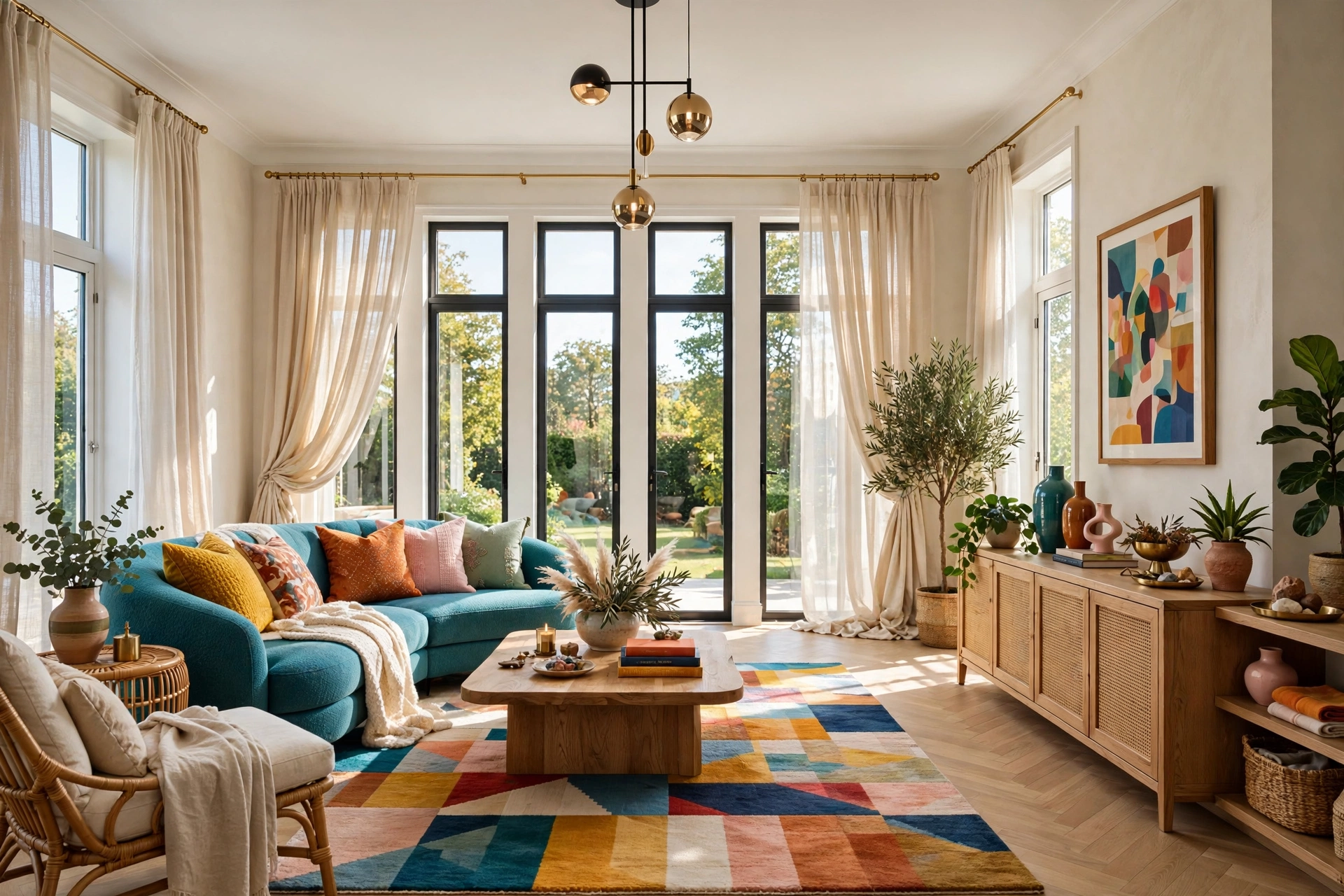
Curtains are one of the highest-impact, lowest-cost upgrades in a small apartment — and also one of the most commonly botched. The classic beginner move is to mount the rod right at the top of the window frame and choose panels that just barely cover the glass. The result? The window looks smaller than it is, the ceiling looks lower than it is, and the whole wall feels squat. Your windows are the eyes of the room; dressing them wrong dims the entire space.
The fix costs nothing if you already own the curtains: mount the rod four to six inches above the window frame — or all the way near the ceiling in rooms with standard eight-foot ceilings — and extend it six to twelve inches wider than the frame on each side. Hang the panels so they just kiss the floor. Suddenly the window reads as grand, the ceiling reads as taller, and daylight pours in around the stacked panels instead of being choked by them. This single change can make a small room look bigger more dramatically than almost any furniture swap.
Width matters as much as height. Panels should be one and a half to two times the width of the window when closed flat, so they hang in generous folds rather than stretched flat like a sheet. And keep the fabric light — airy linen-look or sheer panels let daylight flood in, which is the whole point in a small apartment. Heavy, dark drapes absorb the light your space desperately needs.
5. Relying on a Single Overhead Light

If your apartment has one harsh ceiling light per room — the classic rental “boob light” — and that’s your entire lighting plan, your space will never feel cozy, no matter how beautiful the furniture is. A single overhead source casts unflattering downward shadows, creates glare, and leaves every corner in gloom. It’s the reason so many small apartments feel flat and institutional at night, even when they look fine during the day.
The fix is layered lighting: aim for three sources of light at different heights in every room you spend time in. That sounds expensive, but it isn’t — a plug-in floor lamp in a dark corner, a small table lamp on a console or nightstand, and a warm bulb in the overhead fixture will completely transform the room. Use warm-white bulbs (2700K) everywhere for consistency; mixed color temperatures are a subtle but real source of visual unease. Put the lamps on affordable plug-in dimmers or smart bulbs so you can drop the brightness in the evening.
Good lighting also changes how your space photographs and how it feels to guests — it’s the difference between “nice apartment” and “wow, this place feels amazing.” Pay special attention to dark corners, which visually shrink a room; a lamp in the far corner pushes the walls outward with light. And if you’re renting, every bit of this is reversible: floor lamps, plug-in sconces, and adhesive LED strips leave no trace. Thoughtful lighting is one of the cheapest ways to fix apartment decorating mistakes beginners make without touching a paintbrush.
💡 Pro Tip: Replace the harsh overhead bulb first — it’s the single highest-ROI lighting move. A warm 2700K LED at moderate brightness instantly softens the whole room, even before you add a single lamp.
6. Ignoring Your Vertical Space
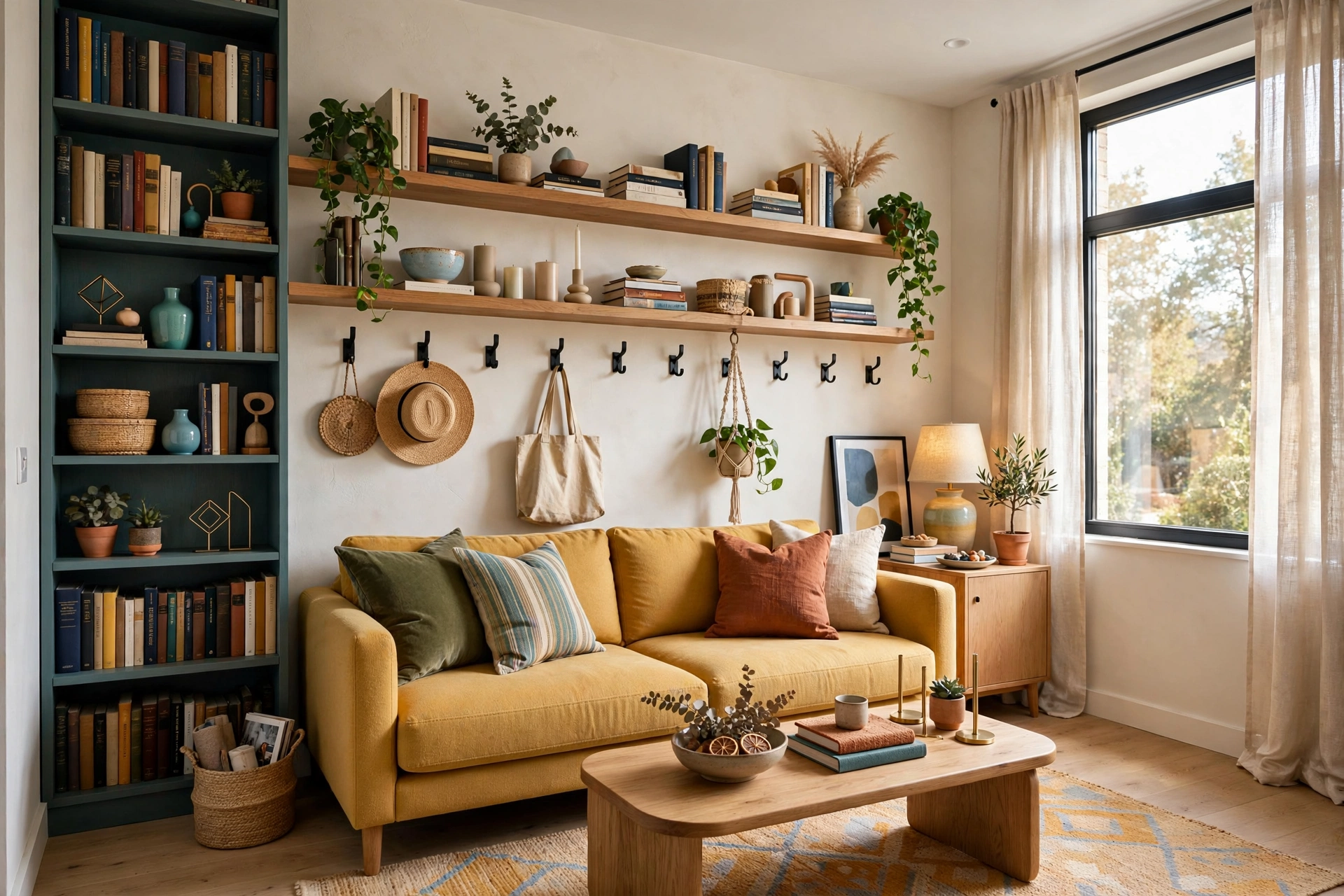
Small apartments are short on floor space but almost always rich in an underused dimension: height. Beginners decorate the bottom four feet of their rooms — furniture, rugs, a few things on low shelves — and leave the walls above eye level completely bare. The result is a room that feels squat and unfinished, with all the visual weight dragging downward. Meanwhile, storage stays cramped because everything has to live at floor level.
The fix is to think in three dimensions. Run a bookshelf all the way up instead of stopping at waist height. Hang floating shelves above the desk, the sofa, or the toilet. Mount hooks and rails on the backs of doors and inside cabinet doors. A tall, narrow bookcase holds as much as a wide low one while eating a fraction of the floor. Even art placement matters: hanging pieces slightly above eye level and using the full wall draws the eye upward, which reads as ceiling height — and ceiling height reads as spaciousness.
Vertical thinking also solves the storage crunch that plagues small apartments. Wall-mounted organizers in the entryway, over-the-door racks in the closet, and high shelves for seasonal items free your floors and surfaces from clutter. Just keep the styling intentional: group items in odd numbers, leave some breathing room between objects, and repeat a color or material so the wall reads as designed rather than crammed. Vertical space is free square footage — decorate and store like it.
7. Cramming In Decor Without a Color Plan

The final beginner trap is the most emotional one: you love the mustard throw, and the teal vase, and the patterned cushions, and the gallery wall of twelve different frames — so everything comes home and lands in one small room. Individually, each piece is lovely. Together, with no unifying color story, they compete for attention and the room reads as chaotic. In a small space, visual chaos shrinks the room faster than almost anything, because the eye has nowhere to rest.
The fix is a simple color plan, and the easiest beginner-friendly formula is the 60-30-10 rule: about 60 percent of the room in a dominant neutral (walls, large furniture, rug), 30 percent in a secondary color (curtains, bedding, an accent chair), and 10 percent in an accent (cushions, art, small decor). You don’t need to be precise — the point is restraint. Pick your palette from one inspiration piece, like a rug or a piece of art, and let it govern every purchase. Suddenly the mustard throw and the teal vase can’t both move in, and the room breathes.
This discipline also saves money, because it stops impulse buys that don’t fit. Before bringing anything home, ask: does it match my 60, my 30, or my 10? If not, it stays in the store. A cohesive palette is what separates “decorated” from “accumulated,” and it’s the difference between a small apartment that feels curated and one that feels cluttered. Start neutral and add color slowly — you can always add, but editing a chaotic room is exhausting.
📌 Important: Your color plan should flow between rooms, especially in open layouts. Repeating one or two colors from room to room makes a small apartment feel like one generous, connected home instead of a series of tiny boxes.
Quick Comparison: The 7 Mistakes by Cost and Effort to Fix
Small Apartment Quick-Start Checklist
- ✅ Measure every room, doorway, and stairwell before buying anything
- ✅ Tape furniture footprints on the floor with painter’s tape first
- ✅ Size rugs so front furniture legs sit on them (5×8 minimum for living rooms)
- ✅ Mount curtain rods 4–6 inches above the frame and wider than the window
- ✅ Add three light sources at different heights in main rooms
- ✅ Use vertical space: tall shelves, hooks, and art hung at eye level or above
- ✅ Pick a 60-30-10 color plan and check every purchase against it
Mistakes to Avoid After You Fix the Big 7
Mistake 1: Blocking Your Best Window
Once the big mistakes are handled, subtler ones surface — and parking a tall bookshelf or a bulky armchair directly in front of your best window is chief among them. Natural light is the most valuable asset a small apartment has; it makes rooms feel larger, colors look truer, and mornings measurably better. Every square foot of blocked window is square footage your eyes can’t use. Keep window walls as clear as possible, choose low-profile pieces for those spots, and let daylight do the heavy lifting.
Mistake 2: Buying the Matching Furniture Set
The showroom set — matching sofa, loveseat, chair, and tables all in one fabric — feels like a safe, “done” decision, but in a small apartment it reads as heavy and monotonous. A room full of identical pieces has no visual rhythm; the eye slides off it. Mixing is better: keep one anchor piece and vary the rest in complementary colors, textures, and eras. A curated mix looks collected over time, feels personal, and paradoxically makes a small room feel more considered and spacious than a matched set ever could.
Mistake 3: Forgetting the Entryway
Beginners pour energy into the living room and bedroom, then let the entryway become a pile of shoes and a tangle of keys. But the entryway is the first and last thing you see every day — it sets the emotional tone of the whole apartment. You don’t need much: a slim console or wall-mounted shelf, a mirror to bounce light (our guide to the best mirrors for small spaces shows which styles do this best), hooks for bags and coats, and a small tray for keys. Five minutes of intention here pays off every single time you walk through the door.
Mistake 4: Skipping a Focal Point
Every room needs one thing the eye lands on first — a piece of art, a styled bookshelf, a beautiful headboard, a great light fixture. Without a focal point, attention scatters across the room and the space feels restless and undefined. This is especially true in small apartments, where “everything visible at once” can read as clutter without an anchor. Choose one star per room, give it the best position (usually the wall you face when entering), and let everything else support it.
Frequently Asked Questions
1. What is the biggest decorating mistake in a small apartment?
Buying oversized furniture is the costliest and hardest to undo — a too-big sofa dominates the room and blocks flow in a way no styling trick can fully fix. Always measure your space and tape out footprints before purchasing. Second place goes to the too-small rug, which visually fragments the floor and makes the room feel smaller than it is.
4. What size rug should I get for a small living room?
For most small living rooms, a 5×8 rug is the minimum that works, with 8×10 being ideal if the layout allows. At least the front legs of your sofa and chairs should rest on the rug. A rug that floats in the middle with furniture around it makes the room look smaller, so when in doubt, size up.
2. How can I make my small apartment look bigger on a budget?
Start with the free fixes: pull furniture slightly off the walls, rehang curtains high and wide, and declutter surfaces. Then add the cheap wins — a correctly sized rug, warm layered lighting with a floor lamp, and a mirror opposite a window. Together these changes cost less than one new furniture piece and transform how spacious the apartment feels.
3. Should all my furniture match in a small apartment?
No — a fully matching set tends to look heavy and monotonous in compact rooms. Instead, choose one anchor piece and mix complementary colors, textures, and styles around it. Keep a consistent color palette (the 60-30-10 rule helps) so the mix feels intentional rather than random.
5. How high should I hang curtains in an apartment?
Mount the rod four to six inches above the window frame — or near the ceiling in standard eight-foot rooms — and extend it six to twelve inches beyond each side of the frame. Panels should just kiss the floor. This makes windows look larger and ceilings taller, which opens up the whole room.
6. How many light sources does a small room need?
Aim for three sources at different heights: an overhead (on a dimmer if possible), a floor or table lamp for ambient warmth, and a task light where you read or work. Use warm-white 2700K bulbs throughout for a consistent, cozy glow. Layered lighting eliminates harsh shadows and makes the room feel larger at night.
7. Can I decorate a rental apartment without damaging the walls?
Absolutely — most of these fixes are renter-friendly. Use removable adhesive hooks and strips for art and shelves, tension rods inside window frames, plug-in lamps and sconces instead of hardwired ones, and freestanding furniture like leaning shelves. Always check your lease, but nearly every mistake on this list can be fixed without a single nail.
Conclusion
Here’s the reassuring truth about apartment decorating mistakes beginners make: they’re universal, they’re predictable, and they’re almost all fixable in a weekend with little or no money — this is apartment decorating on a budget at its most effective. You don’t need a bigger apartment or a bigger budget — you need the right instincts. Float the furniture, measure before you buy, size the rug up, hang the curtains high, layer the light, use your walls’ full height, and commit to a color plan.
Start with the fix that bothers you most when you walk in the door — that’s usually the one with the biggest emotional payoff. Change one thing, live with it for a few days, and notice how differently the room feels. Decorating a small apartment is a skill, and like any skill, it compounds: each room you get right teaches you something for the next one. Your apartment doesn’t need to be perfect; it needs to feel like yours. Fix these seven mistakes, and it will.