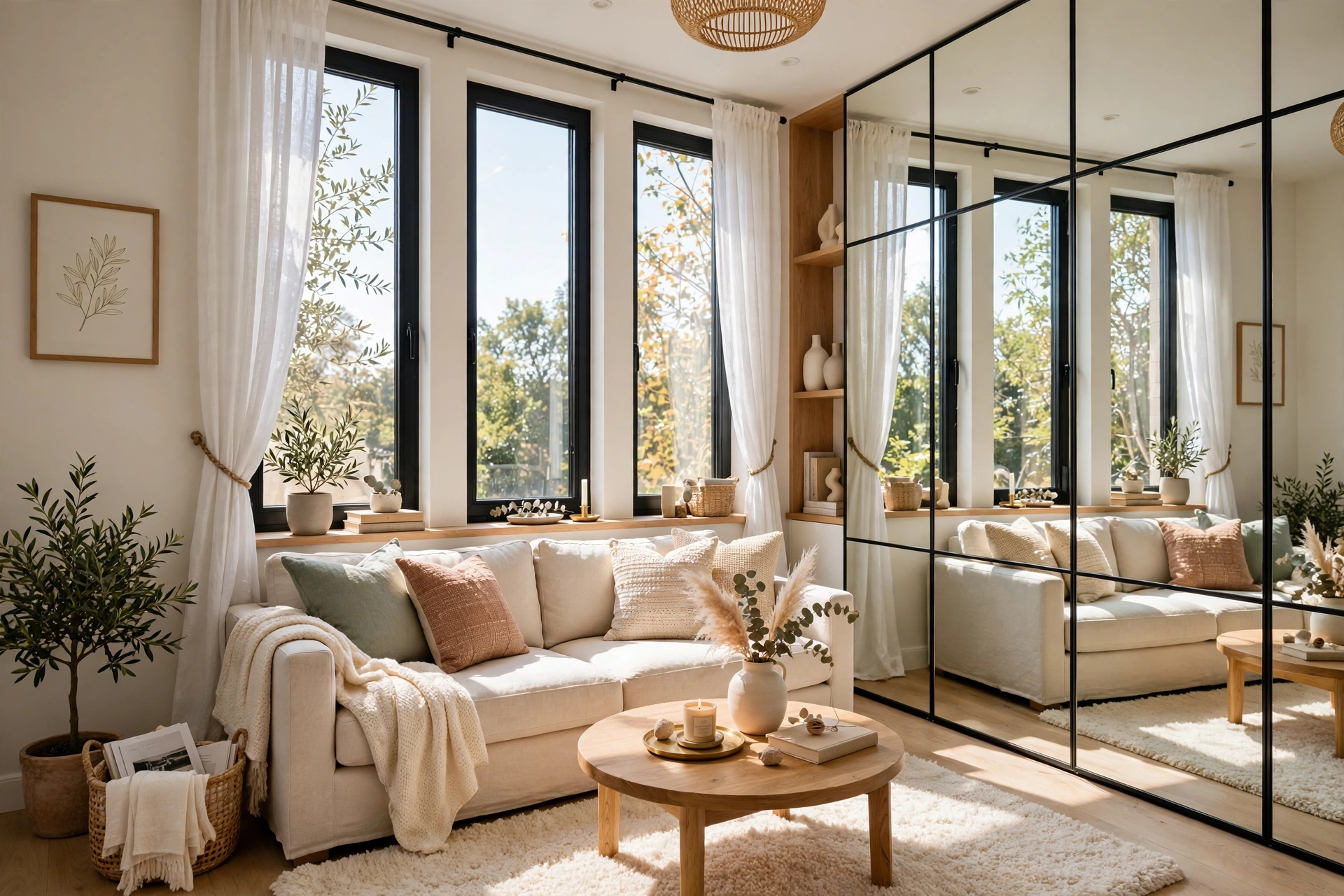
How to Make a Small Room Look Bigger: 15 Designer Tricks
Introduction
Small rooms are judged by the eye, not the tape measure. Two rooms with identical square footage can feel wildly different — one cramped and gloomy, the other airy and generous — and the difference almost never comes down to size. It comes down to perception: where the eye is allowed to travel, how many visual boundaries it trips over, and how light moves through the space. Interior designers know this, which is why their small-room playbook is really a set of optical tricks.
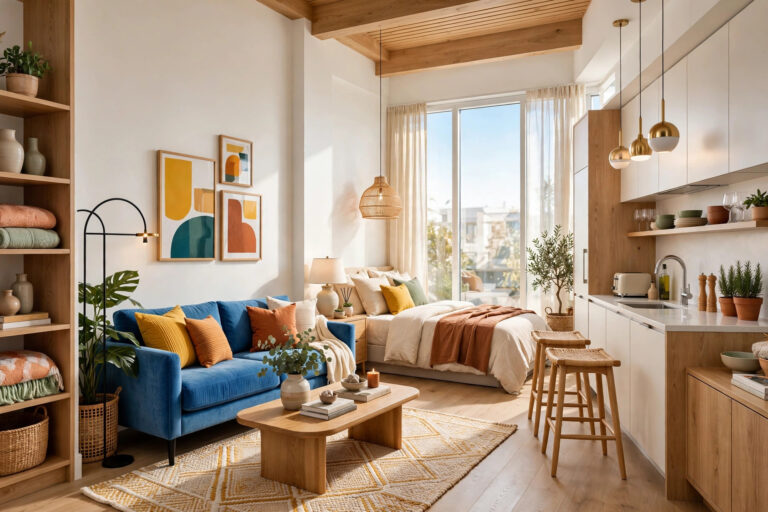
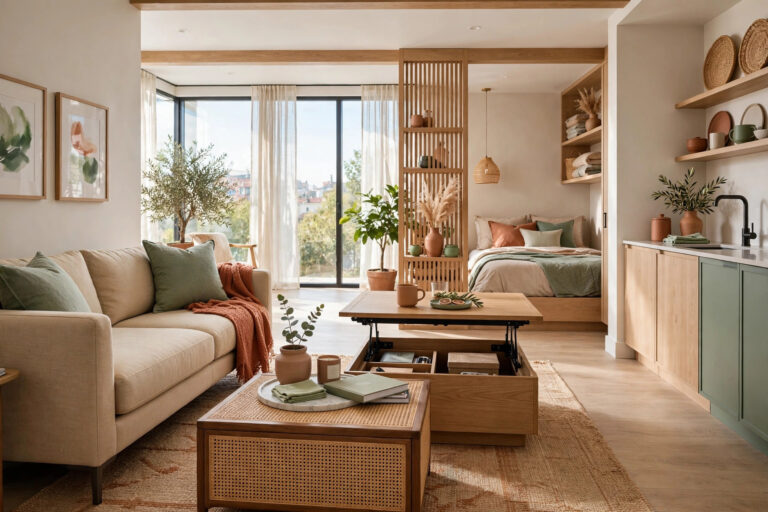
The good news is that none of these tricks require knocking down walls or spending a fortune. Most of them work with paint, placement, and editing — moving what you already own, choosing calmer colors, and removing the visual interruptions that quietly shrink a room. A single weekend of the right changes can make a small bedroom, living room, or studio feel genuinely larger. If you are working with a truly compact home, these tricks pair beautifully with broader tiny apartment decorating ideas that tackle layout and storage at the whole-apartment level.
What follows are fifteen designer tricks, ordered roughly from biggest visual payoff to finishing touch. You do not need all fifteen — pick the three that address your room’s worst problem (dark corners, harsh contrasts, a chopped-up layout), implement those first, and watch the room transform before you spend another dollar.
1. Color-Drench the Room: Walls, Trim, and Ceiling in One Color
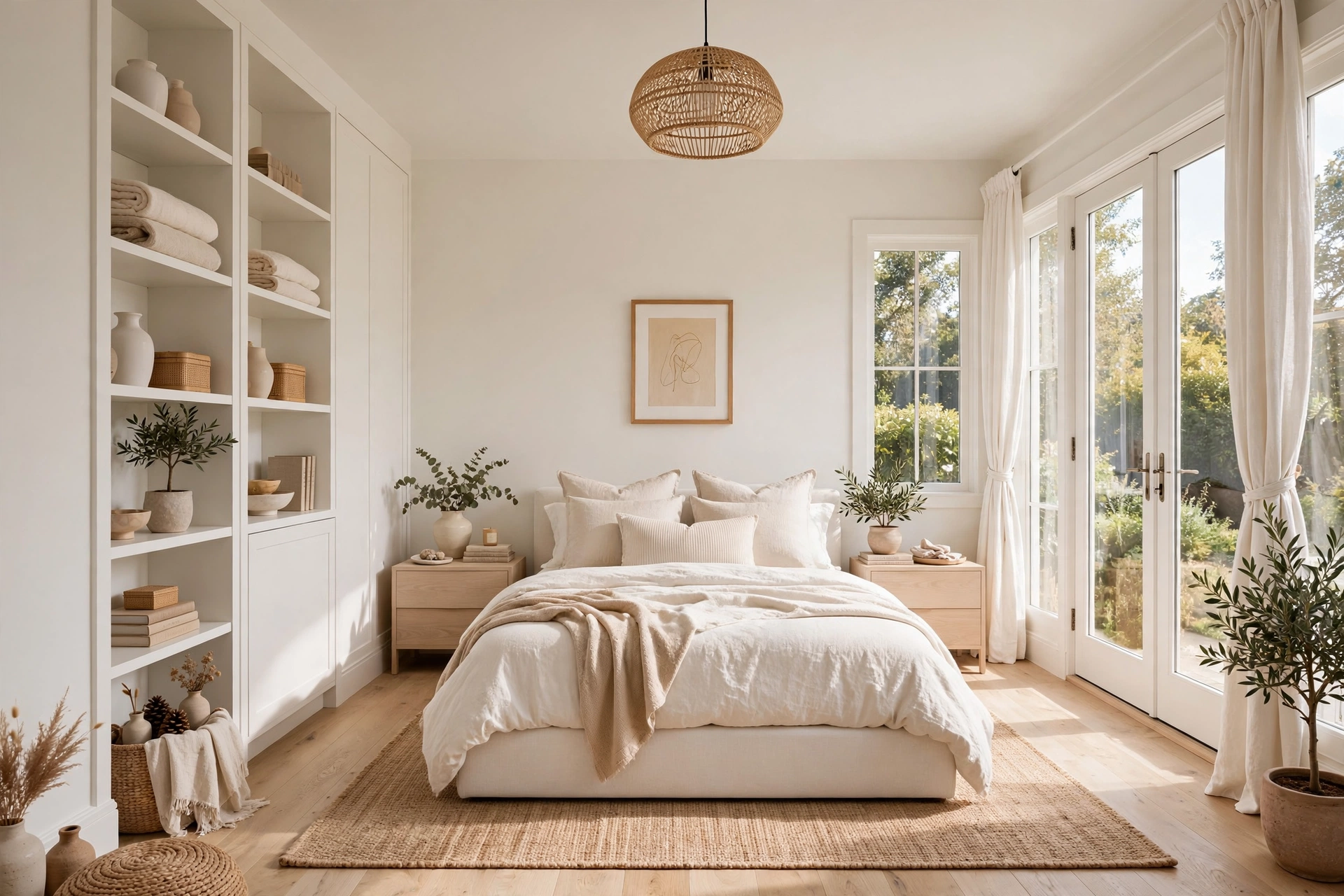
Every place two colors meet, the eye registers a boundary — where wall meets trim, trim meets ceiling, ceiling meets wall. Each of those lines is a visual “stop” that tells the brain exactly where the room ends. Painting the walls, trim, and ceiling in one continuous color erases those stops, so the gaze glides around the room without ever finding its edges. Designers call this color drenching, and for a boxy room with harsh contrasts, it is the single highest-impact change you can make.
The color does not have to be white. Soft warm white, pale greige, muted sage, or powder blue all work beautifully, as long as the trim and ceiling match instead of cutting a bright frame around the walls. If you love warm color, these yellow living room decor ideas prove that even a sunny tint can stay light and spacious when it wraps the whole room instead of stopping at the trim. Keep the sheen consistent too — a uniform eggshell everywhere reads as one calm envelope.
📌 Important: Always test a drenching color on all four walls — not just one swatch — and look at it in morning and evening light. Undertones shift dramatically through the day, and a “warm white” that looks creamy at noon can read pink or gray by lamplight.
2. Cover One Wall in Mirror, Floor to Ceiling
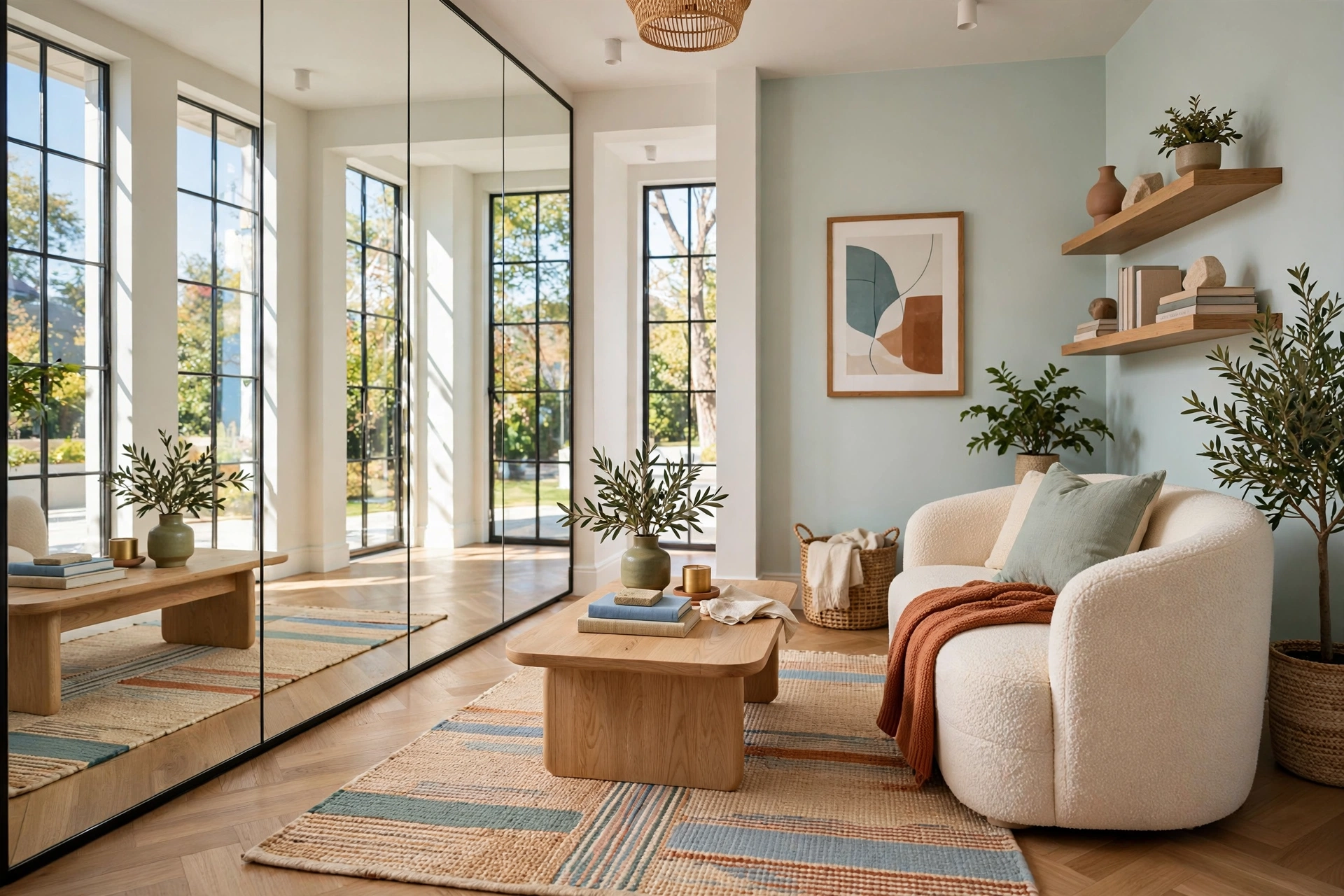
A small mirror decorates; a wall of mirror re-architects the room. Covering one full wall — or a wide floor-to-ceiling section of it — with mirror panels visually doubles the room’s depth, because the reflection has no frame to remind the eye where the room stops. Unlike a single framed mirror, a full mirror wall reads as continuation rather than decoration, and the effect is immediate the moment you walk in.
Placement decides everything. The strongest position is the wall perpendicular to the windows, so the mirror catches daylight and throws it deep across the room. Antique, lightly smoked, or beveled-edge panels soften the effect if a perfect mirror feels too commercial, and a grid of large square panels is easier to install than one giant sheet. In a narrow bedroom or hallway, a mirrored wall on the long side can make the space feel nearly twice as wide.
⚠️ Warning: A mirror doubles everything it reflects — including clutter. Aim a mirror wall at windows, art, or greenery, never at an open closet, a messy desk, or the television. And skip mirrored walls directly opposite the bed if moving reflections at night will bother your sleep.
3. Camouflage Big Furniture Against the Wall Color
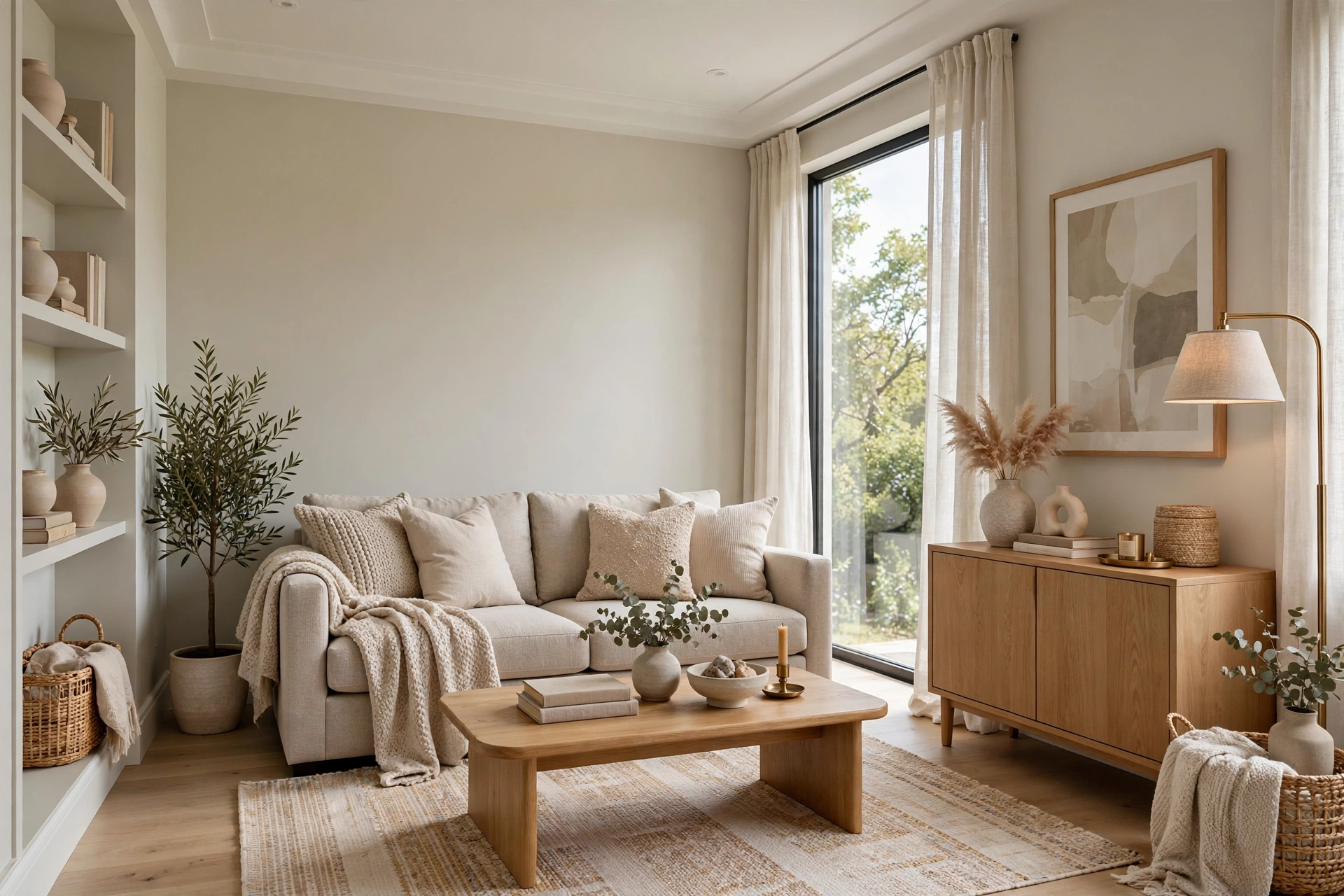
A dark sofa against pale walls is a visual boulder — the hard contrast outlines its bulk and stops the eye cold. Choose your largest pieces in tones close to your wall color and their edges dissolve into the background; the sofa’s silhouette melts away, leaving the eye free to travel past it to the far wall. Designers call this the camouflage effect, and it works on beds, dressers, wardrobes, and bookcases too.
You do not need an all-beige room to pull this off. Keep the large pieces tonal and let contrast live in small, movable things — cushions, throws, a single piece of art — so the room still has personality without visual roadblocks. Pair this approach with genuinely hardworking small space furniture ideas so each low-contrast piece also earns its footprint twice over instead of just looking quiet.
4. Run One Flooring Straight Through Connected Spaces
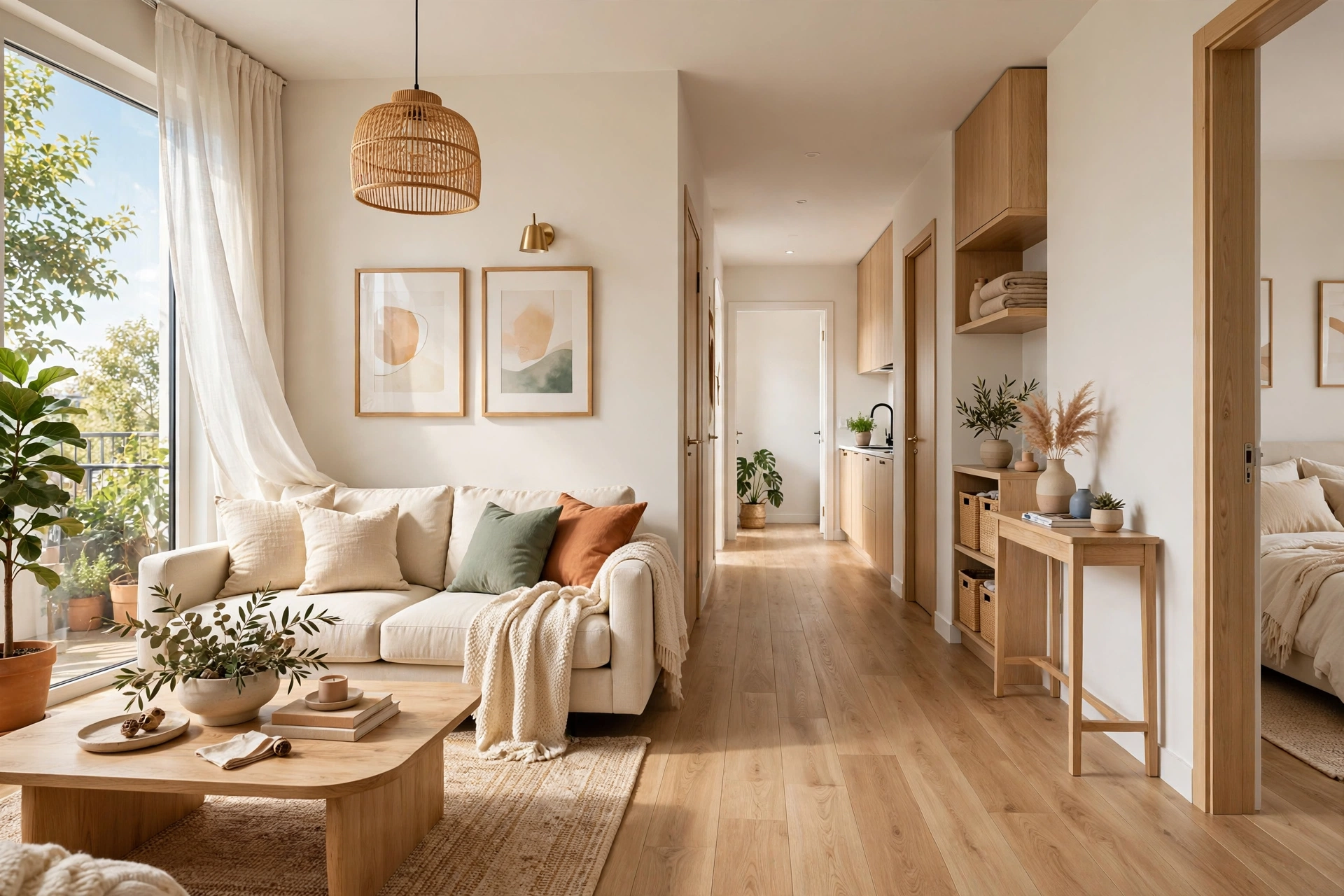
Every flooring change is a boundary line the eye trips on: tile stops, wood starts, and the brain files them as two smaller rooms. When the entry, living area, and hallway share one continuous floor — same material, same direction — the spaces merge into a single larger volume. If replacing floors is out of reach, a large flat-weave rug or runner that spans a threshold fakes the same continuity surprisingly well.
Direction matters as much as material. Run planks — or the long axis of the rug — toward the longest sightline, usually toward the windows or the far wall, so the lines pull the eye forward along the room’s greatest dimension. In rentals, peel-and-stick planks laid in one direction, or a single oversized rug instead of several small ones, capture most of the effect for very little money.
5. Lay Your Longest Sightline on the Diagonal
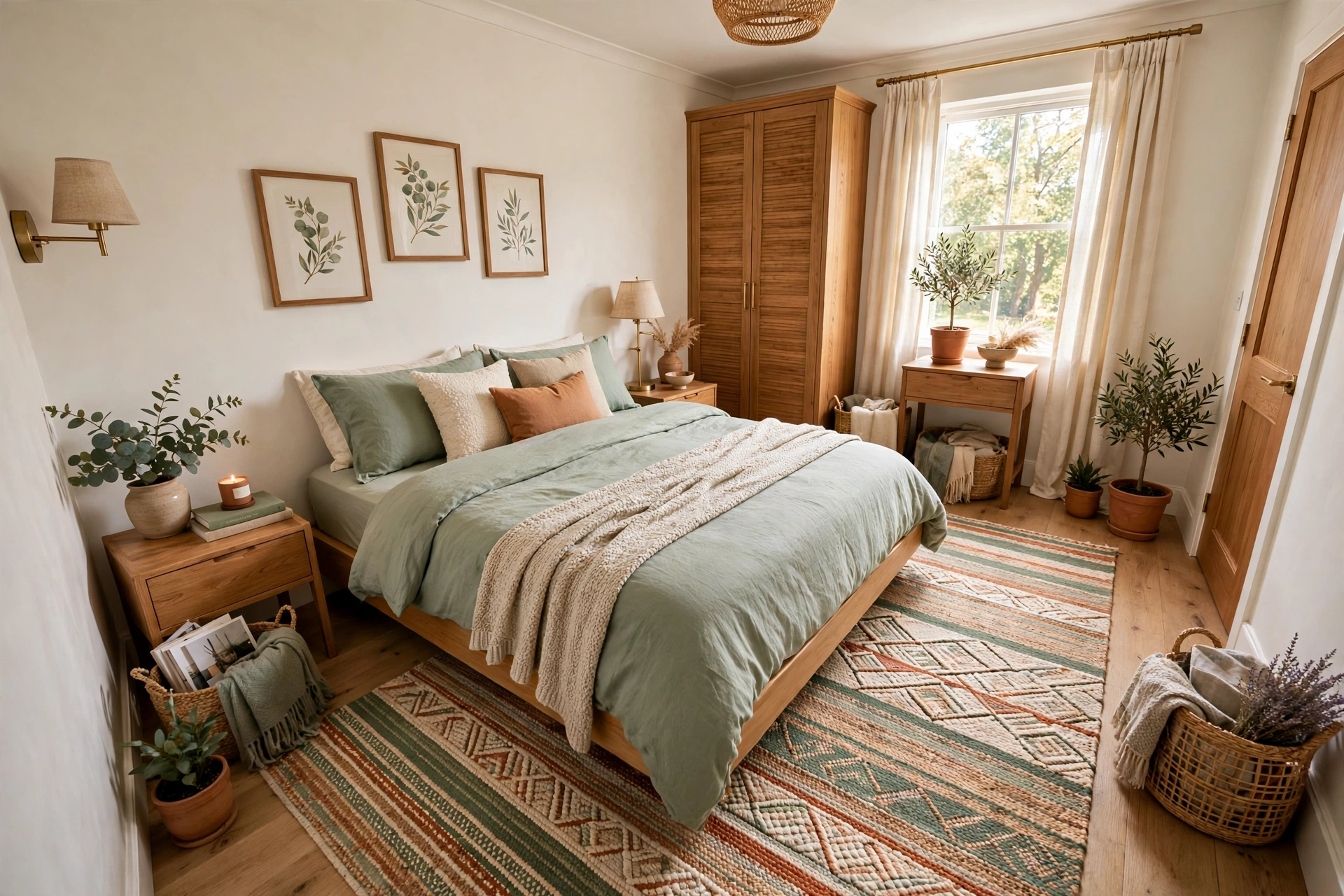
The longest straight line in any rectangular room runs corner to corner — the diagonal is always longer than either wall. Angling the rug and the main furniture grouping along that diagonal lets the eye travel the room’s maximum dimension instead of stopping at the nearest short wall. It is simple geometry working as an optical illusion, and it costs nothing.
You do not need to angle everything: a diagonal rug under a straight sofa still nudges the gaze along the longer path, and floating one armchair at an angle opens the corner behind it. This is a favorite move in studio apartment decor inspiration, because a single open room benefits most from a stretched sightline — but it works just as well in a square bedroom or a boxy living room.
6. Float Shelves, Nightstands, and Vanities Off the Floor
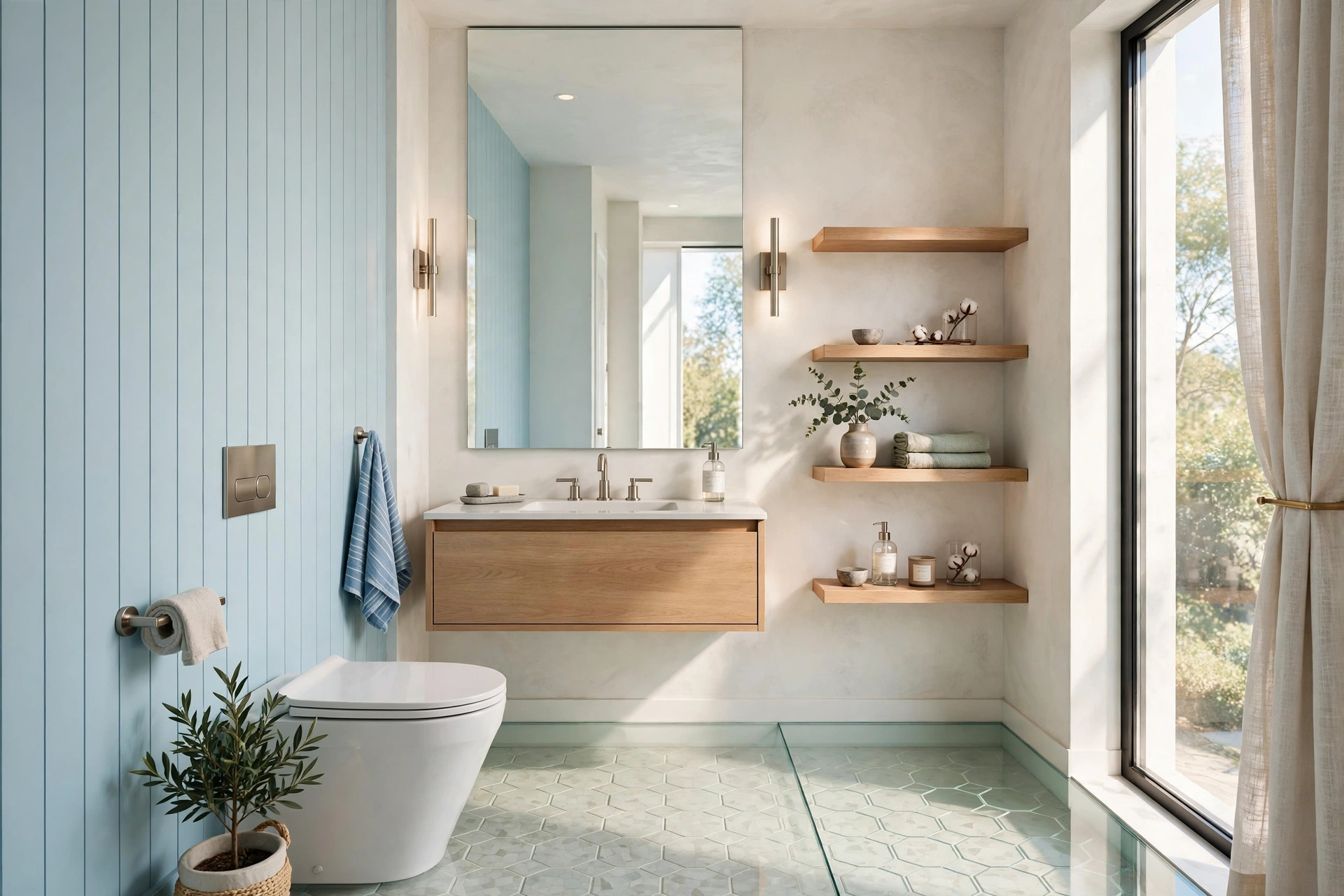
The more uninterrupted floor the eye can see, the bigger the room registers — that is the whole game. Wall-mounted shelves, floating nightstands, and a floating vanity in the bathroom all free the floor beneath them, and that visible stretch of floor reads as extra square footage. A wall-hung vanity can make a compact bathroom feel twice as open without moving a single wall.
The trick only works if the revealed floor stays clear, so resist turning the space under a floating shelf into a dust-collecting storage zone. One floating shelf styled with breathing room beats three crammed ones; negative space is the entire point. Mount floating nightstands at mattress height so they function exactly like their floor-standing cousins, and keep cables clipped and hidden so the floating effect stays clean.
💡 Pro Tip: In the bathroom, a floating vanity plus a large mirror above it is the highest-leverage small-bathroom move there is — you gain visible floor, reflected light, and hidden plumbing in one change, all without touching the tile.
7. Trade Heavy Curtains for Inside-Mount Roller Shades
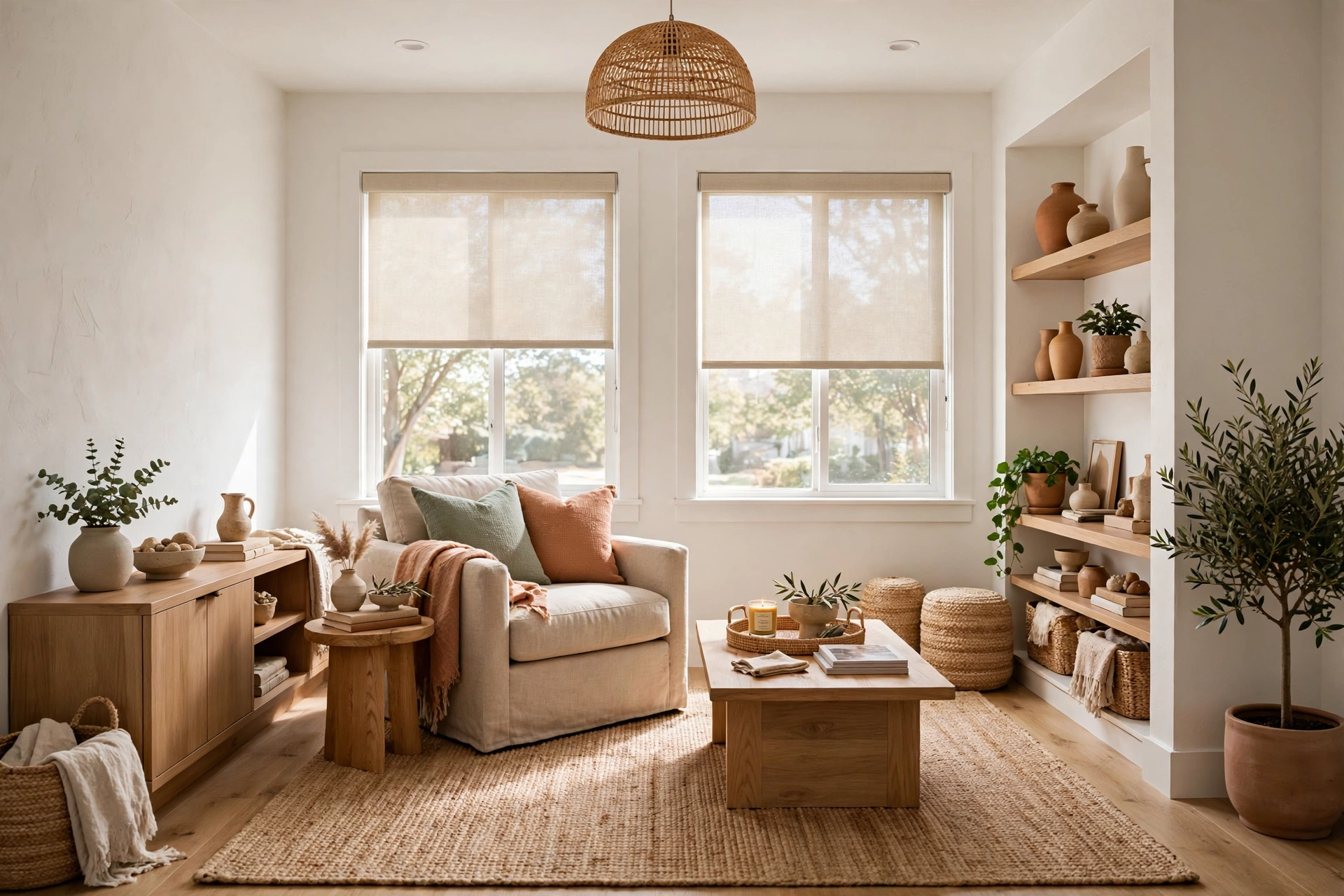
Curtains — even open ones — stack fabric over the wall beside the window, narrowing the glass and eating several inches of wall on each side. An inside-mount roller or Roman shade sits within the window frame itself, leaving the full glass exposed and the wall perfectly clean. The window reads larger, daylight reaches deeper into the room, and the wall gains visual width exactly where the eye expects the room to end.
Choose the shade in a tone close to the wall so the window blends into the architecture instead of punching a dark rectangle in it. Light-filtering fabrics keep daytime privacy without dimming the room, and a top-down/bottom-up style lets you lower the shade from the top for light while keeping the lower half private. It is a particularly strong move in bedrooms, where heavy drapes tend to swallow the wall.
💡 Pro Tip: Inside mounts need exact measurements — measure the frame’s width in three places (top, middle, bottom) and use the narrowest, since window frames are rarely perfectly square. Most shade makers cut to the eighth of an inch for a clean inside fit.
8. Keep the Eye-Level Band Calm
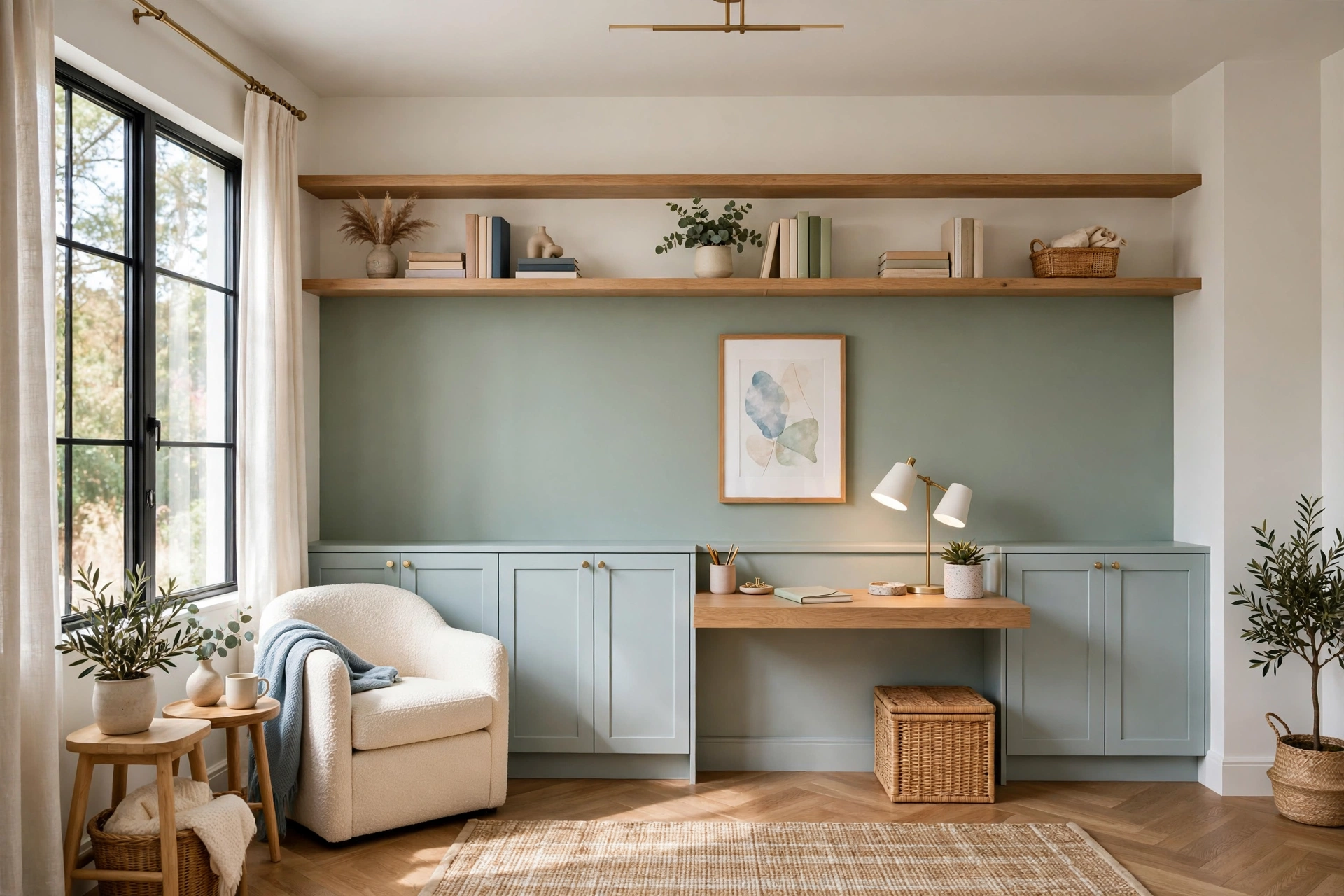
Designers think in horizontal bands, and the one that matters most is standing eye level — roughly three to five feet off the floor, where your gaze naturally scans a room. Clutter concentrated in that band (busy open shelves, tangled cords, stacked boxes, a forest of small objects) reads as chaos, and chaos shrinks a room fast. Push storage above the band onto high shelves and below it into closed cabinets, and keep the middle visually quiet.
This is also the quiet secret behind the best home office organization ideas: a calm eye-level band with supplies stored above and below makes even a desk crammed into a corner feel spacious instead of oppressive. Once the band is calm, a single piece of art or one sculptural plant at eye level becomes a focal point instead of competing with noise for attention.
9. Choose Small-Scale Patterns and Skip Busy Prints
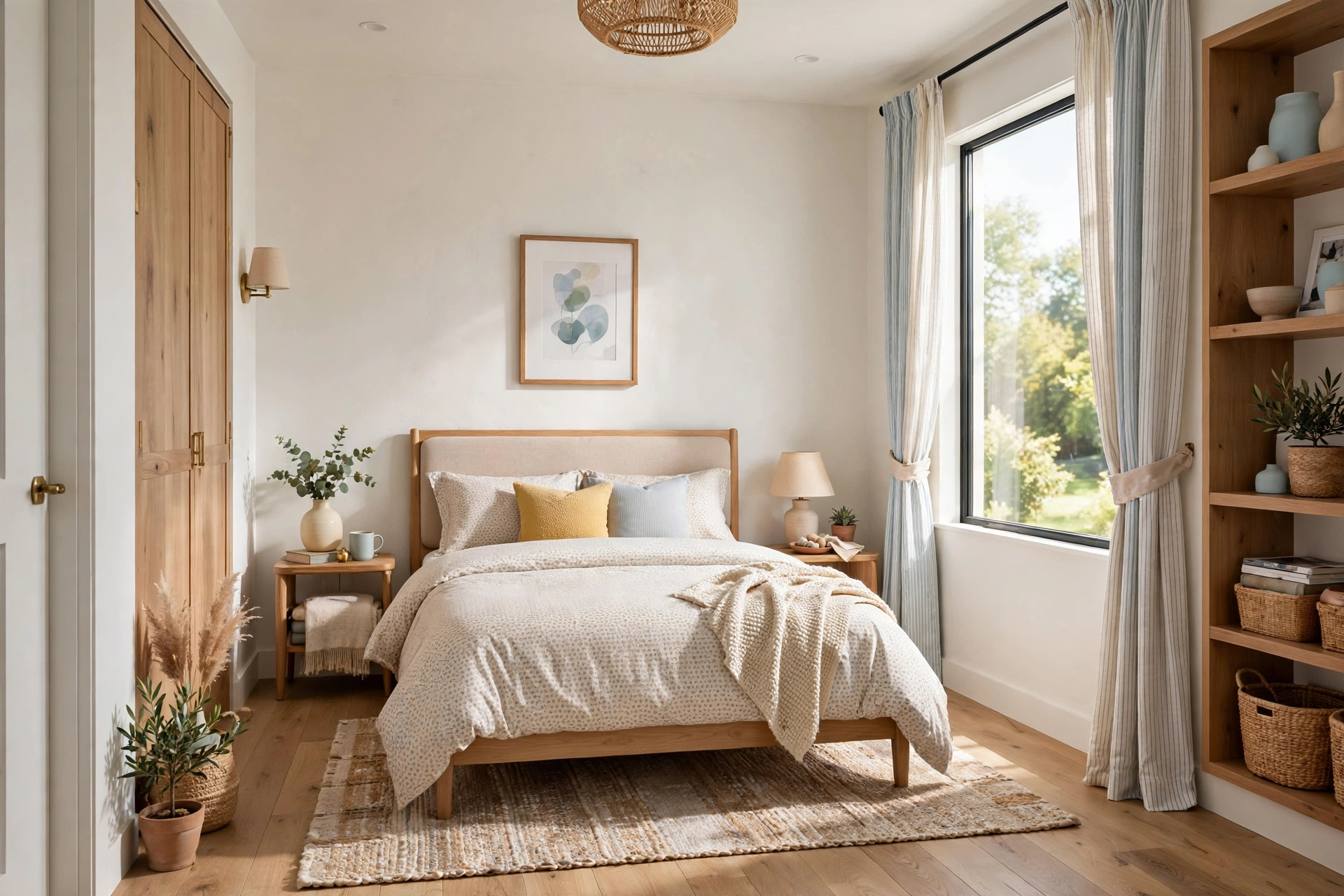
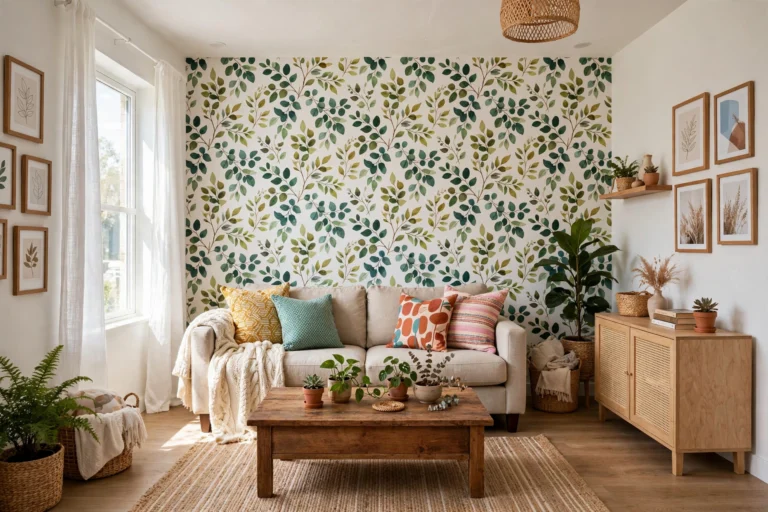
Pattern scale quietly changes perceived size: large, high-contrast prints advance toward the eye and make walls feel closer, while small-scale, low-contrast patterns recede and let the room breathe. In a compact room, choose ditsy florals, fine stripes, pin dots, or subtle geometrics over bold oversized motifs — on bedding, rugs, curtains, and wallpaper alike. The room keeps its character, but the pattern stops pressing in on you.
If you love a big dramatic print, confine it to a single moment — one cushion, one framed print, one lampshade — so it reads as art rather than as the room closing in. Texture can carry the pattern role instead: linen, bouclé, rattan, and woven jute add richness and tactility with almost no visual noise, which is why texture-layered neutrals are the backbone of so many successful small rooms.
10. Stretch Narrow Rooms With Horizontal Lines
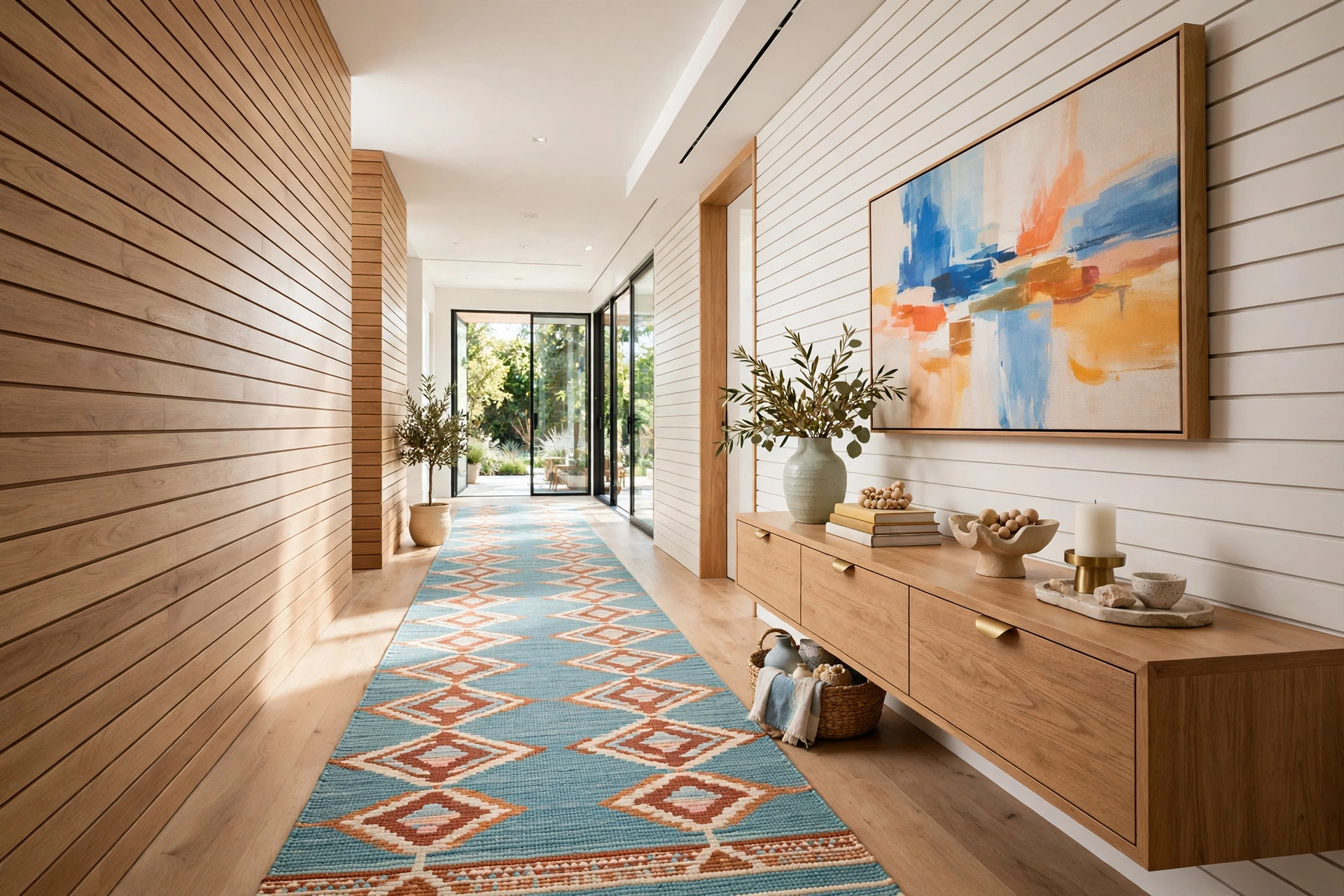
Vertical lines lift a room; horizontal lines widen it. In a narrow bedroom, hallway, or galley kitchen, emphasize the lateral: a long low dresser instead of a tall chest, a wide piece of art hung low, horizontal shiplap or picture-frame molding running the length of the wall. The eye follows those lateral lines outward, and the room reads wider than its tape-measured width.
Keep the horizontals low and unbroken for the strongest effect — one long console beats three small tables lined up, because every gap between them is a visual stop. In a hallway, a continuous runner paired with a single slim floating shelf at one consistent height can stretch a corridor dramatically, turning a pass-through into a gallery.
11. Wash Dark Corners With Light

Dark corners are where rooms visually end — shadows tell the brain “nothing beyond here,” and the perceived wall moves several feet inward. A small uplight, a picture light, or even a flameless candle-style LED tucked into a dim corner erases that boundary, pushing the room’s perceived edge back out to the real wall. Light the corners and the whole room expands, especially after dark when shadows do their worst.
Use warm bulbs around 2700K so the glow feels like late-afternoon sun rather than a showroom. Slim floor-can uplights, plug-in picture lights, and battery-operated LED pucks need no wiring at all, which keeps this fully renter-friendly. Aim one uplight at the ceiling above your reading chair or beside a tall plant — the lifted glow makes the corner feel taller as well as wider.
💡 Pro Tip: Corners where two walls meet the ceiling are the darkest spots in any room. A single uplight aimed into that junction bounces light off two walls and the ceiling at once — triple the perceived expansion from one small fixture.
12. Let the Window Borrow the Outdoors
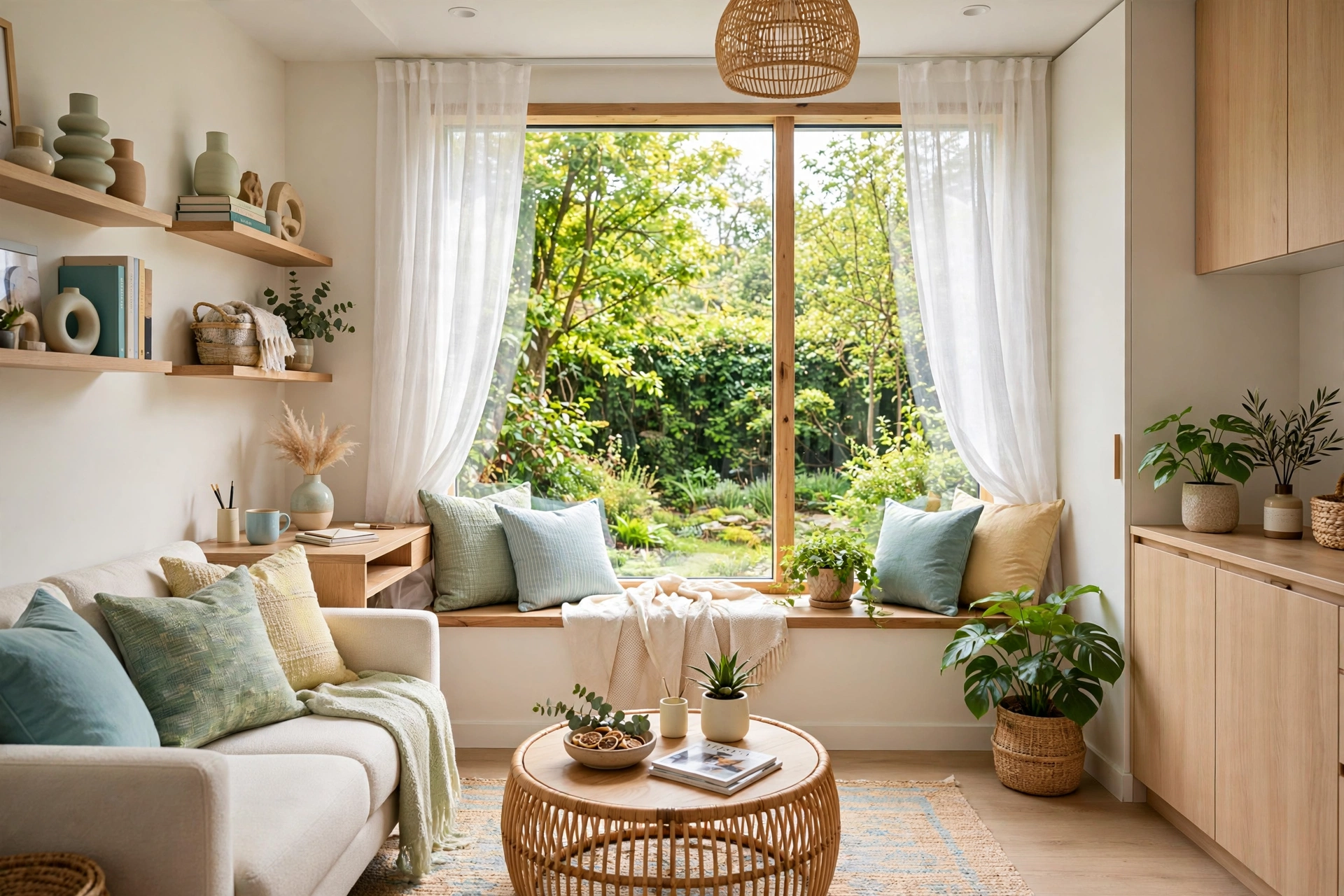
The cheapest square footage you will ever add is the view. When the eye travels past the glass to trees, sky, or a styled balcony, the brain counts that depth as part of the room — designers call it borrowed landscape. Keep sills clear, trim back anything blocking the glass, and style the balcony or patio in your indoor palette so the outdoors reads as one more room of the house.
If the view is a brick wall or an air shaft, borrow light instead of landscape: a sheer shade, a bright curtain in a wall tone, and a healthy plant on the sill turn the window into a glowing panel that still extends the room visually. Either way, never let the window become storage — a sill piled with bottles and boxes ends the room at the glass, which is exactly the wrong place for a boundary.
13. Repeat One Finish on Every Wood and Metal
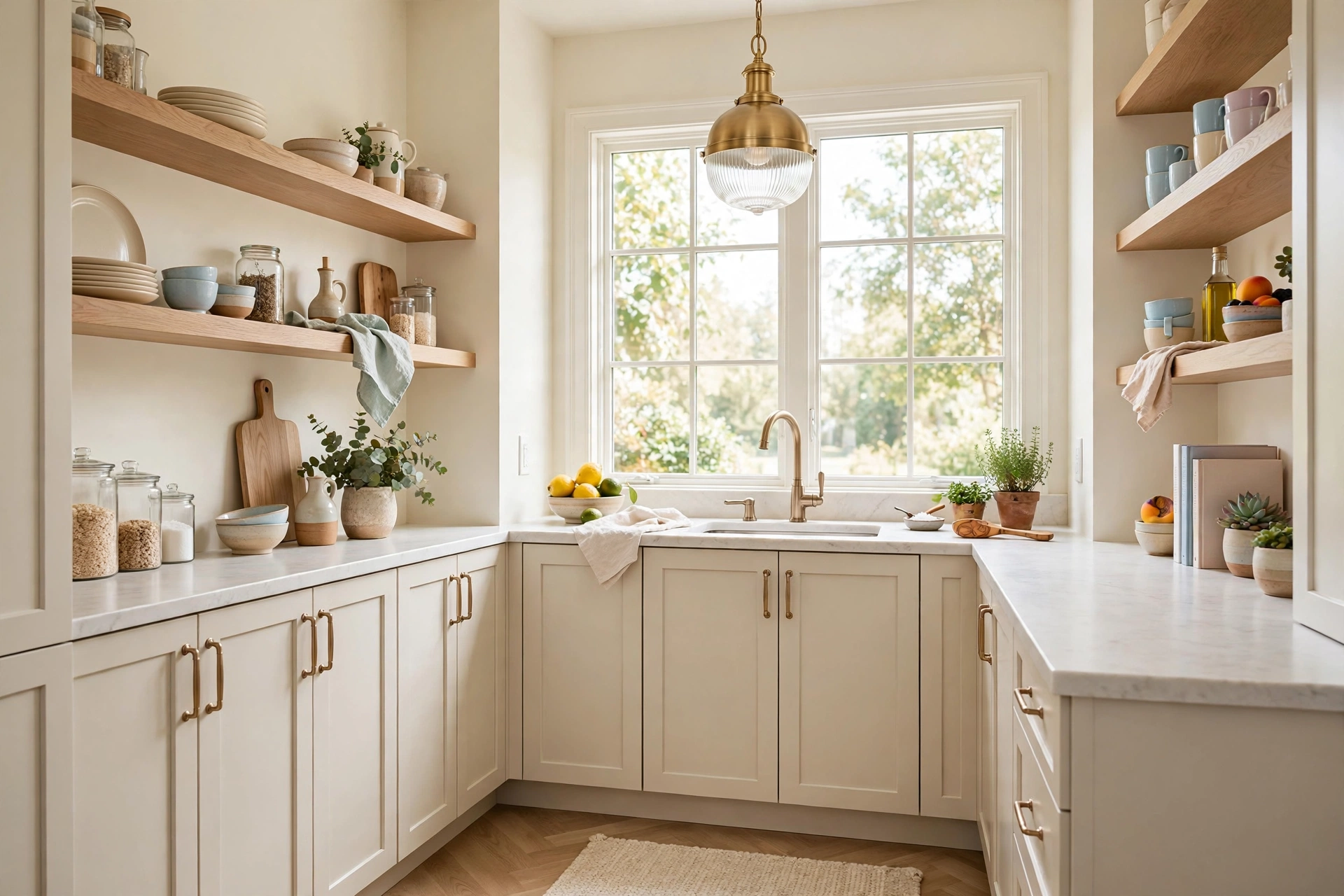
Mixed finishes — oak here, walnut there, chrome beside brass beside matte black — create dozens of tiny micro-contrasts, and each one is a small visual interruption. Choosing one wood tone and one metal finish and repeating them everywhere (cabinet hardware, lighting, mirror frames, furniture legs, curtain rods) removes that chatter, so the room reads as a single calm composition instead of a collection of competing pieces.
The finishes themselves can be anything — warm brass with white oak, or matte black with walnut — consistency is what does the work, not the specific choice. Carry the pairing into adjoining spaces too, so the eye meets the same quiet language from room to room and the whole home feels larger and more considered.
📌 Important: Restraint is what separates intentional from boring here. One repeated metal finish reads as a design decision; five different metals scattered around reads as a hardware-store shelf. When in doubt, edit one finish out rather than adding another in.
14. Hang Art at the End of the Longest Sightline
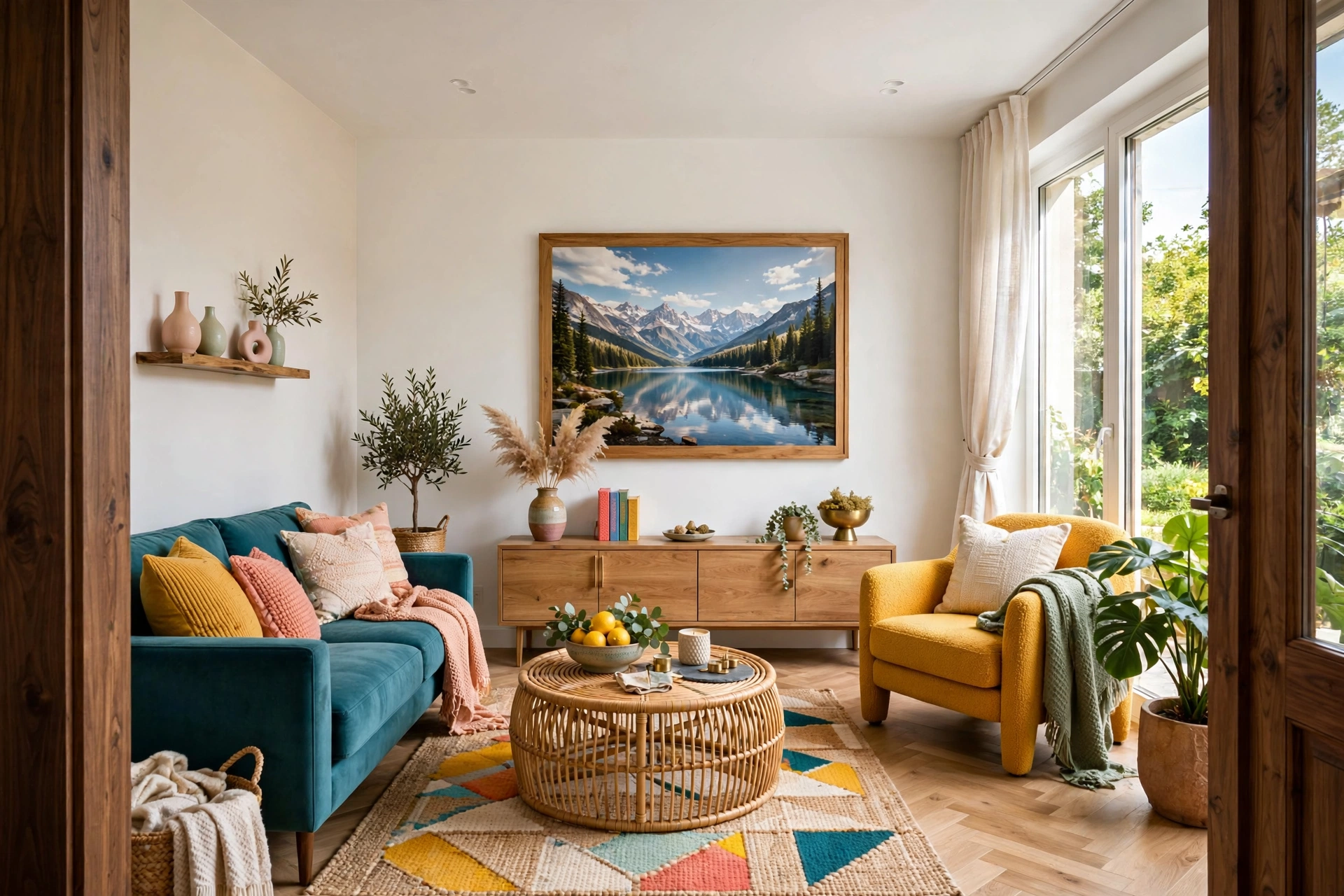
The eye loves a destination. Hanging your strongest piece of art on the far wall — at the end of the longest sightline from the door — pulls the gaze across the entire room, making you experience its full depth every single time you enter. A room the eye travels fully feels substantially larger than one where the gaze stops halfway at a blank wall or a cluttered corner.
Size it generously: in a small room, one substantial piece at the far end beats a scattered cluster, because it gives the eye a single confident landing spot instead of several competing ones. Light it if you can — a small plug-in picture light turns the far wall into a glowing destination after dark, which stretches the perceived depth even further in the evening.
15. Brighten the Ceiling to Lift the Height
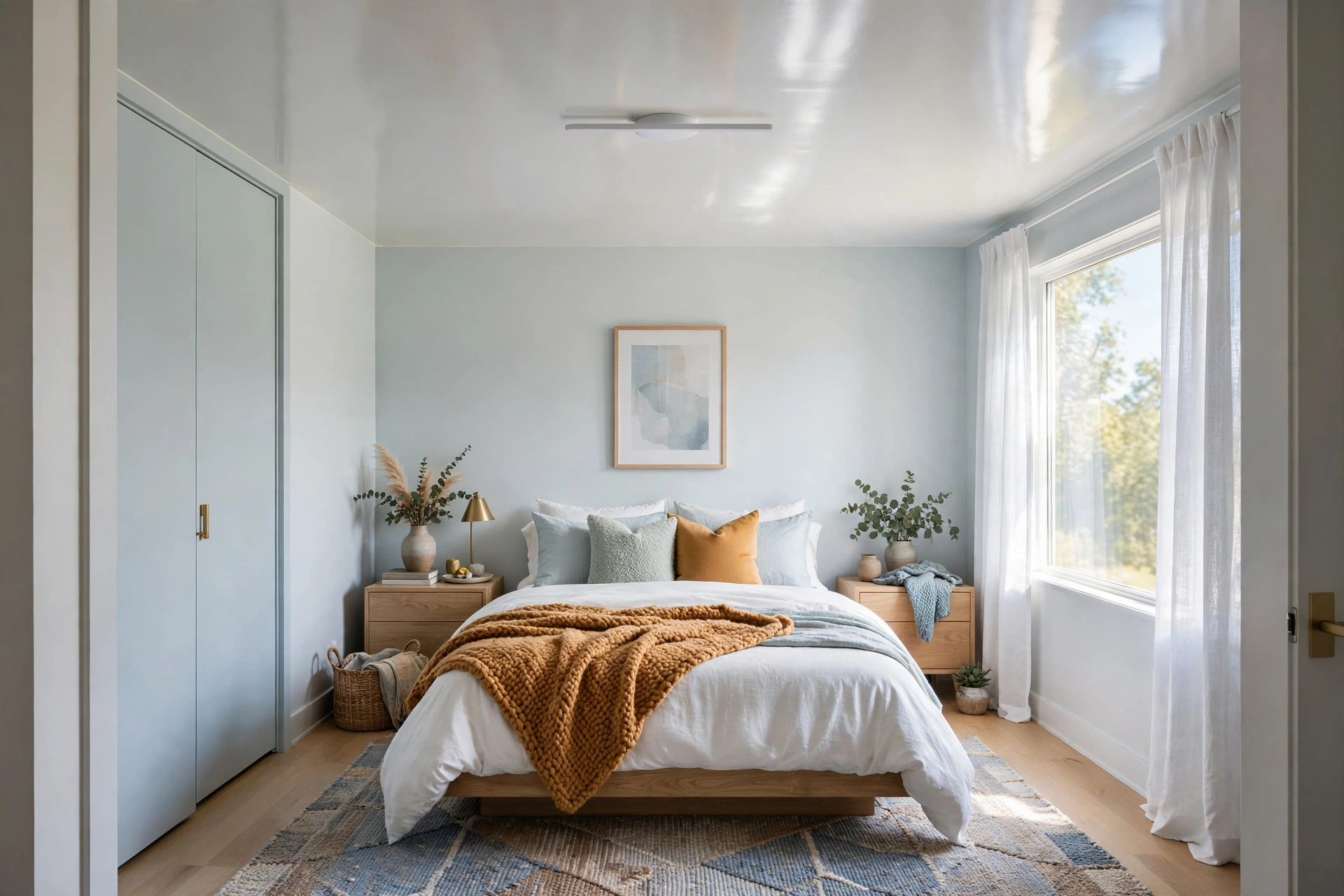
The ceiling is the fifth wall, and in small rooms it is usually the most neglected — dingy, flat, and visually heavy, pressing the whole room down. A fresh coat of bright white, or a whisper-lighter tint of the wall color, bounces light back down into the room and makes the ceiling feel higher. Sheen matters as much as color: flat paint absorbs light while satin or eggshell reflects it, so choose a soft sheen for maximum lift.
For the strongest effect, carry the wall color straight onto the ceiling as in trick one — or paint the ceiling a half-tint lighter so it glows gently above the walls. Keep ceiling fixtures slim and close to the surface; a bulky pendant in a small room hangs the “lid” visibly lower. Flush-mount or recessed lights preserve every inch of perceived height while spreading light evenly.
Quick Comparison: Designer Tricks by Cost and Effort
Small Room Quick-Start Checklist
- ✅ Paint walls, trim, and ceiling in one continuous color to erase boundaries
- ✅ Cover one wall section with floor-to-ceiling mirror to double the depth
- ✅ Float nightstands, shelves, and vanities to reveal more floor
- ✅ Swap heavy curtains for inside-mount shades in a tone close to the walls
- ✅ Keep the eye-level band calm — store high on shelves and low in cabinets
- ✅ Wash dark corners with warm uplighting to push the walls outward
Common Small Room Decorating Mistakes
Mistake 1: Painting the ceiling stark white against colored walls
A brilliant-white ceiling floating above mid-tone walls creates a hard “lid” line that visually lowers the room — the contrast draws a bright frame around the top of every wall. Either color-drench the ceiling in the wall color or choose a half-tint lighter, so the transition melts instead of snapping.
Mistake 2: Scattering lots of small mirrors instead of hanging one big one
A cluster of small mirrors fragments reflections into visual confetti, and each frame adds another boundary for the eye to trip over. One generous mirror — ideally floor-to-ceiling or nearly so — reads as architecture and actually expands the room instead of just decorating it.
Mistake 3: Choosing furniture that contrasts hard with the floor
Dark furniture legs on a pale floor outline every single piece like a diagram, turning each one into a visual roadblock. Tonal furniture that sits quietly against the floor lets the eye glide past, which is why the camouflage trick in this guide matters as much as any layout change.
Mistake 4: Blocking the longest sightline with tall furniture
Placing a tall bookcase or wardrobe on the far wall stops the eye exactly where you most need it to travel. Keep the far wall low and open — a long low console with art above it — so the gaze reaches the room’s full depth every time you walk in.
Mistake 5: Forgetting the ceiling entirely
Dingy, flat, yellowed ceilings press a room down like a weight, yet they are the surface people repaint least. A fresh coat in a bright tone with a soft sheen is one of the cheapest perception upgrades available, and it amplifies every other trick on this list by bouncing more light around.
Frequently Asked Questions
1. What is the fastest way to make a small room look bigger?
Color-drench the walls, trim, and ceiling in one light tone and hang the largest mirror you can fit — those two changes alone transform most rooms in a single weekend. Both work on perception rather than square footage: fewer boundaries for the eye to trip over, and doubled light and depth from the reflection.
2. Do dark colors make a small room look smaller?
Not necessarily — contrast shrinks rooms more than darkness does. A room drenched in one deep, moody color can feel intimate and expansive at once, because the lack of boundaries matters more than the lightness of the paint. What truly closes a room in is high contrast: dark furniture on pale walls, or a white ceiling chopped against colored walls.
3. Where is the best place to put a mirror to make a room look bigger?
On the wall perpendicular to your largest window, in the biggest size you can manage — ideally a floor-to-ceiling section. That position catches daylight and throws it across the room while doubling the perceived depth. Avoid placing mirrors where they reflect clutter, the television, or directly opposite the bed if moving reflections disturb your sleep.
4. What paint color makes a small room look biggest?
Light, warm neutrals — soft white, pale greige, warm beige — reflect the most light, but the specific shade matters less than using it continuously across walls, trim, and ceiling. A mid-tone room with zero contrast lines will feel larger than a white room chopped up by bright-white trim and a stark ceiling.
5. Do vertical stripes really make ceilings look higher?
Yes, but keep them tone-on-tone rather than high contrast. Subtle vertical texture — grasscloth, soft pinstripes, tall bookcases with strong vertical lines — draws the eye upward gently. Bold contrasting stripes add energy but also add visual boundaries, which works against the spacious feeling in a truly small room.
6. How can I make a small bedroom look bigger?
Float the nightstands to reveal floor, choose bedding close to the wall color so the bed recedes, hang one large mirror to double the light, and keep the eye-level band calm with closed storage below and open space above. A small bedroom also benefits enormously from inside-mount shades that leave the full window exposed.
7. Can lighting alone make a small room feel larger?
Significantly, yes. Maximize daylight first — clean glass, sheer coverings, no furniture blocking windows — then layer warm light at several heights and wash the dark corners with uplights so no shadow tells the brain the room ends early. A well-lit small room consistently feels larger than a bigger room left dim.
Conclusion
Every trick in this guide works on the same principle: rooms feel as big as the eye is allowed to travel. Erase the boundaries — between wall and ceiling, between indoors and out, between one flooring and the next — and the brain simply stops registering where the small room ends. None of it requires more square footage, and most of it requires nothing more than paint, placement, and the discipline to edit.
Start with the one weekend project that addresses your room’s worst problem: color-drench a boxy room, mirror a dark one, or float the furniture in a cluttered one. Live with that change for a week before adding the next layer — you will be surprised how rarely you need the full fifteen. Small rooms do not need to feel small; they just need someone to design what the eye sees.