Bedroom Decorating 101: How to Start When Your Room Feels Hopeless
Introduction
Every beautifully decorated bedroom you’ve ever admired started exactly where you are now: with a room that felt hopeless. Maybe the walls are bare and the furniture is mismatched. Maybe it doubled as storage for years and never quite recovered. Whatever brought you here, that sinking feeling you get when you walk in the door is not a sign you lack taste — it’s a sign the room has never been given a chance.
Bedroom decorating for beginners doesn’t start with a design degree or a big budget. It starts with a sequence — a small set of decisions made in the right order, each one building on the last. Most “hopeless” bedrooms aren’t actually hard to fix. They’re just stuck at step zero, where every problem is visible at once and none of them seem solvable. Break the project into pieces, and the room stops feeling like a disaster and starts feeling like a puzzle you can actually finish.
This guide walks you through the entire process in the order that works: what to clear first, what to decide before you spend a dollar, how to build a bedroom that feels calm and personal instead of chaotic. Follow the steps as they’re written, and by the end you’ll have a room that finally feels like yours.
1. Start With a Ruthless Declutter — Not a Decor Store Run
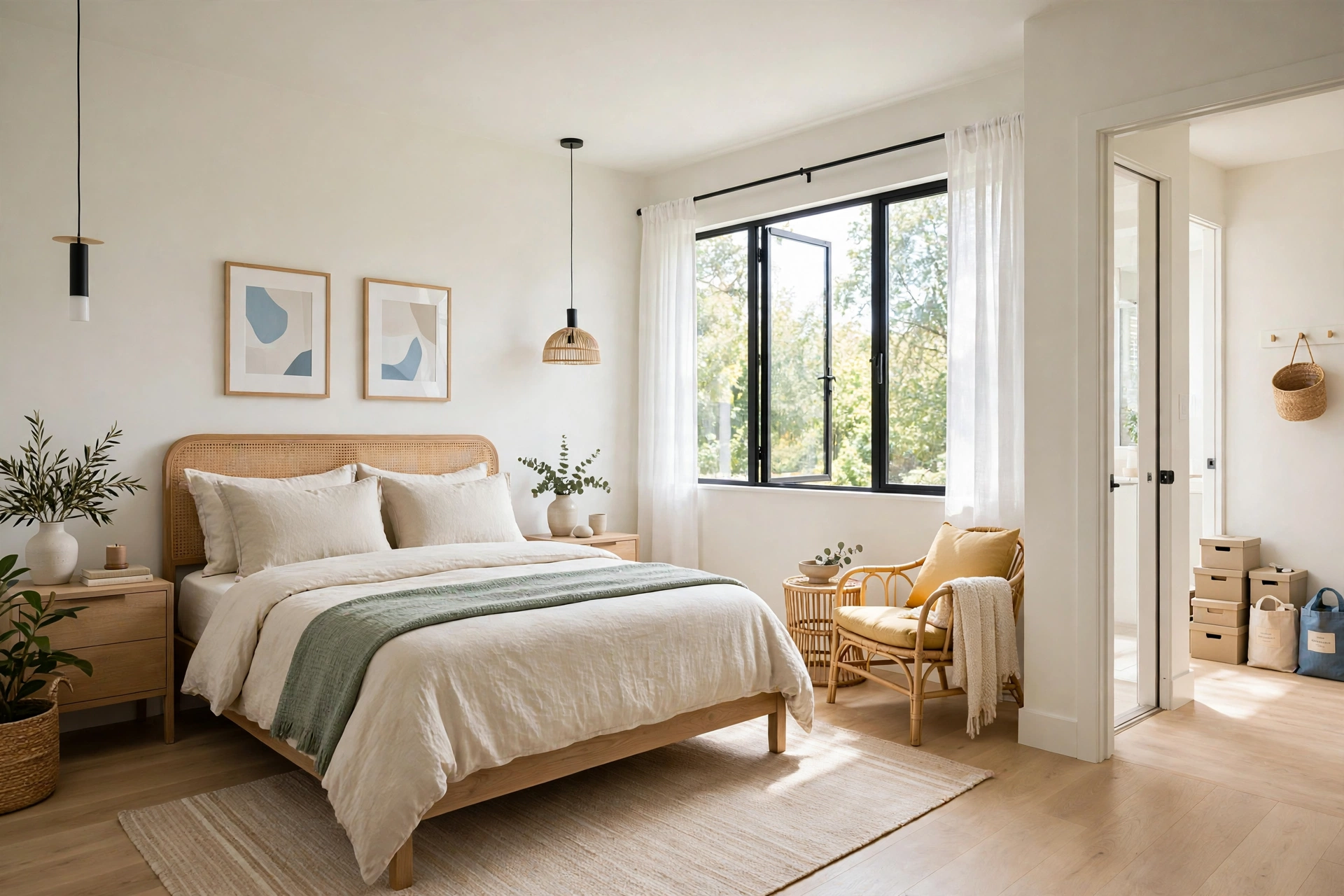
The single biggest mistake beginners make is shopping before clearing. Decorating around clutter is like painting a wall without cleaning it — the new layer never sticks. So the very first step of bedroom decorating for beginners is the least glamorous one: pull everything out of your room that doesn’t belong there. The laundry pile, the box of cables, the chair that’s really a wardrobe — all of it goes.
Then declutter what stays. Be honest about the broken lamp, the nightstand you hate, the bedding that’s gone gray. A room feels hopeless mostly because it’s holding onto things that carry no energy and serve no purpose. Aim for emptier than feels comfortable; you can always bring things back, but you can never decorate your way around visual noise.
💡 Pro Tip: Give yourself one afternoon and one box per category (toss, donate, relocate). Don’t reorganize — remove. A bedroom with three things in it feels more finished than a cluttered one with thirty.
2. Define What “Better” Actually Looks Like

Before you buy a single thing, you need a destination. “I want it to look better” is not a plan — it’s a wish. A real plan sounds like: calm and airy with warm wood tones, or moody and cozy with deep greens. Collect five to ten photos of bedrooms that make you exhale. Notice the patterns: are the walls light or dark? Is the bedding crisp or rumpled? Is there art, or is it minimal?
Then write three words that describe the feeling you want when you wake up there. Rested. Calm. Energized. Grounded. Those three words become your filter for every decision that follows — every color, fabric, and purchase has to earn its place by supporting them. This one exercise separates beginners who flail from beginners who finish.
3. Build Around the Bed First
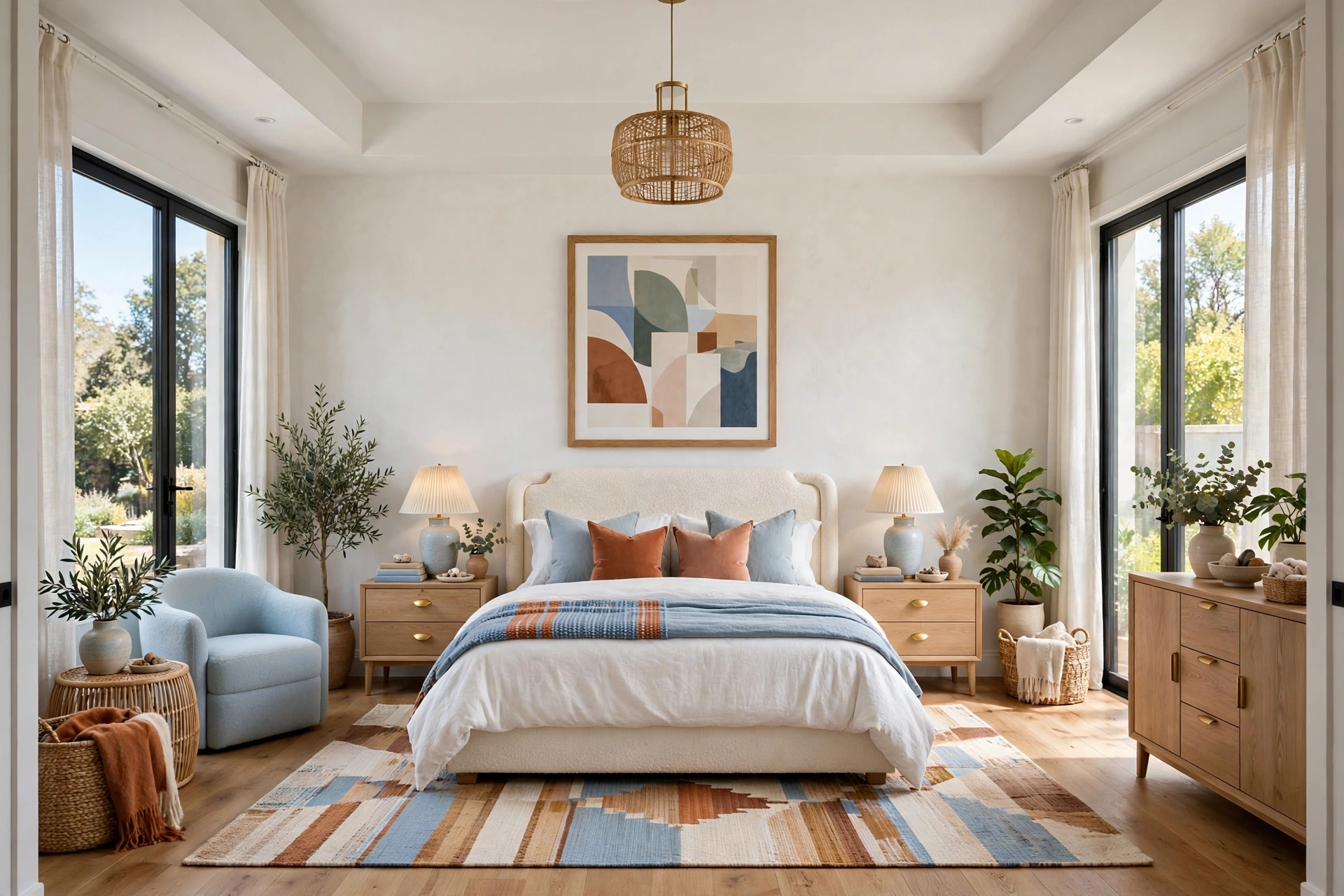
The bed is the sun of your bedroom solar system — roughly 40% of the room’s visual weight — so every decorating plan starts there. Position it first: against a solid wall, centered, ideally facing the door rather than with the door behind your head. Once the bed has its home, the rest of the layout falls into place around it like planets.
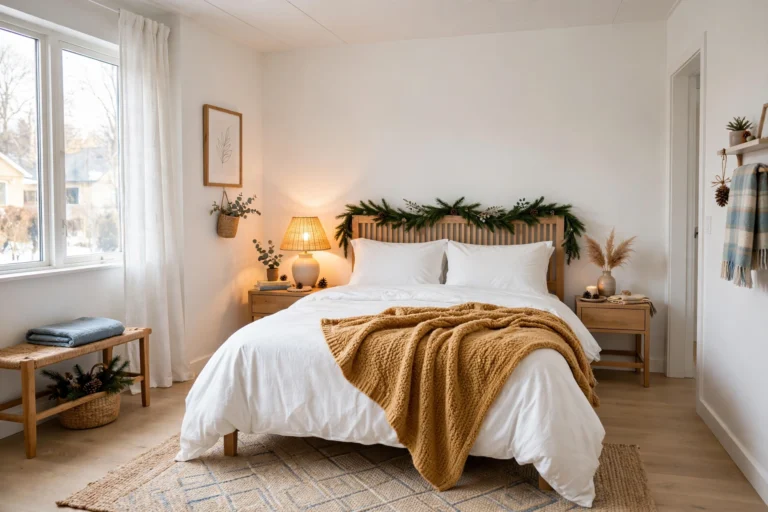
Invest your first real effort in the bed itself, not the walls or the shelves. Fresh bedding in a cohesive palette does more for a hopeless room than any wall art ever will. Get the biggest pillows you can stand (sleeping pillows plus two or three decorative ones), a duvet or quilt with some weight and texture, and a throw folded across the foot. A bed that looks intentional makes the entire room look intentional — even before you’ve done anything else.
Bedroom Decorating Quick-Start Checklist
- ✅ Declutter ruthlessly: remove everything that doesn’t belong in the room
- ✅ Save 5–10 inspiration photos and pick 3 feeling-words for the room
- ✅ Position the bed against a solid wall, centered and facing the door
- ✅ Choose one color story (60-30-10 rule) before buying anything
- ✅ Upgrade the bedding: layered, textured, in your palette
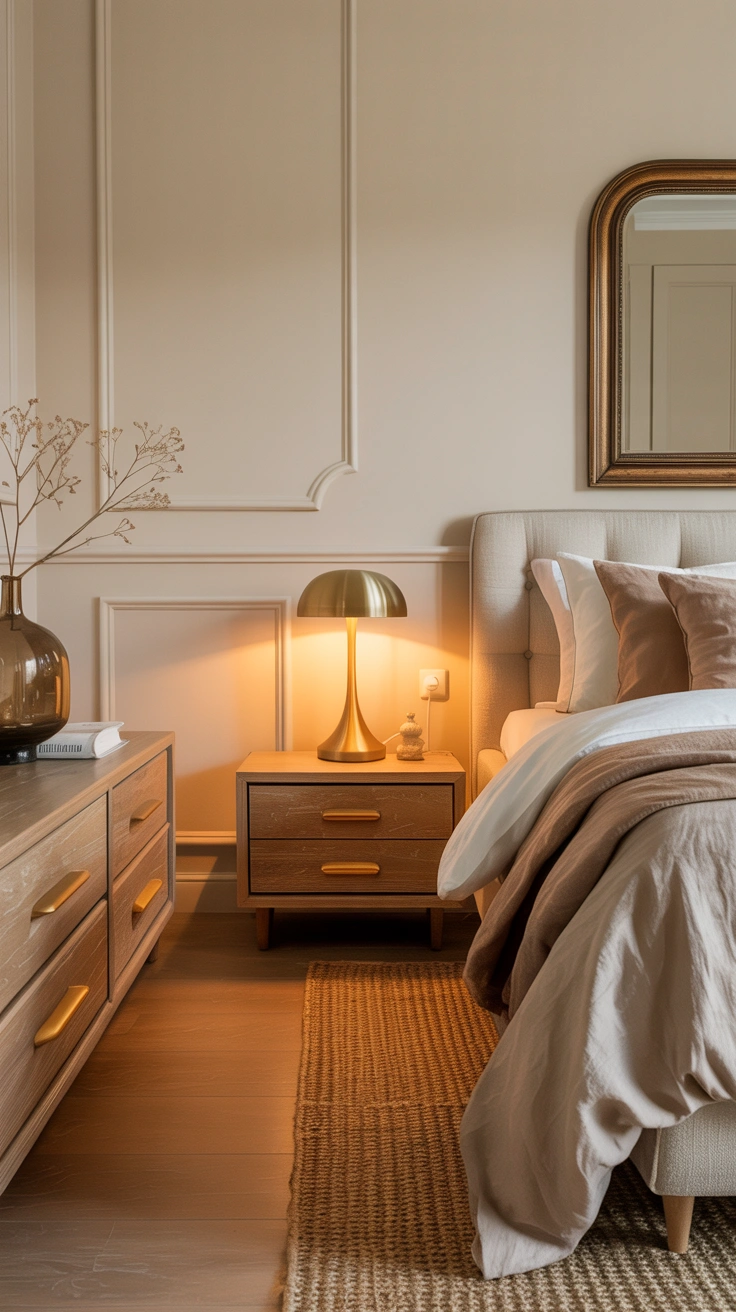
- ✅ Add one warm lamp so the ceiling light isn’t the only option
- ✅ Hang one piece of art or put one plant in the room — proof it’s yours
4. Pick Your One Color Story

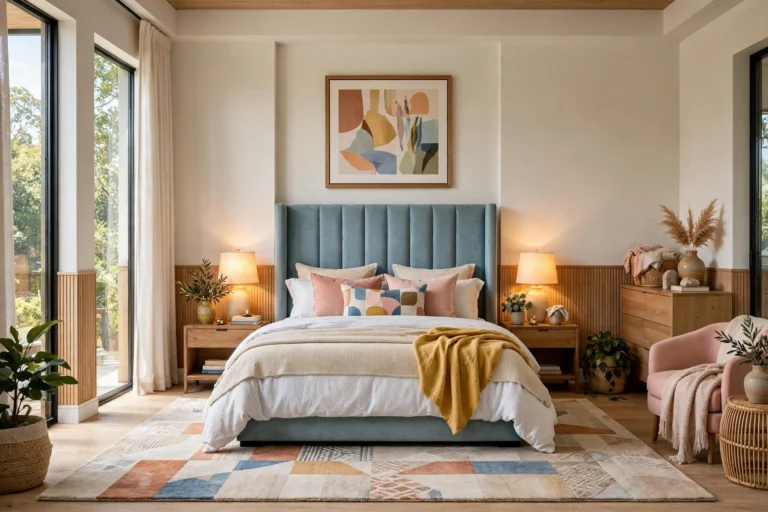
Hopeless rooms almost always share one trait: accidental colors. The gray sheet set, the navy throw, the beige rental walls, the red storage box — none of them chosen together, all of them fighting. Beginners don’t need a design education; they need one decision: a color story, built on the 60-30-10 rule. Sixty percent of the room should be your dominant color (usually walls and large furniture), thirty percent your secondary color (bedding, curtains), and ten percent your accent (throws, art, small decor).
For a first attempt, keep the dominant color light and neutral — warm white, soft greige, pale sage. Neutrals are forgiving: they hide mistakes, make rooms feel bigger, and let you change the mood later by swapping only the accent color. The goal at this stage isn’t boldness. It’s cohesion. If you’d like a simple formula to start from, this color-first framework pairs well with any small space decorating for beginners plan, since it works even when the room is tiny.
5. Add Real Light — Not Just the Ceiling Light
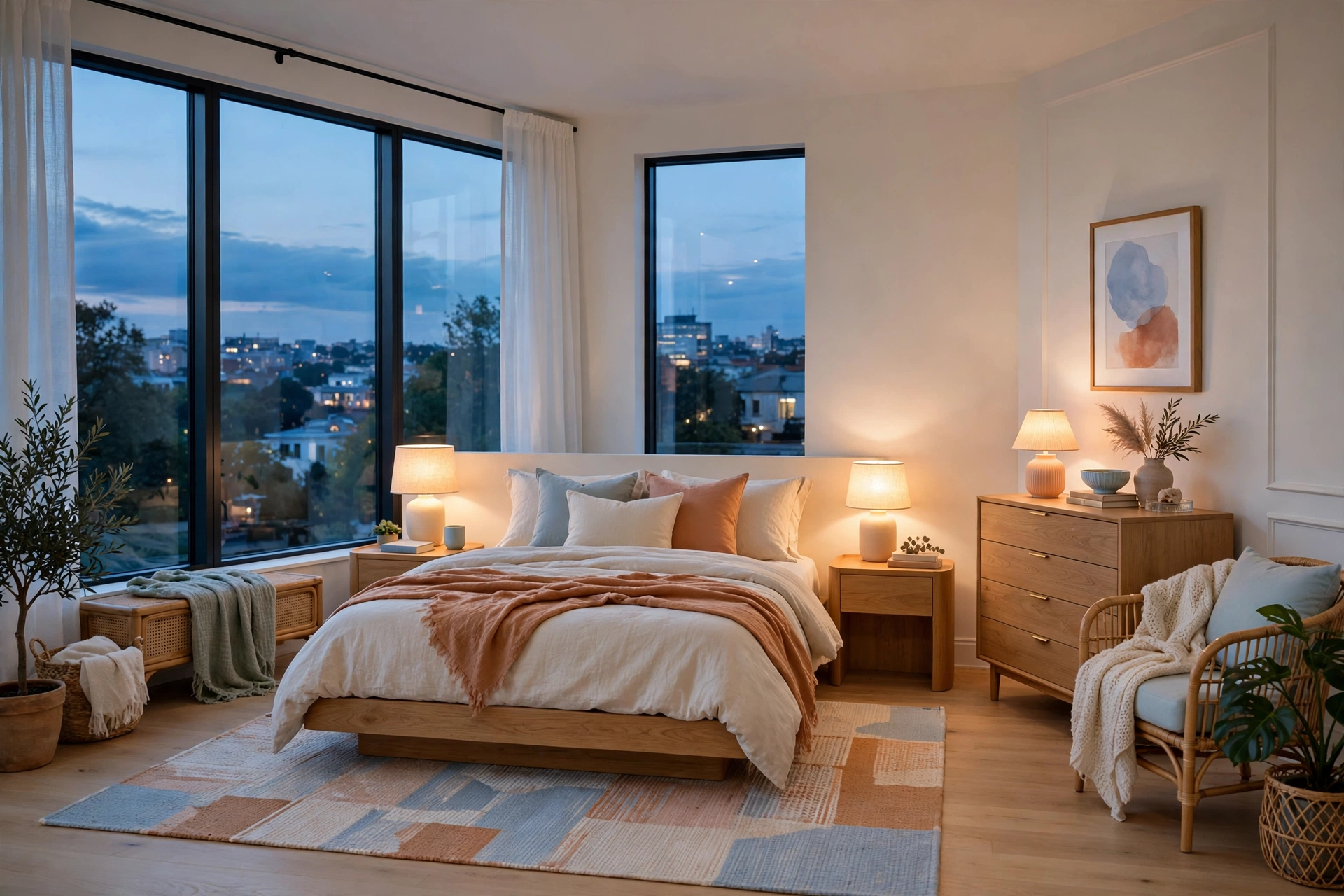
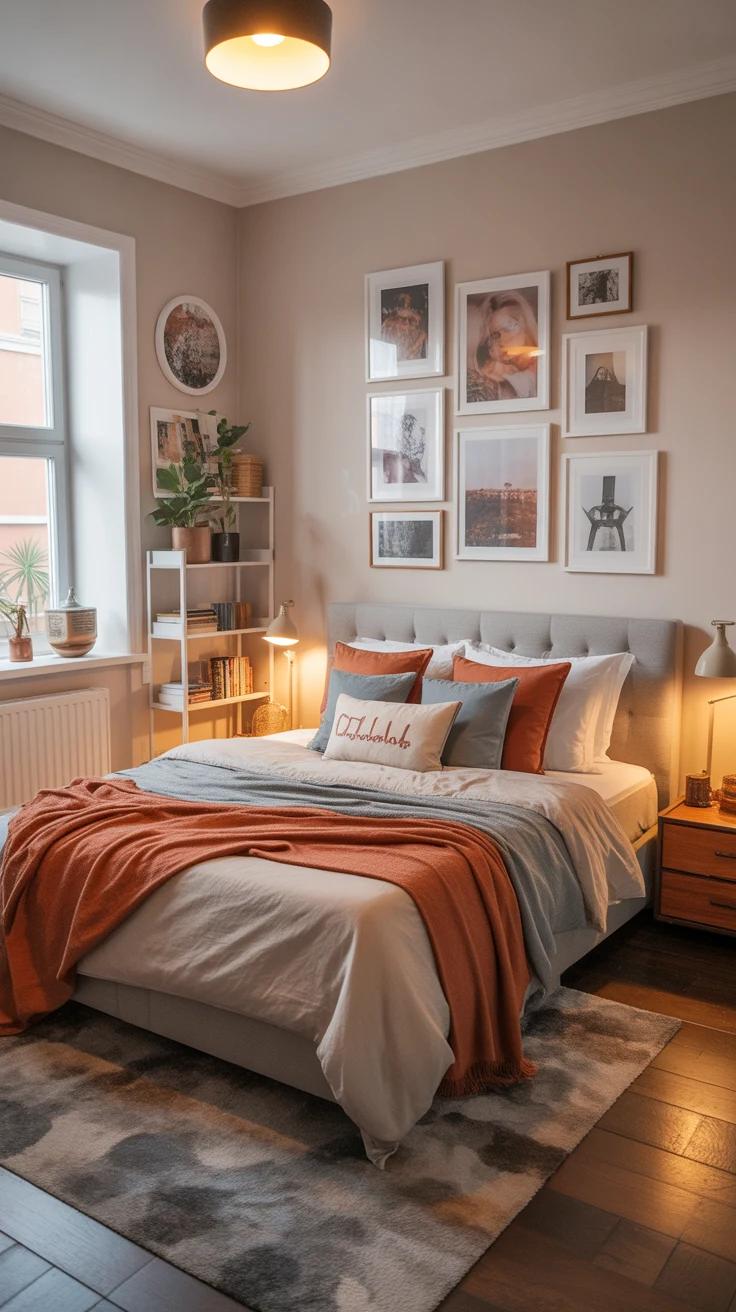
Ask yourself: how many light sources does your bedroom have right now? If the answer is one harsh overhead fixture, you’ve found a major reason the room feels hopeless. No one looks or feels good under a single bare ceiling light, and no room ever will. Beginners should aim for three layers: ambient (a softer ceiling or floor light), task (a reading lamp by the bed), and accent (a warm glow on a dresser, shelf, or in a corner).
You don’t need an electrician or a big budget for this. A pair of bedside lamps with warm-toned bulbs, a small table lamp on the dresser, and maybe a set of string or fairy lights tucked along a shelf will completely change how the room feels after dark. Warm light — around 2700K — flatters everything it touches. Cool white bulbs belong in a dentist’s office, not your bedroom. If the idea of three lighting layers sounds like a lot, start with just the bedside lamps; even one warm lamp takes the edge off that interrogation-room glare. A solid bedroom lighting plan turns even the plainest room into a sanctuary after sunset.
📌 Important: Never judge your room’s progress under the overhead light alone. Turn it off, turn the lamps on, and evaluate from there. You’ll be shocked how different — and how much better — the room looks.
Quick Comparison: Bedroom Decorating Moves by Cost and Effort
6. Dress the Bed Like You Mean It
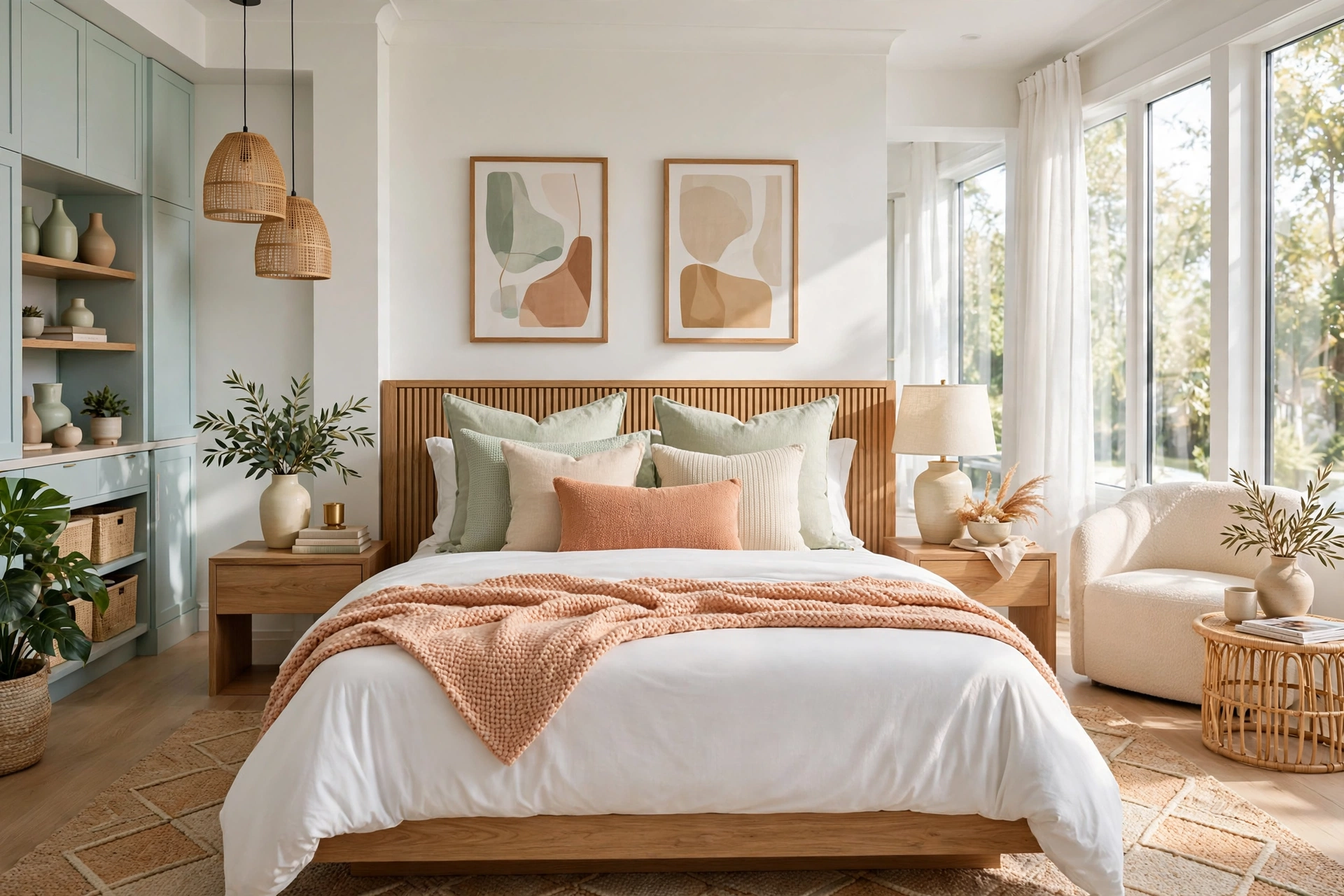
Beginners under-decorate the bed, and it’s the most visible surface in the room. The secret isn’t more pillows — it’s layers. Start with a fitted sheet and flat sheet in a solid color, add a duvet or quilt, then a throw blanket folded across the lower third of the bed, then pillows in descending sizes from back to front: sleeping pillows standing upright, two mid-size shams or euro pillows, then one or two smaller decorative cushions. Each layer adds depth, and depth reads as “designed.”
You don’t need a matching set, which always looks a bit flat anyway. Mix a solid duvet with a subtly patterned throw, or linen sheets with a knitted throw. Just keep every piece inside your color story. And make the bed every morning — seriously. A made bed with layered bedding is the highest-return five minutes in all of bedroom decorating. If you want to take this further, learning to style your bed like a hotel bed will give you the exact folding and layering order professionals use.
7. Fix the Walls (Without Painting, If You’re Renting)
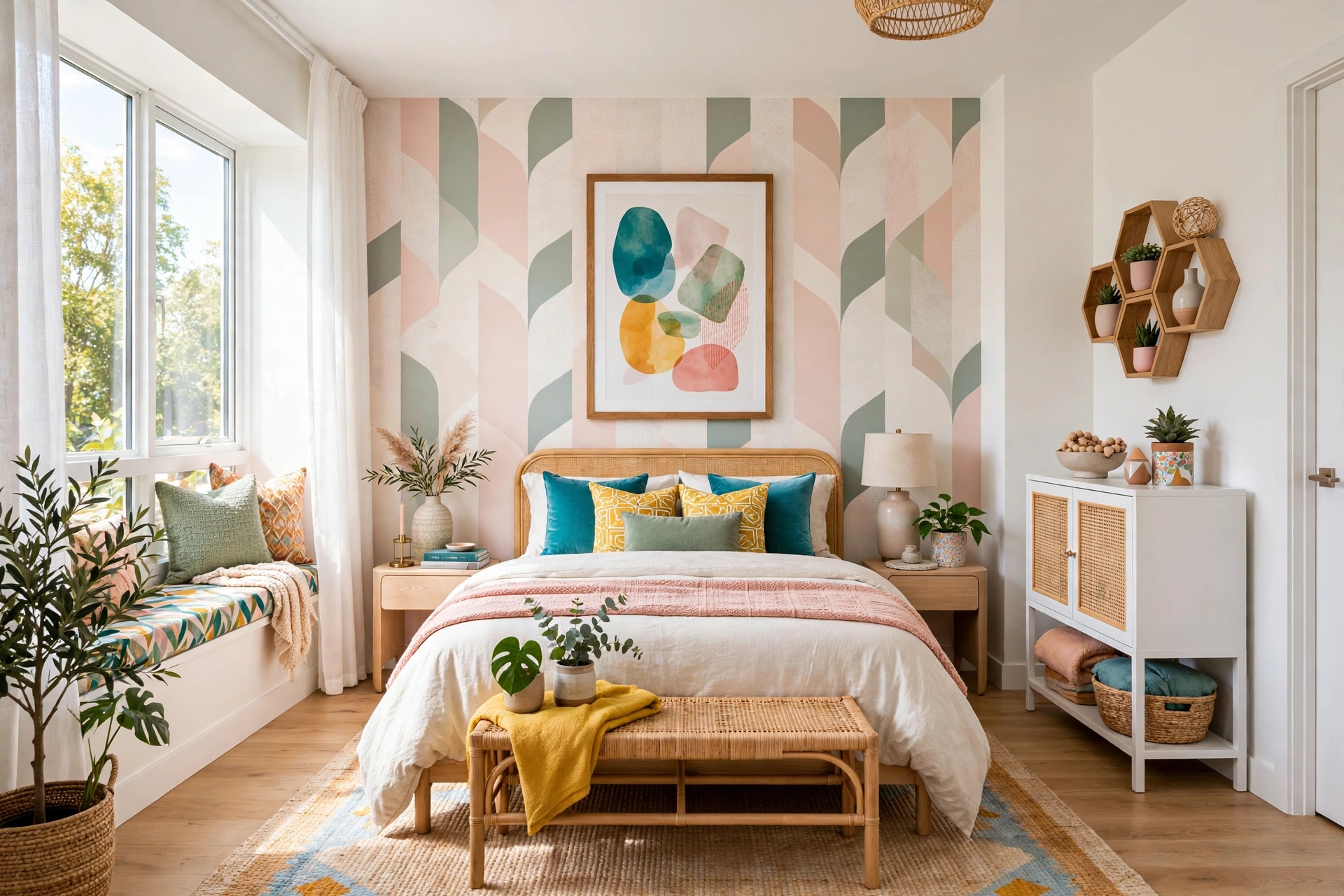
Bare walls are the fastest way to make a bedroom feel unfinished, but painting is neither required nor always allowed. Renters and paint-shy beginners have plenty of options: one large piece of art beats five small ones every time (small pieces scattered around look cluttered, not decorated). A tapestry or fabric wall hanging softens a room and absorbs sound. Removable peel-and-stick wallpaper on one wall gives you the painted look with zero commitment.
The rule of thumb: art should be hung so its center sits at eye level — roughly 57 inches from the floor — and pieces above furniture should span about two-thirds of the furniture’s width. A headboard wall is the natural place for your biggest piece, since the bed already draws the eye there. And hanging bedroom wall decor correctly matters more than the art itself — perfectly hung inexpensive art beats crooked expensive art every single time.
8. Master the Small Bedroom Layout

If your bedroom is small, the layout does the decorating work for you — or against you. The classic beginner error is pushing every piece of furniture flat against the walls, which leaves a dead zone in the middle and makes the room feel smaller than it is. Instead, pull the nightstand slightly away from the wall, angle a small chair in a corner, and let pieces breathe. Leaving even two inches of space around furniture creates the illusion of air.
Think vertically: tall bookshelves, wall-mounted nightstands, and hooks on the back of the door store more while eating zero floor space. Under-bed storage boxes hide the chaos. And mirrors — placed opposite a window or beside the bed — bounce light around and visually double the room’s depth. These layout principles are the same ones behind the best small bedroom makeover strategies, and they cost nothing to apply.
9. Add Texture You Can Touch
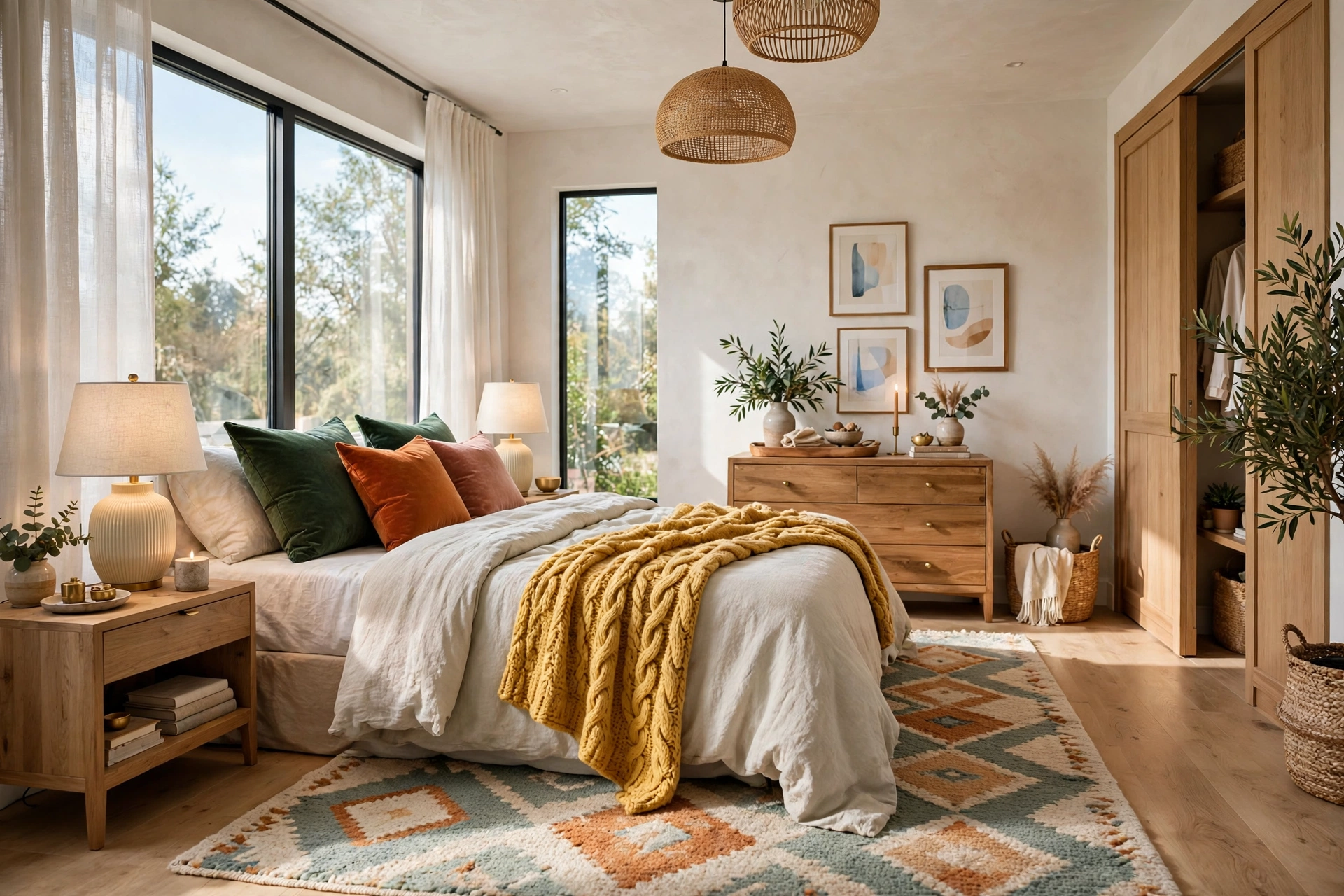
Beginner bedrooms often look “fine” but feel flat, and the missing ingredient is texture. A room with only smooth surfaces — flat bedding, bare walls, hard floors — reads as unfinished no matter how well the colors match. Add things with tactile variety: a chunky knit throw, a linen duvet cover, a jute or wool rug, velvet or bouclé cushions, a wooden tray on the dresser.
Texture is what makes a bedroom feel cozy instead of just decorated — it’s the difference between a showroom and a home. You don’t need much: three to four textured pieces spread around the room is enough. Run your hand over potential purchases and ask whether your fingertips are interested. If everything in the room feels the same to the touch, add something with grain, weave, or pile.
⚠️ Warning: Texture multiplies visually, not just physically. A patterned rug plus patterned bedding plus a patterned throw in one small bedroom will feel busy, not cozy. Pair one bold texture with quieter ones.
10. Layer a Rug (Even in a Small Bedroom)

A bedroom without a rug always feels slightly unfinished — hard flooring underfoot first thing in the morning kills the cozy factor instantly. Even in a small bedroom, a rug works: it just needs to be the right size. The classic rule is that the rug should extend at least 18–24 inches beyond the sides of the bed, so your feet land on softness instead of cold floor.
If a full under-bed rug is out of budget, runners on each side of the bed give you 80% of the effect for a fraction of the cost. Layering works too: a large natural-fiber rug (jute or sisal) as the base with a smaller soft wool or cotton rug on top looks designer-level and feels amazing. Keep the rug inside your color story, and skip tiny rugs that float in the middle of the floor — a too-small rug shrinks the room visually.
11. Style Your Nightstand — Both of Them
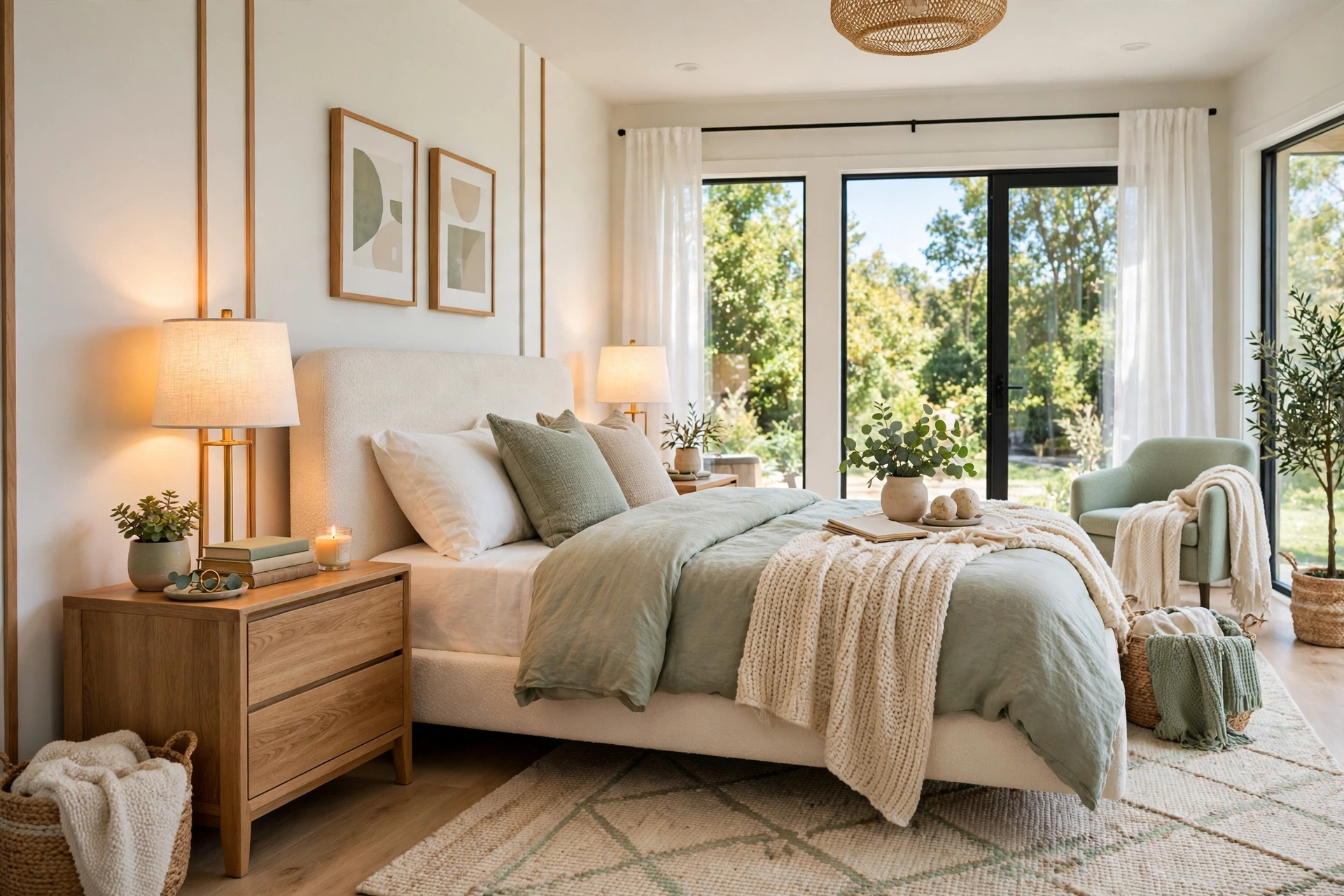
The nightstand is the most personal square foot in your bedroom, and beginners either leave it bare or pile it with clutter. The formula is simple: a lamp, something to drink from, something to read, and one small beautiful thing. That last item — a tiny plant, a candle, a framed photo — is what makes it feel styled rather than just functional.
If you only have room for one nightstand, that’s fine, but use both sides of the bed if you can. Symmetry is a beginner’s best friend: matching lamps and matching nightstands create instant order, which is exactly what a hopeless-feeling room needs. Clear off anything that isn’t in the formula. Your phone charger does not need to be visible, and the stack of mail can live somewhere else.
12. Curtains: The Cheapest Room Transformer

Curtains are the single most underrated move in bedroom decorating for beginners. The difference between bare windows and properly hung curtains is the difference between a dorm room and a grown-up bedroom — and it costs less than almost any other change on this list. The trick is in the hanging: mount the rod 4–6 inches above the window frame and 3–4 inches wider on each side, and let the panels fall all the way to the floor (or just kiss it).
This high-and-wide trick makes windows look bigger and ceilings look taller, which makes the whole room feel grander. Skip short cafe curtains and anything that stops at the windowsill — they visually chop the wall in half. Linen or linen-look panels in a color close to your walls look expensive and let in soft filtered light. White or off-white curtains are nearly impossible to get wrong.
13. Bring In One Piece of Art That Matters

Decorating advice often says “add art,” which is true but unhelpful. Here’s the beginner version that actually works: bring in one piece that means something to you. A photograph from a trip, a print from an artist you love, a framed piece of your own child’s drawing — anything with a story. Decor without meaning is just stuff; one meaningful piece makes a room feel inhabited.
Large beats small here. One oversized piece over the bed or dresser has more impact than a gallery wall that takes a weekend to plan and never looks quite right. If you go the gallery-wall route later, plan it on the floor first and use paper templates on the wall before hammering anything. But for now, one piece, hung correctly at eye level, is a complete transformation on its own.
💡 Pro Tip: Don’t buy art to match your sofa — buy art you love, then let your accent color borrow from it. The room will feel personal instead of staged, and you’ll never get tired of it.
14. Add Something Alive

Every hopeless bedroom has the same flat, airless quality, and the fastest cure is something alive. A plant is the obvious answer — a snake plant or pothos survives almost anything, including beginners — but fresh flowers, eucalyptus in a vase, or even a bowl of lemons on the dresser all work. Living things add color, shape, and a sense of care that no object can replicate.
If you’ve killed every plant you’ve ever owned, start with the nearly indestructible ones: snake plants, ZZ plants, and pothos tolerate low light and forgotten waterings. One medium plant in a corner and one small one on the nightstand or dresser is plenty. Just avoid fake plants if you can — good ones are expensive, and cheap ones are visibly cheap. A living plant signals that someone tends this room, which is the whole point.
15. Edit, Step Back, Repeat
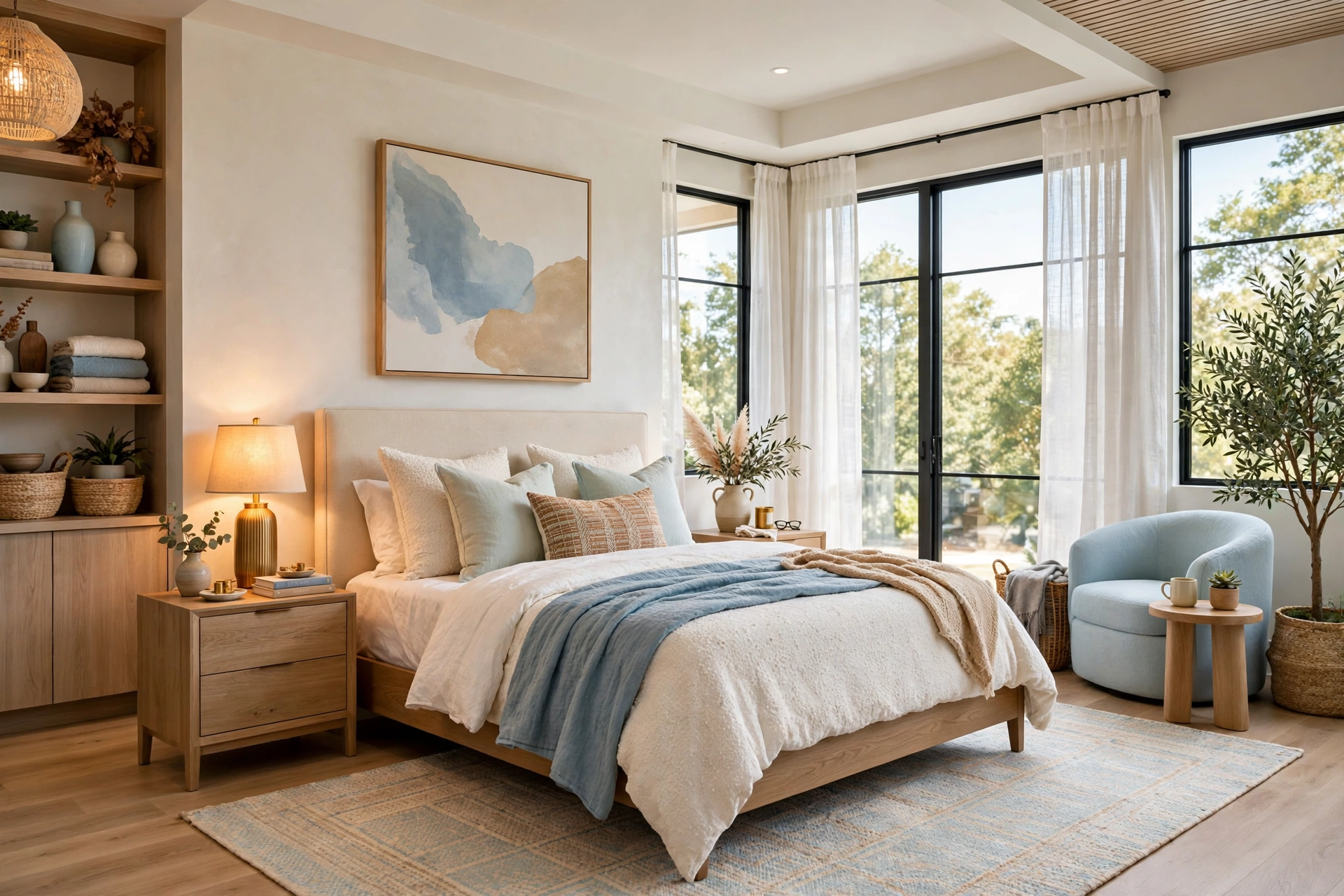
Here’s the step beginners skip: editing. Decorating is a subtractive art as much as an additive one. Once you’ve made your changes, leave the room for an hour, come back, and look at it with fresh eyes — or better, take a photo of the room and study that instead. Cameras are brutally honest: they’ll show you the crooked frame, the cord you stopped noticing, the corner that still feels empty.
Remove one thing before you consider adding anything new. The goal isn’t a room full of decor — it’s a room where everything present is there on purpose. Then live with it for a week before judging. Bedrooms reveal themselves slowly: you’ll notice what you actually reach for, what catches morning light beautifully, and what’s just taking up space. Decorating is a process, not an event, and the edit step is what turns a decorated room into a finished one.
Common Bedroom Decorating Mistakes
Mistake 1: Shopping before you have a plan
The most expensive beginner mistake is buying decor first and figuring out the room later. That cart full of cute things rarely works together, and the returns pile up. Decide your color story and layout before you spend a dollar — the plan is free, and it makes every purchase smarter.
Mistake 2: Pushing all furniture against the walls
It feels like it creates space, but it actually makes a bedroom feel smaller and more rigid. Pull key pieces even slightly away from the walls and use corners for seating or plants. A few inches of breathing room changes the whole feel of the layout.
Mistake 3: Living under one overhead light
A single ceiling light flattens everything and makes the room feel cold. Layer at least two or three warm light sources — bedside lamps plus something on the dresser or in a corner. Your room will look better and you’ll sleep better too.
Mistake 4: Hanging art too high
The number-one art mistake is hanging pieces so high they float near the ceiling. Center artwork at eye level, about 57 inches from the floor, and keep pieces above furniture close to the furniture. Properly hung art at any price beats expensive art hung wrong.
Mistake 5: Choosing a rug that’s too small
A tiny rug floating in the middle of the floor makes a bedroom look smaller and unfinished. Size up: the rug should tuck under the bed and extend well past its sides. When in doubt, go one size bigger than you think you need.
Frequently Asked Questions
1. Where should a beginner start decorating a bedroom?
Start with decluttering, then the bed — its position and its bedding. Those two moves change the room more than anything else. After that, pick your color story before buying anything new, because every later decision depends on it.
2. How can I decorate my bedroom with no money?
Declutter ruthlessly, rearrange the furniture, and deep-clean — all free, all transformative. Then shop your own home: move art, plants, and throws from other rooms. Finally, make the bed properly every day; it’s the cheapest upgrade there is.
3. What is the 60-30-10 rule in bedroom decorating?
It’s a beginner-friendly color formula: 60% of the room in a dominant color (walls, large furniture), 30% in a secondary color (bedding, curtains), and 10% in an accent (throws, art, small decor). It guarantees cohesion without a design degree.
4. How do I make my bedroom feel cozy instead of cold?
Layer textures (knit throws, linen, a soft rug), switch to warm lighting around 2700K, and add something alive like a plant. Coziness comes from tactile variety and warm light, not from more stuff.
5. Should the bed face the door?
Ideally, yes — position the bed against a solid wall where you can see the door without being directly in line with it. This “command position” feels safer and more restful, and it usually gives you the best wall for the bed anyway.
6. How high should I hang curtains?
Mount the rod 4–6 inches above the window frame and extend it 3–4 inches beyond each side. Let the panels fall to the floor. This high-and-wide placement makes windows and ceilings look bigger than they are.
7. What colors make a bedroom feel bigger?
Light, warm neutrals — soft white, warm greige, pale sage — reflect light and recede visually. Keep the palette simple and low-contrast: fewer color changes mean the eye travels further, which the brain reads as more space.
8. How long does it take to decorate a bedroom?
A focused weekend can handle decluttering, rearranging, and the big wins like bedding and lighting. Give yourself two to four weeks total for the slower pieces — art, rugs, the final edit. Don’t rush the edit step; live with the room before calling it done.
Conclusion
A hopeless bedroom is almost never a hopeless cause — it’s just a room where every problem arrived at once and nobody tackled them in order. Start by clearing the noise, decide what “better” means to you, and build outward from the bed. One color story, layered light, honest textures, and a final edit will take you further than any shopping spree.
The room you wake up in sets the tone for everything that follows, so it’s worth getting right. But “right” doesn’t mean perfect, and it definitely doesn’t mean expensive. It means a bed that invites you in, light that flatters instead of interrogates, and a space that finally feels like it belongs to you. Start tonight — even if tonight only means the declutter box. Future you, waking up in a room you actually love, will be glad you did.