15 How To Organize Kitchen Drawers Tips That Make Cooking Actually Enjoyable
Kitchen drawers are where optimism goes to die. You start with good intentions — the spatulas go here, the measuring spoons go there — and within three weeks it has devolved into a situation where finding a can opener requires a full archaeological investigation and a degree of optimism that most mornings simply can’t sustain. Disorganised kitchen drawers don’t just look bad. They actively slow down cooking, create daily low-level frustration, and make the kitchen feel like a room that’s working against you rather than for you. I completely reorganised all twelve of my kitchen drawers over one focused weekend — not just tidied them, genuinely organised them with proper systems — and the change in how the kitchen felt to cook in was immediate and significant. These 15 tips cover everything from the fundamental principles to the specific tools and habits that keep kitchen drawers working beautifully long-term.
1. Empty Everything First
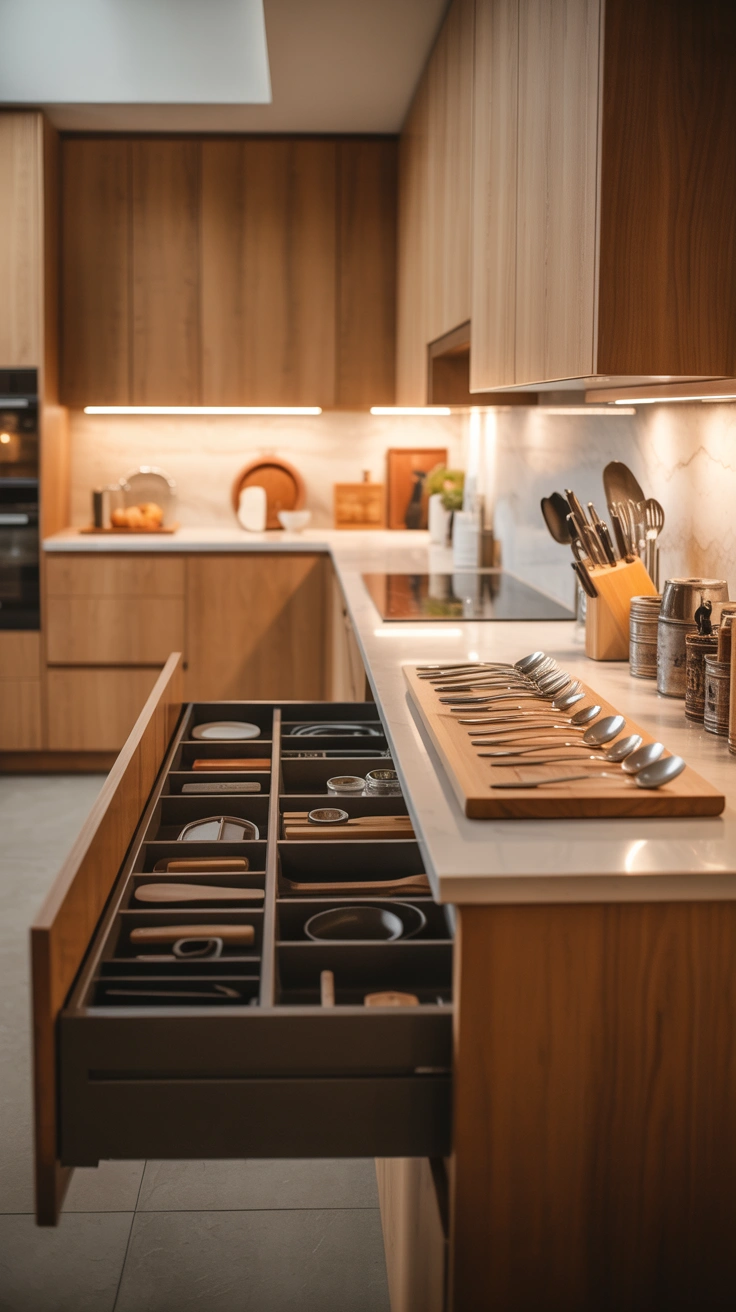
The only way to genuinely organise a kitchen drawer is to start from zero — which means removing absolutely everything from every drawer before making a single decision about where anything should live. Organising around what’s already in the drawers preserves the logic of how things accumulated rather than creating the logic of how they should be used.
Pull everything out onto the counter or the kitchen table. Wipe the empty drawer clean. Now look at what you actually have. This full-contents reveal is usually the moment people realise they own four potato peelers, no less than eight takeaway menus for restaurants that no longer exist, and a collection of mystery keys that have presumably been waiting patiently for their locks to reappear. The empty drawer is the blank canvas. What goes back in should be actively chosen, not passively returned.
2. Purge Before You Organise
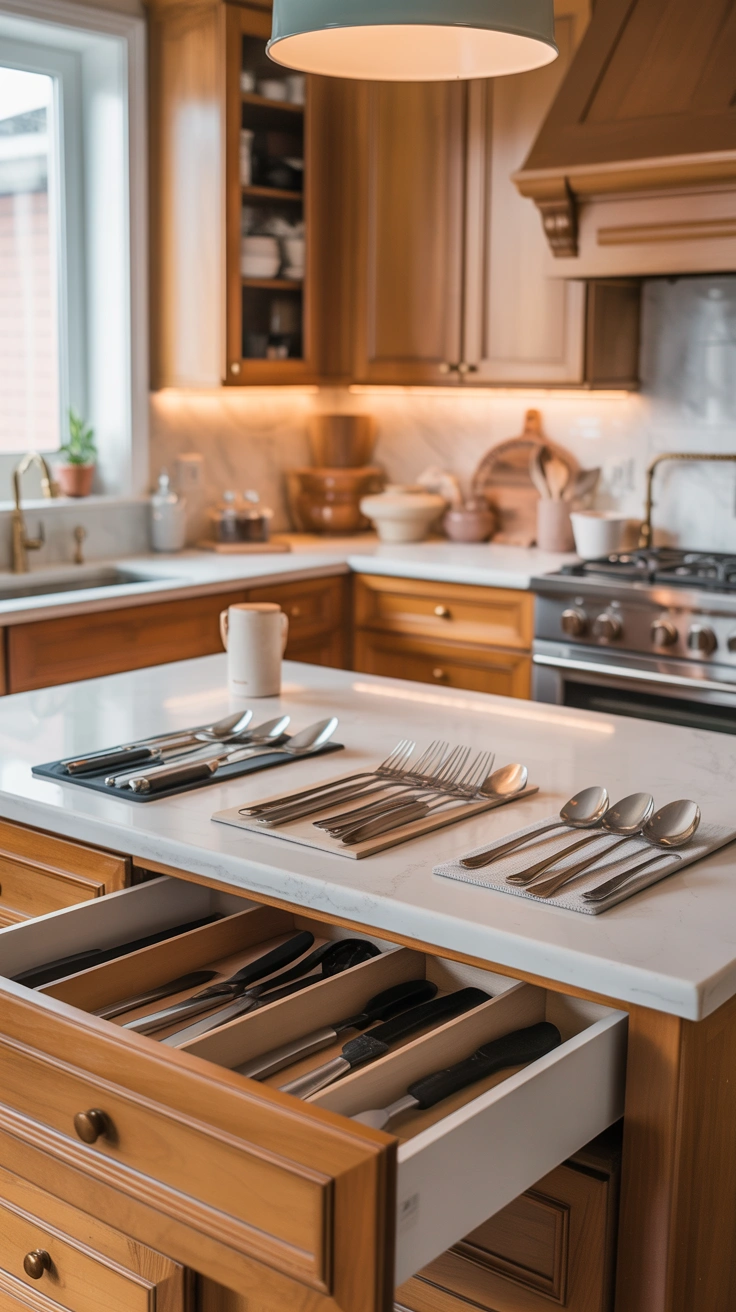
Before anything returns to any drawer, the purge step is the most valuable single action in the entire kitchen drawer organisation process. Organising objects you don’t need is a waste of space, time, and drawer organisers — and it creates systems that immediately feel overcrowded.
Go through everything on the counter and make three honest decisions: keep it, donate or rehome it, or discard it. Keep only what is genuinely used in the kitchen. A kitchen utensil that hasn’t been used in twelve months is not a kitchen utensil — it’s a spatial liability. This step is uncomfortable for about ten minutes and then deeply satisfying. The drawer that returns to service after a genuine purge contains only things you need, which makes every subsequent organisation decision easier.
3. Zone Your Drawers by Function
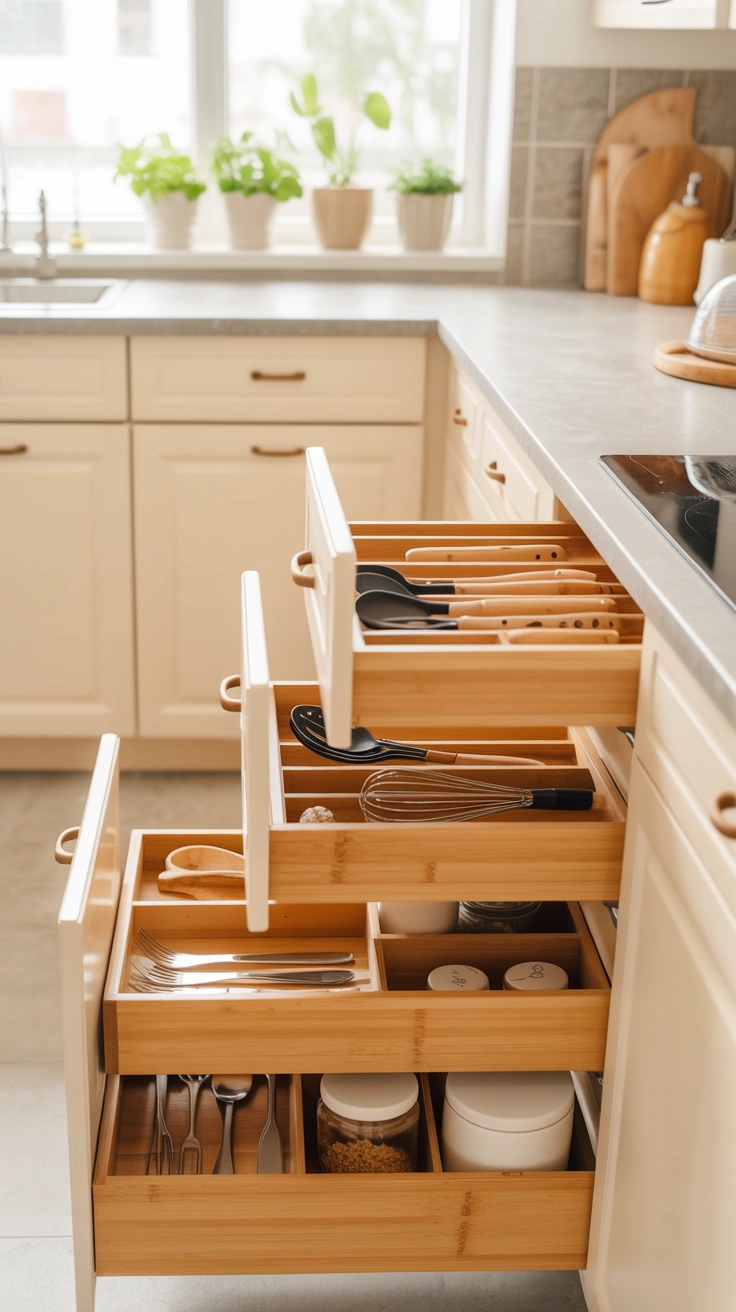
The single most impactful kitchen drawer organisation principle is zoning — assigning each drawer a specific functional category and keeping everything in that category together. When every drawer has a clear purpose and contents that match that purpose, the kitchen becomes intuitive to use rather than requiring active recall of where everything is.
Cooking tools drawer — spatulas, tongs, ladles, spoons. Baking drawer — measuring cups, scales, pastry brushes, piping bags. Cutlery drawer — knives, forks, spoons, serving utensils. Gadgets drawer — peelers, graters, openers, thermometers. Wrap and bag drawer — cling film, foil, baking parchment, sandwich bags. These zone assignments should reflect how you actually cook, not an abstract ideal — and once established, maintaining them is simply a matter of returning things to the right zone after use.
4. Invest in Drawer Dividers
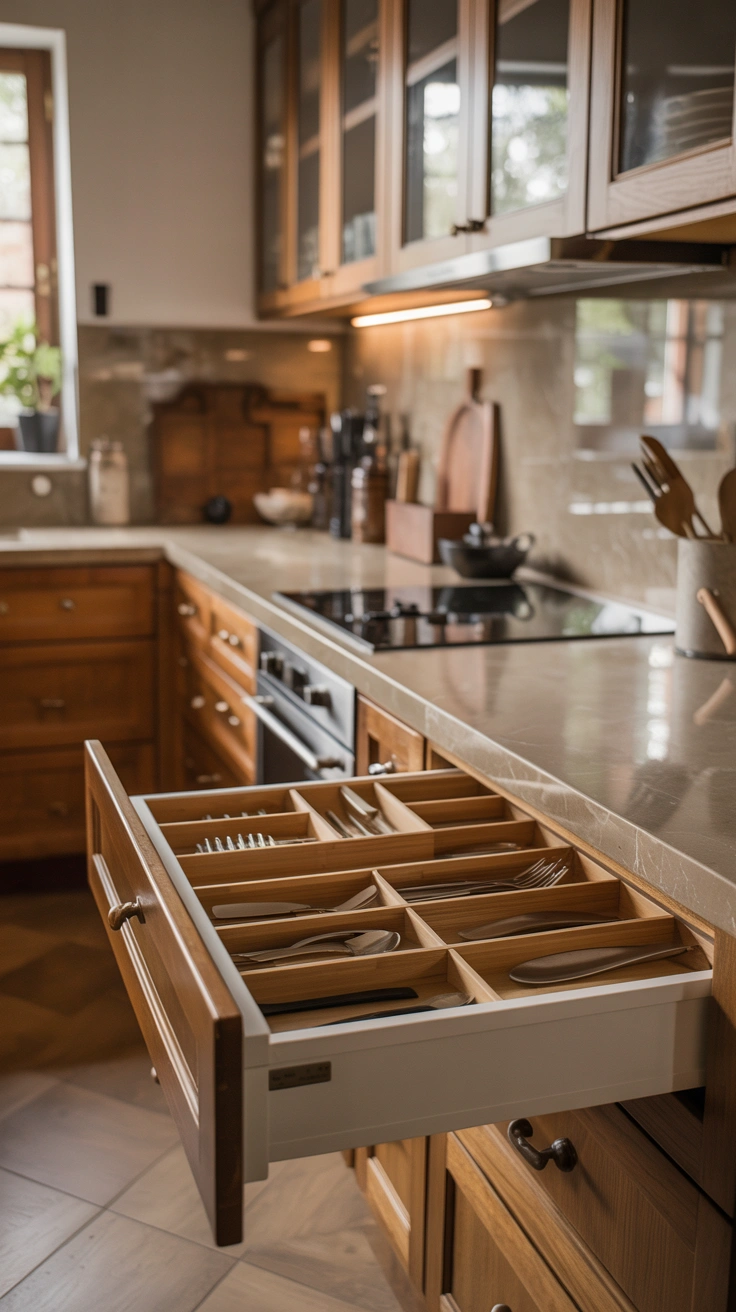
Drawer dividers are the single most effective kitchen organisation tool available — and the difference between a drawer with dividers and one without them is the difference between a functional system and an ongoing battle against entropy. Without dividers, objects migrate. With them, every item has a fixed home it returns to.
Adjustable bamboo dividers that expand to fit different drawer widths are the most versatile and most aesthetically pleasing option for standard kitchen drawers. Fixed plastic insert trays with pre-formed compartments work well for cutlery drawers where the category of objects is consistent. Custom drawer organisers ordered to the exact dimensions of specific drawers create the most satisfying and most durable long-term solution. Whatever the specific choice, dividers are non-negotiable for any kitchen drawer organisation system that lasts longer than a fortnight.
5. The Cutlery Drawer Done Properly
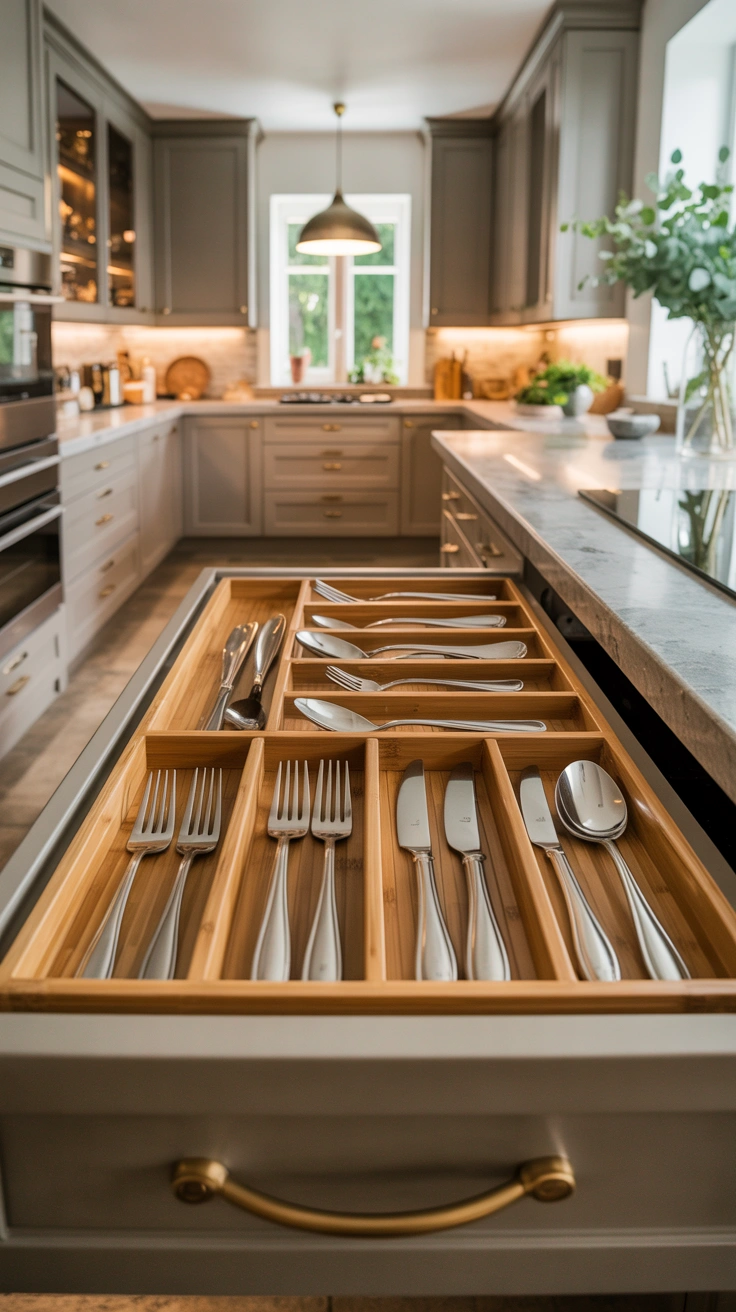
The cutlery drawer is the most frequently opened drawer in any kitchen and the one most likely to be in a constant state of disorganisation if not properly set up from the beginning. Getting it right creates a daily interaction that is smooth, fast, and consistently pleasant rather than involving twenty seconds of rummaging every single meal.
A proper cutlery tray with separate compartments for knives, forks, dessert spoons, teaspoons, and serving utensils creates the immediate, visual order that makes the cutlery drawer genuinely functional. Position the tray so it fills the drawer without leaving gap space around the edges where loose items accumulate. Keep the drawer contents limited to cutlery only — nothing else. The cutlery drawer that contains only cutlery, properly sorted into a quality tray, is one of the most satisfying small domestic organisation achievements available.
6. Utensil Drawer Maximum Capacity
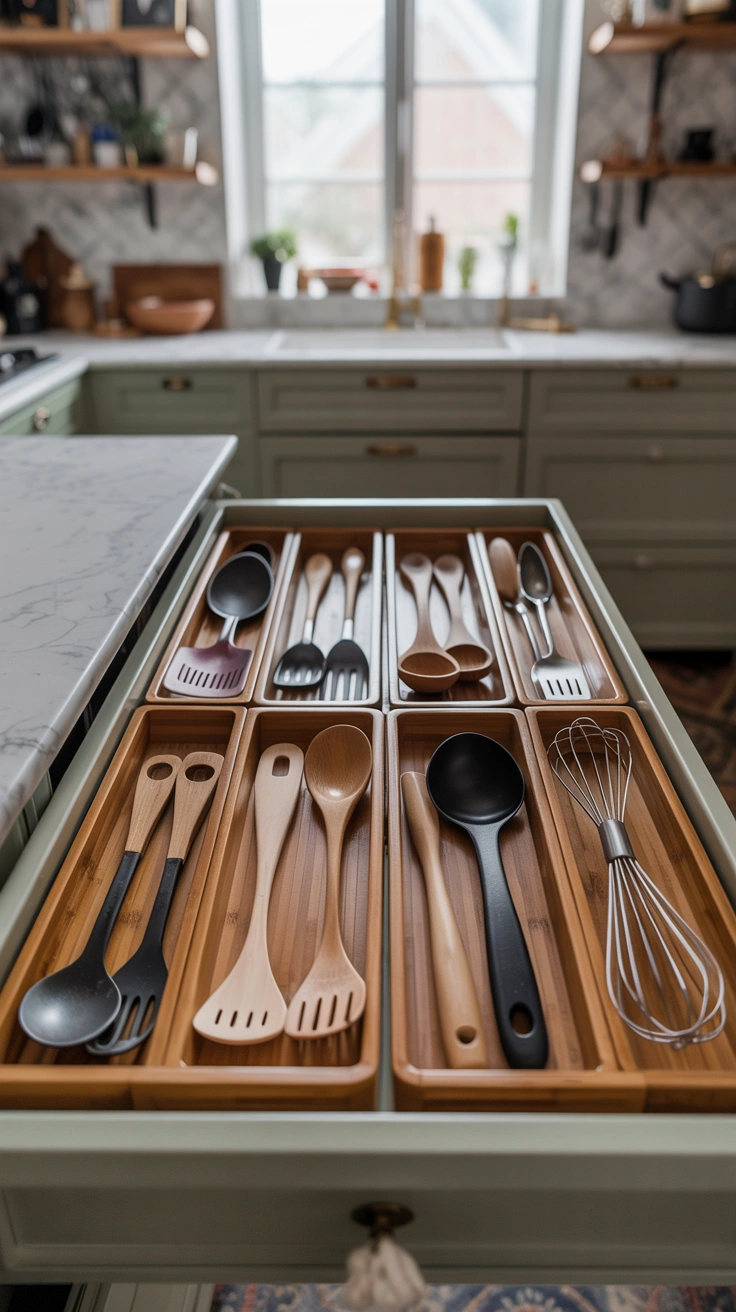
The utensil drawer has a specific maximum effective capacity — the point at which the quantity of tools in the drawer starts to prevent individual items from being retrieved without disturbing everything else. This point is lower than most people think, and exceeding it is the most common cause of kitchen drawer frustration.
FYI — if retrieving one utensil from the drawer requires moving at least two others, the drawer has exceeded its effective capacity. The solution is either to move some utensils to a countertop utensil holder or a second drawer, or to genuinely reduce the number of utensils owned. The utensil drawer that is at 70% capacity — with some visible space between items — is significantly more functional than one at 100% capacity, even when the same organisers are used in both.
7. Stack Measuring Spoons and Cups
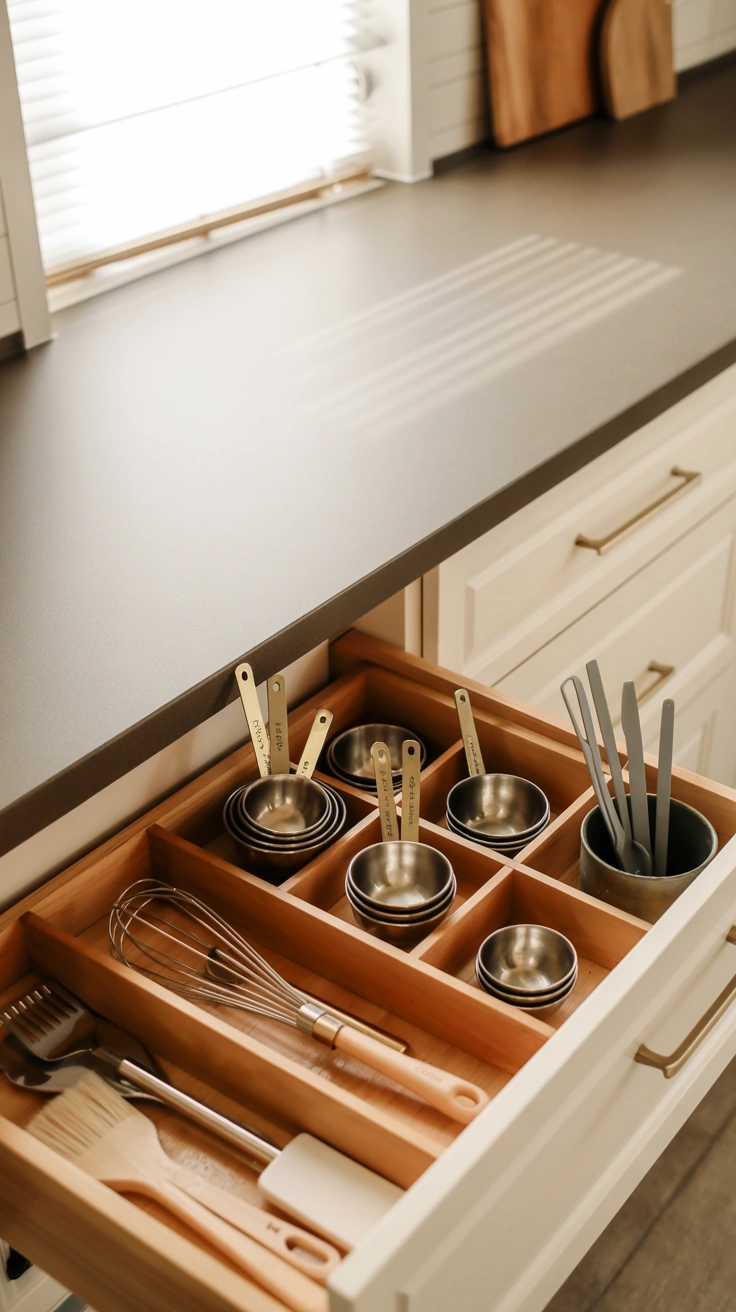
Measuring spoons and cups are among the most spatially inefficient items in any kitchen when stored loose — they nest poorly with each other, take up disproportionate drawer space, and create visual clutter that makes the drawer feel more crowded than its contents justify.
A D-ring or carabiner clip through the holes in measuring spoons and cups keeps each set as a single, compact unit that takes up a fraction of the space of loose individual pieces. Position the clipped sets standing upright in a small section of the drawer rather than lying flat — this makes them immediately visible and immediately accessible without requiring any rearranging to find the right size.
8. Knife Storage Belongs Outside the Drawer
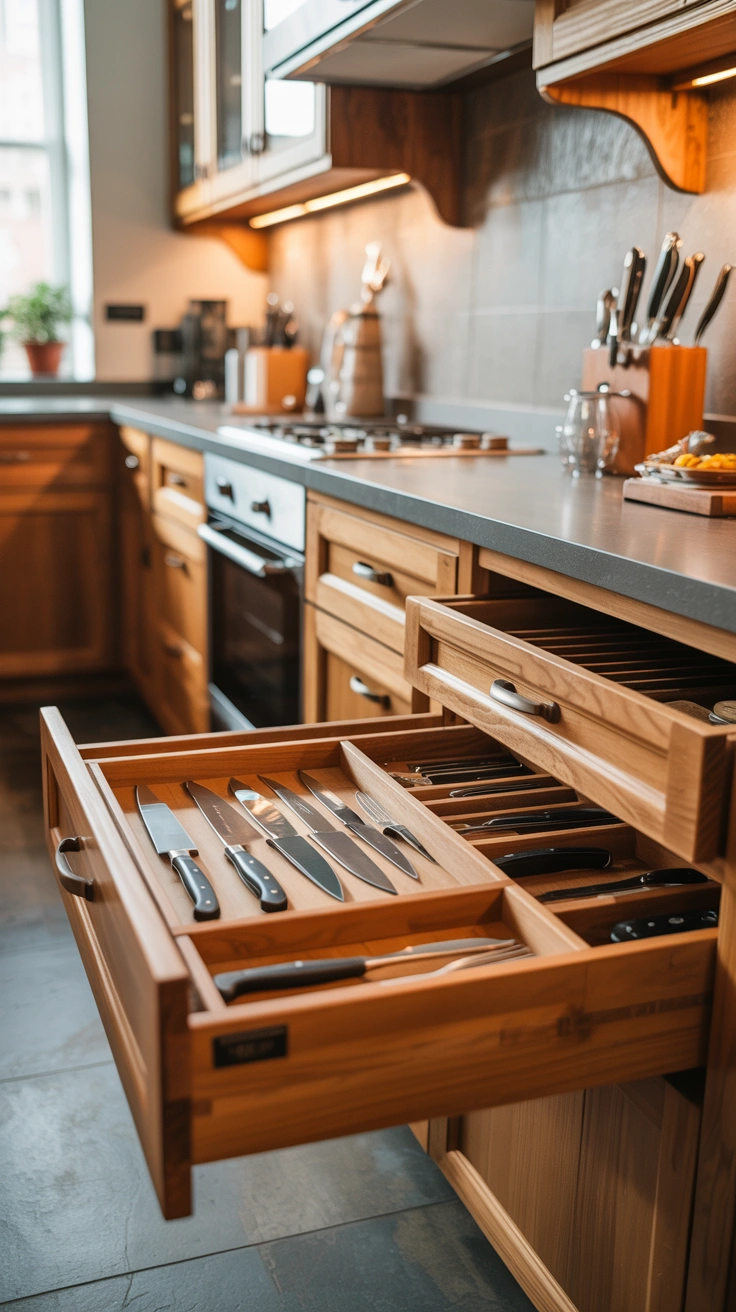
A knife block drawer insert — a low-profile wooden or foam insert that safely stores knives horizontally in a dedicated drawer — is one of the most elegant and most space-efficient knife storage solutions available. It keeps knives safely sheathed, immediately visible, and organised by size without occupying any counter space.
However, if the kitchen doesn’t have a dedicated wide drawer for knife storage, a countertop knife block or wall-mounted magnetic knife strip is a significantly better solution than loose knives in a standard drawer. Loose knives in an unprotected drawer blunt rapidly, create a safety hazard every time the drawer is opened, and occupy space that other utensils need. Wherever knives live in the kitchen, proper, protected storage is non-negotiable.
9. The Junk Drawer Is a Feature, Not a Failure
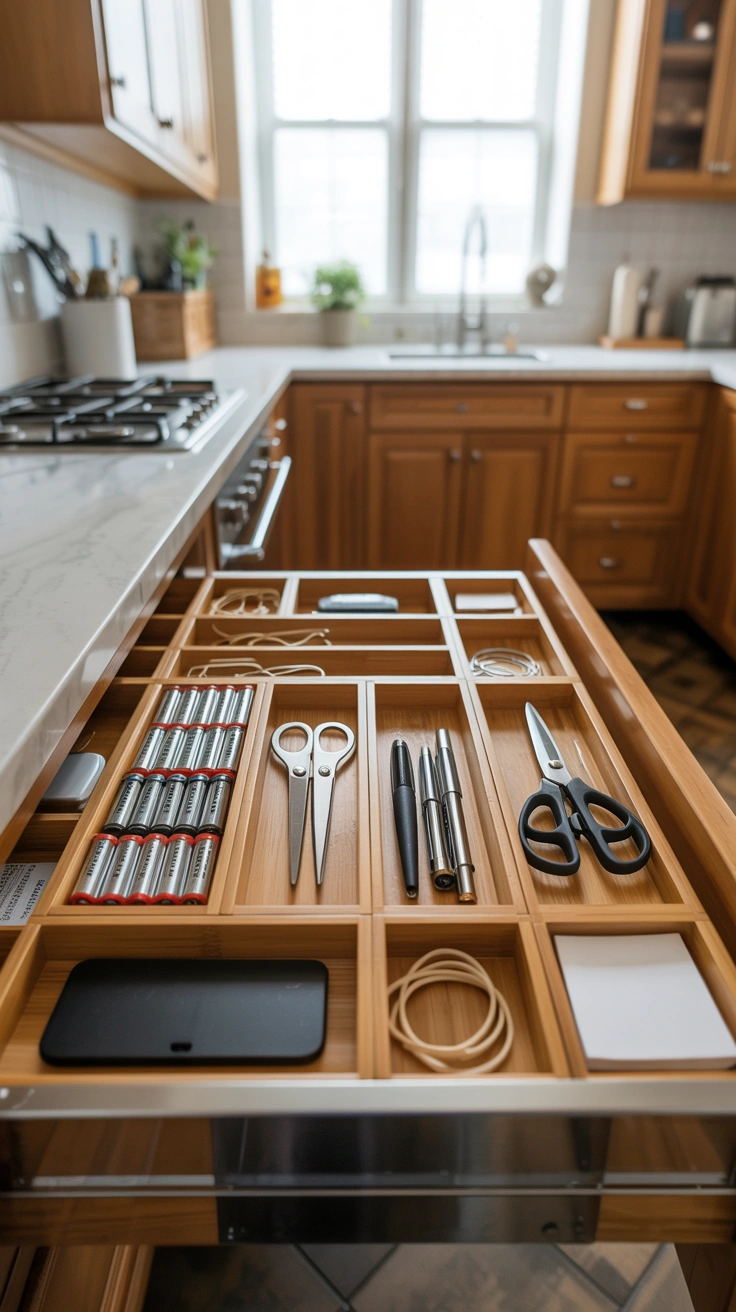
Every kitchen needs a junk drawer — the designated home for batteries, rubber bands, takeaway menus, birthday candles, and the small miscellaneous objects of domestic life that don’t belong to any specific kitchen category. The mistake is not having a junk drawer. The mistake is having a junk drawer that isn’t itself organised.
A junk drawer with small organiser bins or compartments for different categories of miscellaneous items — batteries in one section, stationery in another, small tools in a third — is a functional, accessible storage resource. A junk drawer without any organisation is simply a drawer that absorbs everything unhoused and returns nothing useful when opened. Embrace the junk drawer. Just put dividers in it.
10. Wrap and Foil Drawer Organisation
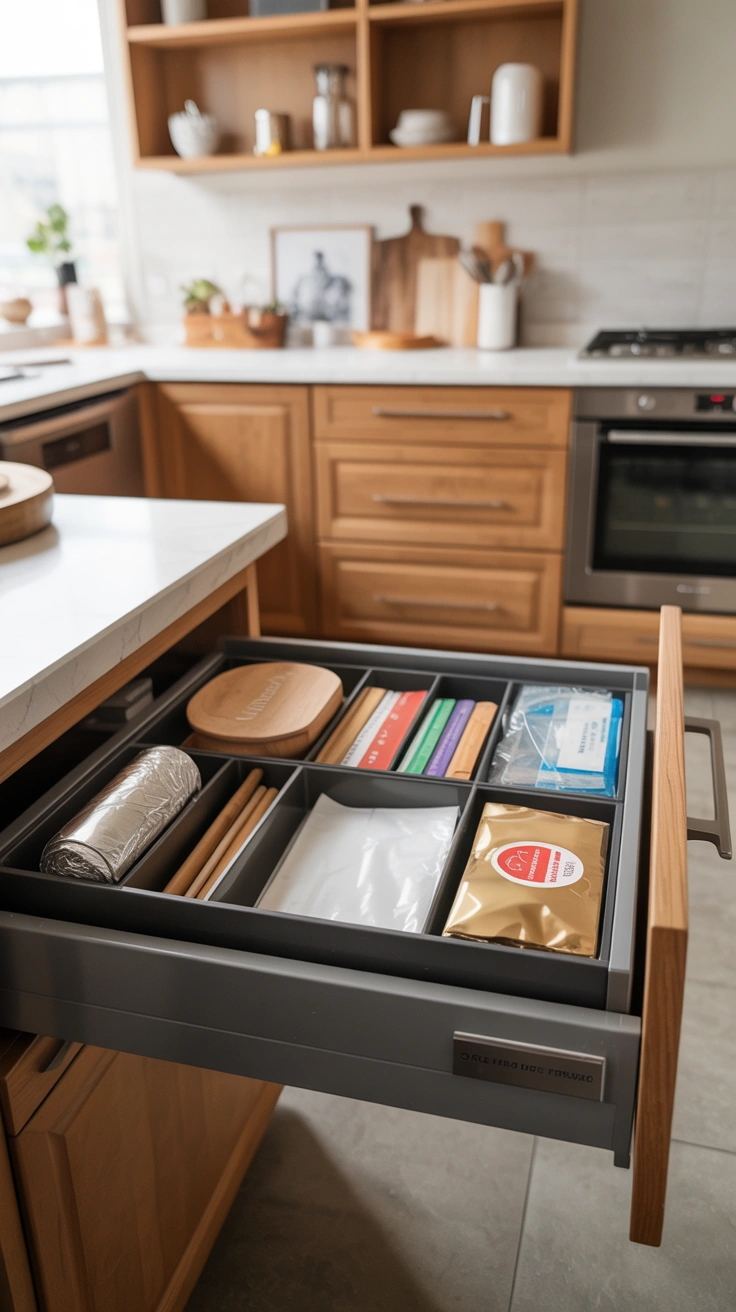
The drawer containing cling film, foil, baking parchment, and food bags is one of the most persistently frustrating drawers in any kitchen — because the rolls and boxes slide around, boxes tear from the back rather than dispensing cleanly, and everything tangles with everything else regardless of how carefully it was last placed.
A dedicated roll organiser — a small rack that holds rolls of cling film, foil, and baking parchment in fixed positions where they can be pulled and cut without the roll escaping — is the most effective solution for this drawer. Alternatively, storing rolls vertically rather than horizontally in a tall, narrow section of the drawer prevents them from sliding. Food bag boxes stored facing outward with each box slightly pulled out for immediate access create a system that works as quickly as a drawer dispenser.
11. Spice Drawers vs Spice Cupboards
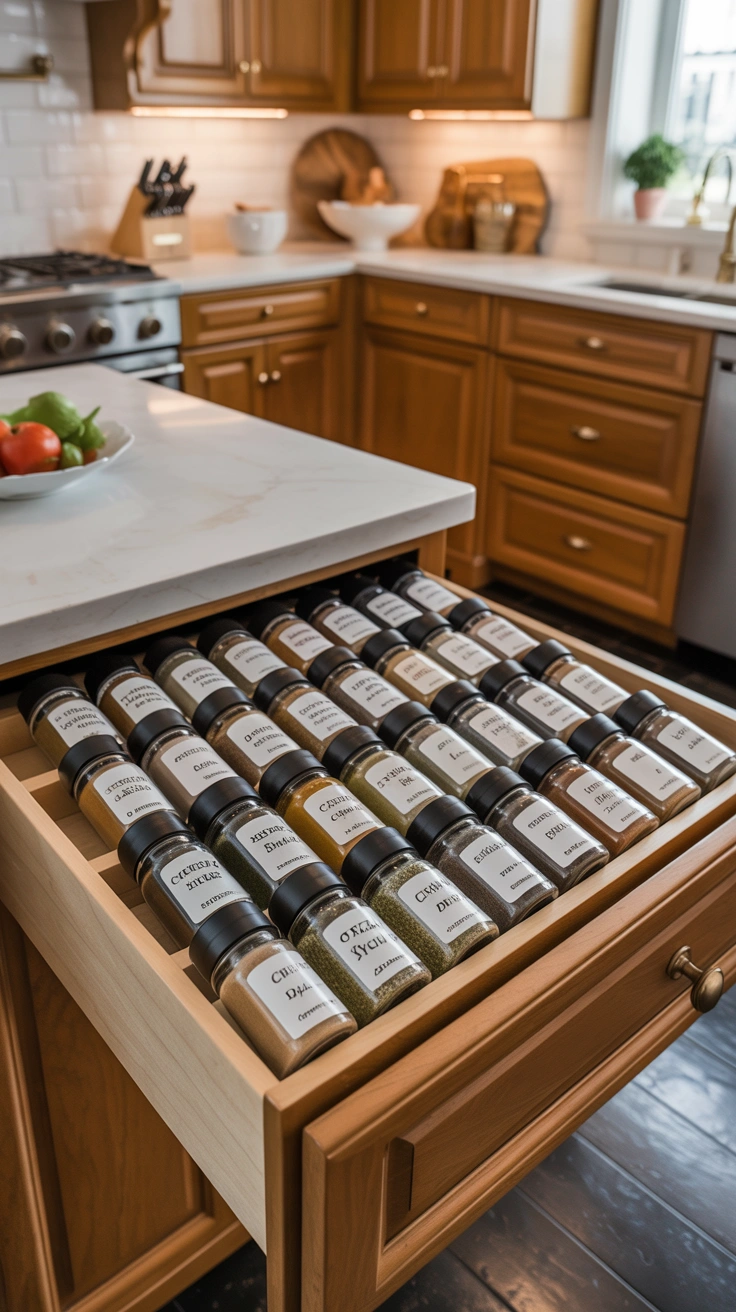
A shallow spice drawer — storing spices horizontally with labels facing upward — is one of the most searched and most admired kitchen organisation solutions available, and for genuine reason: it creates immediate, complete visibility of every spice at a glance without any searching, reaching, or rotating.
The spice drawer requires alphabetical organisation or category organisation (baking spices together, cooking spices together, world cuisine spices together) to realise its full functional potential. Label the top of every jar consistently — whether printed labels or handwritten ones — so every spice is identifiable without picking up the jar. This system works beautifully in a dedicated shallow drawer and creates the specific quality of organised kitchen efficiency that makes cooking genuinely more enjoyable.
12. The Gadget Consolidation Rule
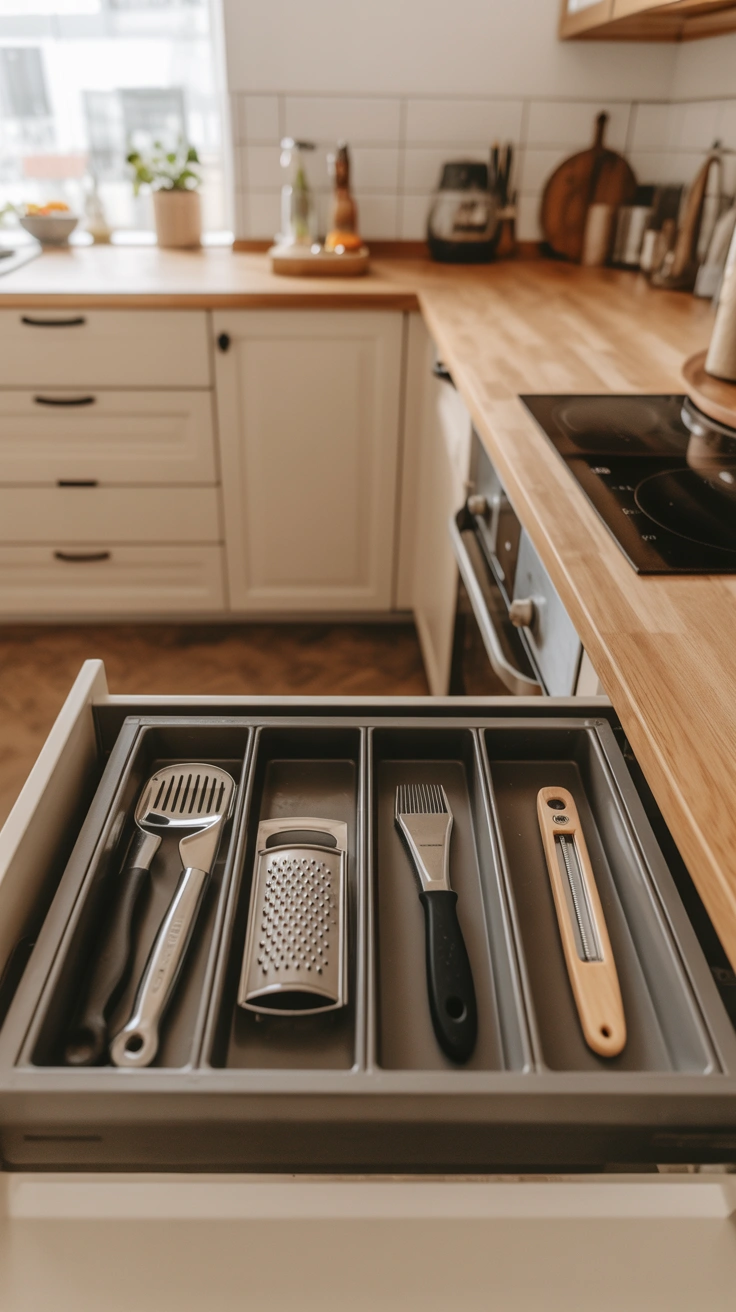
Kitchen gadgets breed in drawers — and the gadget drawer that started with a peeler and a grater has typically expanded to include a mandoline, three different tin openers, an avocado slicer, a strawberry huller, and several items whose purpose is no longer clear. The gadget consolidation rule addresses this directly.
For every new kitchen gadget that enters the kitchen, one existing gadget must leave. This one-in-one-out principle prevents gadget accumulation from continuously expanding the space required for gadget storage. Apply it strictly. The kitchen that owns only the gadgets it actually uses is a kitchen whose drawers remain organised without continuous maintenance effort.
13. Drawer Liners for Maintenance
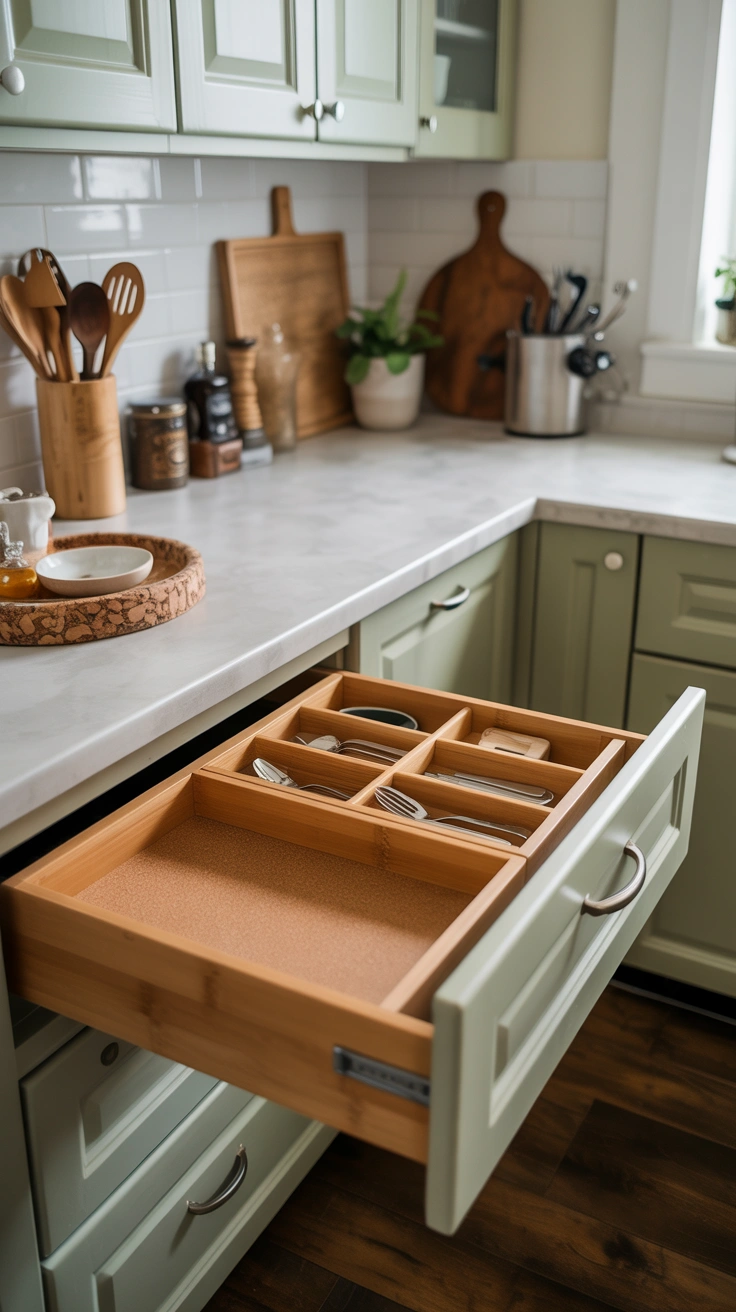
A drawer liner — a non-slip mat cut to the exact dimensions of the drawer base — keeps organiser trays and dividers in position, protects the drawer surface from scratches and moisture, and creates a clean, finished appearance inside even working drawers. It also makes cleaning the drawer significantly easier when required.
Cork, silicone, and woven fabric liners all work well in kitchen drawers. Choose a liner material that suits the drawer’s primary contents — a washable, waterproof silicone liner for drawers near the sink, a cork liner for dry utensil drawers. Cut liner material slightly smaller than the drawer dimensions for a clean fit that doesn’t buckle at the edges.
14. The Weekly Reset Habit
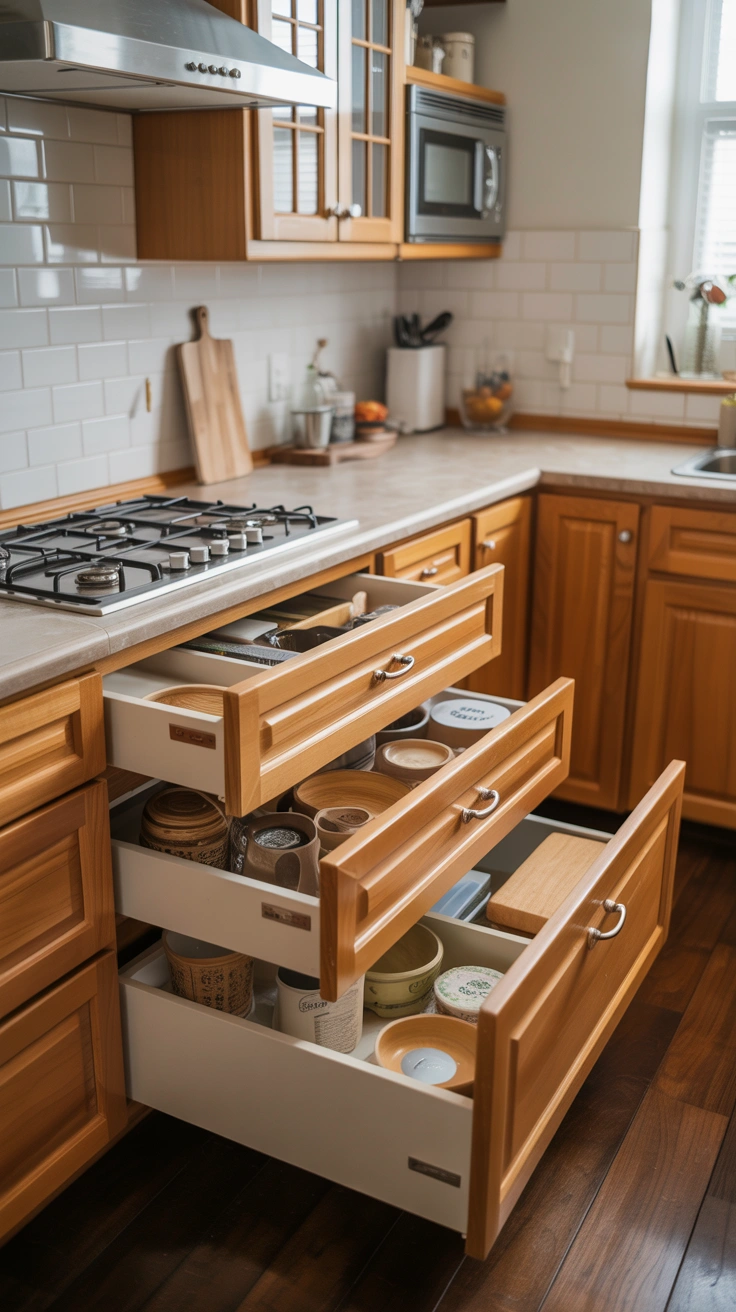
IMO, the kitchen drawer organisation system that maintains its quality over months and years rather than gradually deteriorating back to its original state is almost always one that includes a brief weekly reset — a five-minute habit of returning items to their correct zones and reorganising anything that has migrated.
Every Sunday morning, or whichever day suits, open each drawer and spend thirty seconds checking that everything is in its correct zone, dividers are in position, and nothing has accumulated that doesn’t belong. This five-minute total investment across all drawers prevents the gradual entropy that turns organised systems back into chaos over months and maintains the daily functional pleasure of a kitchen where everything has a place and returns to it.
15. Beautiful Inside as Well as Out
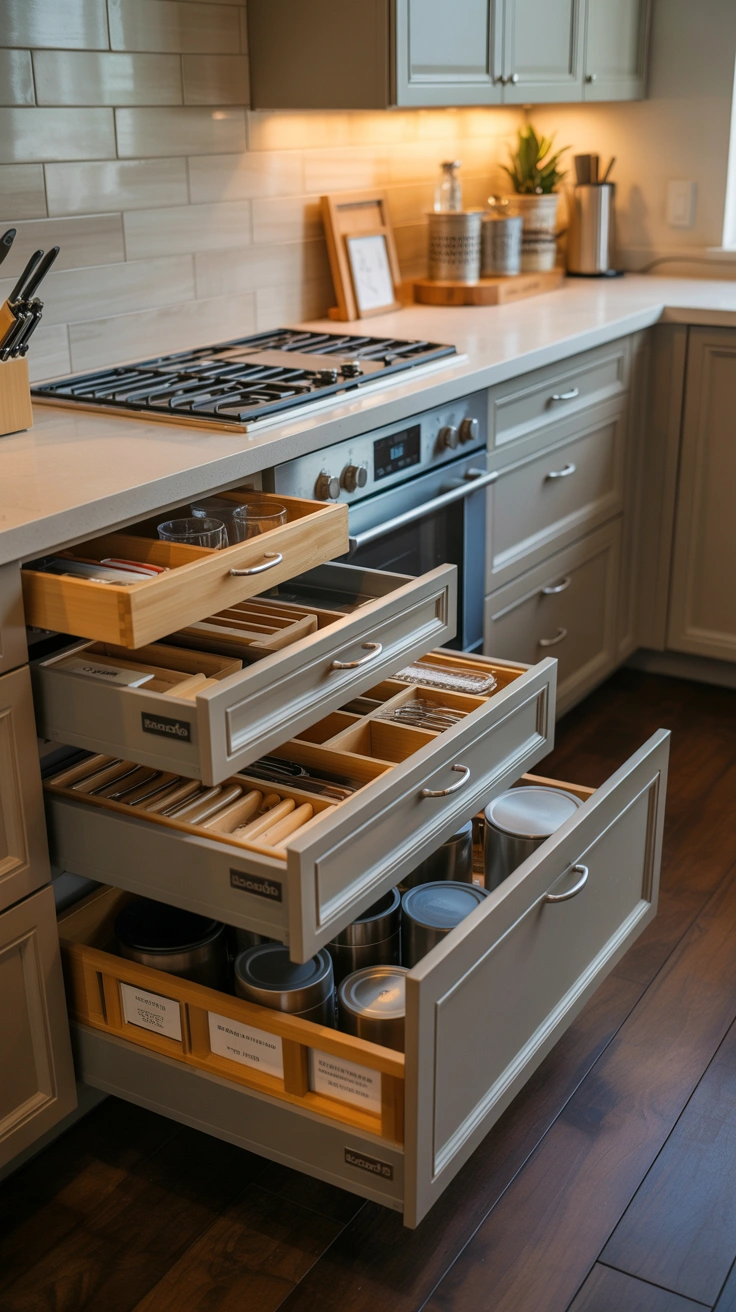
The kitchen drawer organisation system that is purely functional but visually uninspiring creates a practical improvement without the aesthetic satisfaction that makes maintaining it feel genuinely worthwhile. Making the inside of kitchen drawers beautiful — matching organiser materials, consistent liner colour, carefully chosen dividers — creates the specific pleasure of opening a well-organised drawer that reinforces the habit of keeping it that way.
Matching bamboo divider sets across multiple drawers. A consistent liner colour throughout the kitchen. Matching spice jar sets in the spice drawer. Labels in a consistent font and format. These aesthetic choices cost very little beyond the basic organisation investment but create a dramatically different subjective experience of the kitchen — one that feels not just organised but genuinely cared for at every level.
Conclusion
Fifteen tips that cover every dimension of how to organise kitchen drawers — from the foundational empty-and-purge process through zoning, dividers, specific drawer solutions for cutlery, utensils, wraps, spices, gadgets, and knives, through to the maintenance habits and aesthetic choices that keep the system working beautifully over the long term.
An organised kitchen is not a one-weekend project — it’s the result of a good system maintained by simple daily and weekly habits. The initial investment of a focused organisation session creates the foundation; the habits protect it indefinitely.
Start with the most chaotic drawer in your kitchen. Just one. Thirty minutes, some dividers, and a ruthless purge. Then try to stop at just the one.