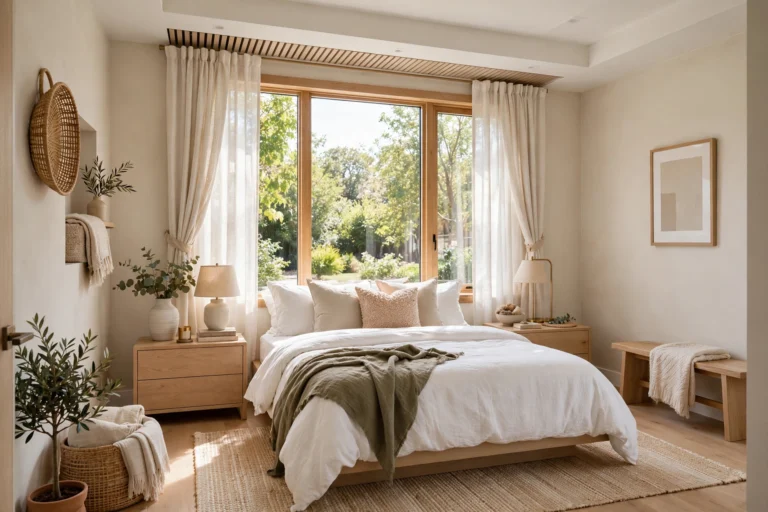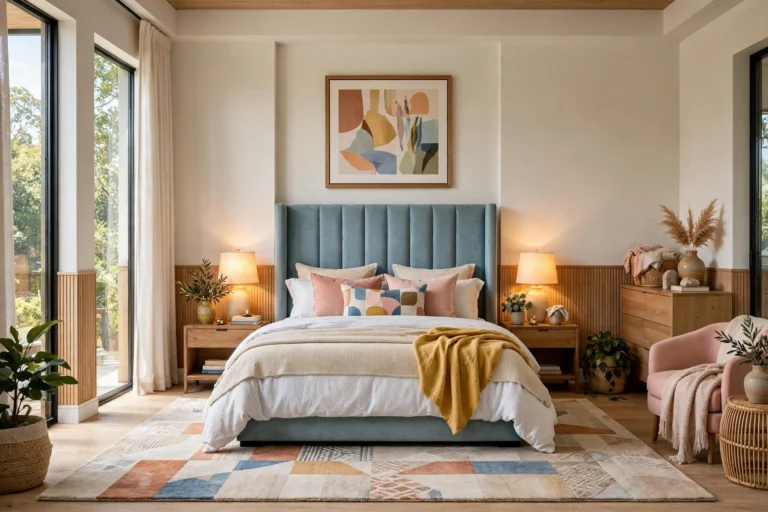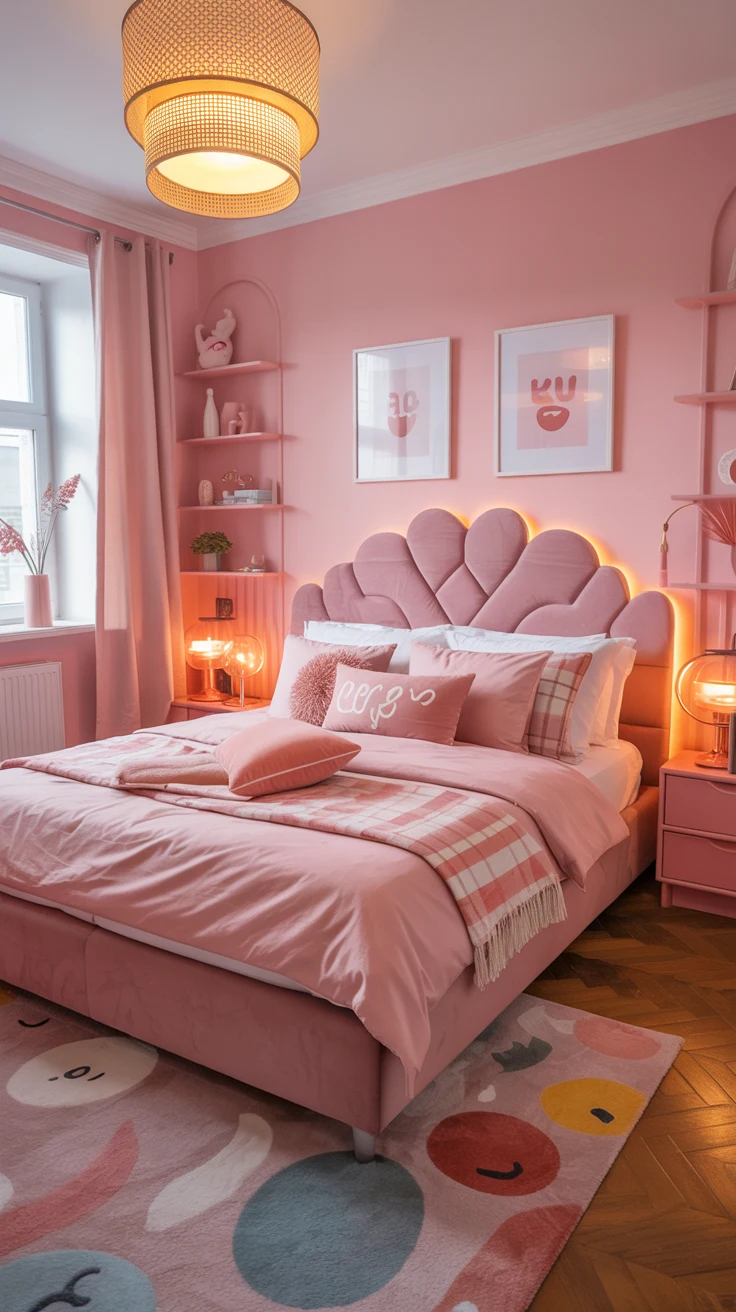

25 Dreamy Bedroom Decor Ideas That Feel Like a 5-Star Hotel
Introduction
There is a reason hotel rooms feel so restorative: every detail is designed for rest. Crisp bedding, perfect symmetry, layered lighting, zero clutter, and that unmistakable sense of calm the moment you walk in. The good news is that none of that magic requires room service — it is a set of decorating decisions you can recreate in your own bedroom, most of them in a single weekend.
A 5-star hotel bedroom is not about expensive furniture. It is about a formula: a calm palette, a beautifully dressed bed, lighting at multiple heights, matched pairs on the nightstands, and surfaces kept almost monastically clear. Get those five things right and your bedroom starts to feel like a retreat instead of just the room where you sleep.
Below are 25 dreamy bedroom decor ideas that capture that five-star hotel feeling, ordered from the highest-impact moves to the finishing touches. If your bedroom is on the smaller side, start with our guide on how to make small bedroom feel bigger — the hotel formula works even better once the room itself feels generous.
1. Start With Crisp White Hotel Bedding

The single fastest hotel transformation is white bedding. Hotels use white for a reason: it signals cleanliness, reflects light, and creates a blank canvas that makes everything else look intentional. Swap patterned or dark bedding for crisp white sheets and a white duvet cover, and the bed instantly reads as “luxury suite.”
Choose a percale or sateen weave in cotton — percale for that cool, crisp hotel feel, sateen for a subtle sheen. Wash new bedding two or three times before judging it; cotton softens and brightens with washing. The white does not have to be blinding — warm ivory and soft white both deliver the effect while feeling a touch more livable.
2. Invest in an Upholstered Statement Headboard
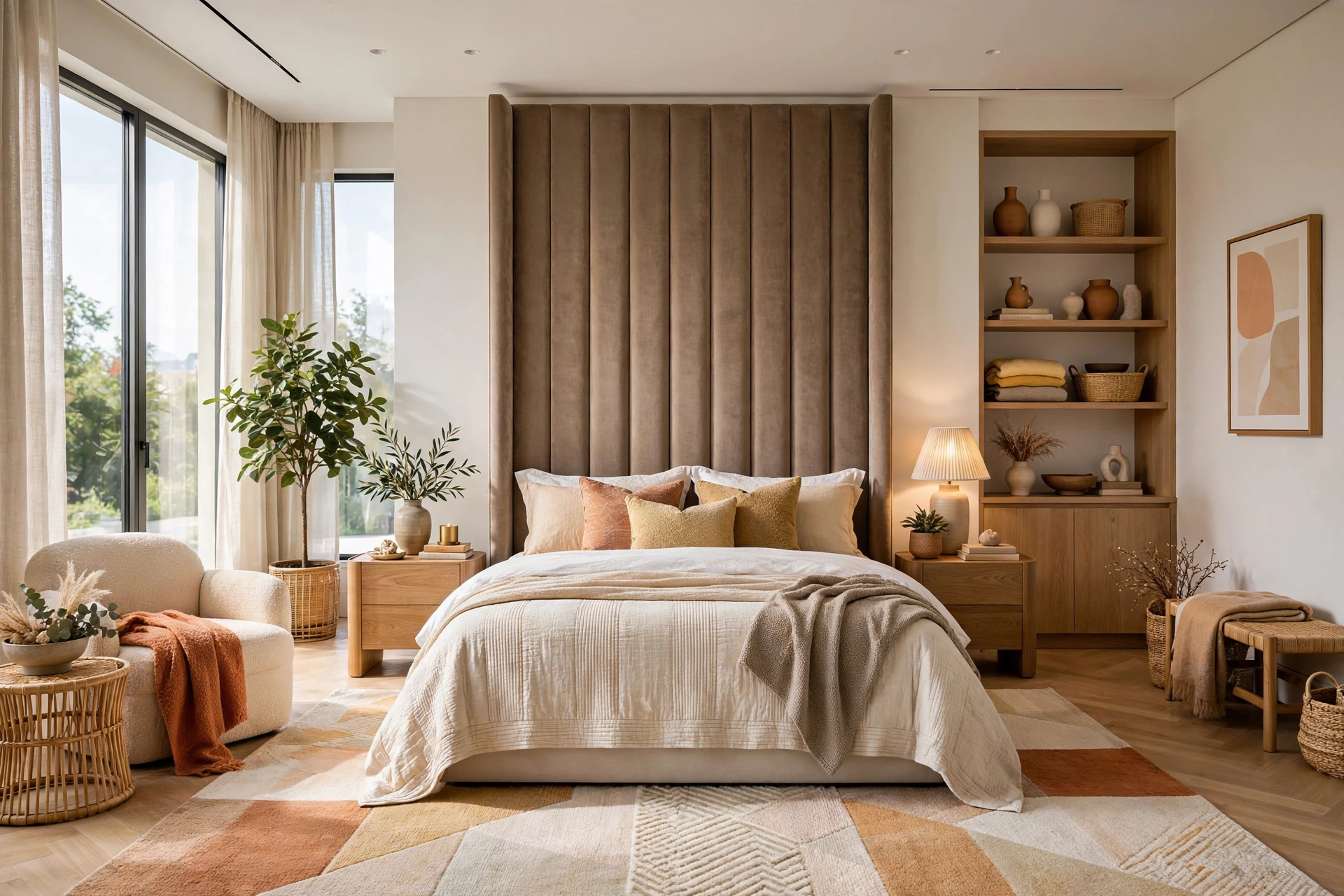
Nothing says boutique hotel like a tall, upholstered headboard. It gives the bed presence, frames the pillows, and turns the wall behind the bed into a designed focal point. Choose one that extends at least 24 inches above the mattress — hotel headboards are generous, and that height is what makes the bed feel grand rather than ordinary.
Velvet, linen, and bouclé are the classic hotel fabrics: velvet for glamour, linen for relaxed luxury, bouclé for texture. A neutral tone — oatmeal, warm gray, soft taupe — keeps it timeless, while a deep jewel tone makes it the room’s statement. If a new headboard is out of budget, hang a large textile or an oversized frame at headboard height for a similar focal effect.
3. Layer the Bed Like a Hotel Housekeeper
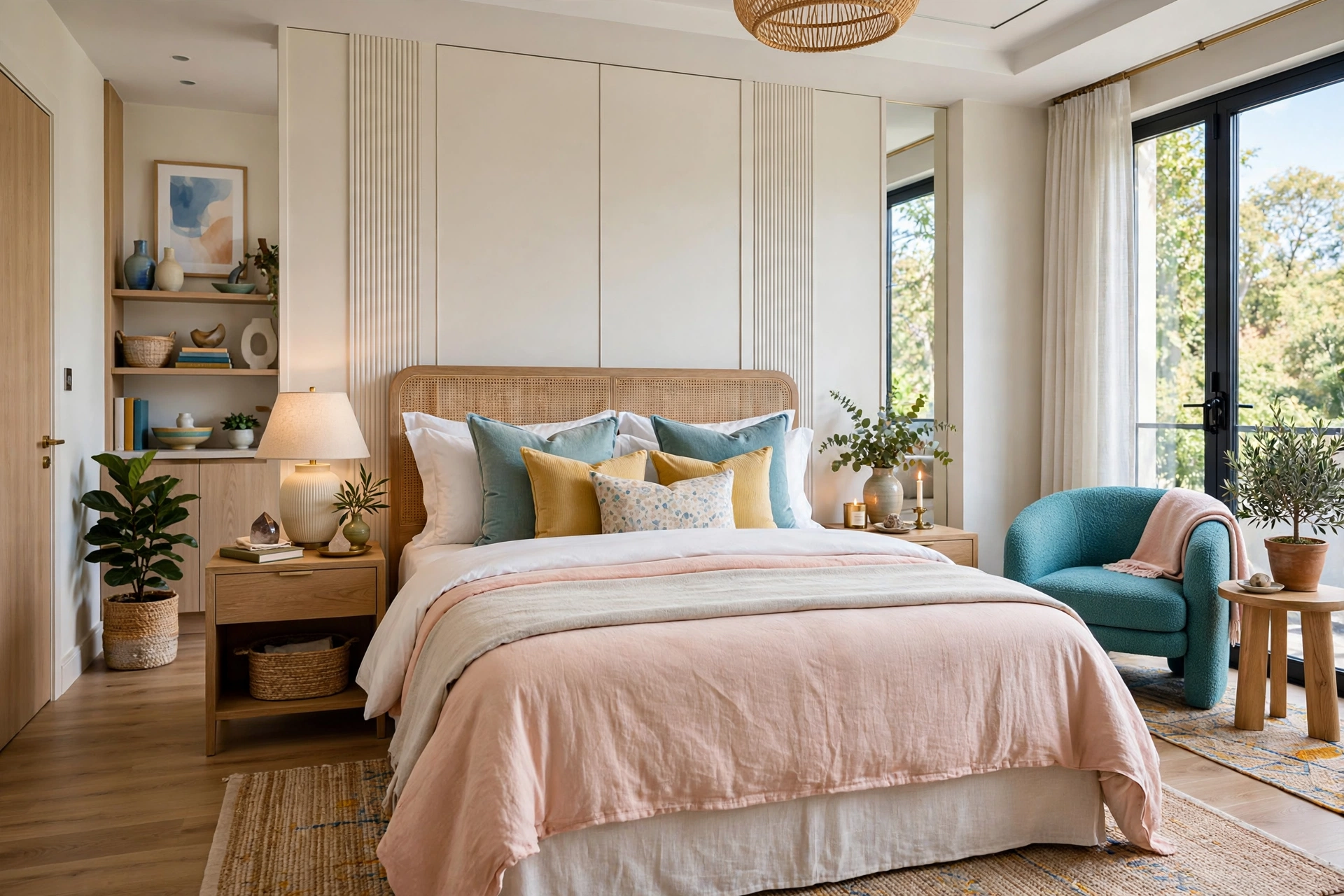
Hotel beds look abundant because they are layered with intention. Copy the formula: fitted sheet, flat sheet folded back over the duvet, duvet cover, then a folded throw or coverlet across the foot. Each layer is smooth, symmetrical, and tucked with precision — no lumps, no half-undone corners.
The fold is the detail that sells it. Fold the top sheet and duvet down about a third of the way to create that crisp band across the bed, then place the sleeping pillows flat and upright against the headboard. It takes three extra minutes in the morning and transforms the bed from “slept in” to “suite ready” — the highest-return habit on this entire list.
💡 Pro Tip: Iron or steam the duvet cover’s visible fold once a week. Hotels press their linens, and that single crisp edge is what separates a made bed from a hotel bed. A handheld steamer takes ninety seconds and changes everything.
Dreamy Bedroom Quick-Start Checklist
- ✅ Switch to crisp white or ivory bedding in cotton percale or sateen.
- ✅ Create perfect nightstand symmetry — matched lamps, matched styling.
- ✅ Layer lighting at three heights: overhead, bedside, and accent.
- ✅ Clear every surface to hotel standards — nothing without a home.
- ✅ Hang curtains high, wide, and to the floor in a light fabric.
- ✅ Add one plush rug that extends beyond the bed on three sides.
- ✅ Finish with scent: one candle, diffuser, or linen spray.
4. Create Perfect Bedside Symmetry
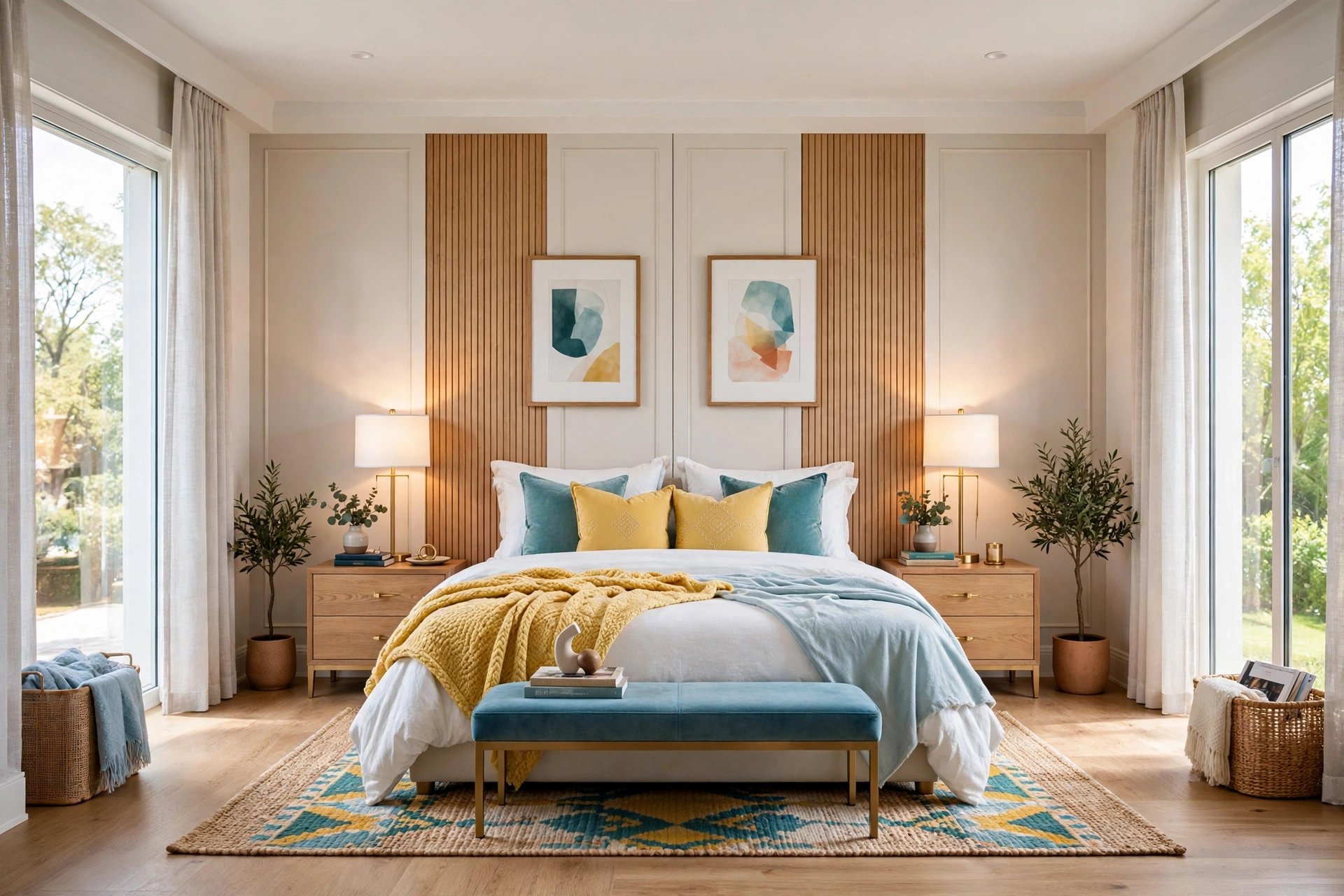
Walk into any luxury hotel room and you will notice the mirror-image nightstands: two identical tables, two identical lamps, styled the same way. Symmetry is the brain’s shortcut to calm — it tells the eye that everything is under control, which is exactly the feeling a restful bedroom needs.
You do not need expensive furniture for this. Two matching nightstands (or even two matching stools or wall shelves) with two matching lamps create the effect. Style them identically: a small stack of books on one side gets a small stack on the other; a bud vase left means a bud vase right. The pair does not have to be costly — it has to match.
5. Install Matching Table Lamps on Both Sides

Bedside lighting is where hotel rooms quietly excel, and the rule is simple: two matching lamps, warm bulbs, shades at the same height. The matched pair flanks the bed like sentries, giving each sleeper their own pool of warm light for reading — and giving the room its most important evening glow.
Choose lamps with some presence — 24 to 28 inches tall is the hotel sweet spot — and shades that cast light up and down rather than trapping it. Put both on warm 2700K bulbs, and if you can, add dimmers or smart bulbs so the room drops from bright to candlelit in seconds. Matching lamps are one of the cheapest ways to buy the hotel look outright.
Quick Comparison: Hotel-Style Bedroom Ideas by Cost and Effort
6. Add a Bench or Ottoman at the Foot of the Bed
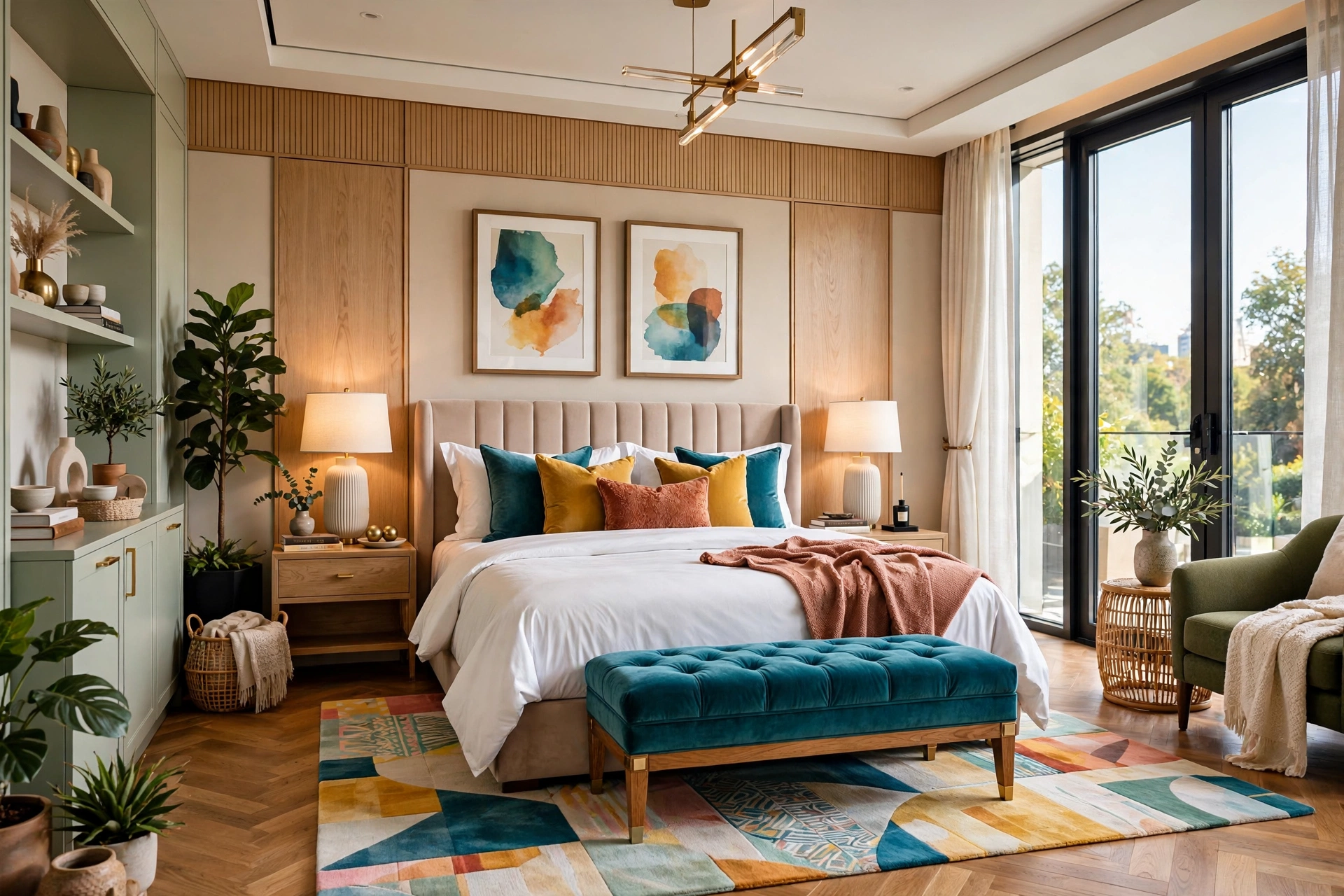
A bench at the foot of the bed is pure hotel language. It gives the bed a finished, tailored look, provides a spot to lay out tomorrow’s clothes or sit while putting on shoes, and fills the often-dead space at the bed’s foot with intention. Upholstered benches in velvet or linen read most luxurious; a simple wooden bench with a cushion works in relaxed schemes.
Size it to about two-thirds the bed’s width so it reads as part of the bed rather than a separate piece. In small bedrooms where a bench will not fit, a long lumbar pillow or a folded throw across the foot delivers a similar finished line without the footprint. Either way, the foot of the bed should look dressed, not bare.
7. Choose a Calm, Low-Contrast Palette
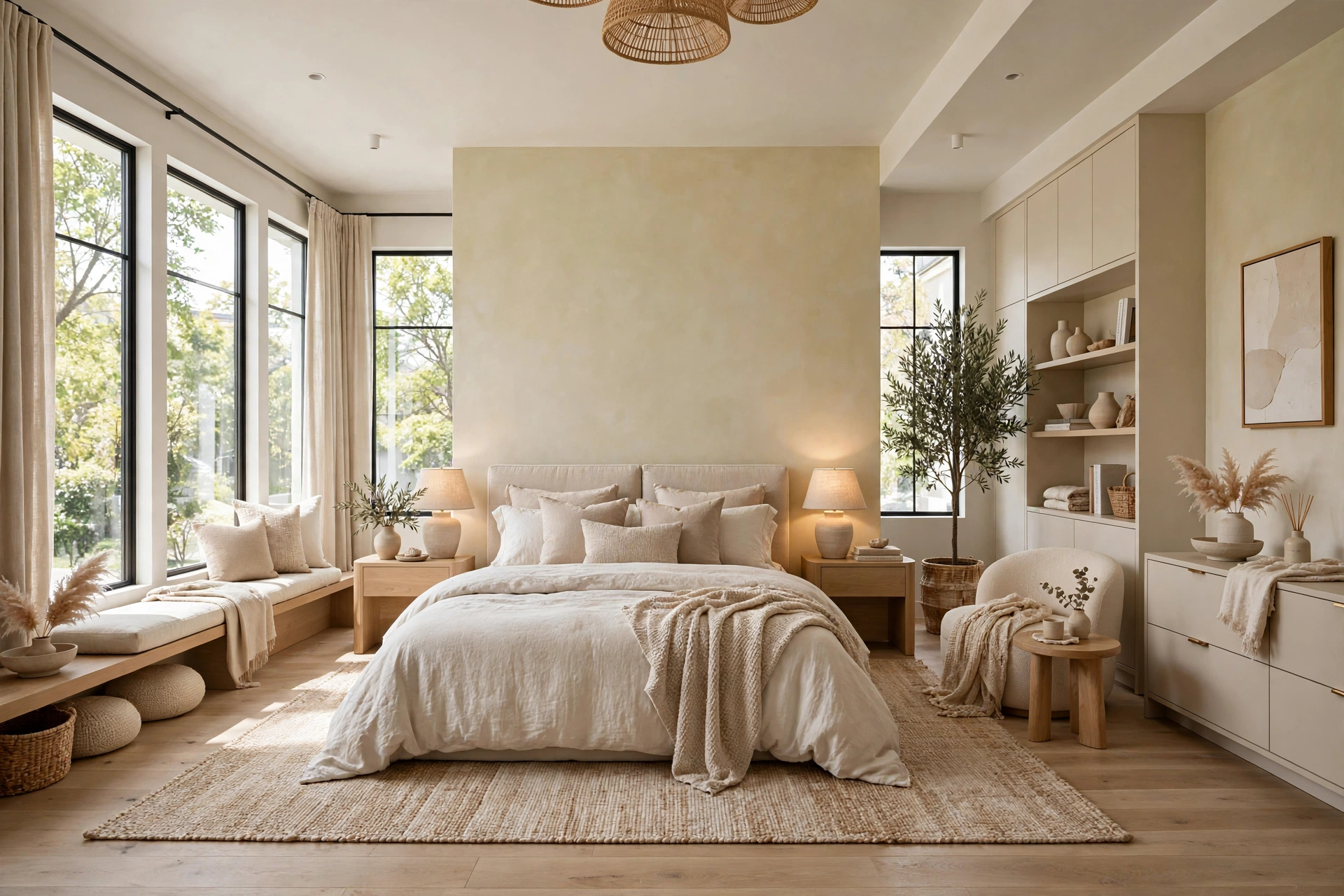
Hotel rooms never shout. The palette stays within one calm family — warm whites, soft grays, gentle taupes, muted blues — with contrast kept low across the big surfaces. When the eye flows across walls, bedding, and curtains without stopping at hard boundaries, the nervous system gets the message: rest here.
Build the palette through the largest surfaces first: walls, bedding, curtains, rug. Keep them tonal, then add depth through texture rather than color — linen against velvet, wool against wood, matte against sheen. Two or three small darker accents (a frame, a lamp base, a woven basket) give the room depth without breaking the calm. This is the same principle behind our guide to make a small room look bigger: low contrast lets the eye travel, and a traveled eye reads the room as generous.
8. Hang Floor-to-Ceiling Curtains

Short curtains that just cover the glass are the fastest way to make a bedroom look budget — hotels would never. Mount the rod six to eight inches above the frame, extend it well past each side, and hang panels that just kiss the floor. The window instantly looks twice its size, the ceiling reads higher, and the whole wall gains presence.
Keep the fabric light and simple: sheer linen-look weaves or light-filtering panels in a pale tone that glows with daylight behind it. For true hotel sleep, layer sheers with blackout panels on a double rod — gauzy light by day, total darkness by night. One window dressed properly does more for the room’s luxury quotient than almost any furniture purchase.
9. Layer Lighting at Three Heights

Hotel rooms are never lit by a single overhead — they glow in layers. Copy the formula: ambient light from the ceiling fixture, task light from the bedside lamps, and accent light tucked low or high — a picture light over the art, an LED strip behind the headboard, a small glow on the dresser. Each layer has its own switch, so the room shifts mood in stages.
The evening sequence is the point. Overhead off, bedside lamps on low, accent glow on: the room drops into its nighttime self, warm and cocooned. Use 2700K warm bulbs everywhere — mixed color temperatures make even expensive rooms feel restless. If you do one electrical upgrade, make it dimmers on the bedside lamps; dimmable warm light is the actual mechanism of “hotel calm.”
📌 Important: Keep every bulb the same warm color temperature across all three layers. One cool-white bulb hiding in the ceiling fixture will fight every warm lamp in the room — and the eye always notices the fight, even when you cannot name it.
10. Add a Plush Area Rug Under the Bed

The hotel wake-up experience starts underfoot: swinging your legs out of bed onto something soft. A plush area rug extending well beyond the bed on three sides delivers that moment daily — and visually, it unifies the floor into one continuous, generous plane. In bedrooms, bigger is better: the rug should reach at least 18 to 24 inches beyond the bed’s sides and foot.
Choose low-pile plush or a soft flatweave in a light tone that matches your calm palette. The rug anchors the bed the way a frame anchors art — without it, even a beautiful bed can look adrift on bare floor. If a full under-bed rug will not fit the budget, two long runners along each side of the bed capture the barefoot luxury for a fraction of the cost.
11. Style the Nightstands Like a Concierge Desk

Hotel nightstands are styled, not stuffed. Edit each one down to four intentional items: the lamp, a small stack of two or three books, one living thing (a bud vase, a tiny plant), and one personal object (a candle, a framed photo, a carafe). Everything else — chargers, medicines, clutter — lives inside the drawer or in a beautiful box.
Corral the small things on a tray: it turns scattered objects into one composed moment and makes the surface easy to wipe. Keep the styling identical on both sides for the symmetry effect from idea #4. A nightstand styled this sparsely does something psychological too — it signals that the day is handled, which is precisely what lets the mind rest.
12. Bring in Mirrored or Lacquered Accents
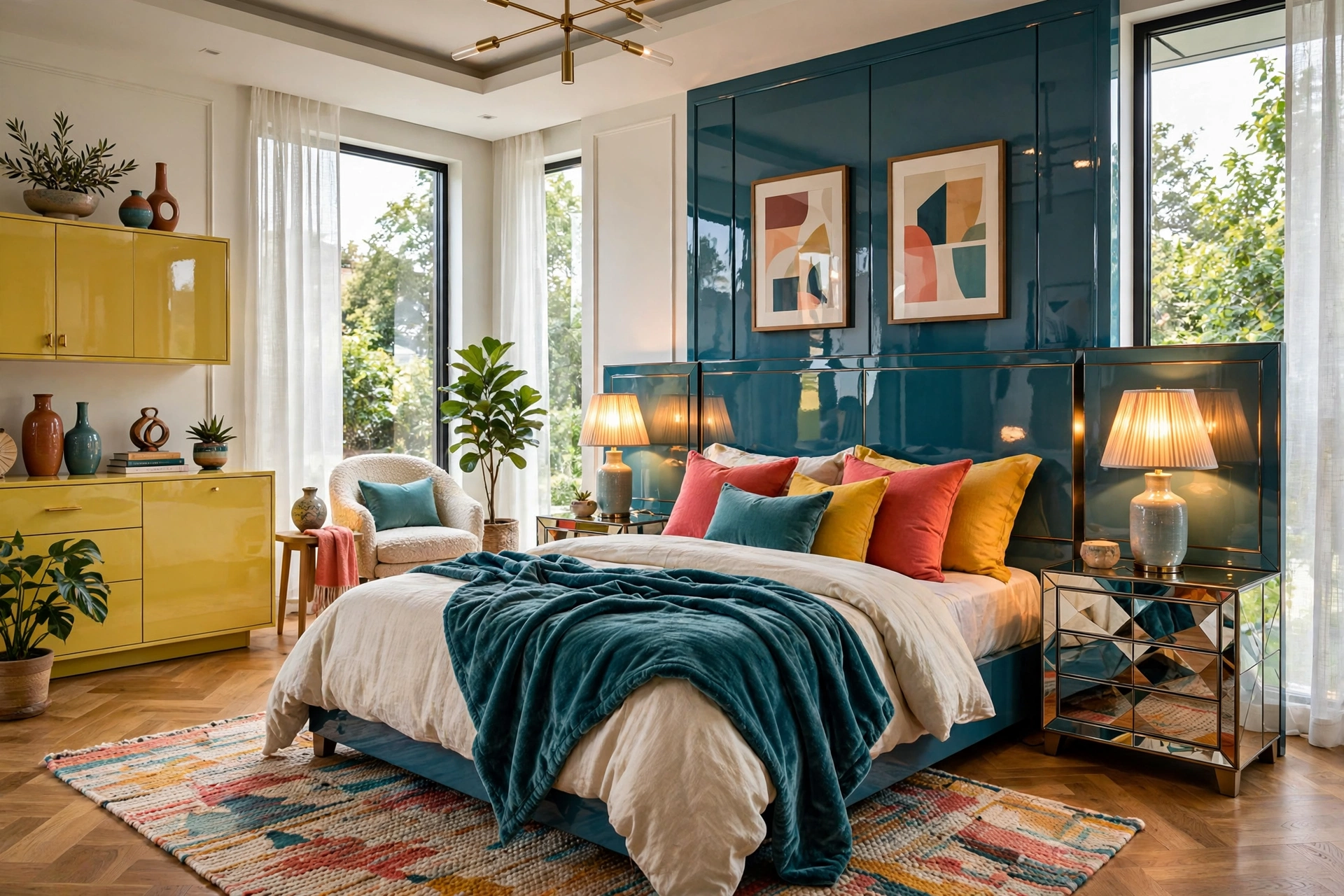
A little reflection is a hotel signature: mirrored nightstands, a lacquered tray, a beveled mirror over the dresser. Reflective surfaces bounce lamplight around the room, doubling the glow and making the space feel brighter and more polished after dark. One or two reflective pieces is the sweet spot — more tips into glitz.
A large mirror opposite or adjacent to the window is the highest-leverage move: it bounces daylight deep into the room and creates the illusion of a second window. Our guide to the best mirrors for small spaces covers the sizes and placements that genuinely expand a room. Keep the reflected view intentional — a mirror doubles whatever it faces, so aim it at the window, the art, or the greenery, never at clutter.
13. Hang One Large Piece of Art
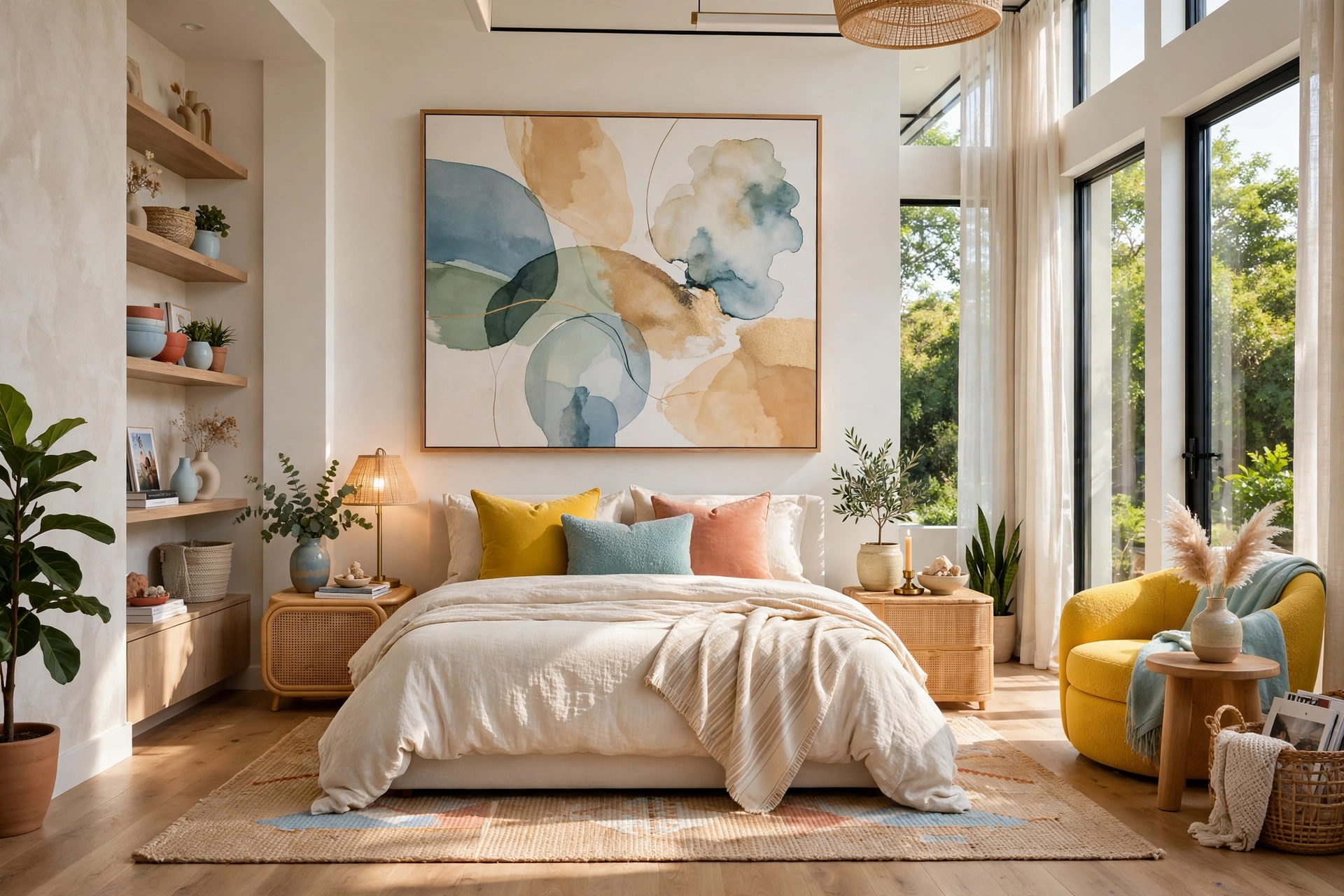
One generous piece of art above the bed or on the main wall beats a scattered cluster every time. Hotels understand that scale is the statement: a single confident piece gives the eye a destination, anchors the room’s palette, and reads as a decision rather than decoration-by-accumulation.
Abstract landscapes, soft botanicals, and serene photography in your palette’s tones are the safest hotel-style choices. Size it to roughly two-thirds the bed’s width and hang the center at eye level. Large-scale prints and canvas wraps deliver the scale without gallery prices — what matters is the confidence of the size, not the provenance of the piece.
14. Add Fresh Flowers or Greenery
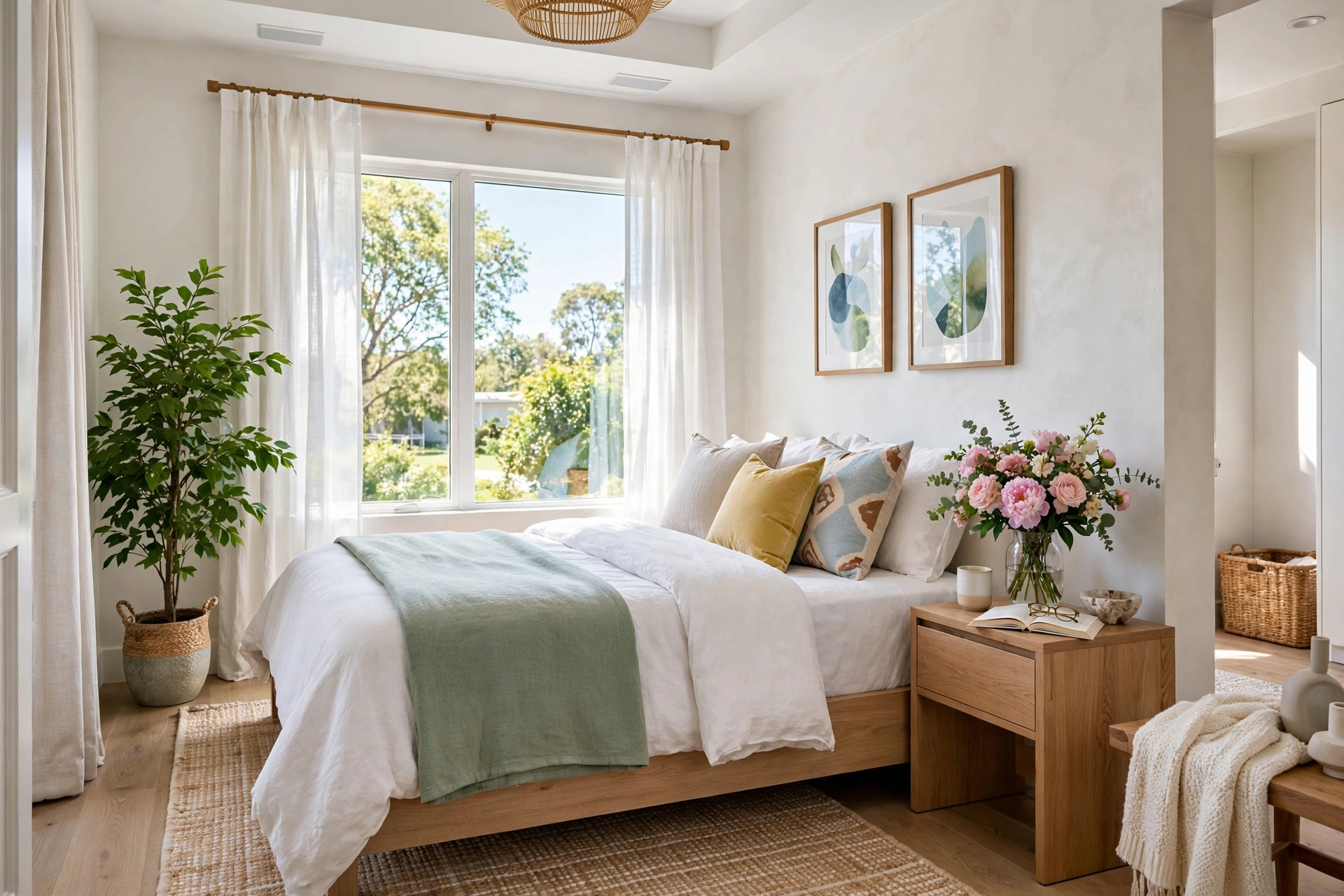
Every luxury hotel lobby has flowers, and the bedroom deserves the same living touch. A small vase of fresh blooms on the nightstand or dresser — even grocery-store stems — adds life, color, and a subtle scent that no decor object can fake. It is the detail that makes the room feel cared for rather than merely decorated.
If fresh flowers weekly is too much, one sculptural plant does the job with less maintenance: an orchid, a tall snake plant, or eucalyptus stems in a vase (they dry beautifully and last for months). Choose a vessel with presence — ceramic, brass, or smoked glass — because the container is half the arrangement. Living things are the difference between a room that looks like a hotel and one that feels like it is waiting for you.
15. Upgrade to Blackout Curtains for True Darkness

The deepest hotel sleep secret is not the mattress — it is the darkness. True blackout curtains (or blackout liners behind your sheers) create the cave-like dark that lets your body produce melatonin properly. If you have ever slept noticeably better in a hotel, darkness was doing half the work.
Layer them behind sheer day curtains on a double rod for the full hotel treatment: glowing filtered light by day, total blackout by night. Check for light leaks around the edges — wraparound rods or curtain returns that bend back to the wall seal the sides. This is also the single best upgrade for shift workers, light sleepers, and anyone whose bedroom faces a streetlight.
💡 Pro Tip: Test blackout effectiveness at noon, not at night. Stand in the room with the curtains closed midday — if you can see your hand clearly, light is leaking. Seal the top with a pelmet or valance and the sides with returns before you declare victory.
16. Create a Reading Corner With a Luxe Chair
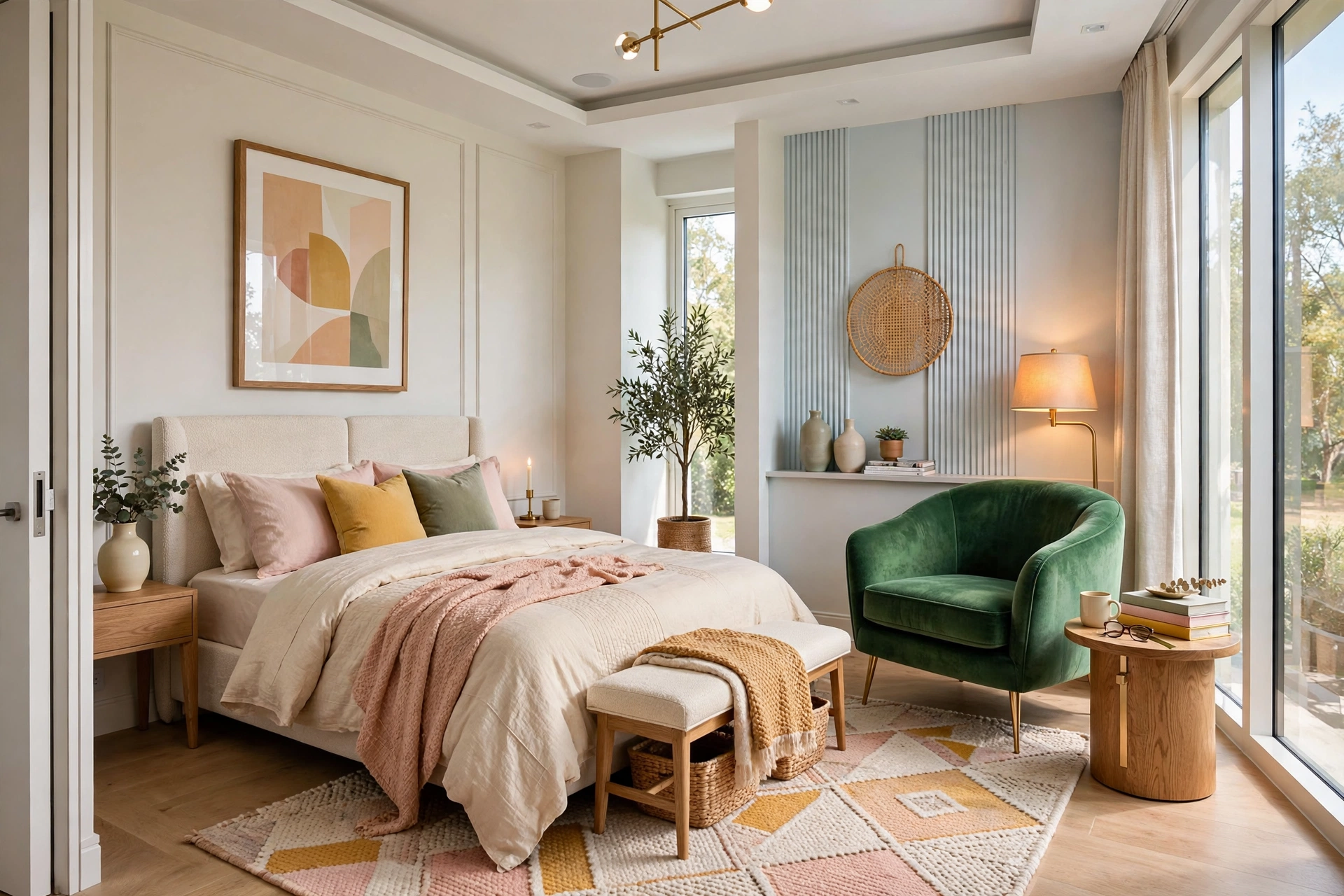
Five-star suites have a second destination inside them — usually a chair by the window — and your bedroom should too. One comfortable accent chair, a small side table, a floor lamp with a warm bulb, and a throw: four elements that turn a dead corner into the room’s most coveted seat.
Angle the chair toward the room so the nook feels connected, not exiled. This is the spot for slow mornings, bedtime reading, and the ten minutes of quiet that make the bedroom feel like a retreat rather than just a sleep station. In a studio apartment, where the bed shares its four walls with everything else, carving out this corner matters even more — our guide on how to divide studio apartment into zones shows how to give the sleep area a true sanctuary identity. A boucle or velvet chair in your palette keeps the hotel language; a floor cushion and low table create the same destination in a smaller footprint.
17. Use Scent Like a Boutique Hotel

Luxury hotels have signature scents for a reason — smell reaches the emotional brain before sight does. Give your bedroom one consistent fragrance: a reed diffuser on the dresser, a linen spray on the pillows, or a candle lit for an hour before bed. Warm, clean scents — white tea, fig, sandalwood, light vanilla — read as luxury; anything sharp or synthetic breaks the spell.
Keep it to one scent family and keep it subtle. The room should smell like itself when you walk in, not like a candle shop. Rotate seasonally if you like — heavier ambers in winter, fresh greens in spring — but never layer competing fragrances. Scent is the invisible thread that makes the room feel like a specific, cared-for place.
18. Add Texture: Velvet, Linen, and Faux Fur
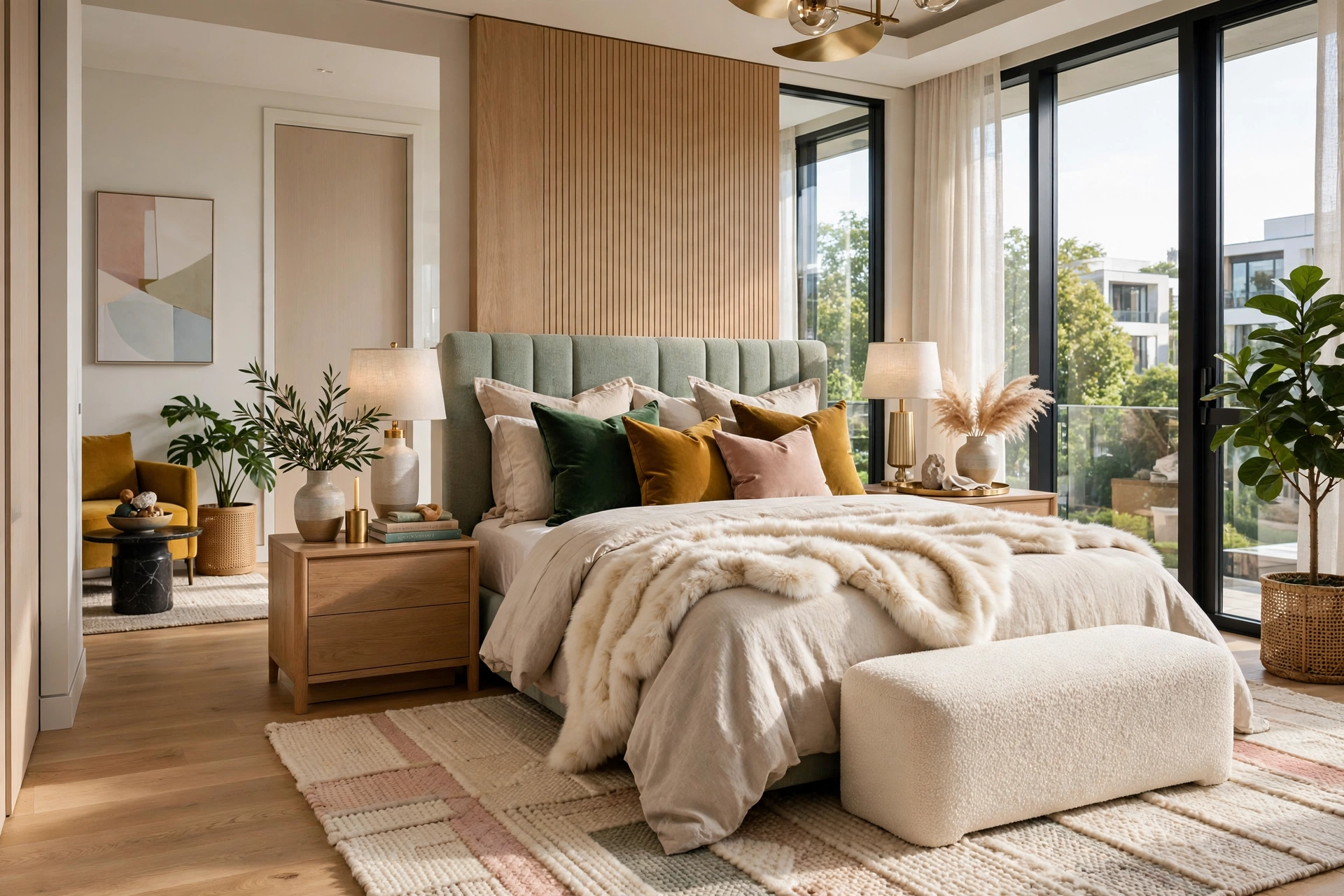
When the palette is calm, texture carries the richness. Hotels layer it relentlessly: velvet cushions against linen duvets, a nubby wool throw over smooth sateen, a faux-fur throw at the bed’s foot. The hand wants to touch everything, and that tactility is what the eye reads as luxury.
Build it in three weights: smooth (sateen sheets, silk-look pillows), nubby (linen duvet, woven throw), and plush (velvet cushions, faux-fur accent). Repeat each texture at least twice so it reads as a scheme — the velvet appears in the cushions and the bench, the linen in the duvet and the curtains. Texture is how a neutral room avoids ever looking flat.
19. Keep Surfaces Clutter-Free

The unsexiest hotel secret is also the most powerful: clear surfaces. Hotel rooms have almost nothing on display — and that visual quiet is half of what makes them restful. Audit every surface in your bedroom with hotel eyes: dresser, nightstands, windowsill, bench. If an object does not earn its place aesthetically, it gets a home inside something closed.
Build the habit of the nightly reset: mail in one tray, chargers in the drawer, clothes in the hamper or closet — nothing draped, nothing stacked. It takes five minutes and the payoff is disproportionate: a clear surface reflects lamplight and reads as calm, while a covered one absorbs light and reads as noise. This costs nothing and does more for the hotel feeling than any purchase on this list — the same editing discipline behind our tiny apartment decorating ideas, where every visible object has to earn its place.
⚠️ Warning: Do not confuse minimalism with emptiness. A hotel room is edited, not bare — the styled nightstand, the art, the throw all stay. Remove the clutter (the chargers, the paperwork, the half-unpacked bag), keep the intention (the books, the candle, the flowers). The line is whether the object was chosen or merely landed there.
20. Install Wall Sconces Instead of Table Lamps

For the true boutique look, swap bedside table lamps for wall-mounted sconces. Sconces free the entire nightstand surface, cast a flattering up-and-down glow that makes the wall itself luminous, and read as custom and considered — the detail that separates decorated bedrooms from designed ones.
Plug-in sconces with cord covers make this fully renter-friendly: no wiring, no electrician, just a hook and a fabric cord run neatly down the wall. Mount them at about 55 to 60 inches from the floor, roughly 30 inches apart centered on the bed. Pair with the floating-nightstand trick and both sides of the bed become air — the floor disappears, the wall glows, and the room feels custom.
21. Choose a Statement Chandelier or Pendant

The ceiling fixture is the bedroom’s jewelry, and hotels never waste it on a sad flush mount. A sculptural chandelier, a woven rattan pendant, or a pair of small pendants flanking the bed instantly elevates the room — it draws the eye up, adds a focal point above the sightline, and makes the whole space feel considered.
Scale it to the room: the fixture’s diameter in inches should roughly equal the room’s length plus width in feet (a 12×14 room wants ~26 inches of fixture). Hang it 7 feet off the floor minimum so nobody meets it unexpectedly. And put it on a dimmer — a chandelier at full blast is interrogation lighting; dimmed to a glow, it is the room’s evening crown.
22. Add a Tray With Carafe and Glasses
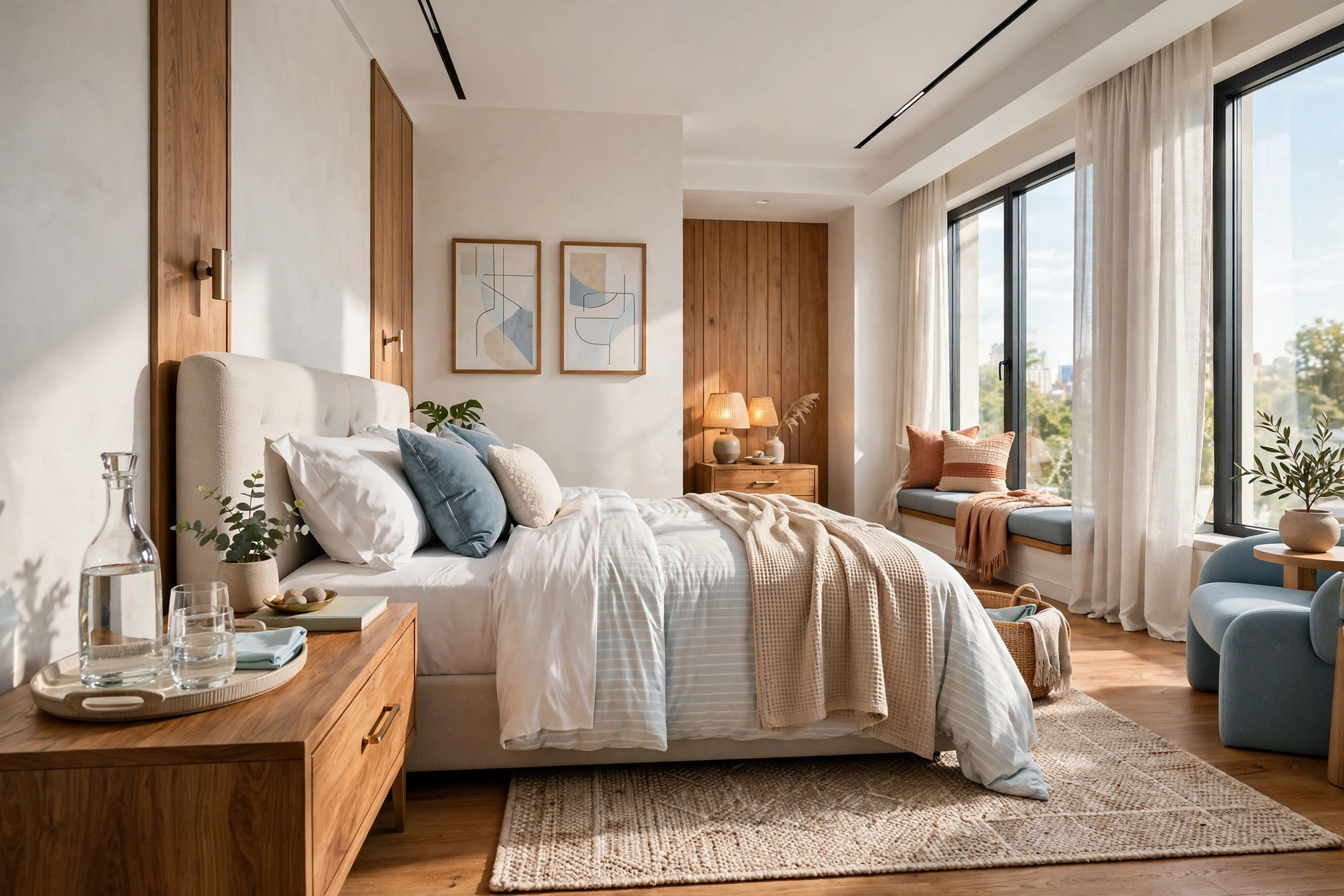
This tiny ritual object is pure hotel theater: a tray on the nightstand or dresser holding a water carafe and two glasses. It costs almost nothing, takes ten seconds to arrange, and delivers an outsized message — someone thought about your comfort here, even if that someone was you.
Choose a tray with presence (mirrored, lacquered, or brass) and keep the styling minimal: carafe, two glasses, nothing else. Refill it as part of the evening routine. It is the kind of detail guests notice and remember, and it turns an ordinary nightstand into a considered vignette. Small rituals, repeated nightly, are what make a room feel like a retreat rather than a holding pen for sleep.
23. Drape a Cashmere-Style Throw
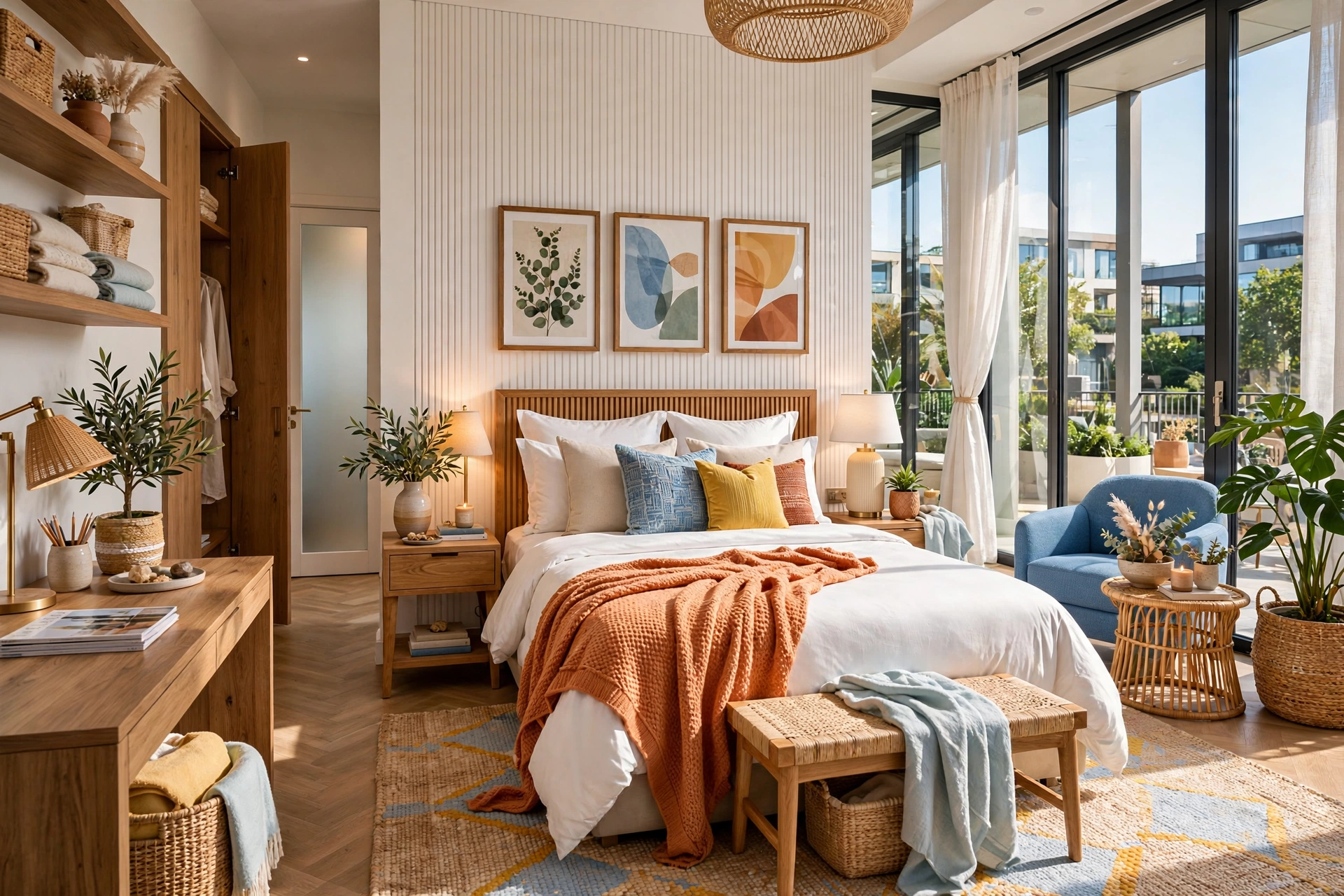
The throw across the foot of the bed is the hotel bed’s signature flourish — that band of contrasting texture that says “this bed was dressed by someone who cares.” Choose a throw in a rich texture (chunky knit, faux fur, or a soft plaid) in a tone that complements the bedding, and drape it casually across the foot, slightly off-center for that effortless look.
Fold it in thirds lengthwise first for a tailored band, or toss it for a relaxed feel — both read as hotel, just different hotels. This is also your seasonal refresh engine: swap the throw’s weight and color twice a year and the whole bed feels restyled for the price of one textile. Keep a second throw in a basket nearby for actual use, so the dressed one stays pristine.
24. Upgrade Your Pillow Game
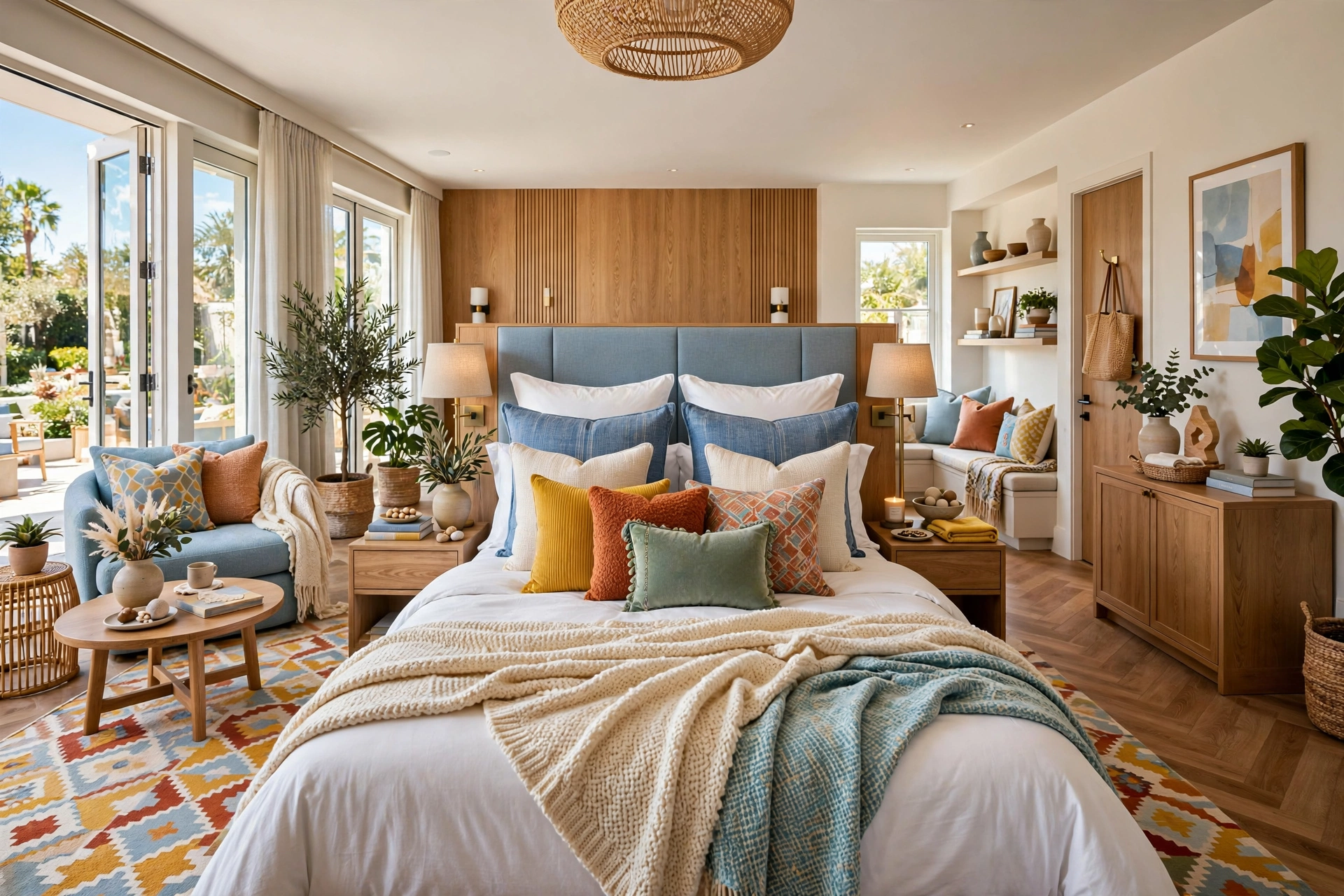
Hotel beds look abundant because of the pillows — and the arrangement is a formula, not a mystery. Back row: two sleeping pillows flat and upright against the headboard. Middle row: two Euro shams (26×26) standing tall. Front row: two or three smaller decorative cushions, karate-chopped down the middle for that plump crease. That is the whole architecture.
Invest in the sleeping pillows first — good ones with the right loft for your sleep position matter more than any decorative sham. Then add the Euros in the same white as the bedding, and finish with two accent cushions that pull in your palette’s tones. Fluff and chop daily; flat sad pillows undo the entire effect in seconds.
25. Finish With the Turndown Touch
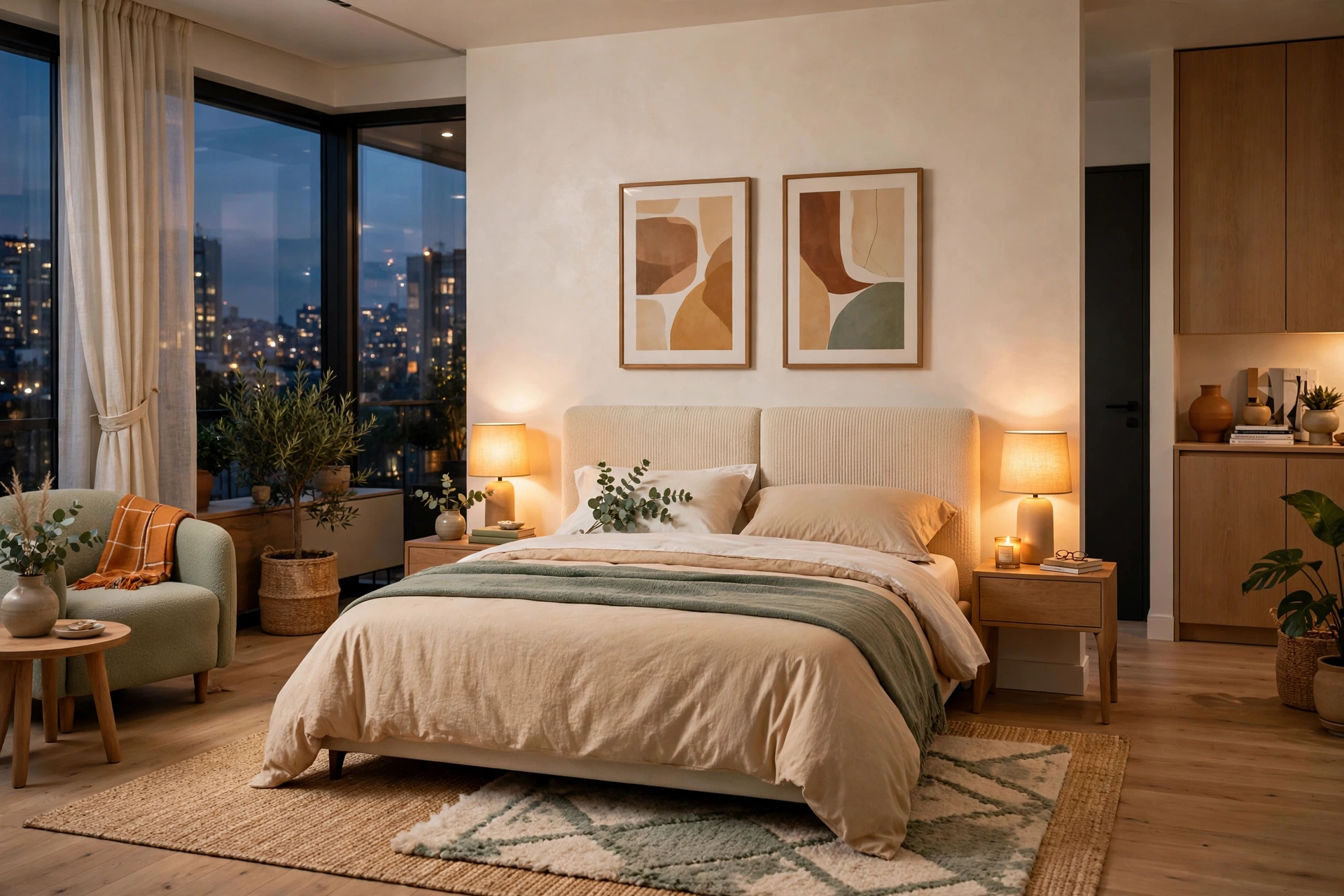
The final hotel secret is a ritual, not a purchase: the turndown. Each evening, fold back the duvet corner, fluff the pillows, dim the lamps, and — if you are feeling theatrical — place a small chocolate or a sprig of eucalyptus on the pillow. It takes two minutes and it reframes the entire relationship with the room: the bedroom is not where the day ends by default, it is prepared for you.
Pair the turndown with the nightly reset from idea #19 and the room greets you the way a suite does — calm, glowing, ready. This is the idea that costs nothing and delivers the most, because the hotel feeling was never really about the thread count. It was about the sense that someone — even if that someone is you — prepared this room with care.
Common Hotel-Style Bedroom Mistakes
Mistake 1: Buying Hotel Style in the Wrong Color Story
A “hotel bedding set” in the wrong palette — icy blue-gray when your room is warm, or stark white when everything else is cream — creates a disjointed bed that fights the room. Build the bedding around your room’s actual undertones: warm ivory for warm rooms, crisp white for cool ones. The hotel look is about harmony, not a specific shade.
Mistake 2: Symmetry on the Nightstands, Chaos Everywhere Else
Matching lamps mean nothing if the dresser is buried and the floor is a laundry field. Symmetry is the finishing layer, not the foundation — it only reads as calm when the room underneath is already edited. Do the declutter reset first, then add the matched pairs. Order matters enormously here.
Mistake 3: One Overhead Light Doing All the Work
A single ceiling fixture blasting down is the fastest way to kill the hotel mood, no matter how beautiful the bedding. Hotels layer: overhead for function, bedside for reading, accent for glow. If you add only one thing after the bedding, make it a second light source — the room’s evening personality lives in its layers.
Mistake 4: Skimping on What You Touch
Thread count is not the whole story, but what touches your skin matters more than what the eye sees. Cheap scratchy sheets in a beautiful room still feel cheap at midnight. Spend on the sheets and pillows first, save on the decorative layers — nobody ever stroked a Euro sham at 2 a.m. and felt luxurious.
Mistake 5: Forgetting the Room Has to Work by Day
A bedroom styled purely for the evening glow can feel flat and lifeless at noon. The hotel formula works around the clock because daylight is part of the design: sheers that glow, mirrors that bounce light, a palette that looks good in sun. Style for the morning too — the reading corner, the flowers, the clear surfaces all earn their keep in daylight.
Frequently Asked Questions
1. How can I make my bedroom feel like a 5-star hotel on a budget?
Start with the highest-impact, lowest-cost moves: crisp white bedding, perfect nightstand symmetry with matching lamps, a nightly declutter reset, and warm layered lighting. These four deliver most of the hotel feeling for very little money. Add the throw, the tray-and-carafe ritual, and the turndown habit — all nearly free — and the room transforms without a renovation.
2. What color should a hotel-style bedroom be?
Calm and low-contrast: warm whites, soft grays, gentle taupes, muted blues — one family, differing in tone and texture rather than color. White or ivory bedding is the classic anchor. Keep contrast in the small accessories, never in the big surfaces, so the eye flows across the room without stopping.
3. How do hotels get their beds to look so perfect?
Layering and precision: fitted sheet, flat sheet folded back over the duvet, smooth duvet cover, a folded throw across the foot — each layer smooth and symmetrical. Pillows follow the formula: sleeping pillows upright at the back, Euro shams in the middle, two or three accent cushions in front. The daily habits — the crisp fold, the fluffed pillows — matter as much as the linens.
4. Are white sheets practical for a real bedroom?
Yes, with the right fabric and habits. White cotton percale or sateen washes clean, and bleach (used sparingly) keeps whites bright in a way colors never stay. The practical secret is having two sets so one is always fresh. Pets and kids do add laundry, but washable whites are honestly easier to keep looking good than mid-tone colors that fade unevenly.
5. What lighting does a hotel-style bedroom need?
Three layers: ambient from the ceiling fixture, task light from matching bedside lamps or sconces, and accent glow — a picture light, an LED strip, a dresser lamp. All warm 2700K, all on separate controls, bedside on dimmers. The evening sequence (overhead off, bedsides low, accent on) is what creates the hotel mood.
6. How do I get the hotel look in a small bedroom?
The formula scales down beautifully — in fact, small bedrooms take to it naturally since hotels rooms are compact by design. Prioritize the bed wall, keep the palette light and low-contrast, use mirrors to double the light, and float nightstands to free the floor. Our full guide on how to make small bedroom feel bigger pairs perfectly with these ideas.
7. What is the cheapest hotel-style upgrade with the biggest impact?
The nightly turndown-and-reset ritual: fold back the duvet, fluff the pillows, clear every surface, dim the lamps. It costs nothing, takes five minutes, and reframes the room completely. Second cheapest: matching bedside lamps with warm bulbs — symmetry and glow for the price of two lamps.
Conclusion
The 5-star hotel bedroom was never about money — it was about decisions. Crisp bedding, perfect symmetry, layered warm light, clear surfaces, and small rituals repeated daily: that is the entire formula, and every piece of it works in a real bedroom on a real budget. You do not need room service to wake up feeling restored; you need a bed dressed with intention and a room edited with care.
Start with the bedding and the nightstands this weekend, add the lighting layers next, and finish with the turndown ritual that costs nothing. Within a month, your bedroom will not just look like a suite — it will feel like one. And the best part of the hotel feeling at home? You never have to check out.