
18 Small Master Bedroom Ideas That Make the Most of Every Inch
Introduction
A small master bedroom is not a design problem to solve — it’s an invitation to be intentional. When every square foot counts, each choice carries more weight: the bed you pick, the color you paint, the lamp you place beside your pillow. And that focus can be a gift. Small master bedrooms often end up feeling more serene, more finished, and more “you” than their sprawling counterparts, simply because nothing in them is there by accident.
The good news is that making a small bedroom feel generous has less to do with square footage and more to do with smart decisions. Clear sightlines, a calm palette, furniture that earns its footprint, and storage that hides in plain sight can make even the most modest master feel like a retreat. You don’t need to knock down walls or spend a fortune — you just need a plan.
Below you’ll find 18 practical, room-tested ideas that help a small master bedroom feel bigger, work harder, and look beautiful. Browse them all, or cherry-pick the ones that fit your space and budget. Every idea is something you can actually do — no renovation crew required.
1. Choose a Low-Profile Bed Frame
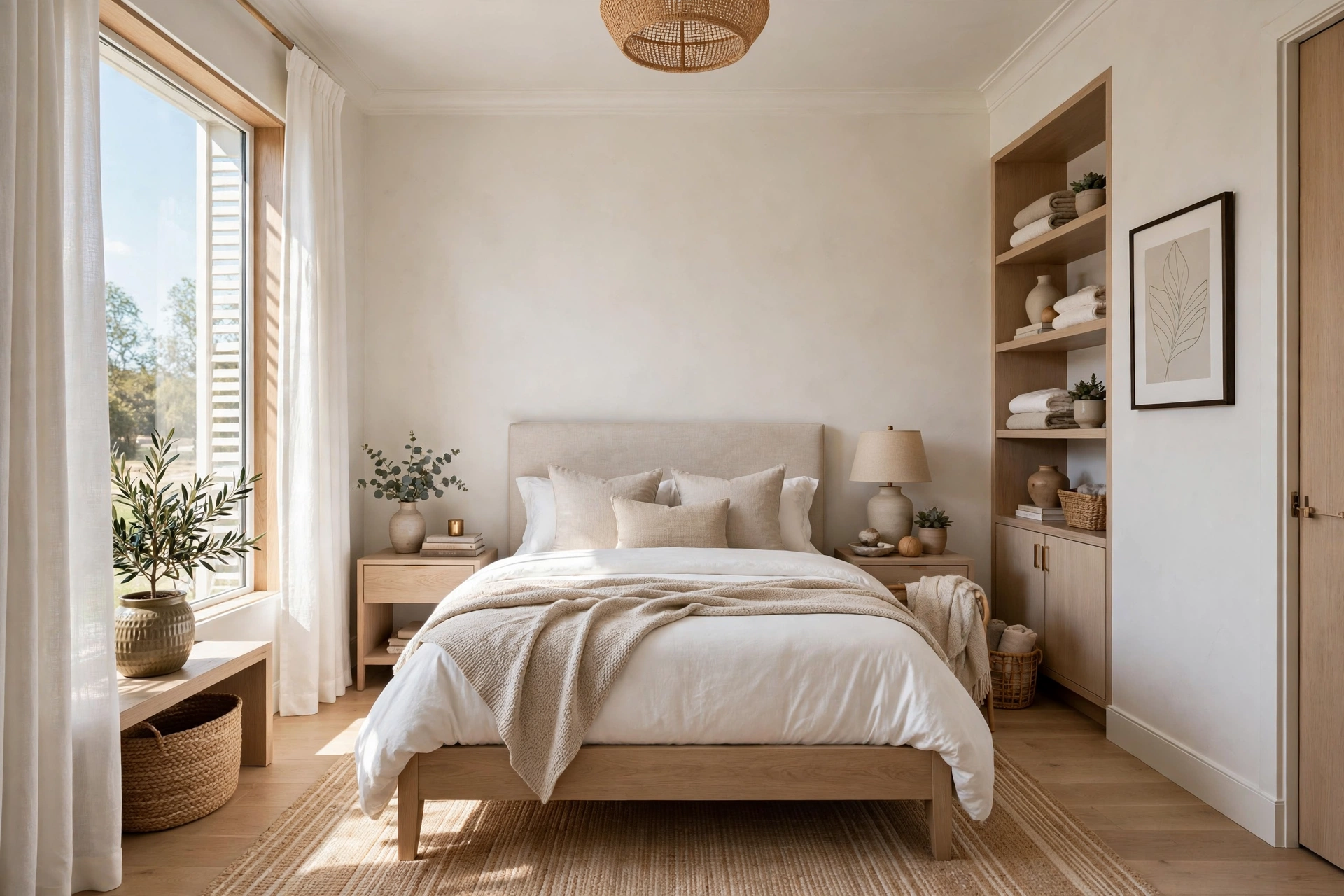
The bed is the biggest object in the room, so its silhouette sets the tone for everything else. A tall, bulky headboard and a towering frame can make a small bedroom feel boxed in, while a low-profile bed with a slim headboard keeps sightlines open and the ceiling feeling higher. Look for designs with clean lines and legs that lift the frame a few inches off the floor — that sliver of visible floor underneath tricks the eye into reading the room as larger.
Leggy frames also make cleaning easier, which matters more than it sounds in a small space. Dust bunnies multiply fast in tight quarters, and being able to slide a vacuum or mop under the bed keeps the whole room feeling fresher. If you love the look of an upholstered headboard, choose one with a narrow profile and a neutral fabric so it reads as texture rather than mass.
2. Mount Wall Sconces Instead of Table Lamps

Nightstands are prime real estate in a small master bedroom, and a chunky table lamp eats up most of it. Wall-mounted sconces free your nightstand surface for the things you actually reach for at night — a book, a glass of water, your phone — while delivering light exactly where you need it for reading. It’s one of the simplest swaps with the biggest payoff.
Choose plug-in sconces with swing arms if you don’t want to deal with wiring; they hang on a simple bracket and the cord can be dressed neatly down the wall. Position them so the light falls over your shoulder when you read in bed. This is one of those master bedroom design ideas that feels custom and high-end but is genuinely renter-friendly when done with plug-in fixtures.
3. Use Mirrors to Bounce Light Around

Mirrors are the oldest small-space trick in the book because they work. A large mirror opposite or adjacent to a window doubles the daylight in the room and creates the illusion of depth beyond the wall. In a small master bedroom, even one generous mirror — a full-length leaning mirror in a corner, or a wide round mirror above the dresser — can change how the room feels the moment you walk in.
Be thoughtful about what the mirror reflects. Aim it at something pleasant: a window, a piece of art, the prettiest corner of the room. A mirror that reflects clutter just doubles the clutter. Keep the frame slim and simple so the mirror itself doesn’t add visual weight, and if you’re working with very little wall space, mirrored closet doors do double duty beautifully.
Small Master Bedroom Quick-Start Checklist
- ✅ Measure your room and sketch the layout before buying anything
- ✅ Pick a low-profile bed with a slim headboard to keep sightlines open
- ✅ Free up nightstand space with wall-mounted sconces
- ✅ Place one large mirror to bounce window light around the room
- ✅ Commit to a light, cohesive color palette for walls and bedding
- ✅ Add hidden storage: under-bed bins, a storage ottoman, or drawers in the nightstands
- ✅ Hang curtains high and wide to make the window (and room) feel larger
4. Go Vertical with Storage

When floor space is scarce, the walls are your best friend. Tall, narrow dressers and wardrobes draw the eye upward and store a surprising amount without sprawling across the room. Floating shelves above the bed or beside a window turn dead wall space into display and storage for books, plants, and pretty boxes that hide the less pretty stuff.
The key is keeping vertical storage tidy — open shelves in a small room are on display, so use matching baskets or boxes to corral small items. A single tall bookcase in a corner can hold a wardrobe’s worth of folded clothes, shoes, and accessories if you organize it well. Think of your walls as a second floor plan, stacked upward.
5. Commit to a Light, Cohesive Palette

Color is one of the most powerful tools for making a small bedroom feel bigger. When walls, bedding, and large furniture pieces share a light, harmonious palette — warm whites, soft beiges, pale greys, gentle sage — the boundaries between objects blur and the room reads as one continuous, airy space. High-contrast color blocking, on the other hand, chops a small room into visual fragments.
That doesn’t mean everything must be white. Layer tones within the same family for depth: ivory walls, oatmeal bedding, a natural jute rug, oak nightstands. Add color through smaller, swappable pieces like throw pillows, art, and a throw blanket. If you crave a moody accent wall, keep it to the wall behind the bed and keep everything else light so the room doesn’t close in.
💡 Pro Tip: Paint the ceiling the same color as the walls (or one shade lighter) to erase the hard line where wall meets ceiling — the room will feel noticeably taller.
Quick Comparison: Small Master Bedroom Ideas by Cost and Effort
6. Use a Rug to Anchor the Room

It seems counterintuitive, but a generously sized rug makes a small bedroom feel larger, not smaller. A too-small rug chops up the floor and makes the room feel piecemeal; a rug that extends well beyond the bed on both sides unifies the floor plane and gives the eye one continuous surface to travel across. In a small master, aim for a rug that reaches at least 18 inches beyond each side of the bed.
Choose a low-pile rug in a light or neutral tone so it doesn’t visually dominate. A subtle pattern is fine — even welcome, since it hides everyday wear — but keep the contrast gentle. And make sure the rug sits flat and secure; a rug that slides around underfoot makes a small room feel chaotic instead of calm.
7. Pick Nightstands That Work Harder

In a small master bedroom, every piece of furniture should multitask, and nightstands are no exception. Choose nightstands with drawers or a closed cabinet rather than a simple open table — that hidden storage swallows chargers, medications, reading glasses, and all the small things that otherwise migrate onto the surface and create clutter. If you’re tight on width, a single wider nightstand on one side can work, or try narrow floating nightstands mounted to the wall.
Match the nightstand height roughly to the top of your mattress so reaching for things feels natural. And resist the urge to style the surface heavily: a lamp (or better, a sconce above), one small dish for jewelry, and a book is plenty. In small rooms, a clear surface reads as calm, and calm reads as spacious.
8. Hang Curtains High and Wide

Window treatments have an outsized effect on how big a room feels. Mount your curtain rod 4–6 inches above the window frame and extend it well beyond the frame on both sides, so when the curtains are open they frame the wall rather than covering the glass. This makes the window look dramatically larger and pulls more daylight into the room — both of which help a small bedroom feel bigger.
Choose curtains in a light fabric that coordinates with your walls; heavy, dark, high-contrast curtains visually shrink a small room. If privacy allows, sheer or light-filtering panels keep the room bright while softening the view. Floor-length curtains that just kiss the floor elongate the wall, so skip the sill-length styles in a small master.
9. Maximize Under-Bed Storage

The space under your bed is some of the most valuable real estate in a small master bedroom — use it. Low, flat storage bins or purpose-built under-bed drawers can hold off-season clothing, extra linens, shoes, or luggage without taking up a single inch of visible space. It’s essentially a free closet you already own.
To keep it functional, choose bins with lids and smooth-rolling wheels or handles, and label them so you actually use what you store. Vacuum-sealed bags are excellent for bulky items like winter bedding since they compress flat. Just be honest about what goes under there: if you haven’t touched it in a year, it probably doesn’t need prime under-bed real estate.
⚠️ Warning: Skip bed skirts or dust ruffles if you use under-bed storage — they hide your access and make the bed look bulkier. A tailored look keeps the bed feeling light.
10. Add a Bench or Storage Ottoman at the Foot of the Bed

If you have even two feet of clearance at the foot of the bed, a bench or ottoman earns its place many times over. It gives you somewhere to sit while putting on shoes, a landing spot for the throw blanket at night, and — if you choose one with storage inside — another hidden compartment for linens or out-of-season clothes. It’s the Swiss Army knife of small bedroom furniture.
Keep the scale modest: a bench should be slightly narrower than the bed and low enough not to block your view across the room. Upholstered styles in a light fabric keep things soft and cohesive, while a slim wooden bench with a cushion adds warmth. Either way, it turns dead space at the foot of the bed into one of the hardest-working spots in the room.
11. Keep Bedding Simple and Streamlined

Fussy bedding — ruffled skirts, a mountain of pillows, heavy layered patterns — adds visual bulk that a small bedroom can’t afford. Streamlined bedding in a cohesive palette makes the bed look tailored and calm, which makes the whole room feel more composed. Start with crisp sheets, a simple duvet or coverlet, and two sleeping pillows plus one or two accent pillows. That’s plenty.
Texture is your friend here: a chunky knit throw or a linen duvet cover adds richness without visual noise. Tuck or neatly fold the top of the duvet rather than letting it puddle, and make the bed every morning — in a small master, the bed dominates the view, so a made bed is the single fastest way to make the room feel orderly. These kinds of dreamy bedroom decor ideas prove that restraint often looks more luxurious than abundance.
12. Carve Out a Tiny Reading Nook

A master bedroom should feel like a retreat, not just a place to sleep — and even the smallest master can usually spare one corner for a reading nook. All you need is a comfortable chair (a compact armchair or even a large floor cushion), a small side table or wall-mounted shelf, and a good reading light. Tuck it into an underused corner, beside a window, or at the foot of the bed.
Define the nook with a small rug or a throw draped over the chair so it feels intentional rather than leftover. This little zone gives the bedroom a sense of purpose beyond sleeping, which paradoxically makes the room feel larger — it reads as a suite with areas, not a box with a bed. For more cozy bedroom inspiration, think of the nook as the room’s exhale: soft light, soft textures, zero clutter.
📌 Important: Keep the nook truly small — one chair, one light, one surface. A nook that sprawls defeats the purpose in a tight room.
13. Install Floating Shelves

Floating shelves are a small bedroom’s secret weapon: they add storage and display space without touching the floor, so the room’s footprint stays open. A pair of shelves above each nightstand can replace a bulky bookcase; a long shelf above the headboard becomes a gallery ledge for art and small plants; a single shelf beside a window makes a perfect mini bar-meets-vanity.
Style them with breathing room — a few books stacked horizontally, one plant, one framed photo. Crammed shelves in a small room read as clutter, while edited shelves read as design. Use sturdy brackets rated for the weight you plan to put on them, and keep everyday items within easy reach so the shelves stay functional, not just decorative.
14. Edit Your Wall Decor Ruthlessly

In a small master bedroom, wall decor should be curated, not collected. One or two well-chosen pieces — a large framed print above the bed, a small gallery of three frames on another wall — give the room personality without closing it in. A dozen small frames scattered across every wall, on the other hand, makes the room feel busy and smaller than it is.
Scale matters: art that’s too small for the wall looks lost and fussy, so go bigger than your instinct suggests for the main piece. Keep frames consistent (all black, all natural wood, all white) for a cohesive look that doesn’t add visual chatter. And leave some walls bare — negative space is a design element too, and in a small room it’s one of the most luxurious ones.
15. Choose One Statement Piece

Every beautiful small bedroom has one thing your eye lands on first — a gorgeous headboard, a striking pendant light, a bold piece of art, an incredible rug. One statement piece gives the room a focal point and a sense of intention; five competing statements give it chaos. Pick the one that makes you happiest and let everything else play a supporting role.
The statement piece should still respect the room’s scale. A dramatic oversized pendant hung low over the bed can actually work in a small room because it draws the eye up and adds drama without eating floor space. A sculptural chair in the reading nook, a vintage dresser with beautiful lines — whatever it is, give it room to breathe and keep its neighbors quiet.
💡 Pro Tip: If your statement piece is the headboard, keep bedding neutral so the headboard stays the star. Competing patterns shrink a room visually.
16. Layer Your Lighting

Overhead lighting alone makes a small bedroom feel flat and institutional. Layered lighting — a dimmable ceiling fixture or pendant, bedside sconces or lamps for reading, and one soft ambient source like a small table lamp on the dresser or LED strip behind the headboard — creates depth and warmth that makes the room feel larger and infinitely more inviting.
Put the layers on separate controls so you can shift the mood: bright and even for getting dressed, low and warm for winding down. Warm-toned bulbs (2700K-ish) flatter skin and make small rooms feel cozy rather than clinical. Good lighting is one of the most affordable ways to make a small room look bigger, because a well-lit room always feels more generous than a dim one.
17. Rethink Your Closet Doors

Swinging closet doors are space thieves: they need a clear arc of floor to open, which in a small master often collides with the bed or blocks a walkway. Swapping them for sliding doors, bifold doors, or even a simple curtain panel reclaims that floor space instantly and removes a daily frustration. It’s a weekend project with an everyday payoff.
While you’re at it, audit the closet interior. Double hanging rods, shelf dividers, and slim velvet hangers can roughly double a small closet’s usable capacity, which means less overflow into the bedroom itself. A closet that actually holds your clothes is one of the best small space furniture ideas in disguise — it keeps the bedroom serene because everything has a home behind closed doors.
18. Keep the Floor as Visible as Possible

Here’s the underlying principle behind almost every idea on this list: the more floor you can see, the bigger the room feels. Furniture with legs, wall-mounted nightstands and shelves, curtains hung high, a bed you can see under — all of these preserve visible floor, and visible floor is what tells your brain a room is spacious. When you’re deciding between two pieces, pick the one that shows more floor.
This doesn’t mean the room should feel empty. It means being deliberate: every item earns its footprint, pathways stay clear, and nothing sits on the floor “temporarily” for six months. A small master bedroom with clear floors, calm colors, and thoughtful storage doesn’t feel small at all — it feels like exactly the retreat it was meant to be. That’s the real secret behind every small bedroom feel bigger transformation: space you can see is space you can enjoy.
Common Small Master Bedroom Mistakes
Mistake 1: Buying furniture before measuring
Falling in love with a dresser online and discovering it’s four inches too wide for the wall is a classic small-bedroom heartbreak. Measure the room, doorways, and clearances first, and tape out furniture footprints on the floor with painter’s tape before you buy. Ten minutes with a tape measure saves weeks of regret.
Mistake 2: Pushing everything against the walls
It feels logical — clear the middle! — but lining every wall with furniture can make a small room feel like a storage unit. Floating the bed slightly off the wall (even a few inches) or angling one piece creates breathing room and better flow. Leave one wall relatively open so the eye has somewhere to rest.
Mistake 3: Using only overhead lighting
A single ceiling light casts harsh shadows and makes a small bedroom feel flat and cave-like. Without bedside and ambient layers, the room never feels cozy no matter how pretty the decor. Add at least two more light sources at different heights before you buy another throw pillow.
Mistake 4: Keeping every flat surface styled
In a small room, a fully styled dresser top, nightstand, and shelf collection reads as clutter, not design. Leave genuine empty space on surfaces — it gives the eye rest and makes the pieces you do display look intentional. When in doubt, remove one object from every surface.
Mistake 5: Ignoring the closet
A disorganized closet overflows into the bedroom: chairs become clothing racks, floors become shoe storage, and the room feels chaotic. Spend one afternoon adding double rods and slim hangers, and the whole bedroom gets calmer overnight. Storage you can’t see is the most valuable kind.
Frequently Asked Questions
1. What is the best bed size for a small master bedroom?
A queen is the sweet spot for most small masters — it sleeps two comfortably while leaving room to walk around. A king usually overwhelms a small room and eats the space you need for nightstands and pathways. If the room is truly tiny, a full-size bed with great bedding can still feel like a proper master.
2. What colors make a small master bedroom look bigger?
Light, warm neutrals — soft whites, warm beiges, pale greys, gentle sage — reflect light and blur the edges between surfaces so the room reads as larger. Keep contrast low between walls, bedding, and large furniture. You can still add deeper colors in small doses through pillows, art, and throws.
3. How can I add storage without making the room feel crowded?
Favor hidden and vertical storage: under-bed bins, nightstands with drawers, a storage ottoman, tall narrow wardrobes, and floating shelves. Closed storage beats open storage in small rooms because it hides visual clutter. Every piece of furniture should ideally store something.
4. Should the bed go against the wall in a small bedroom?
It depends on the layout. Against the longest wall usually works best and leaves the most open floor, but in a very narrow room, placing the bed with one side against the wall (like a daybed setup) can free up surprising floor space. Try painter’s-tape layouts before committing.
5. Do mirrors really make a small bedroom feel bigger?
Yes — a large mirror opposite or beside a window effectively doubles the daylight and creates an illusion of depth. The key is reflecting something pleasant like a window or art, not clutter. One generous mirror beats several small ones scattered around.
6. Can I have a reading nook in a very small master bedroom?
Usually yes. A compact armchair or even a comfortable floor cushion in an unused corner, paired with a small side table and a reading light, is all it takes. Keep it to one chair and one light so the nook adds charm without crowding the room.
7. What’s the biggest mistake people make in small master bedrooms?
Overfilling the room — too much furniture, too many small decor items, and surfaces covered edge to edge. Small rooms need negative space more than large rooms do. Edit ruthlessly, keep floors visible, and let a few good pieces do the talking.
Conclusion
A small master bedroom doesn’t need to feel like a compromise. With the right bed, a calm palette, lighting that flatters, and storage that works invisibly, a modest room can feel serene, spacious, and entirely yours. The ideas above aren’t about spending more — they’re about choosing better, editing bravely, and letting the room breathe.
Start with the quick-start checklist, pick two or three ideas that fit your space and budget, and live with them for a week before adding more. Small changes compound fast in a small room. Before long, you’ll stop thinking of your master as “small” at all — and start thinking of it as your favorite room in the house.