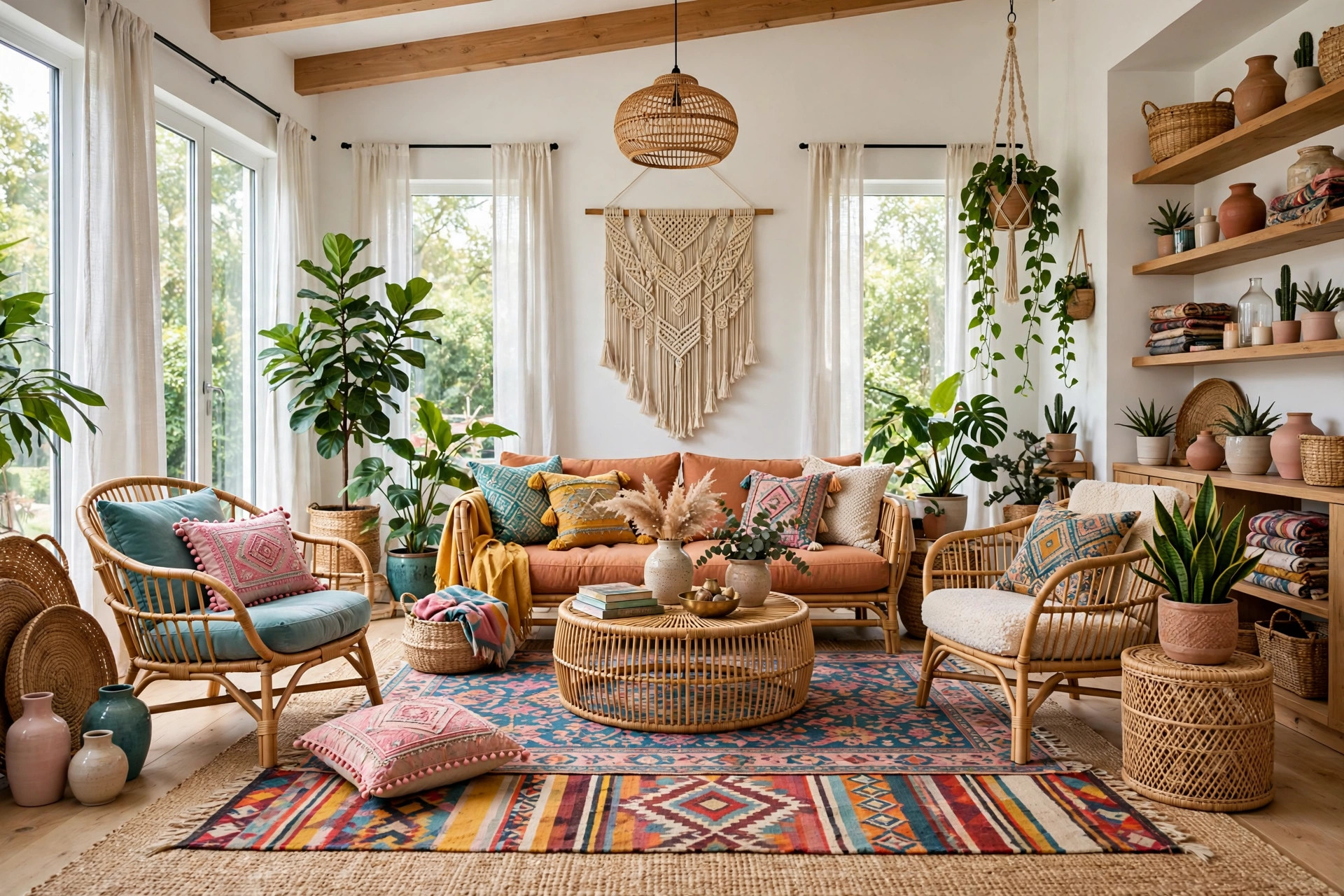
15 Bohemian Living Room Ideas: Layered, Eclectic Spaces to Copy
Some rooms are decorated. Bohemian living rooms are gathered. They grow the way a traveler’s suitcase grows — one kilim pillow from a market stall, one brass tray from an antique shop, one plant cutting from a friend — until the whole space hums with stories. If you have ever walked into a room and felt instantly at ease without knowing why, chances are you were standing in a boho space done right.
The bohemian style is wonderfully forgiving for real life. There is no single correct sofa, no mandatory color, no rule that says everything must match. What holds it together is layering: textiles over textiles, patterns over patterns, old beside new, rough beside smooth. That forgiving quality makes bohemian living room ideas some of the most approachable on the internet — and some of the most personal, because no two boho rooms ever look the same.
Below are fifteen bohemian living room ideas arranged from the highest-impact foundations to the finishing touches. Pick the three or four that speak to you first; boho is built in layers, not in one shopping trip. If your boho leanings also crave comfort, our roundup of cozy living room ideas layers beautifully with every idea here.
1. Start With a Layered Rug Foundation
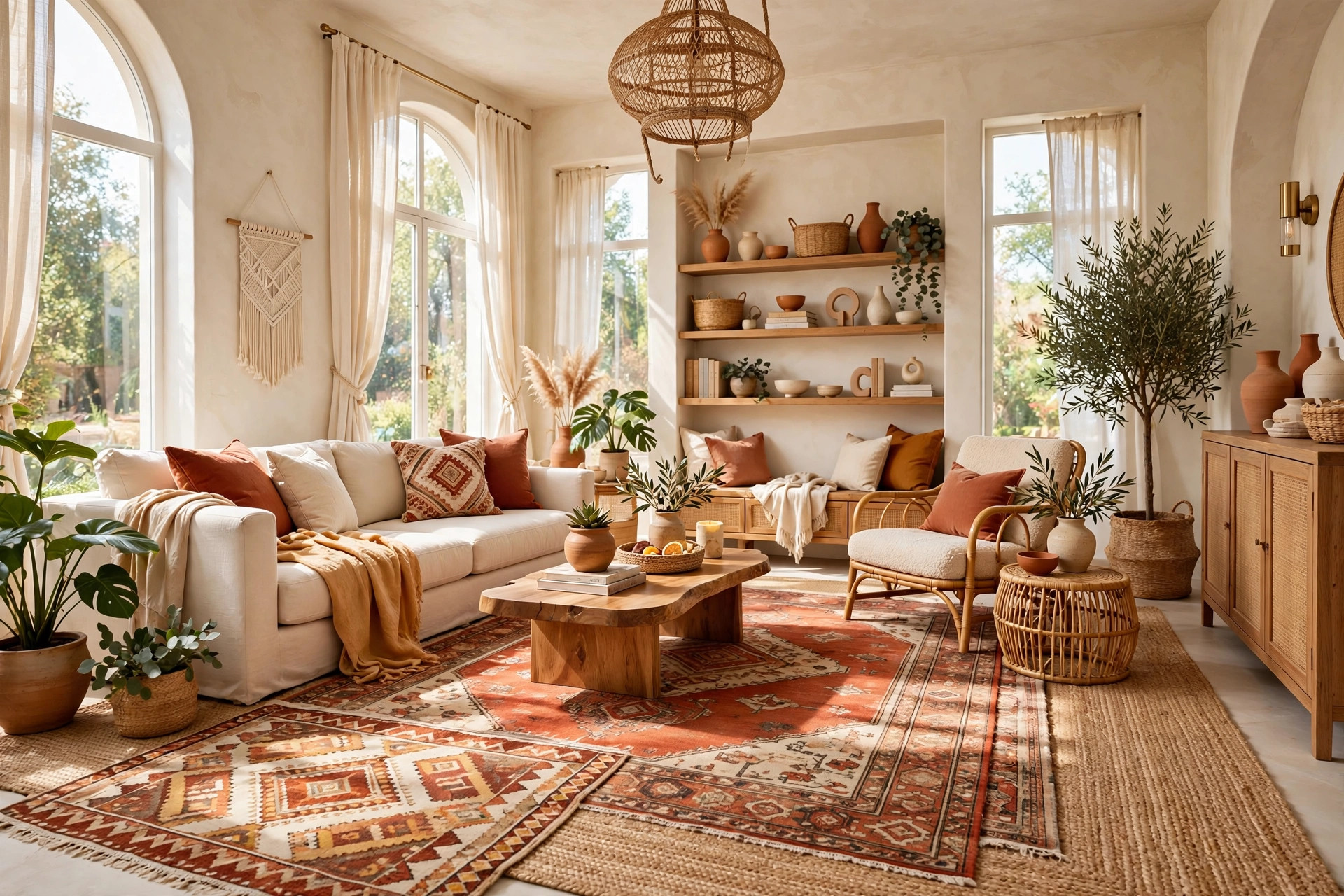
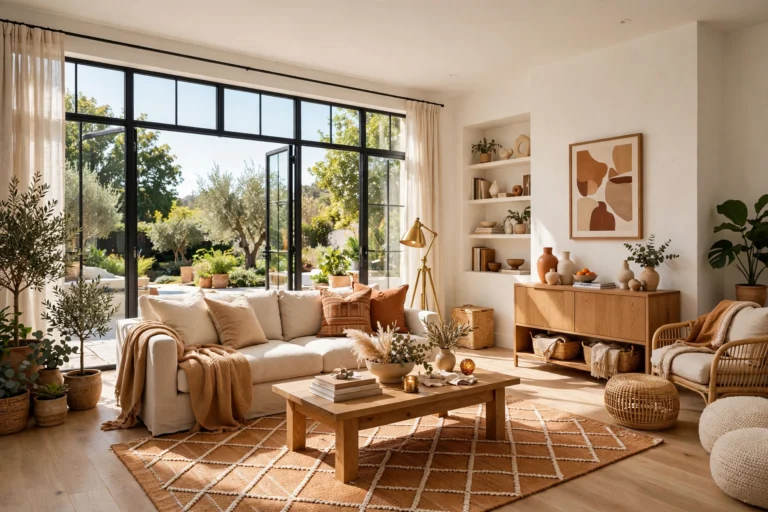
Every great bohemian living room starts at floor level. A single flat rug looks finished; two layered rugs look collected. Begin with a large natural-fiber base — jute or sisal in a warm neutral — big enough to sit under the front legs of your seating. Then layer a smaller, softer rug on top at a slight angle: a vintage-style Persian, a kilim, or a Moroccan-inspired pattern in your favorite colors.
The layering does two jobs at once. Visually, it adds instant depth and that traveled, collected-over-time feeling boho is famous for. Practically, it defines your seating zone the way a room-within-a-room should, which is especially useful if you are styling boho in a compact space — our small living room ideas for apartments roundup shows how one grounded zone can organize a whole open floor plan.
📌 Important: Keep the base rug neutral and the top rug patterned — never two loud patterns fighting each other. And size the base generously: a base rug that is too small makes the layered top look like it is floating instead of grounded.
2. Mix Patterns Fearlessly
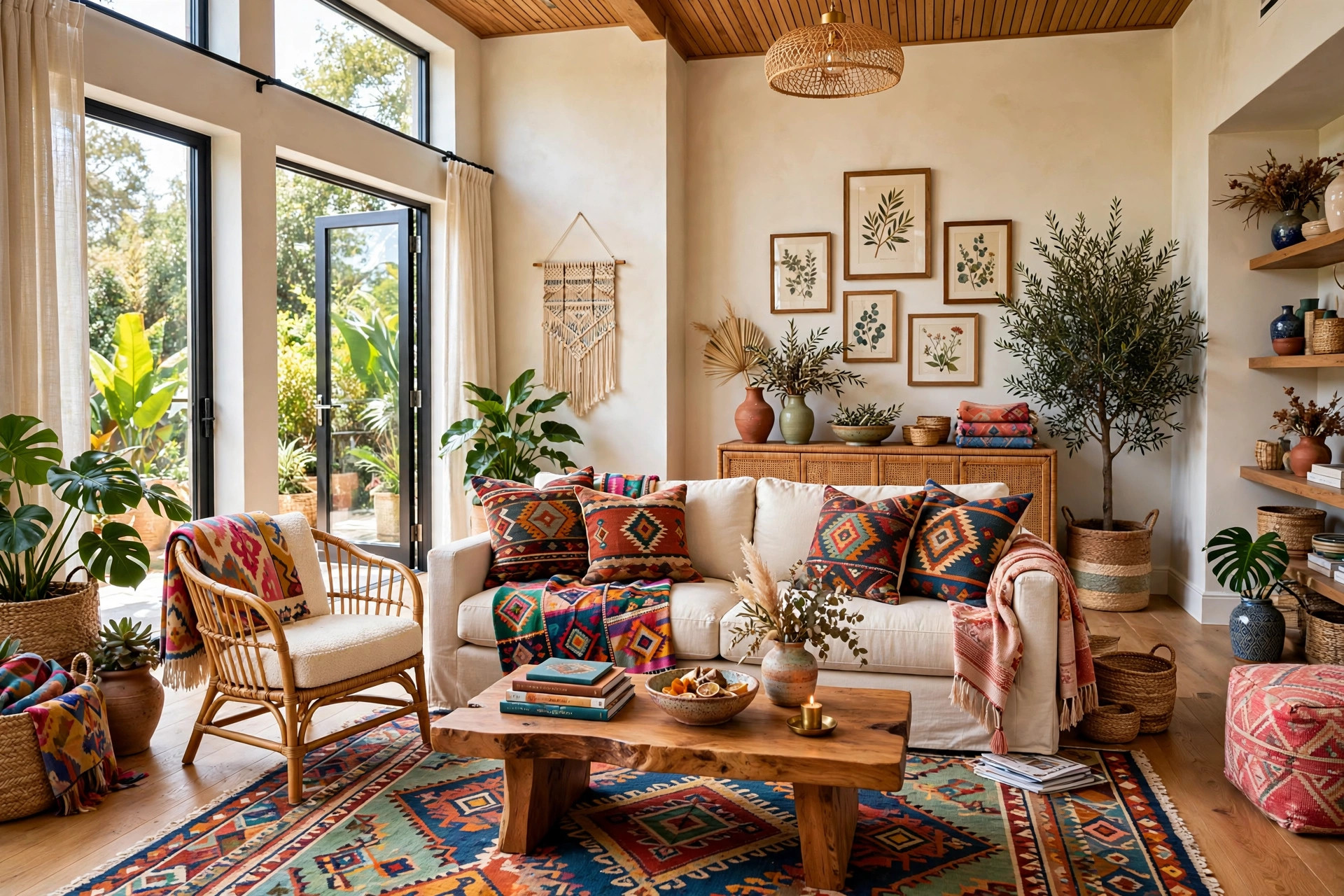
Boho is the one style where pattern-mixing is not just allowed, it is required. Stripes against florals, kilim geometry beside block-print paisley, a tribal mudcloth next to a faded botanical — the friction between patterns is what makes a bohemian room feel alive instead of staged. The secret that keeps it from becoming chaos is a shared color story: if every pattern pulls from the same warm palette, the mix reads as harmony.
Start with your two biggest patterns — usually the rug and the sofa pillows — and let them set the palette. Then echo one or two of their colors in every smaller pattern you add. A cushion, a throw, a lampshade, a piece of art: each one is a chance to repeat the story. Designers call this the “three-times rule” for a reason — a color that appears in three places becomes a scheme, while one that appears once looks like an accident.
3. Anchor the Room With a Rattan Accent Chair
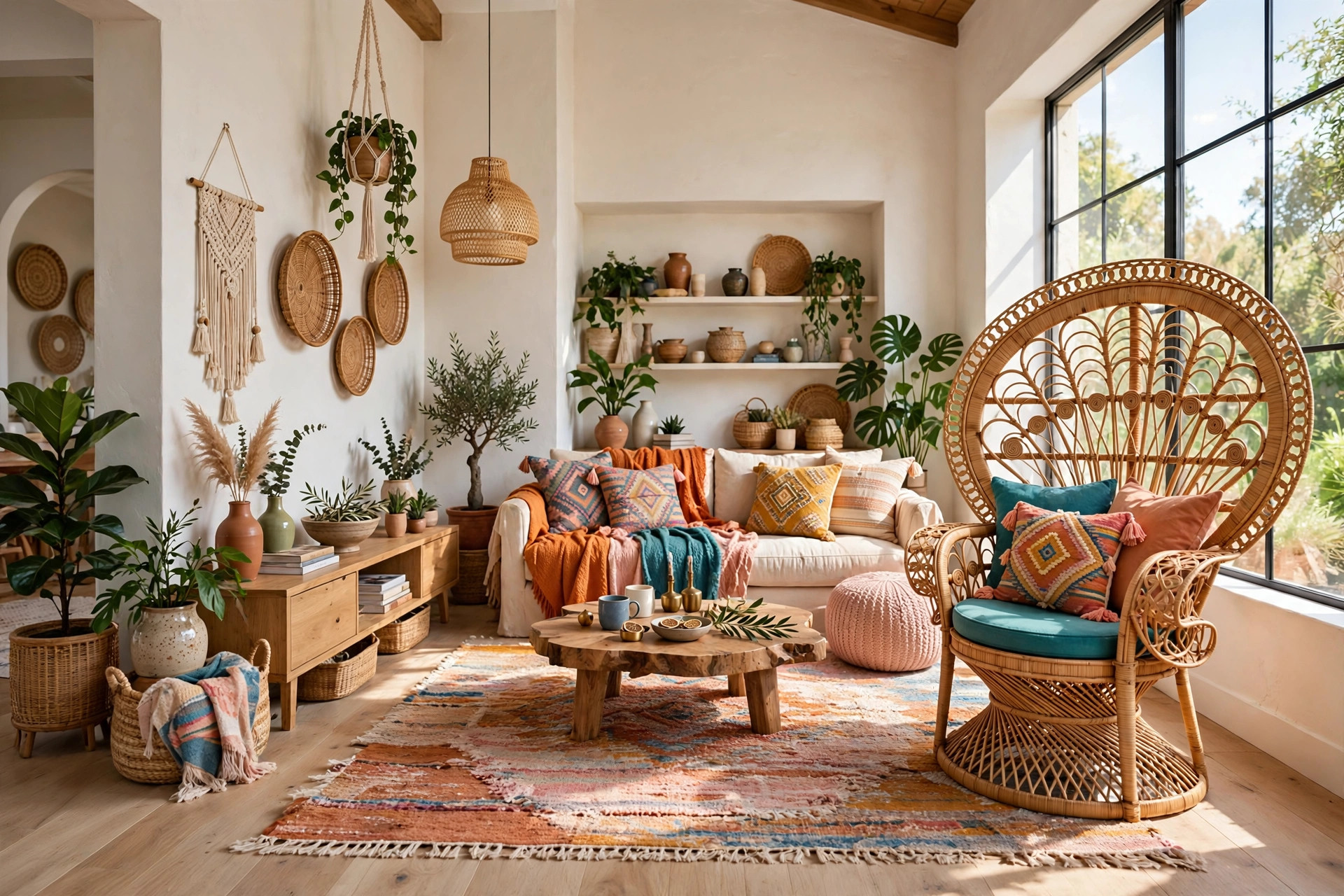
Few pieces say bohemian faster than rattan. A peacock chair, a hanging egg chair, or a simple curved rattan armchair brings the woven, handcrafted texture that anchors the whole boho look. It is the kind of piece that turns a corner from dead space into the room’s favorite seat, and it photographs beautifully — which is exactly why rattan chairs appear in nearly every boho living room worth copying.
Place yours where it catches the light: angled toward the sofa near a window, or floating as the room’s sculptural moment. Style it with one cushion and a small throw — rattan is already visually busy, so it needs very little dressing. If a full chair is out of budget, a rattan side table or a woven basket in the same honey tone gives you the material story for a fraction of the cost.
💡 Pro Tip: Real rattan varies in tone from honey to deep amber. If you are mixing rattan pieces, keep them within one tone family or the room can feel scattered — warm honey with warm honey, weathered gray with weathered gray.
4. Hang a Macramé Wall Hanging
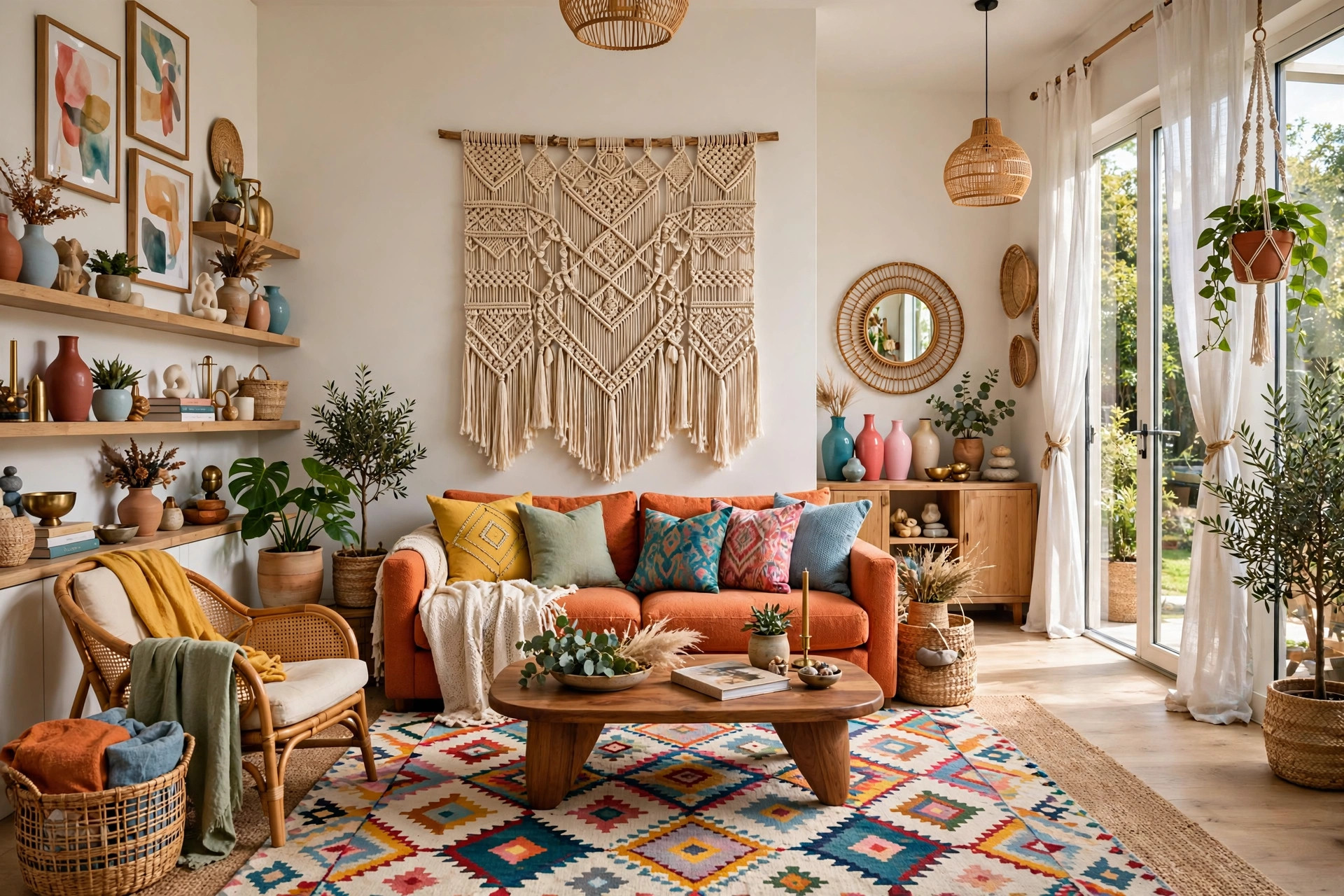
A large macramé wall hanging above the sofa is the boho focal point that never fails. Its knotted texture catches light and shadow in a way flat art never does, and it softens the hardest surface in the room — the wall — with something handmade and organic. Whether you buy one from an artisan or knot your own over a weekend, it instantly tells the eye this room was made, not just furnished.
Scale is everything here. A macramé piece should be generous — roughly two-thirds the width of the sofa beneath it. Too small and it reads as an afterthought. Hang it so its center sits at eye level, around 57 to 60 inches from the floor. If your walls cannot take the weight, lean a large macramé piece on a mantel or shelf for the same effect without a single nail.
5. Pile on Floor Cushions and Poufs for Casual Seating
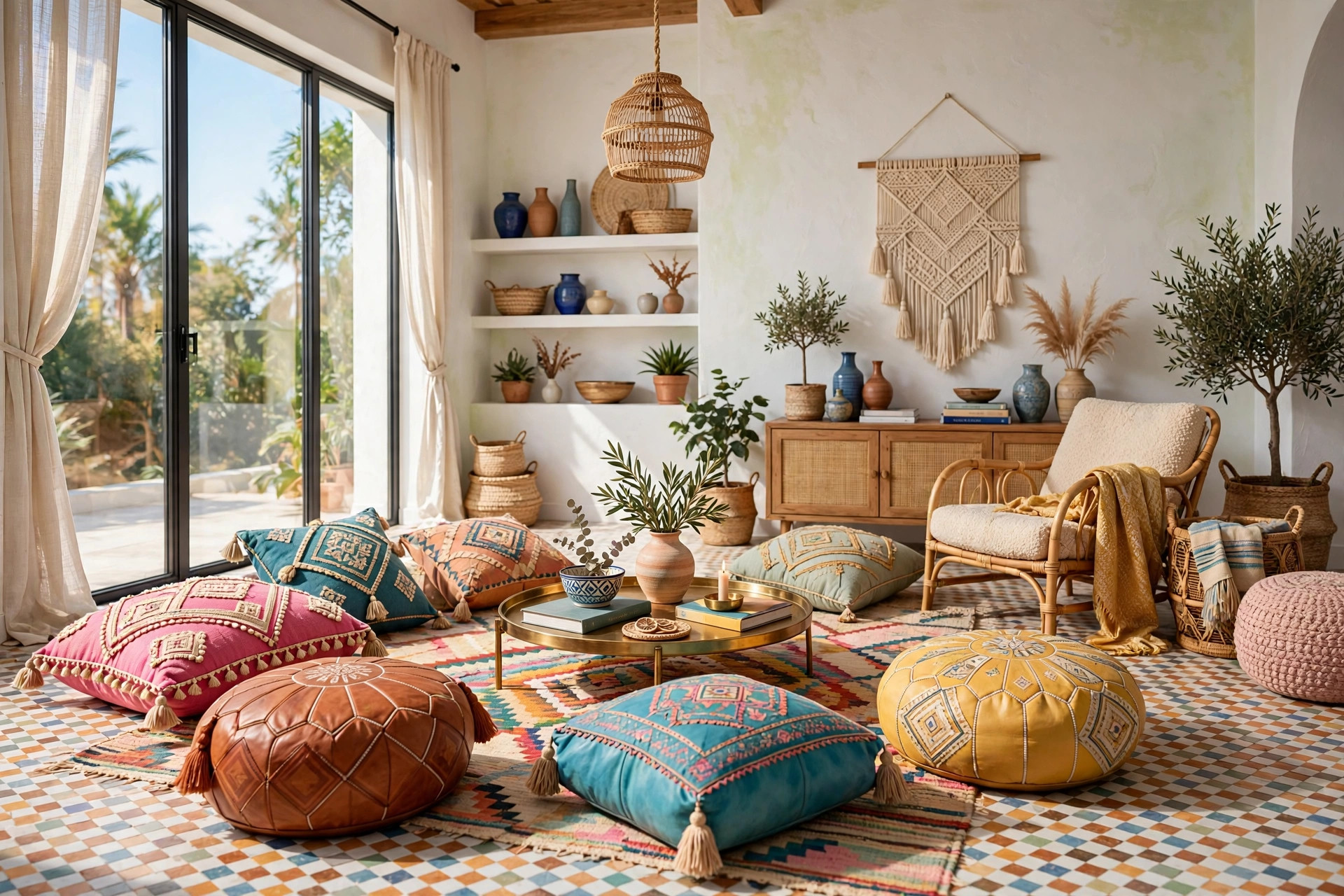
Bohemian living is low living. Floor cushions, Moroccan leather poufs, and oversized pillows scattered around a low table turn a formal seating area into an invitation: sit down, stay a while, put your feet up. This is the idea that makes a boho room feel instantly welcoming to guests — and it is one of the cheapest ways to add both seating and style.
The trick is variety within a family. Mix shapes (round poufs, square cushions, a long bolster), mix textures (embroidery, leather, kilim weave, pom-poms), but keep the palette in your room’s color story. Arrange them in a loose cluster rather than a neat row — boho seating should look like it drifted there, not like it was placed with a measuring tape. When extra seating is not needed, stack cushions in a corner basket and they become decor.
6. Warm Up the Palette With Earth Tones
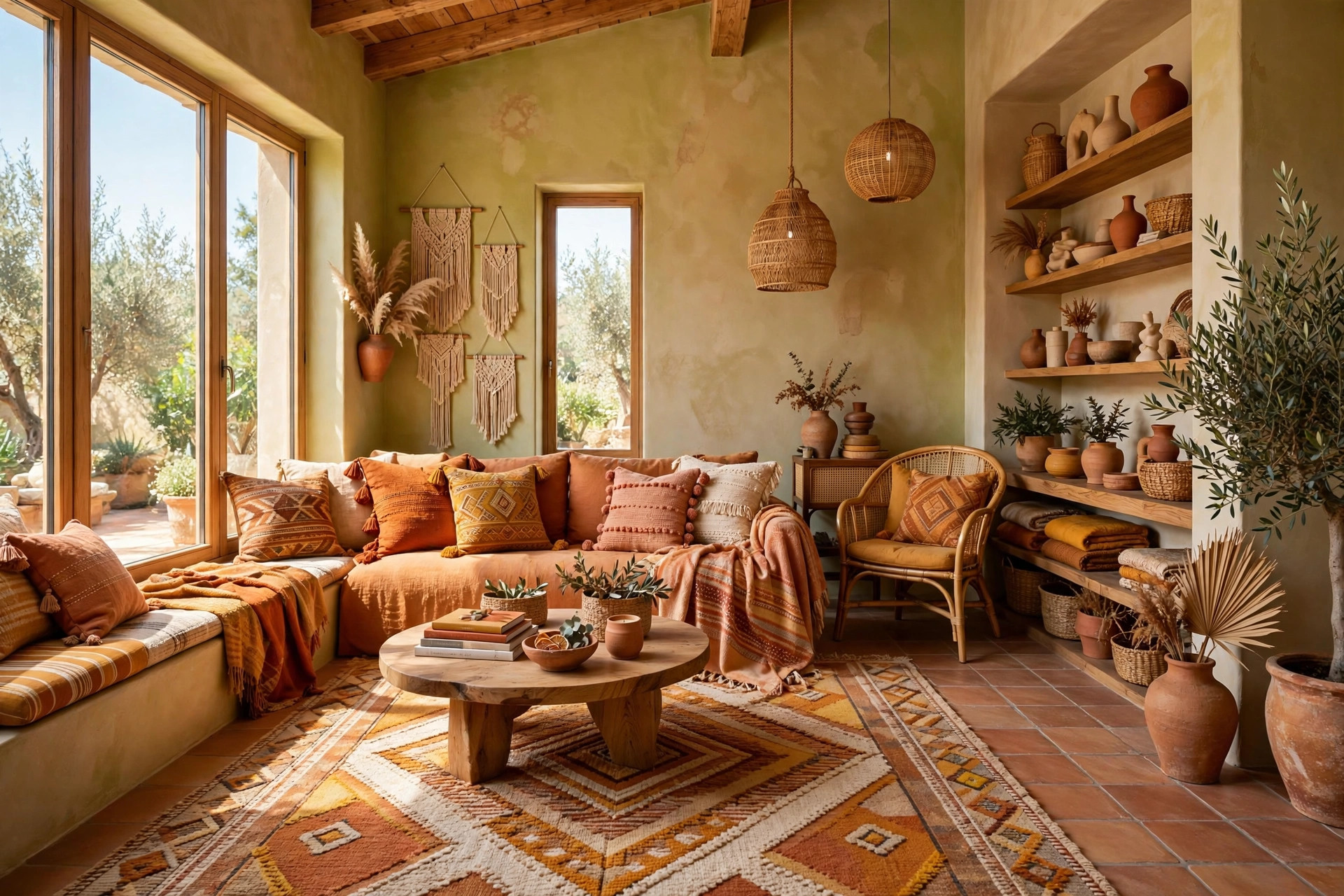
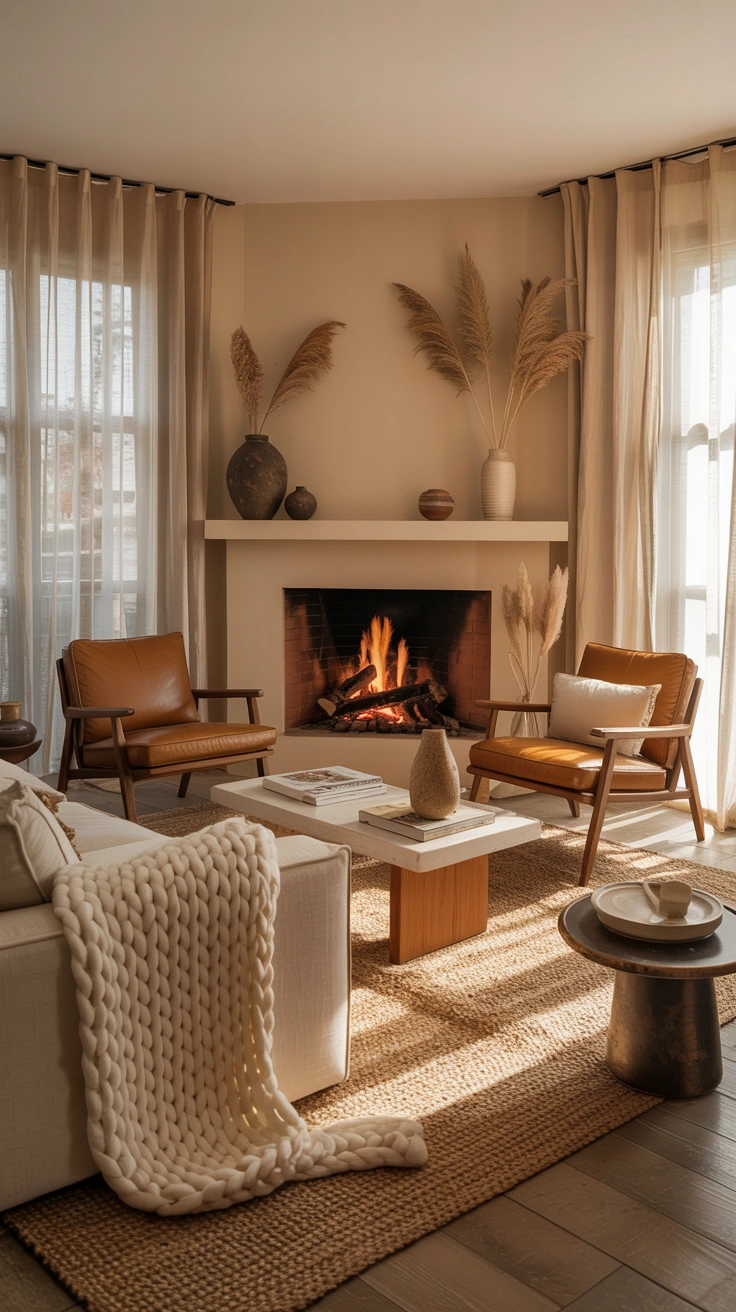
Bohemian color lives in the earth: terracotta, ochre, clay, rust, warm sand, olive, and deep warm browns. These are the pigments of sunbaked clay, spice markets, and desert light, and they give a boho room its unmistakable warmth. Even a room full of patterns feels calm when every color comes from the same sun-warmed family.
A simple way to get the proportions right is the 60-30-10 color rule: roughly 60 percent of the room in a calm warm neutral (walls, big rug), 30 percent in a mid-tone like caramel upholstery or honeyed wood, and 10 percent in the saturated earth accents — terracotta cushions, an ochre throw, one rust-colored vase. For deeper guidance on building palettes like this, our living room color schemes guide walks through designer-tested combinations. Keep your brightest earth tones in the swappable layers so you can shift the mood seasonally without repainting.
7. Fill Every Corner With Greenery
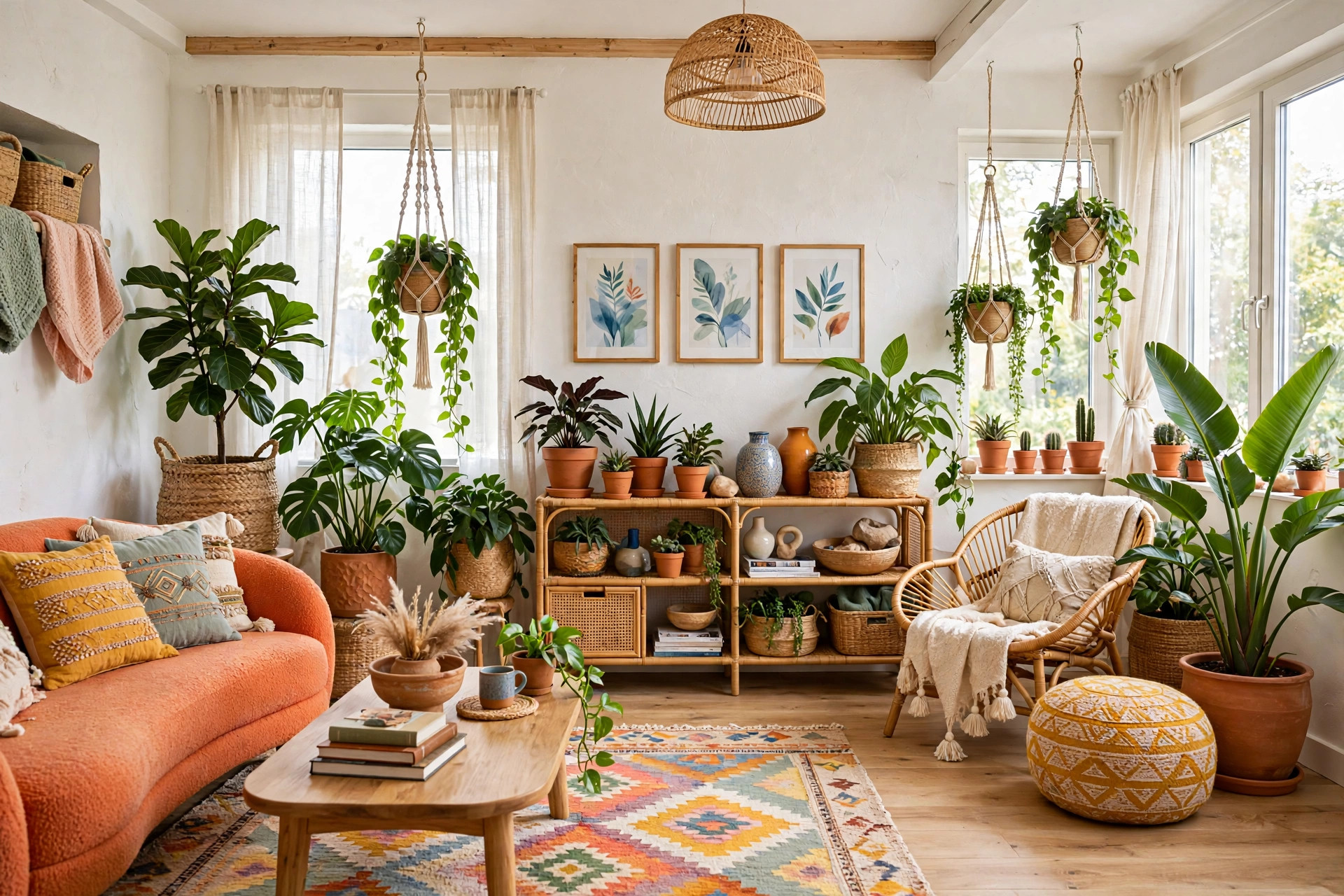
Plants are the living layer of a bohemian room, and boho is the style that asks for abundance. A tall fiddle-leaf fig in a woven basket, pothos trailing from a high shelf, a cluster of small succulents on the coffee table — greenery softens every hard edge and makes warm neutrals look warmer. In a style built on natural materials, real plants are not decoration; they are a material.
Group plants in odd numbers at different heights for the most natural look: one tall floor plant, one medium plant on a stool or side table, one trailing plant up high. Choose warm-material pots — terracotta, woven seagrass baskets, matte clay — because plastic nursery pots break the spell instantly. Low on natural light or plant skills? A few high-quality faux plants tucked among real ones keep the jungle feeling without the maintenance anxiety.
⚠️ Warning: More plants means more watering, more drainage trays, and more humidity near textiles. Always use saucers or waterproof liners inside woven baskets — one unnoticed leak can stain a rug and undo your whole layered foundation.
8. Hunt Down Vintage and Thrifted Treasures
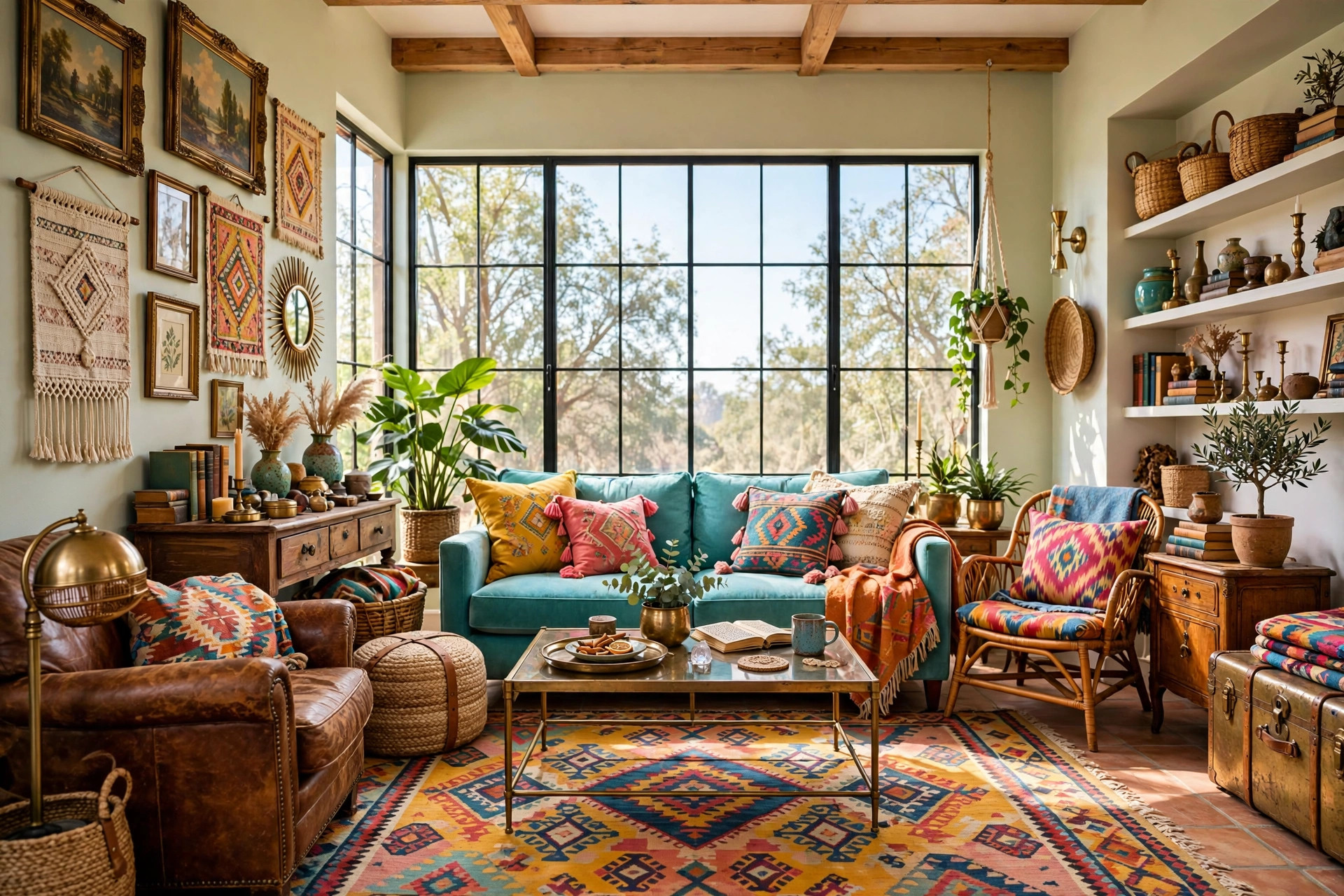
A bohemian room without anything old feels like a costume. The soul of boho is the collected-over-time feeling, and nothing creates it faster than genuinely old things: a brass candlestick with a real patina, a worn leather footstool, a carved wooden box, a stack of vintage books with sun-faded spines. Thrift stores, flea markets, and estate sales are boho gold mines — the style rewards the hunt.
Shop with a filter, not a list. Look for honest materials — solid wood, brass, ceramic, leather, woven fibers — and pieces with visible age. A scratched brass tray has more boho credibility than a perfect new one. And unlike the restraint in our modern living room design ideas guide, boho rewards a little clutter of the right kind: the difference is that every vintage piece should feel chosen, not accumulated. One rule of thumb: if you would not notice it missing, it is clutter, not curation.
9. Layer Throws and Blankets Everywhere
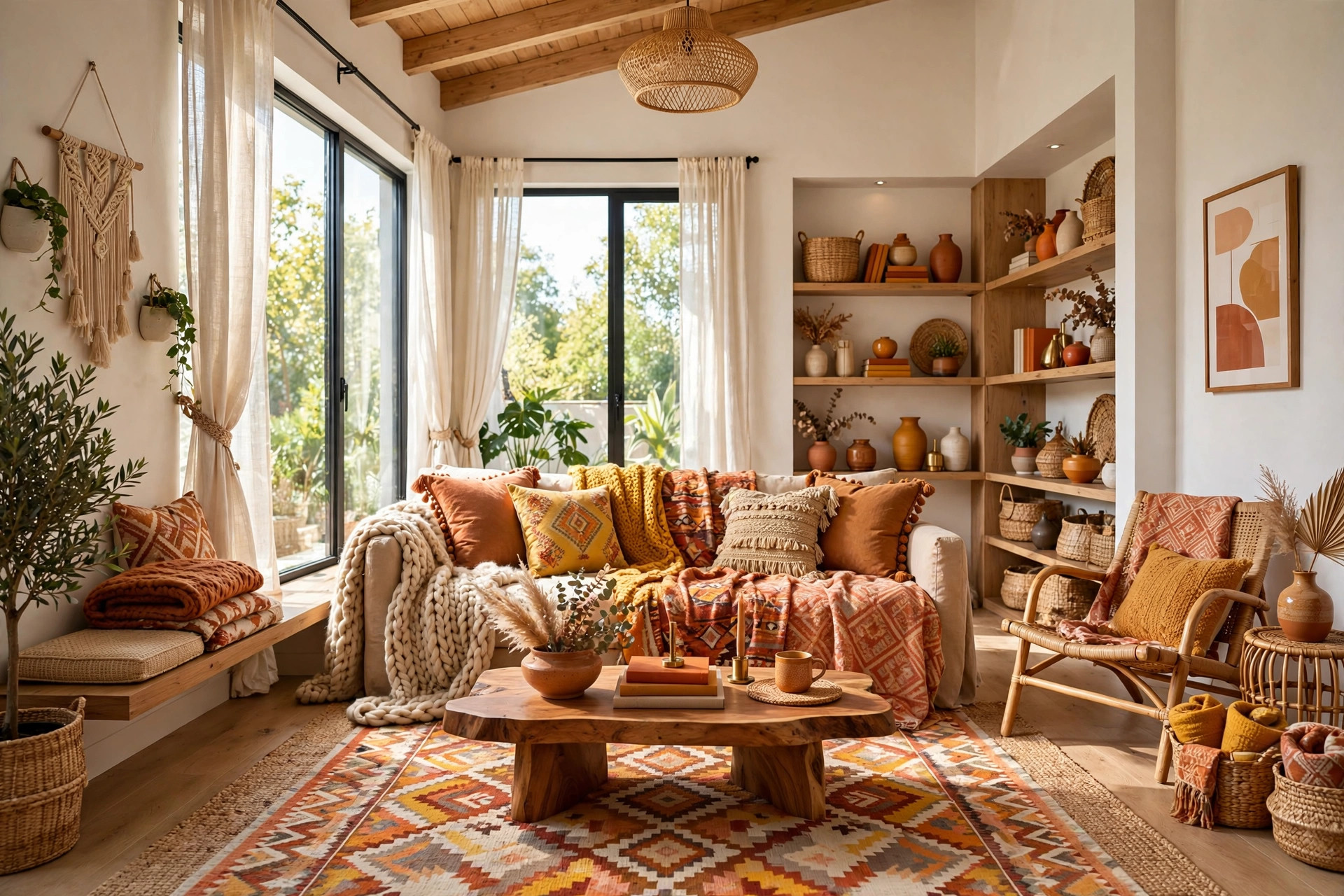
If rugs are the foundation, throws are the atmosphere. Drape a chunky knit over the sofa arm, fold a patterned kantha quilt across the foot of a chair, toss a mudcloth throw over the reading nook — every surface in a boho room should look like it is ready to keep someone warm. The layering is what separates a room that looks bohemian from one that feels bohemian.
Vary the weights and weaves: a nubby wool, a smooth cotton block print, a fringed lightweight throw, a heavier quilt. The contrast between them is what makes the layering read as rich instead of messy. And do not fold everything with military precision — boho throws look best casually tossed, with one corner trailing. Corral the spares in a big woven basket beside the sofa so the abundance stays intentional instead of sliding into laundry-pile territory.
💡 Pro Tip: Wash and rotate throws seasonally. A quick refresh — heavier knits in fall, lighter cottons in spring — makes the room feel intentionally restyled twice a year for zero cost.
10. Build an Eclectic Gallery Wall
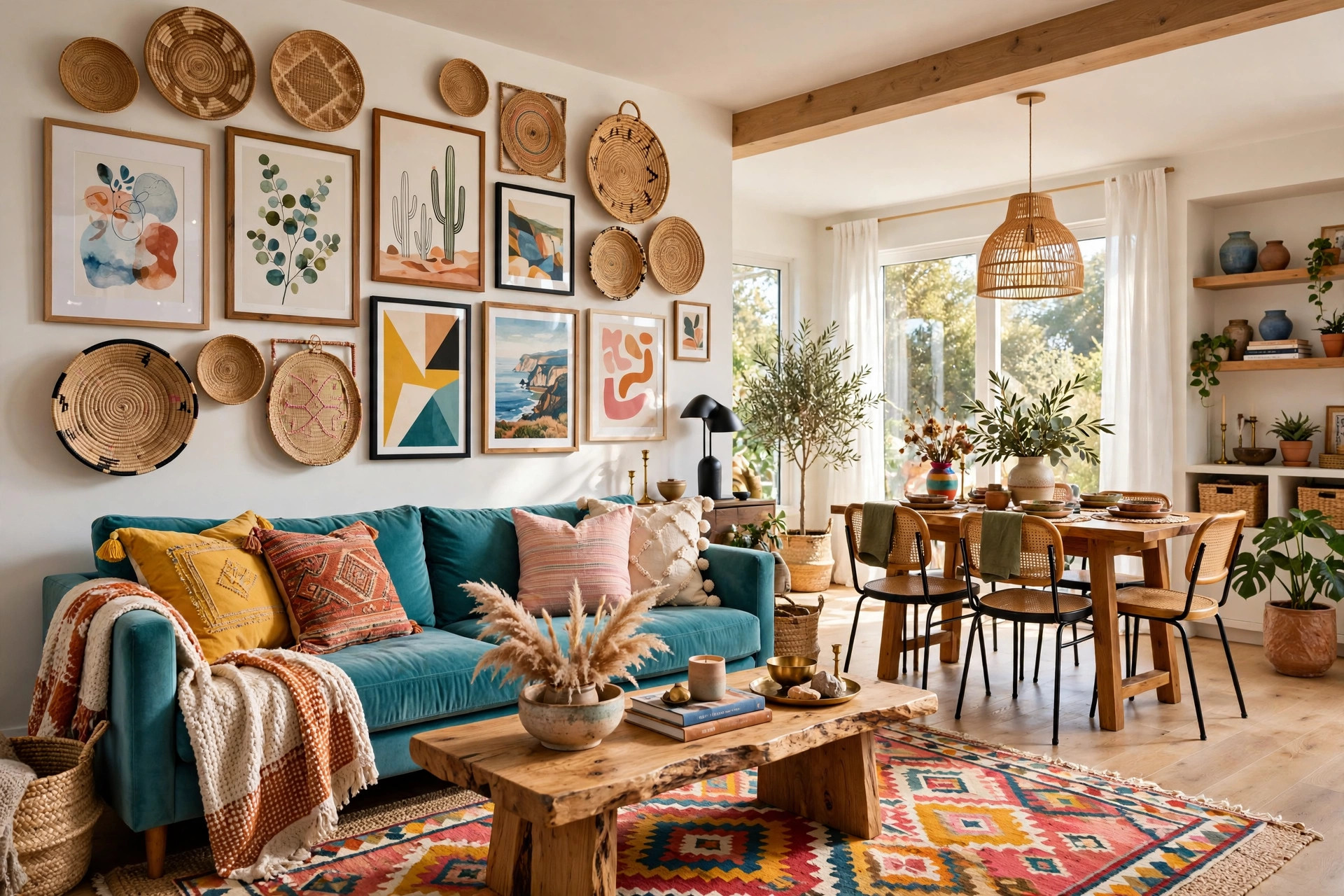
A gallery wall is where a bohemian living room shows its personality, and boho is the one style where the wall should genuinely be eclectic: art prints beside woven wall baskets, a small mirror beside a textile hanging, framed photography beside a carved wooden mask. The mix of mediums is the point — a wall of identical frames belongs to a different style.
The glue is the layout, not the frames. Plan the arrangement on the floor first, starting with the largest piece slightly off-center, then fill around it keeping two to three inches of consistent spacing. Take a phone photo of the floor layout before you hang anything — it is far easier to rearrange on the floor than on the wall. Keep the palette tied to the room (one or two of your accent colors appearing in the art) and the chaos becomes a collection.
11. Glow It Up With Lanterns and String Lights
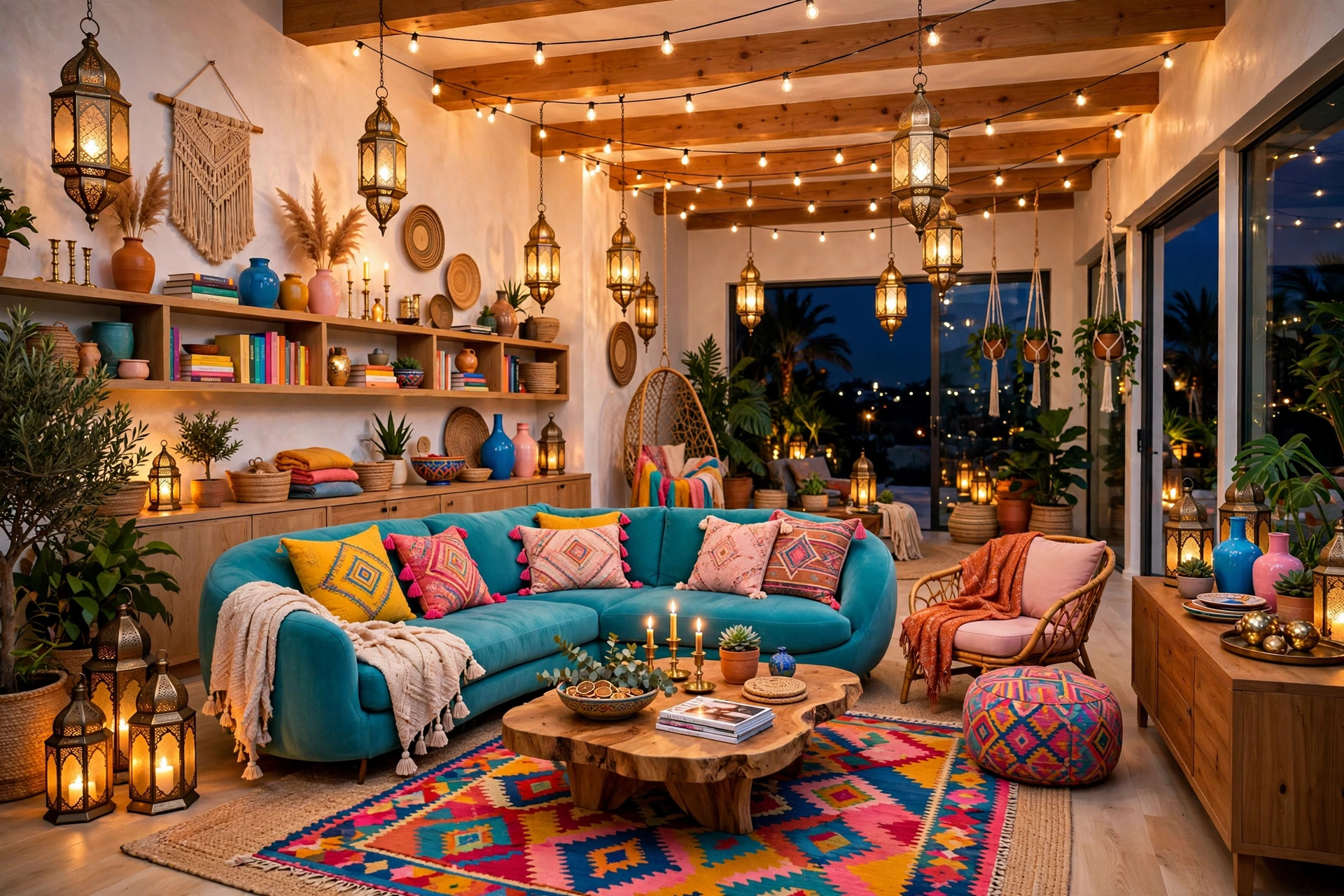
Bohemian rooms come alive after dark. Overhead lighting flattens all that beautiful texture, but lanterns, string lights, and candles make it glow: a Moroccan pierced-metal lantern casting patterned shadows, warm fairy lights draped along a shelf, a cluster of candles on the coffee table. Layered warm light is what turns a boho room from a styled space into a mood.
Aim for light at three heights — a floor-level lantern, table-height candles, something glowing up high like string lights — all in warm white (2700K or below). Flameless candles inside real lanterns give you the flicker without the fire worry near all those textiles. And keep one dimmable main lamp for practical evenings; even the dreamiest boho room needs to function when you are looking for your keys.
12. Ground the Space With a Carved Wood Coffee Table
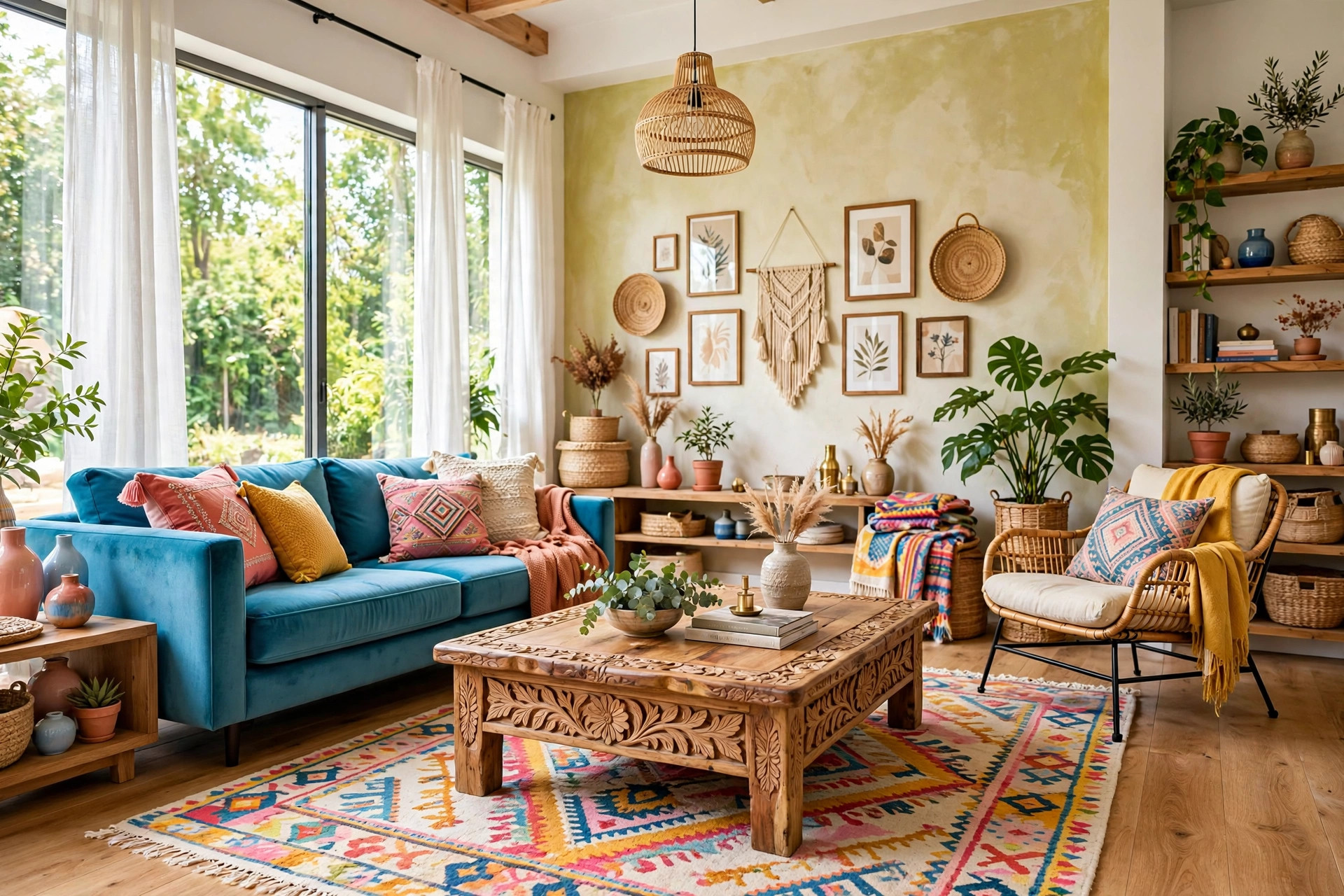
Amid all the softness and pattern, a bohemian room needs one solid anchor — and a carved wood coffee table does the job beautifully. Its weight balances the airy textiles, its carving echoes the handcrafted story of the macramé and baskets, and its surface becomes the stage for your best styling: a tray, a stack of art books, a candle cluster, one living plant.
Look for darker, richer woods — walnut, mango wood, reclaimed teak — with visible carving or inlay work. The table should feel like it has a history even if it is new. Size it to about two-thirds the length of your sofa and keep the styling low, nothing over twelve inches tall, so sightlines across the room stay open. If carved wood is out of budget, a simple trunk or a stack of vintage suitcases gives you the same grounded, storied feeling.
13. Mix Natural Materials and Wood Tones Freely
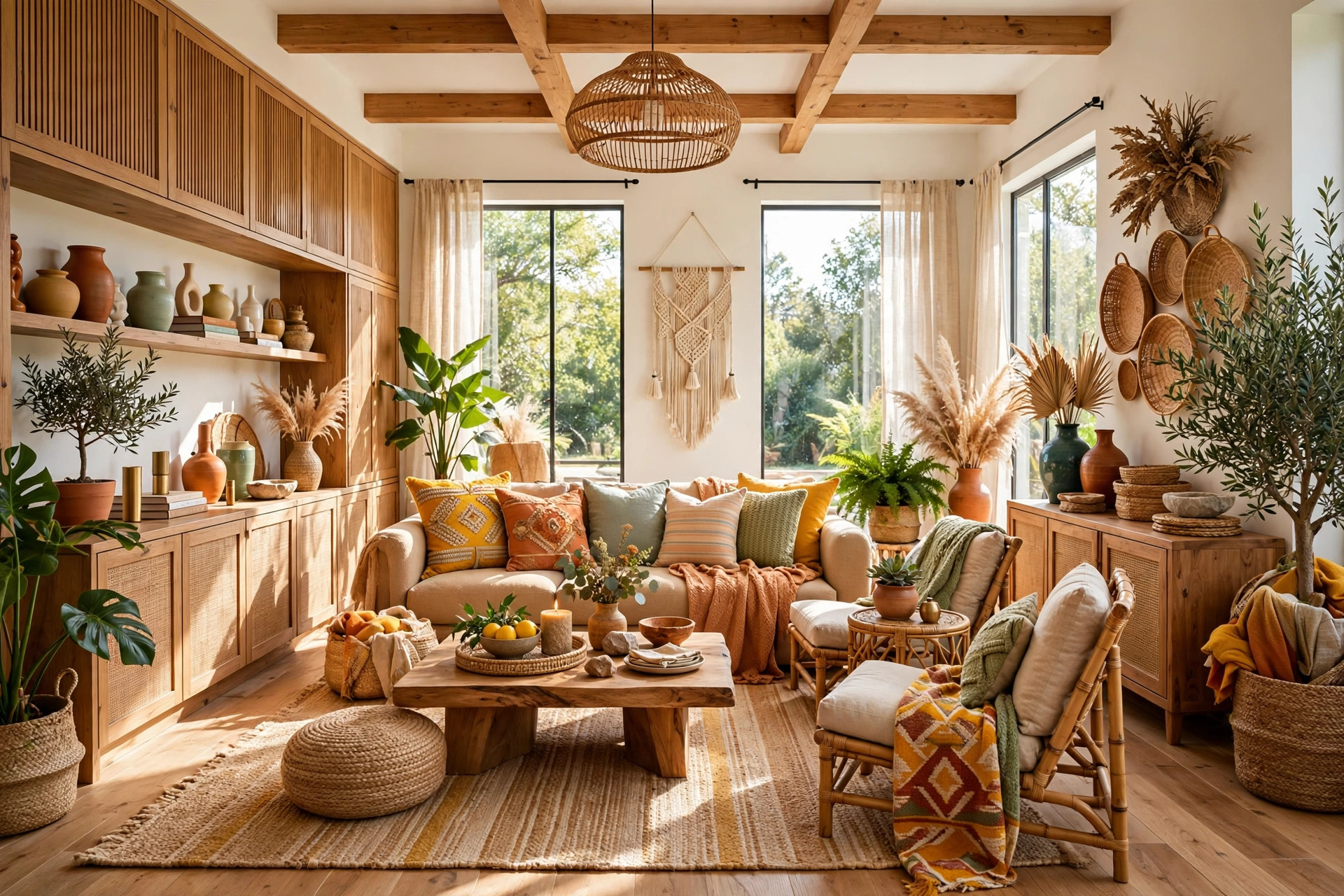
Boho is a material story as much as a color story. Jute, rattan, bamboo, raw wood, clay, linen, wool, leather — the style is built from things that come from the earth, and the magic happens when they all share a room. A jute rug under a rattan chair beside a reclaimed-wood console, with linen curtains and a clay vase on top: that sentence alone is a bohemian living room.
Do not stress about matching wood tones exactly. Boho forgives — even celebrates — the mix of honey oak beside dark walnut beside weathered driftwood. The harmony comes from the fact that they are all real, natural materials with visible grain and texture. The one thing to avoid is the shiny and synthetic: glossy laminates, chrome, and plastic read as intruders in a room built on organic materials. When in doubt, choose the material you could imagine growing, being woven, or being carved.
📌 Important: Natural fibers need real maintenance to stay beautiful. Vacuum jute rugs without a beater bar, condition leather poufs twice a year, and keep rattan out of direct blasting sun — sun-bleached rattan goes brittle and pale fast.
14. Carve Out a Cozy Reading Nook
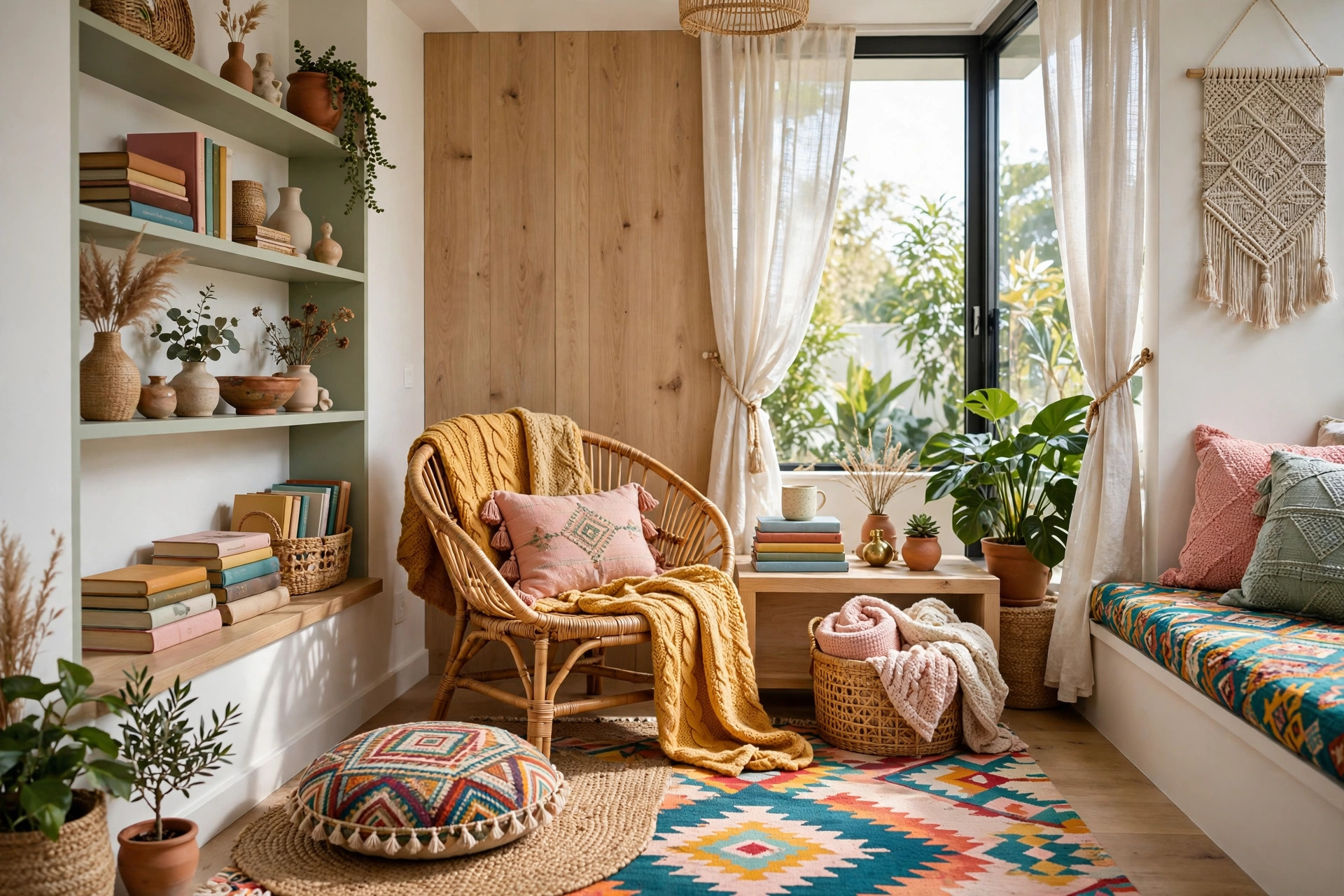
Every bohemian living room deserves a destination within it — and a reading nook is the perfect one. You need only a corner: a comfortable chair (that rattan accent chair is ideal), a good warm lamp at reading height, a small side table for tea, and a throw within arm’s reach. Suddenly the living room has a place that feels like it was made for one person, which paradoxically makes the whole room feel more welcoming.
Angle the chair slightly toward the room rather than facing the wall — a nook should feel connected, not exiled. Add a floor cushion nearby for feet, stack a few books on the side table, and hang one small piece of art or a tiny wall basket above. The nook does not need to be large; it needs to be complete. Four elements — seat, light, surface, textile — and the corner is done.
15. Finish With Global Accents
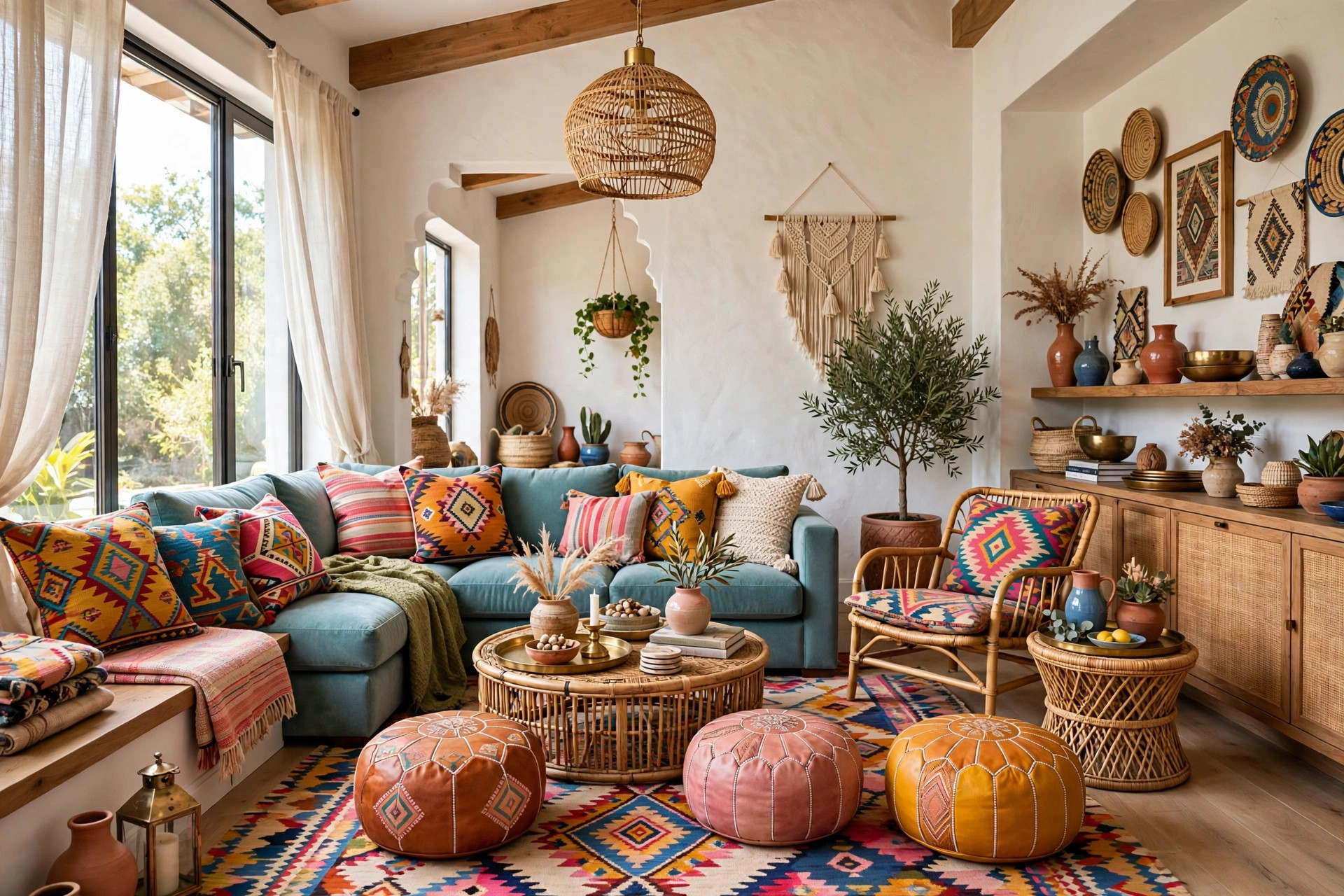
The finishing layer of a bohemian living room is the world itself: a brass tray from a Moroccan market, kilim pillows with Anatolian patterns, a carved wooden elephant, block-printed textiles from India, a woven basket from a craft fair. These are the pieces that make guests ask “where did you get that?” — and the story behind each one is what makes the room feel personal rather than purchased.
You do not need a passport to build this layer. Import shops, artisan marketplaces, and even the global-aisle finds at home stores carry the look — the key is choosing pieces with visible handcraft: uneven weaves, hammered metal, hand-painted details. Machine-perfect replicas read as souvenirs; handmade-feeling pieces read as treasures. Place them where the eye lands — the coffee table, the mantel, the top of the bookcase — and let each one earn its spotlight.
Quick Comparison: Bohemian Living Room Ideas by Cost and Effort
Your Bohemian Living Room Quick-Start Checklist
- ✅ Lay the base rug first, then layer the patterned rug on top at an angle
- ✅ Pick one warm palette and echo it in every pattern you add
- ✅ Add one woven statement piece — rattan chair, macramé hanging, or big basket
- ✅ Bring in three plants at three different heights
- ✅ Swap all bulbs to warm white (2700K or below) and add one lantern
- ✅ Drape throws on the sofa and armchair, tossed not folded
- ✅ Style the coffee table: tray, books, candle, one living plant — and stop there
Common Bohemian Living Room Mistakes
Mistake 1: Mixing Every Color Instead of One Palette
The most common boho failure is the rainbow explosion — red pillows, blue rug, green throw, yellow art, all shouting at once. Bohemian is eclectic, not random. The fix is simple: choose one warm color family (terracotta/rust/ochre, or sage/olive/moss, or indigo/denim/clay) and let every pattern live inside it. Eclectic within a palette reads as curated; eclectic across every palette reads as a yard sale.
Mistake 2: Buying Everything From One Store
A room furnished entirely from a single retailer’s “boho collection” looks like a showroom, not a home — and showroom boho is the fastest-dating decor there is. The collected-over-time soul of the style cannot be purchased in one cart. Mix at least three sources: one new anchor piece, one thrifted or vintage find, one handmade or artisan item. The friction between sources is what creates the authentic layered feeling.
Mistake 3: Forgetting the Editing Pass
Layering is boho’s superpower, but layering without editing becomes clutter. After you have styled the room, do the doorway test: stand in the doorway and squint. If you cannot find three clear focal points, remove the five smallest objects and try again. Boho should feel abundant, not crowded — every object should earn its place, even in a maximalist style.
Mistake 4: Ignoring Lighting Temperature
Cool white bulbs are the silent killer of bohemian rooms. All those warm earth tones, honeyed woods, and golden textiles turn flat and lifeless under 4000K+ lighting. Swap every bulb to warm white at 2700K or below, put the two main lamps on dimmers, and watch the room transform after dark. Lighting is the cheapest, highest-impact boho upgrade there is.
Mistake 5: Skipping the Focal Point
A room where everything is equally interesting is a room where nothing is interesting. Even the most layered boho space needs one clear hero — usually the macramé wall hanging, the rattan chair, or the carved coffee table — with everything else playing a supporting role. Decide your hero before you shop, and let the supporting layers orbit around it.
Frequently Asked Questions
1. What exactly is bohemian style in a living room?
Bohemian style is an eclectic, layered look built on mixing patterns, textures, and global influences — think layered rugs, rattan furniture, macramé, plants, and vintage finds in warm earth tones. It has no strict rules about matching; instead, cohesion comes from a shared color palette and natural materials. The goal is a room that feels collected over time and personal, not purchased in one trip.
2. How do I make a bohemian living room without it looking messy?
The difference between layered and messy is editing and palette discipline. Keep every pattern inside one warm color family, repeat key colors at least three times around the room, and do the doorway squint test — if you cannot spot three clear focal points, remove the five smallest objects. Corral small items on trays and in baskets so abundance reads as intentional.
3. What colors work best for a boho living room?
Warm earth tones are the classic boho palette: terracotta, ochre, clay, rust, warm sand, olive, and deep browns, usually on a warm neutral base like cream or warm white. Keep brights as accents (the 10 percent layer) rather than dominant colors. If you love cooler tones, sage and dusty blue can work as long as warm woods and brass keep the room from going cold.
4. Can a bohemian living room work in a small space?
Absolutely — boho might be the best style for small rooms because it does not demand matching sets or lots of furniture. Layered rugs define the zone, floor cushions add seating without bulk, plants go vertical, and thrifted small-scale pieces fit tight budgets and tight footprints. The key is keeping the palette controlled so the layering feels cozy rather than cramped.
5. Is bohemian style expensive to achieve?
It is one of the cheapest styles to do well. Thrift stores, flea markets, and the handmade marketplace are boho’s natural habitat — vintage brass, secondhand rattan, and artisan textiles often cost less than mass-produced equivalents. The most expensive-looking boho rooms are usually the thriftiest. Spend real money only on the pieces your body touches daily: the sofa, the main rug, and good lighting.
6. How do I mix patterns without clashing?
Use the shared-color rule: every pattern in the room should contain at least one color from your chosen palette. Vary the scale — one large-scale pattern (rug), one medium (pillows), one small (throw or lampshade) — so patterns do not compete at the same size. And limit yourself to three or four distinct patterns; beyond that, even a shared palette starts to feel busy.
7. What is the one piece that makes a room feel bohemian fastest?
A large macramé wall hanging or a rattan peacock chair — either one instantly signals boho. If you can only add one thing this weekend, choose based on your weakest spot: bare walls need the macramé, an empty corner needs the rattan chair. Both are widely available secondhand, which keeps the budget boho-authentic too.
Conclusion
A bohemian living room is never truly finished, and that is the best part. It grows with you — a textile from one trip, a plant from one friend, a brass tray from one lucky flea-market morning — and every addition makes it more yours. Start with the foundation layers this weekend: the rugs, the palette, the light. The stories will accumulate on their own.
The fifteen ideas above are not a shopping list to complete in order; they are a palette to paint from. Pick the three that fix your room’s biggest gaps, live with them for a week, and let the room tell you what it wants next. That slow, responsive way of decorating is the real secret of bohemian style — and it is why no two boho living rooms, including yours, will ever look the same.