Dark Academia Living Room Aesthetic: How to Get the Look
Introduction
Some living rooms feel like they belong to a story — candlelight pooling on worn leather, shelves sagging under old books, the faint suggestion of oak libraries and rain against tall windows. That is the dark academia living room aesthetic: a style that trades brightness for atmosphere, newness for patina, and minimalism for a richly layered, scholarly mood. It looks like the sitting room of a centuries-old university, and it is one of the most magnetic ways to decorate a living room right now.
Dark academia is not just a color palette, though the palette matters — deep greens, oxblood, walnut browns, blackened bronze, and candlelit golds. It is a feeling of intention. Every object earns its place: the globe that has seen better decades, the armchair with the cracked leather, the stack of clothbound books that are actually read. Getting the look is less about buying a “dark academia set” and more about collecting the right textures, light, and mood over time.
Below are fifteen ideas that build the dark academia living room aesthetic from foundation to finishing touch. Start with the bones — walls, furniture, light — then layer in the books, art, and details that make the room feel haunted in the best possible way. If you want the moodier side of our broader guides, our cozy living room ideas roundup covers the warm-lighting tricks that every dark room needs.
1. Paint the Walls a Deep, Moody Color
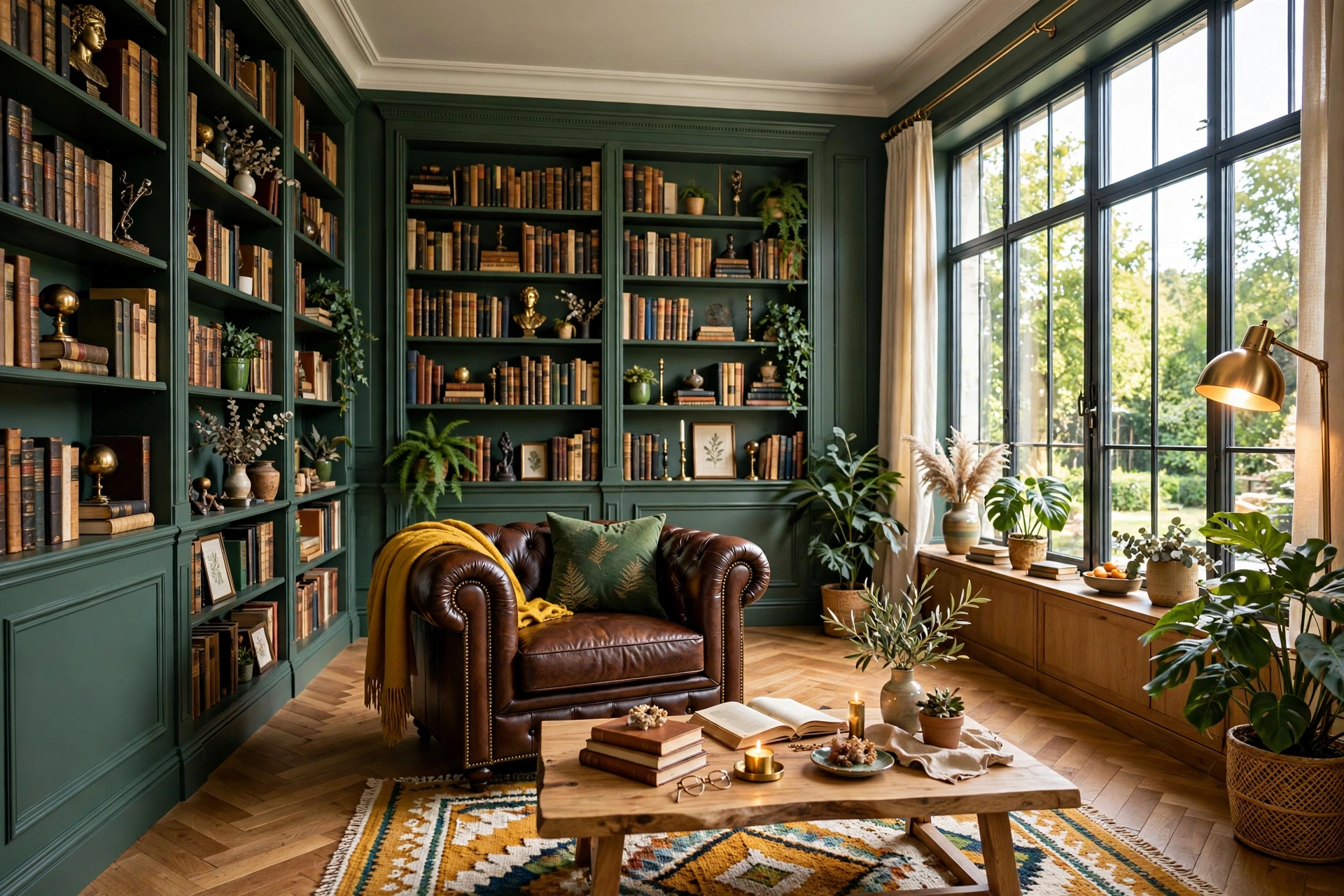
The dark academia look begins with shadow. Walls in deep forest green, oxblood, charcoal, or espresso wrap the room in the kind of depth that pale paint can never fake. The room stops feeling like a box and starts feeling like a library — closer, warmer, and far more dramatic once the lamps come on.
Dark walls do something counterintuitive: they blur the room’s edges, so the space feels larger at night and intimate by day. Choose a paint with a matte or eggshell finish so the color reads velvety rather than glossy, and carry it onto the trim for a fully enveloping effect. Our living room color schemes guide covers the deep palettes that designers trust most.
📌 Important: Test dark paint under your actual evening lighting before committing — a green that looks rich by daylight can turn almost black under warm bulbs. Paint a full poster board, tape it up, and live with it for two evenings.
2. Anchor the Room With a Leather Armchair
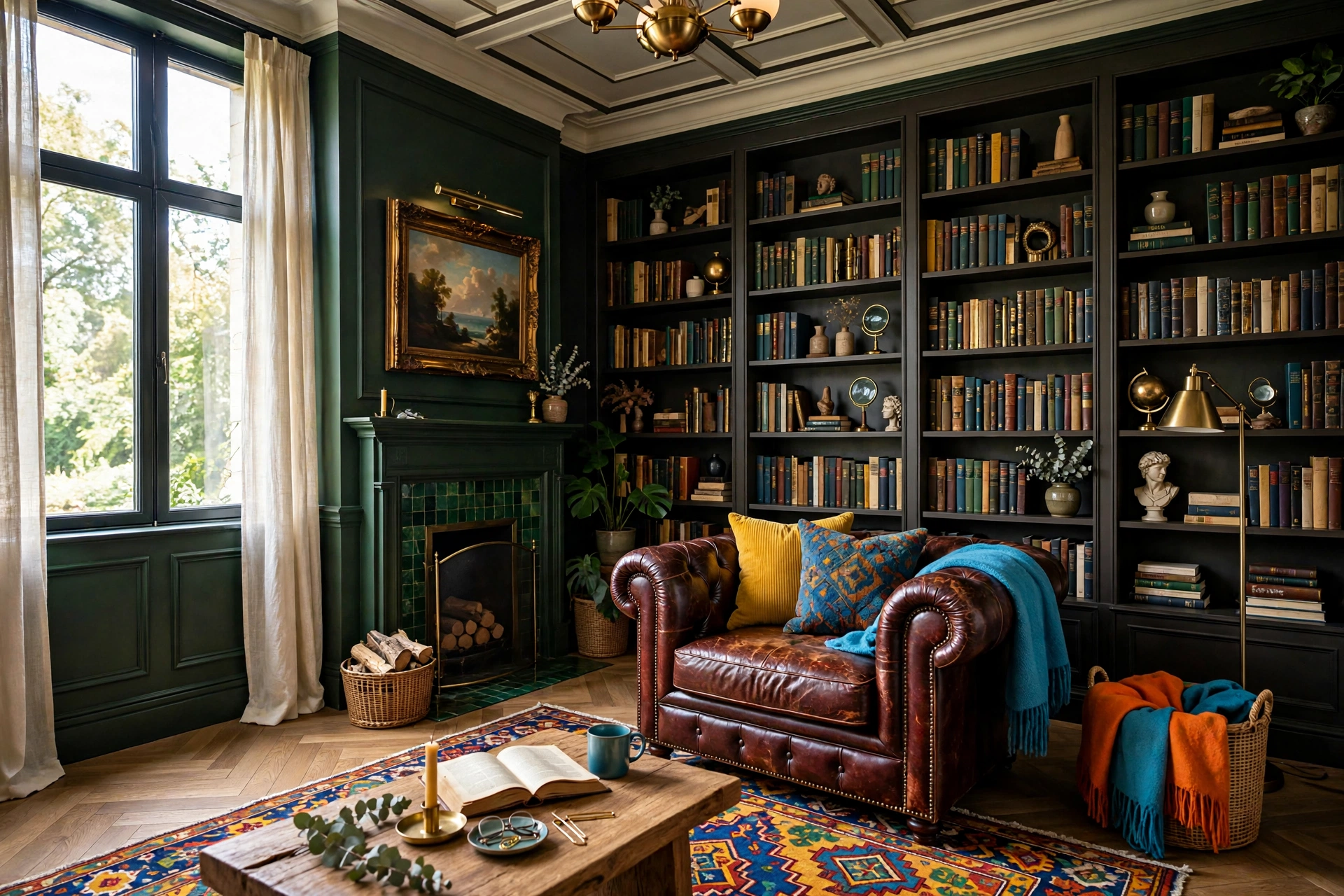
No single piece says dark academia like a leather armchair. Think Chesterfield-style deep-buttoned leather, worn caramel or oxblood, with rolled arms and a silhouette that belongs in a gentlemen’s club. It becomes the room’s gravitational center — the seat everyone fights over, the chair that makes the whole aesthetic legible.
Leather is honest about age: it creases, darkens, and softens, which is exactly what dark academia celebrates. If a vintage Chesterfield is out of reach, a secondhand leather armchair with good bones can be revived with a conditioning balm, and faux leather in the right brown works in dimmer rooms. Place it near the bookshelves or window, add a floor lamp behind it, and the reading corner builds itself.
3. Build Floor-to-Ceiling Bookshelves
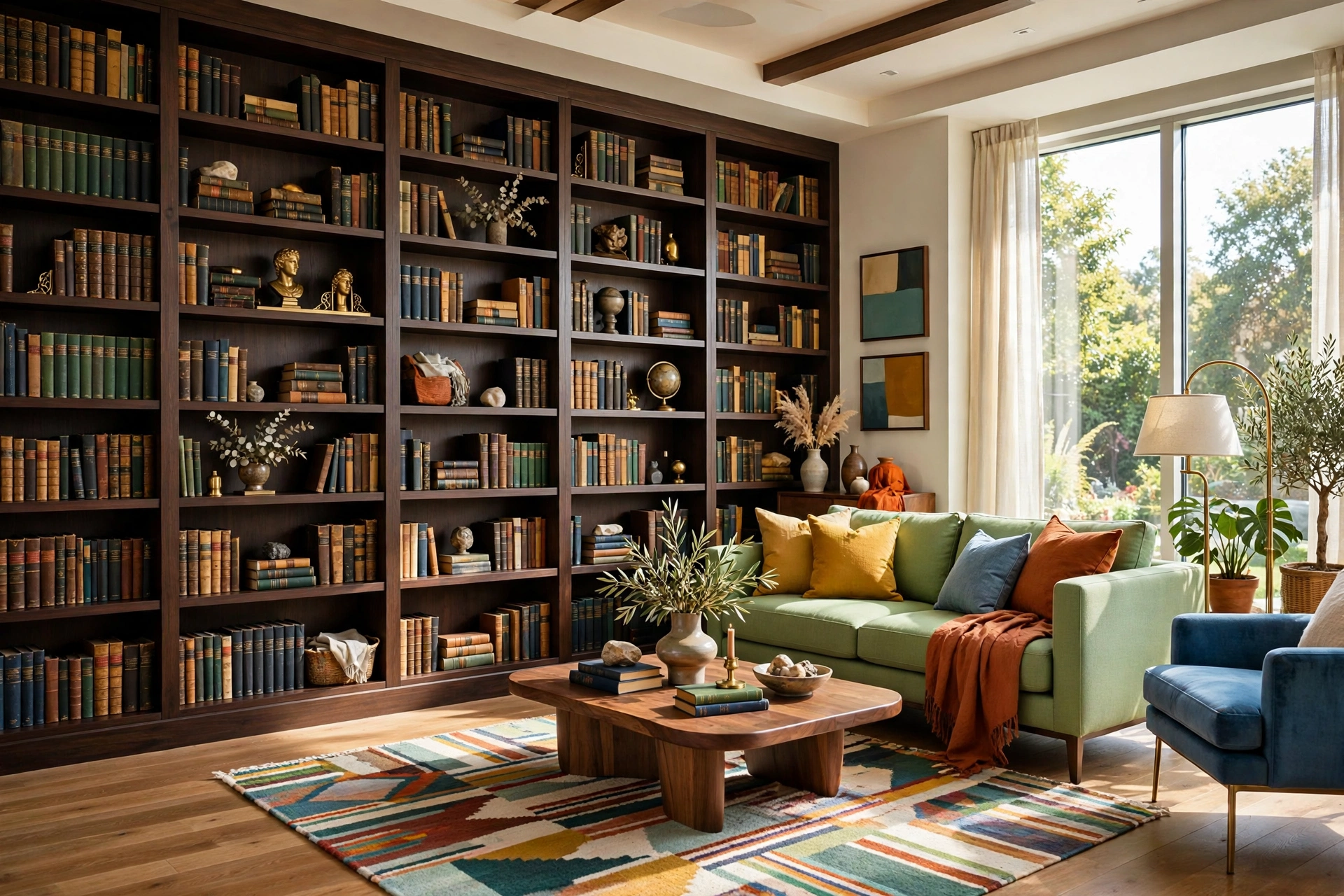
Bookshelves are the architecture of dark academia. A wall of books — floor to ceiling if possible, filled two-deep and double-stacked in places — gives the room its scholarly spine. The shelves do not need to be precious: painted IKEA bookcases trimmed with crown molding read as built-ins, and dark-stained wood casework looks instantly historic.
Style them like a real library, not a showroom. Group books by height rather than color for the serious look, stack some horizontally to break the rows, and leave small gaps for brass objects, framed miniatures, and candle clusters. Our modern living room design ideas guide shows how shelving can anchor a room even when the style is eclectic.
💡 Pro Tip: Books read most “dark academia” in clothbound editions with muted spines — forest, burgundy, navy, and tan. Slip dusty paperback covers into brown paper wraps or strip them to reveal hardcovers underneath for an instant uniform look.
4. Layer a Persian or Oriental Rug
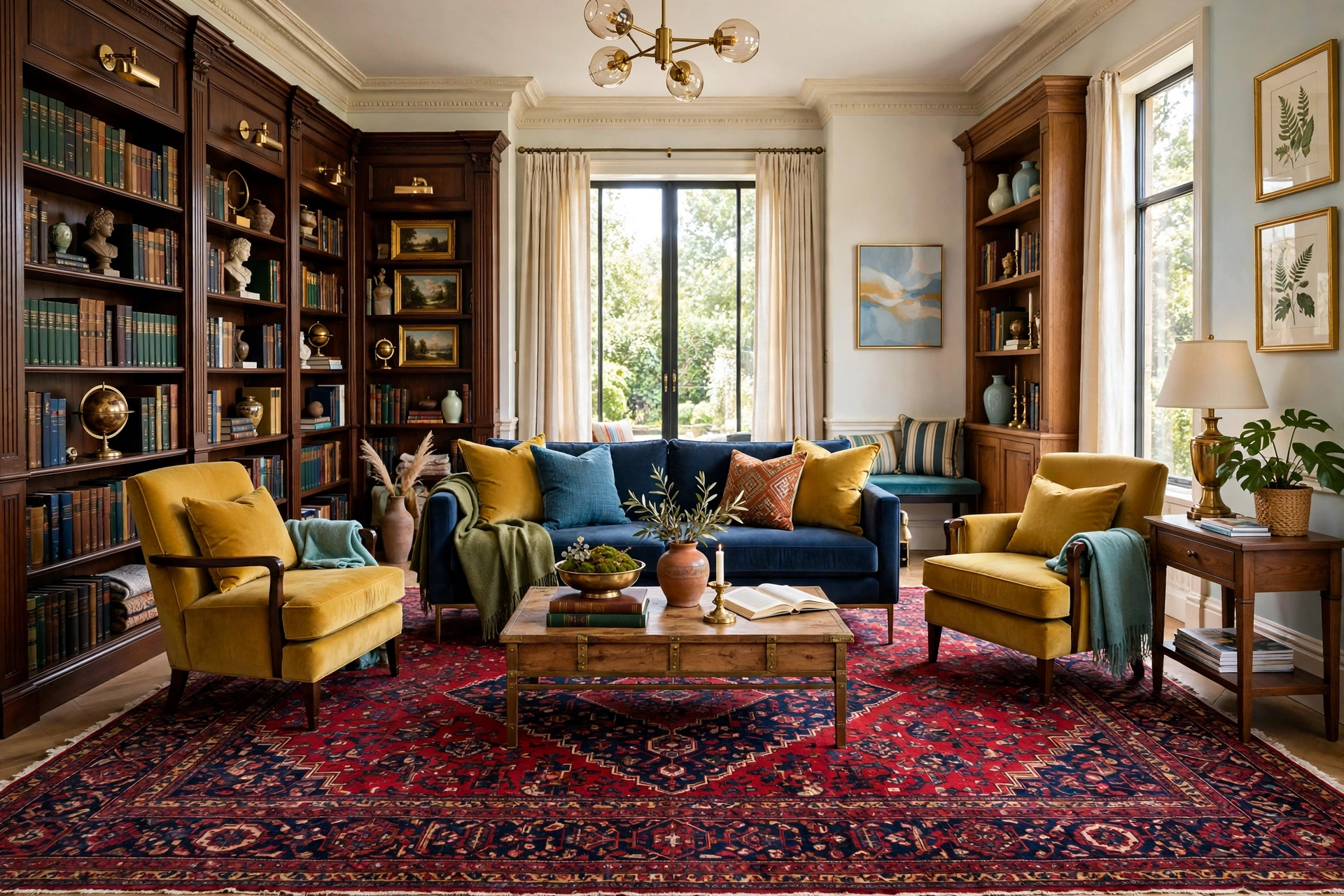
Underfoot, dark academia wants history. A Persian or Oriental-style rug — deep reds, navy, ivory motifs, visible age — grounds the room in a way flat contemporary rugs cannot. The pattern does the work of ten decorative objects, and its dark tones hide real-life wear beautifully.
Size it generously: the front legs of all seating should rest on the rug, which usually means going one size larger than your instincts suggest. Layer a smaller vintage-style rug over a large dark jute or wool base for extra depth, a trick our cozy living room ideas guide recommends for any style. In a room this moody, the rug is allowed to be the brightest patterned thing in sight.
5. Switch to Warm, Low Lighting
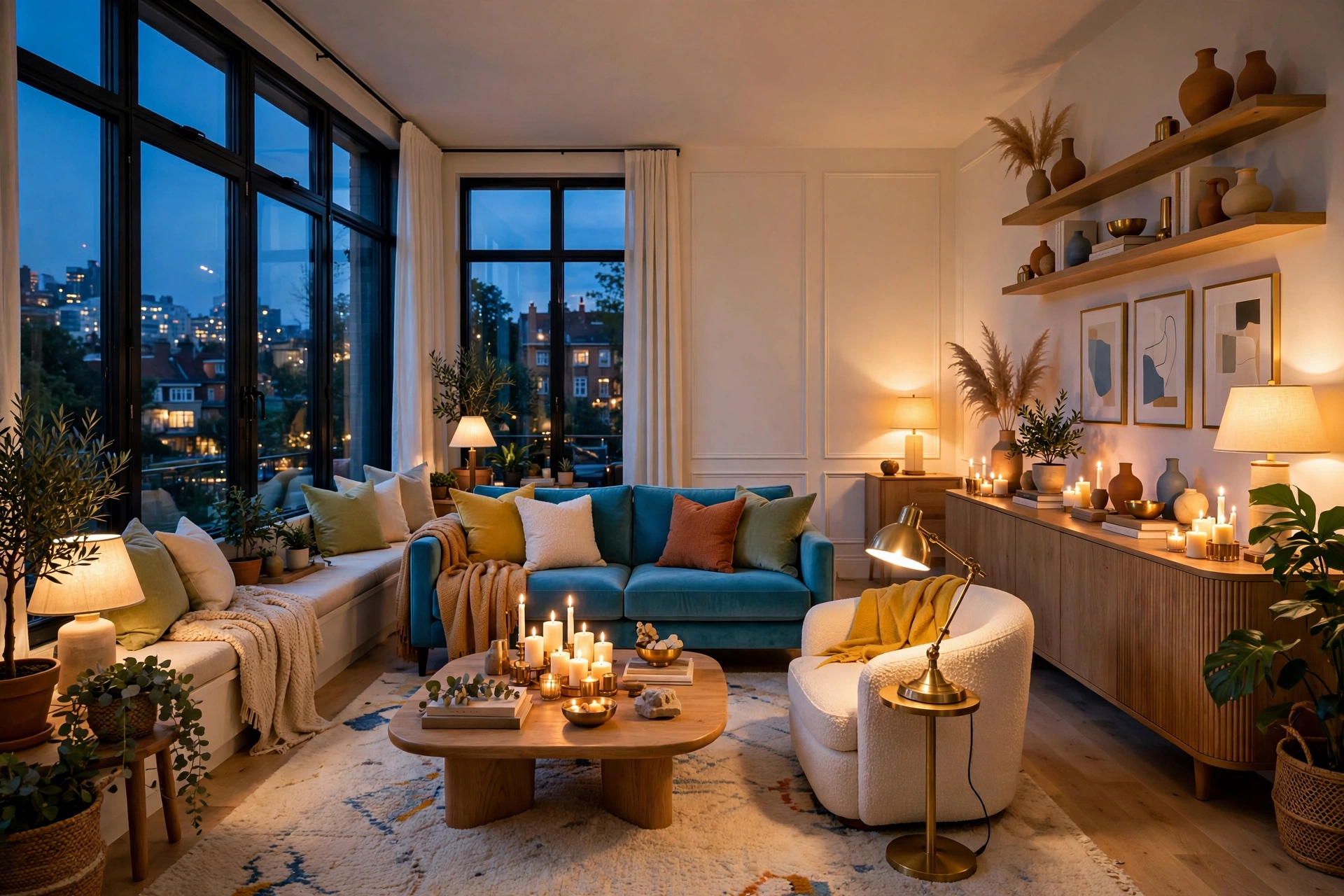
Dark academia rooms are never brightly lit — they are lit like old libraries, in pools. Replace overhead lighting with table lamps, floor lamps, and candles at multiple heights, all in warm 2700K bulbs or lower. Brass pharmacy lamps, bankers’ lamps with green glass shades, and candlestick table lamps are the fixtures of this style.
Light the room the way a film set would: one pool by the reading chair, one over the bookshelves, one low on a side table, candles on the mantel or coffee table. Dimmers are essential — the aesthetic lives between “dinner” and “midnight” brightness. Harsh daylight overhead should die at sunset; the lamps take the story from there.
6. Hang Classical Art and Portraits
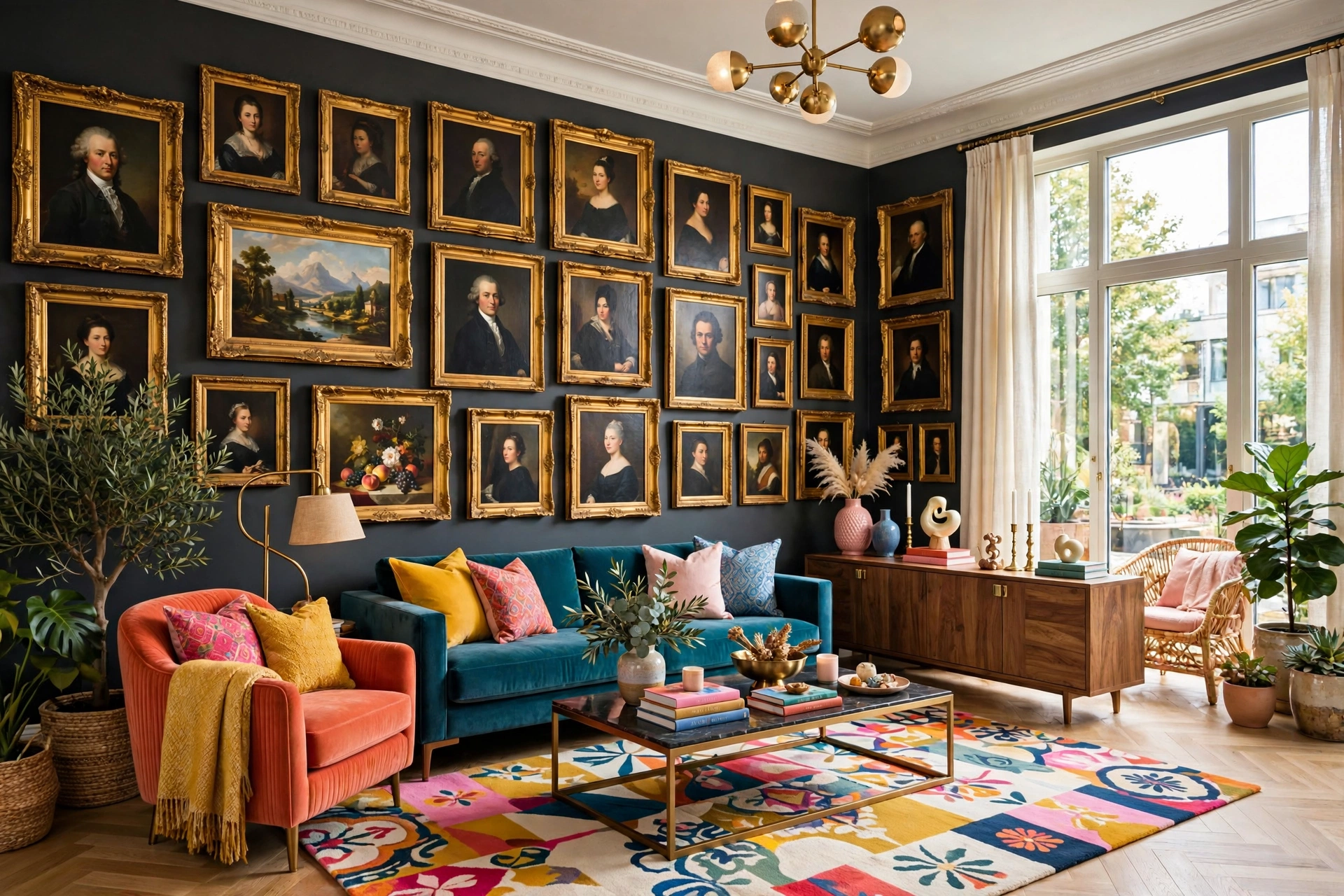
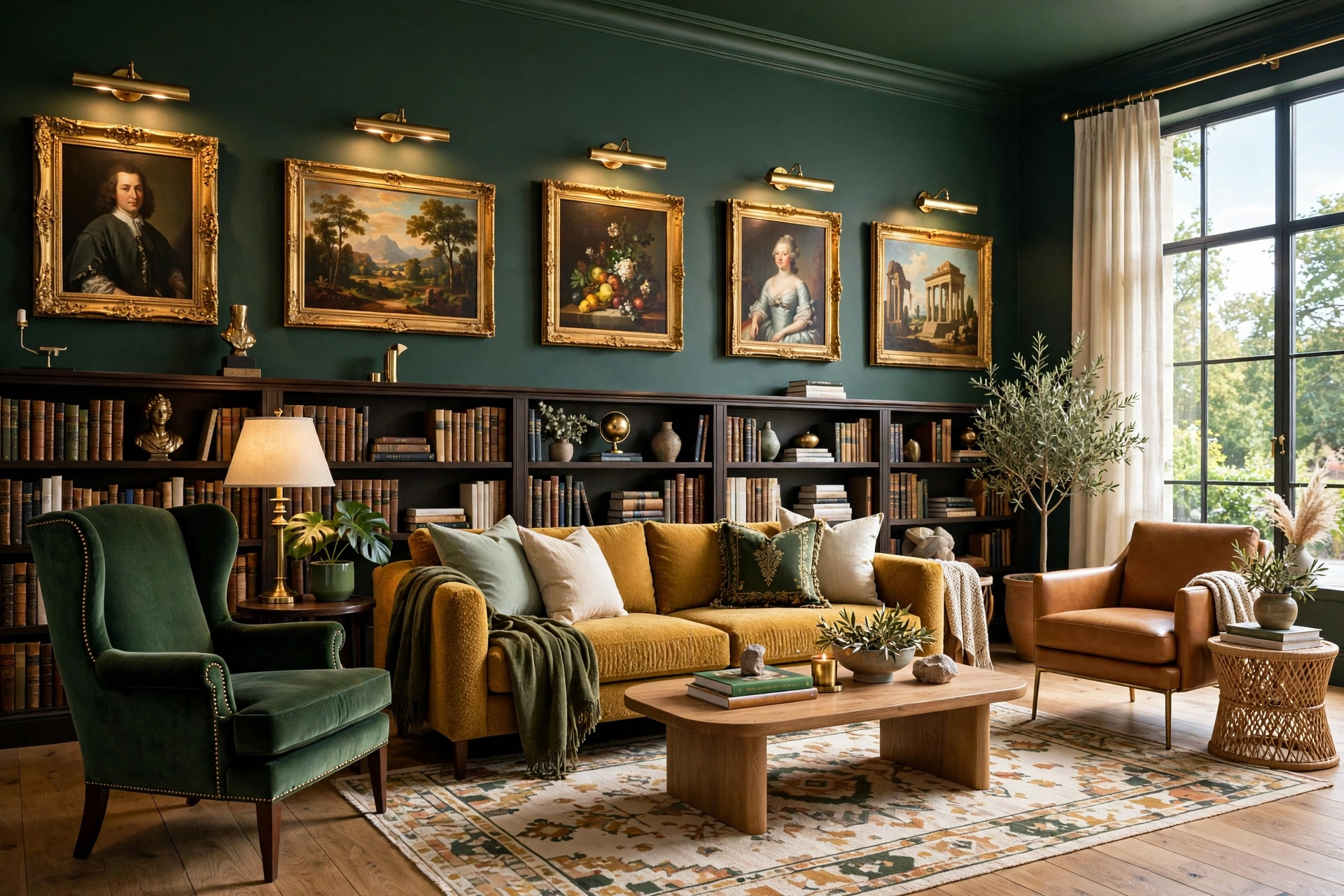
Dark academia walls wear their history. Gilt-framed oil paintings — moody landscapes, portraits with dark backgrounds, botanical studies, architectural engravings — turn bare walls into a gallery. The frames matter as much as the art: heavy gilt, dark wood, or brass frames with a patina of age.
You do not need original oils. Thrifted prints in the right frames, museum-print reproductions, and even dark landscape photography in gilt frames all work. Hang one large piece over the mantel or sofa, then cluster smaller frames in a salon arrangement on another wall. Keep the glass non-reflective if possible — glare breaks the illusion of age faster than anything.
⚠️ Warning: Skip modern neon prints, white minimalist frames, and anything that screams “dorm poster.” One bright contemporary piece will undo an entire wall of classical art. Keep every frame in the wood, brass, or gilt family.
7. Add a Vintage Globe or Brass Telescope
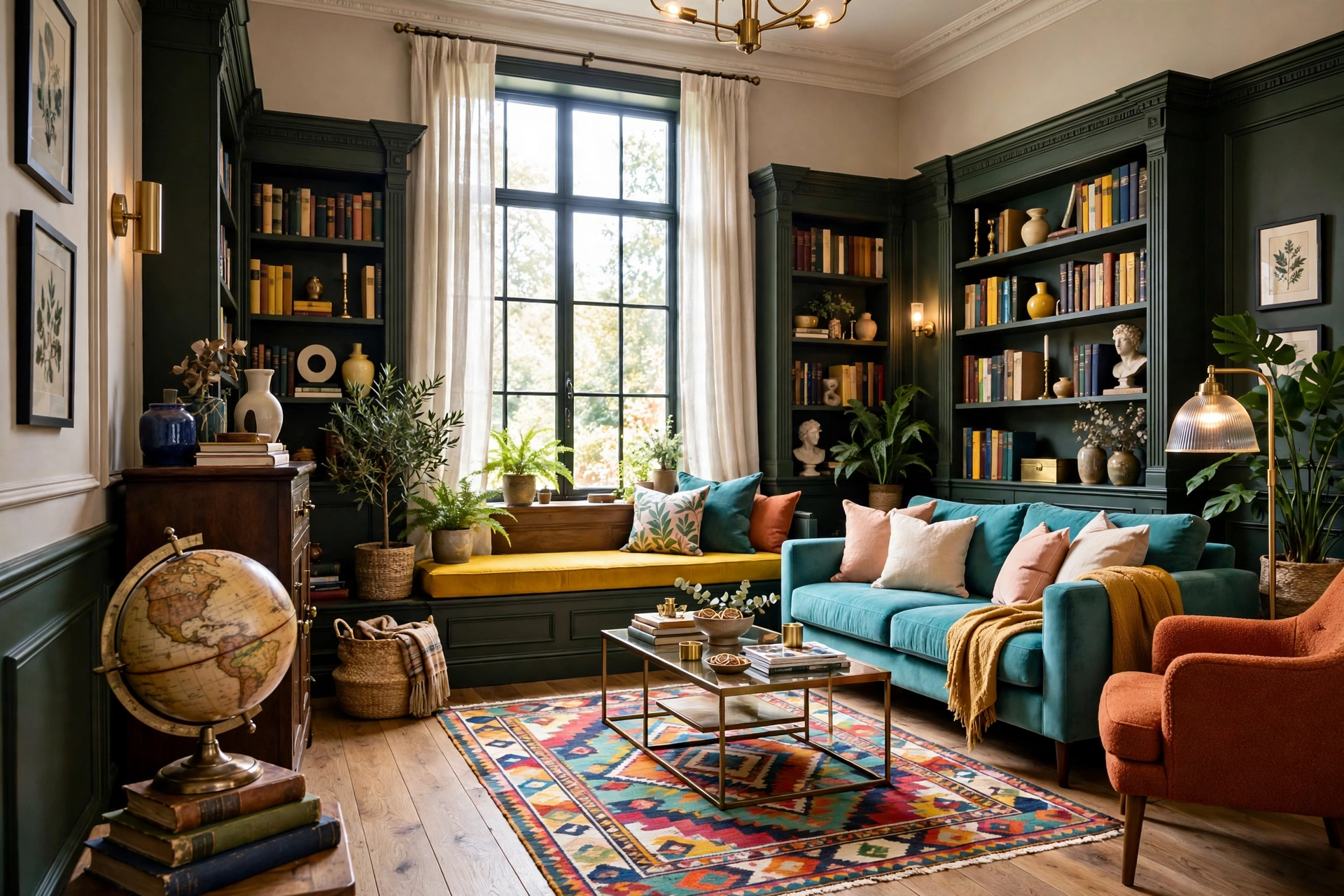
Nothing telegraphs “old-world scholar” faster than a vintage globe. A weathered desktop globe on a stand in the corner, or a brass telescope by the window, tells the room’s story in one glance. These are the objects that make guests lean in — they invite touch and conversation in a way plain decor never does.
Source them secondhand: estate sales, antique shops, and online marketplaces overflow with globes whose maps are charmingly outdated. A globe with faded oceans and pre-war country borders is a feature, not a flaw. Style it on a stack of books or its own wooden stand where lamplight catches the brass meridian.
8. Style the Coffee Table Like a Study Desk
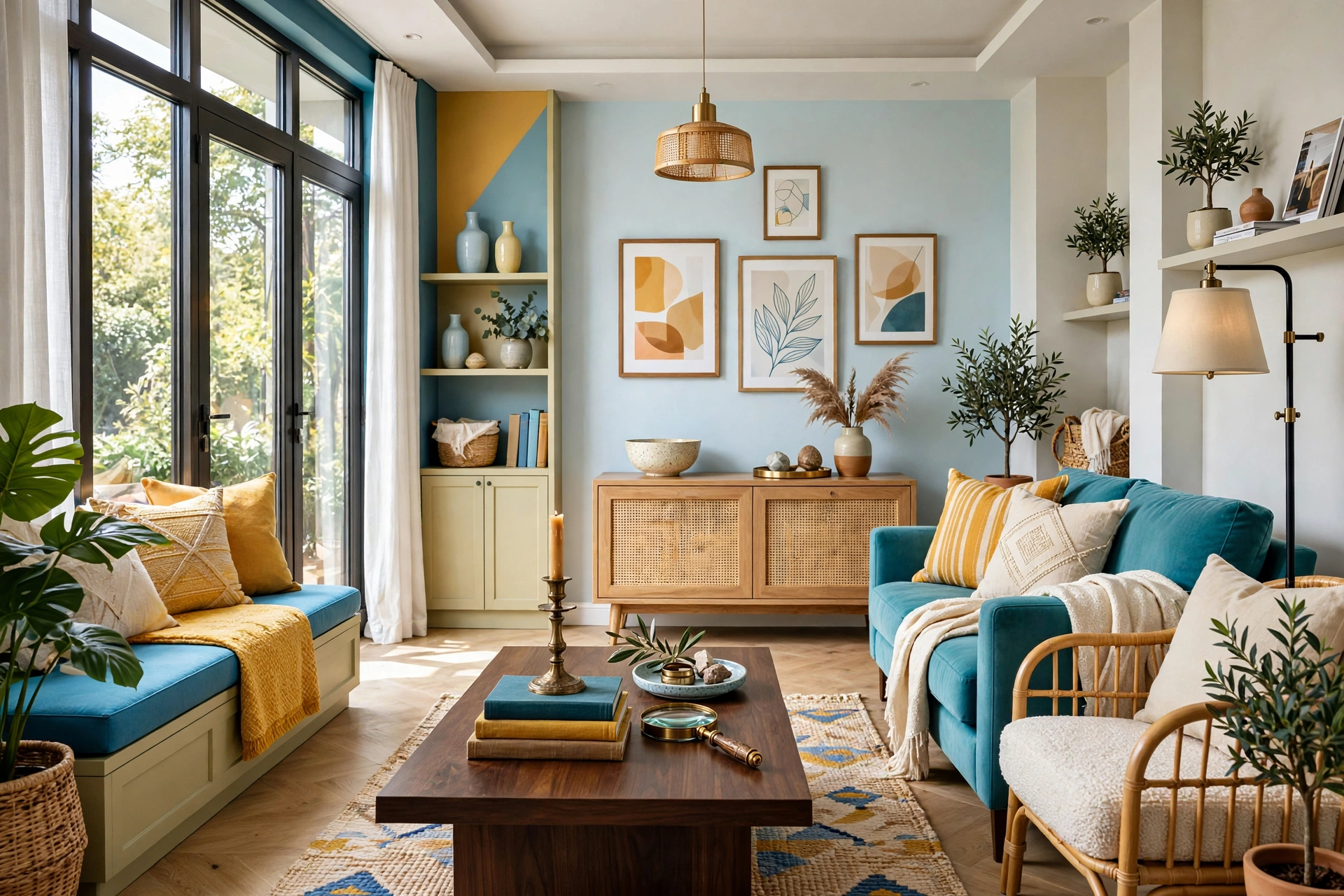
In a dark academia living room, the coffee table stops being a surface and becomes a still life. Stack three or four substantial books, add a brass candlestick, a small stack of letters tied with twine, a magnifying glass, or an hourglass. Every object should feel like it belongs to someone interesting.
Keep the composition low and asymmetrical — one tall element (candlesticks), one flat stack (books), one small curiosity (a brass compass, a pocket watch, a ceramic inkwell). The tray trick from our cozy living room ideas guide works beautifully here: a dark wood or brass tray corrals the objects into one composed vignette and leaves room for real life.
9. Bring in Heavy Velvet Curtains
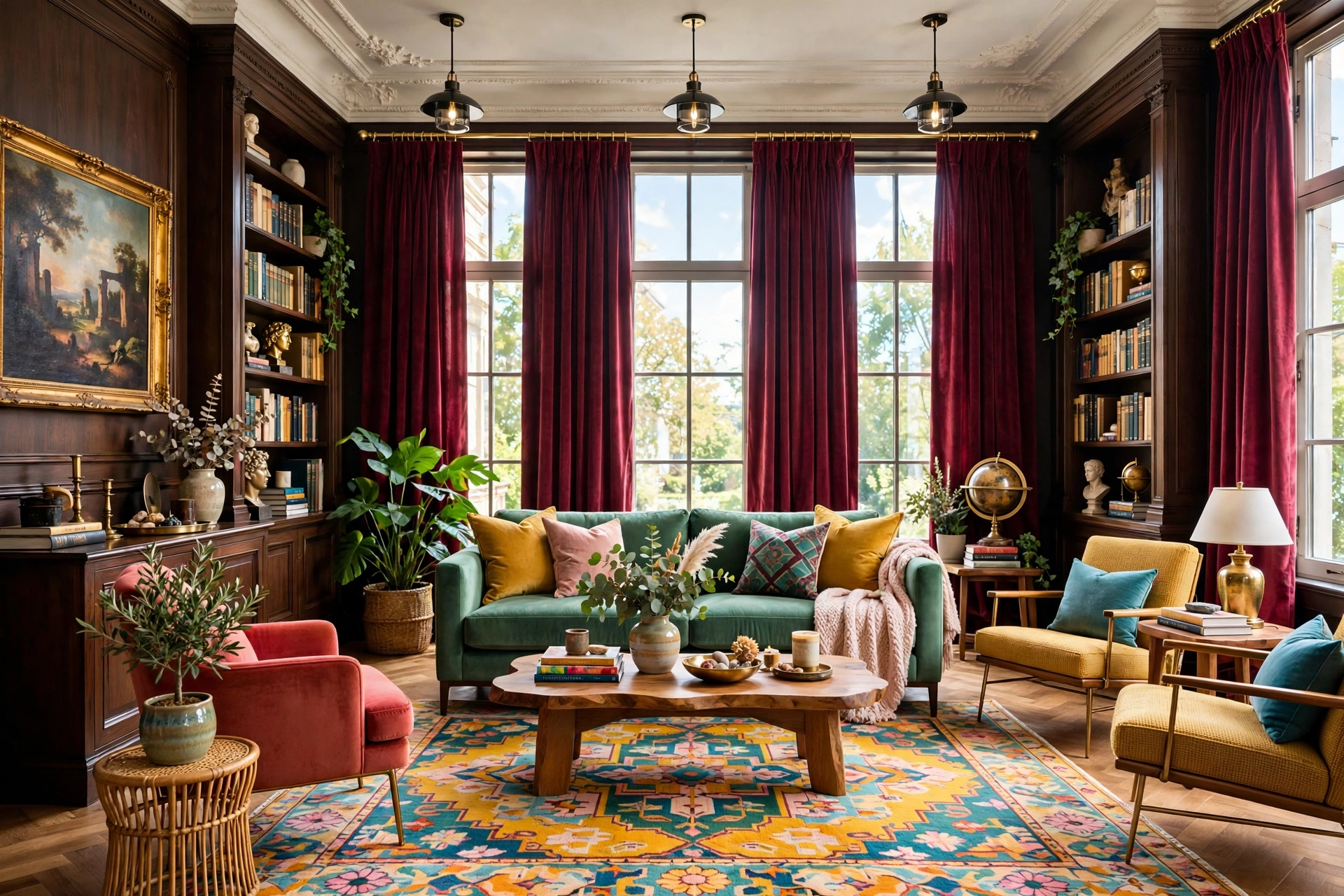
Windows in dark academia rooms are dressed, not bare. Floor-to-ceiling velvet curtains — deep green, burgundy, chocolate, or black — add the theatrical weight this style demands. They absorb sound, block harsh daylight, and frame the windows like a stage set.
Mount the rod high and wide so the panels stack over the wall and puddle slightly at the floor. Velvet reads richest in dim light, catching lamplight in deep folds. If full velvet feels heavy for your climate or budget, lined cotton in a dark tone layered over sheer linen gives the same gravitas with less fabric.
💡 Pro Tip: Velvet curtains in the exact tone of your walls make the room feel twice as large — the window wall becomes one continuous dark surface instead of a framed interruption.
10. Choose Wood Furniture With a Story
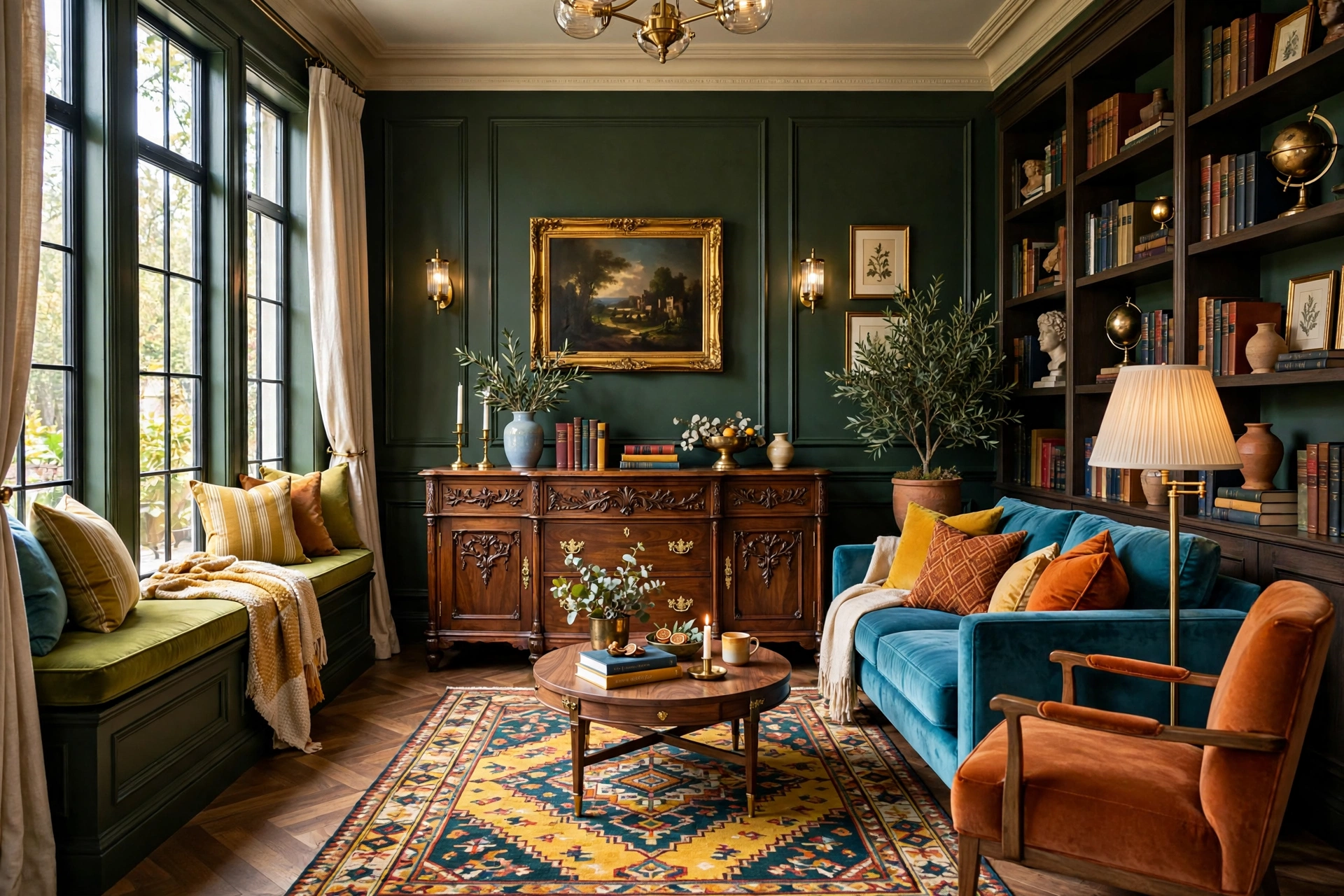
Dark academia furniture is dark, heavy, and visibly old — walnut, mahogany, and ebonized wood with carved details, turned legs, and brass hardware. A carved wooden coffee table, a secretary desk against the wall, a sideboard with patinated pulls: each piece should look like it survived a century of use.
Thrift stores and estate sales are the natural hunting ground. Look past surface scratches — they are the point — and check joinery and solidity instead. A quick coat of dark wax or furniture oil revives tired wood in an afternoon. If buying new, choose pieces with genuine weight and traditional proportions; lightweight modern frames in dark stain always read as costume rather than character.
11. Display Candles in Brass and Iron Holders
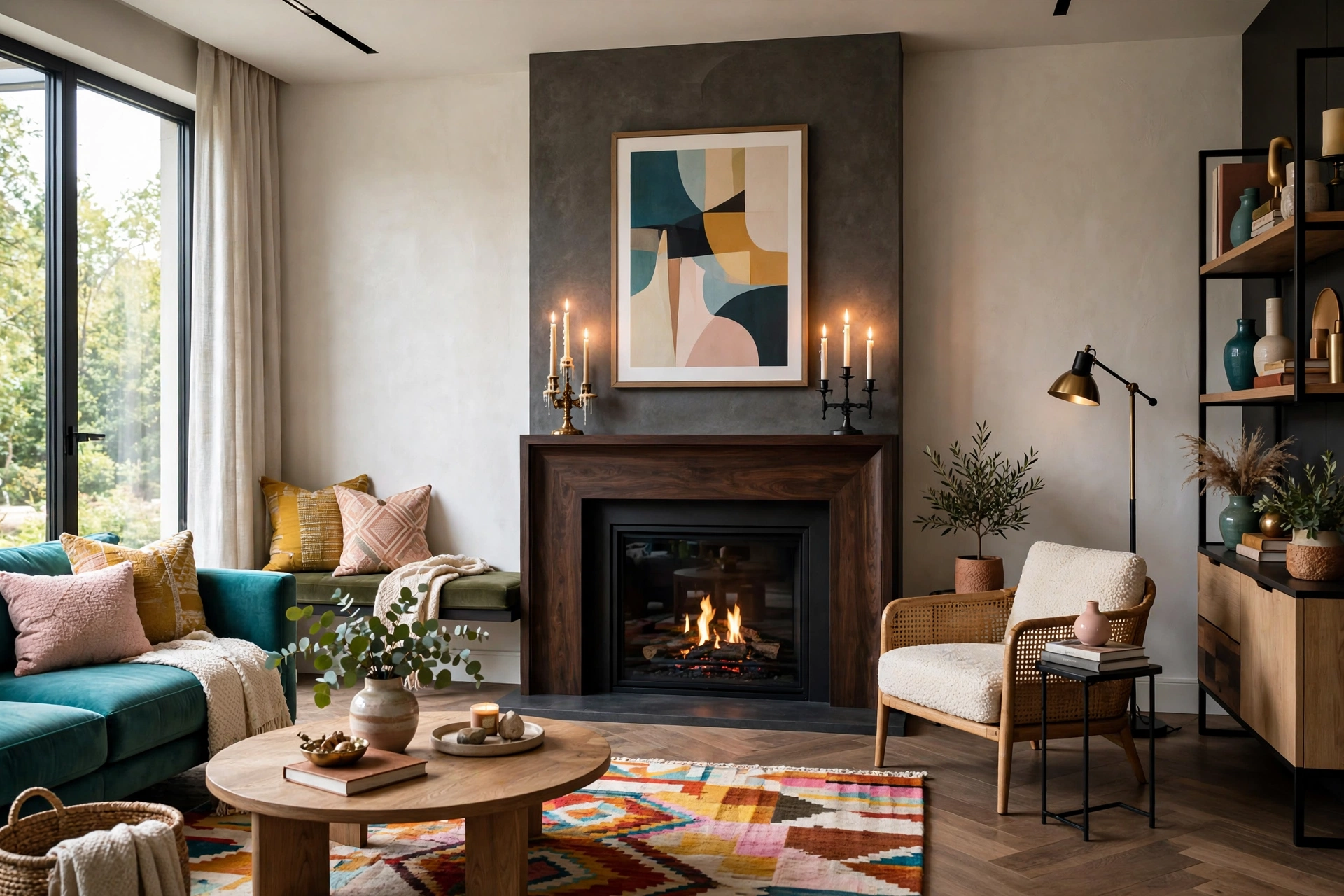
Candlelight is the signature light of dark academia. Cluster pillar candles in brass holders, taper candles in iron candelabras, and tea lights in smoked glass across the mantel, shelves, and coffee table. The flicker does what no bulb can — it makes the whole room breathe.
Mix heights and metals for a collected look: tall tapers beside squat pillars, brass beside blackened iron. Flameless candles with warm LEDs convince inside frosted holders and on high shelves where real flame would be risky. Light the real ones nightly — the ritual of lighting candles is as much a part of the aesthetic as their glow.
12. Add a Bust, Skull, or Classical Sculpture
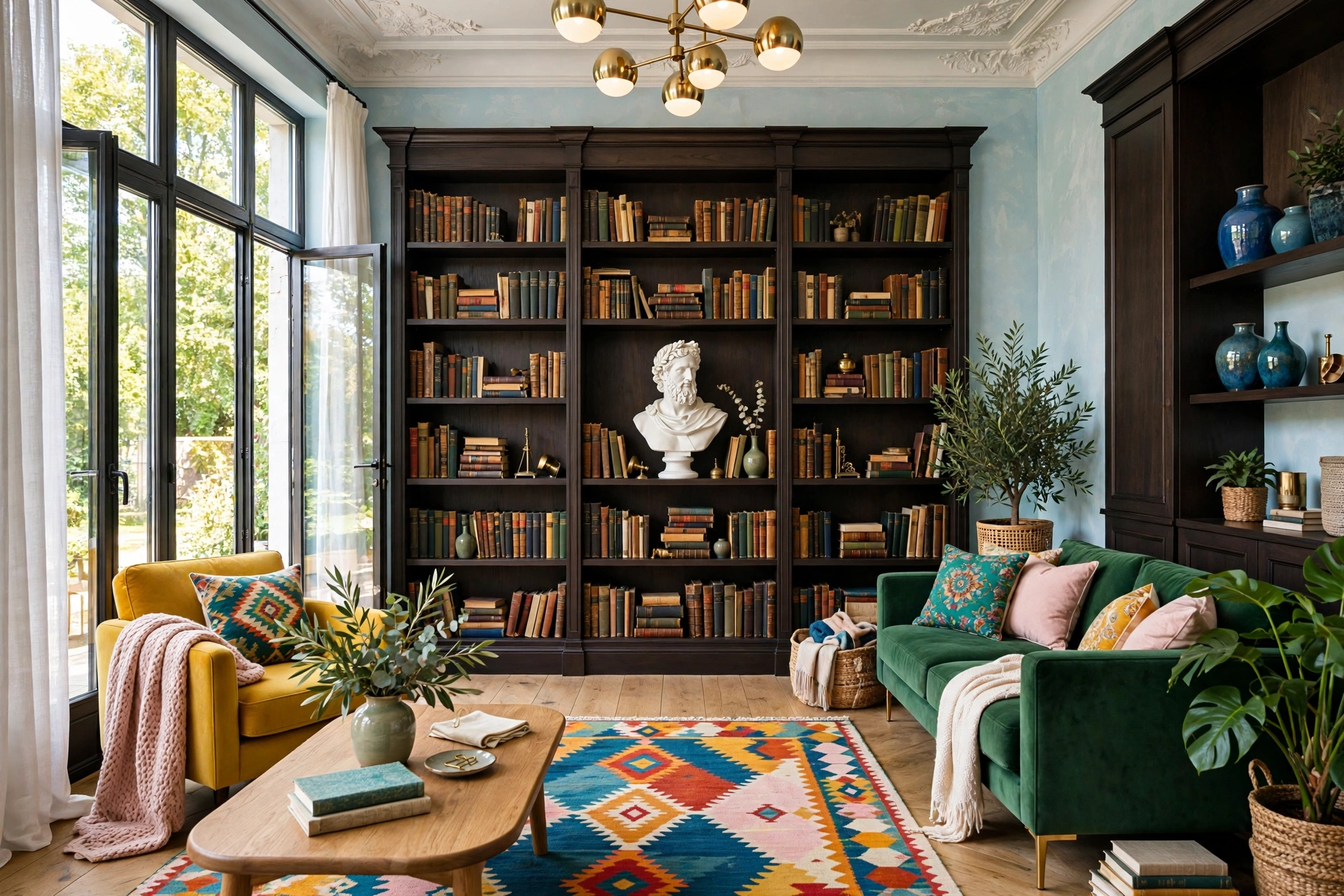
A plaster bust of a poet, a small marble-style skull, a classical column fragment — dark academia loves its memento mori. These sculptural moments give shelves and side tables the gravitas of a museum collection, and they photograph beautifully against dark walls.
Scale them like jewelry, not statuary: one bust on the bookshelf, one small skull among the books, a classical hand on the side table. White plaster pops dramatically against deep walls, which is precisely the contrast the style wants. Keep it to two or three pieces — a room full of skulls tips from scholarly into theatrical.
📌 Important: Keep sculptures in matte plaster, stone, or aged bronze. Glossy resin replicas with visible seams read cheap and break the old-world illusion — the material’s honesty matters more than the subject.
13. Weave in Tartan, Herringbone, and Houndstooth
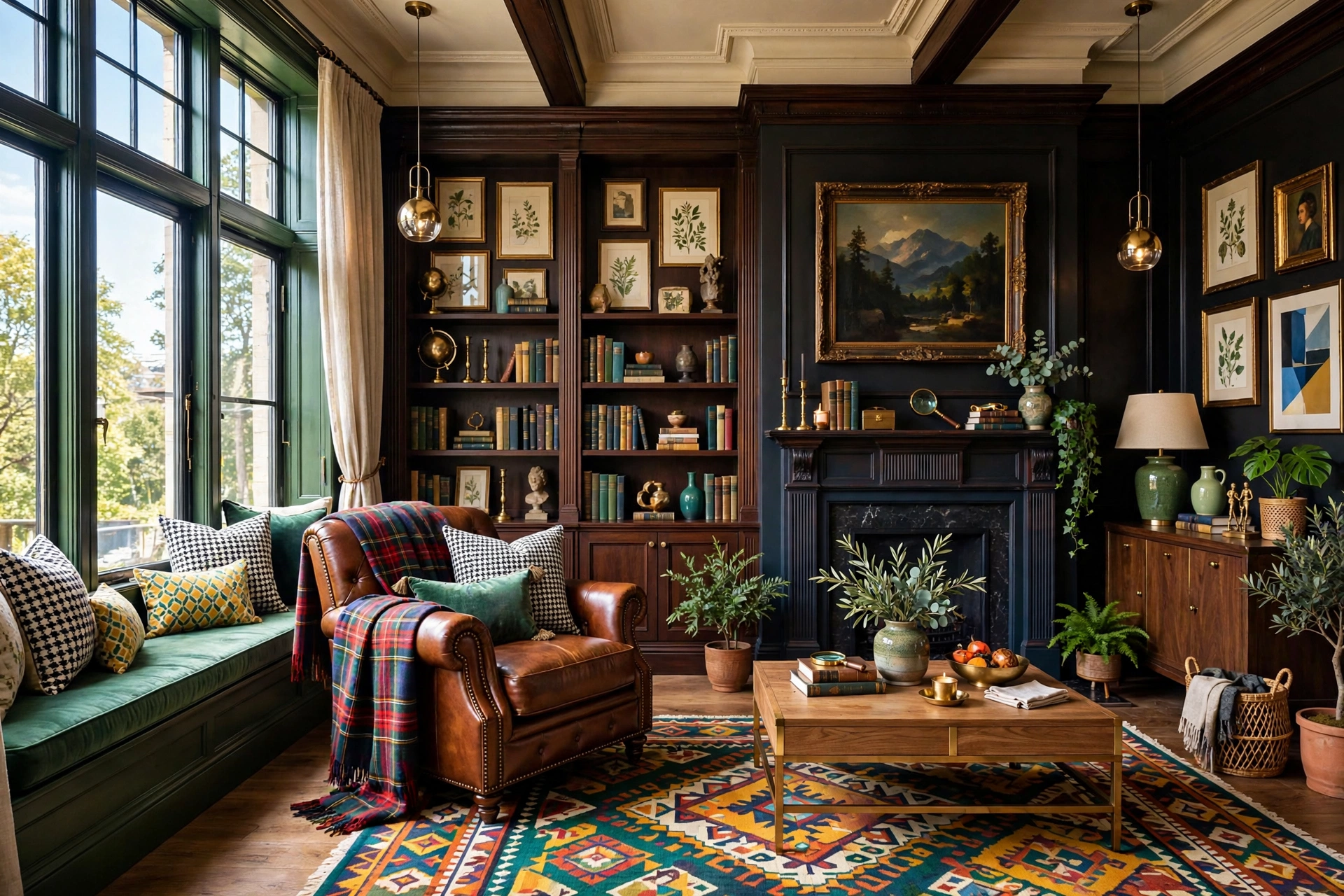
The textiles of dark academia are the fabrics of old libraries and country houses: tartan throws, herringbone wool, houndstooth cushions, tweed upholstery. These patterns add scholarly texture without color noise — they sit in browns, greens, grays, and blacks that deepen the palette.
Drape a tartan throw over the leather chair, add two houndstooth cushions to the sofa, choose a herringbone wool for any reupholstered piece. Like our bohemian living room ideas guide teaches for pattern mixing, keep the patterns in one tonal family so they read as layered rather than loud.
14. Create a Dedicated Reading Corner
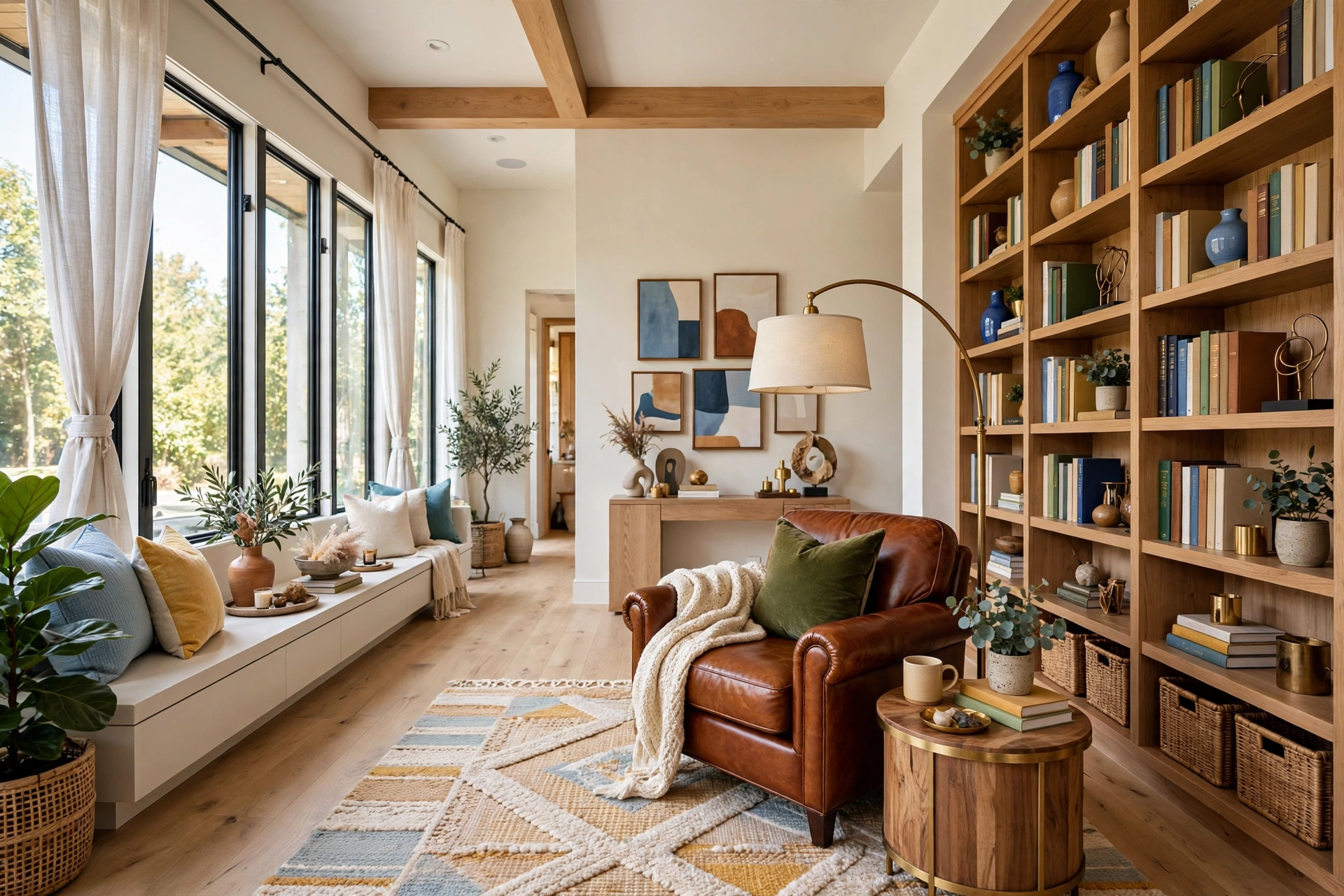
Every dark academia living room deserves a reading corner — the one seat that is unmistakably for disappearing into a book. Combine the leather chair, a brass floor lamp arcing over the reading shoulder, a small side table for tea and the current read, and a throw within arm’s reach. It should look inviting at a glance and irresistible up close.
Position it near the bookshelves so the next book is always within reach, ideally by a window for daylight reading and beside a lamp for evening. A small rug under the chair marks the corner as its own zone. This is the seat that will appear in every photo of the room — style it accordingly.
15. Finish With Aged Brass and Antique Details
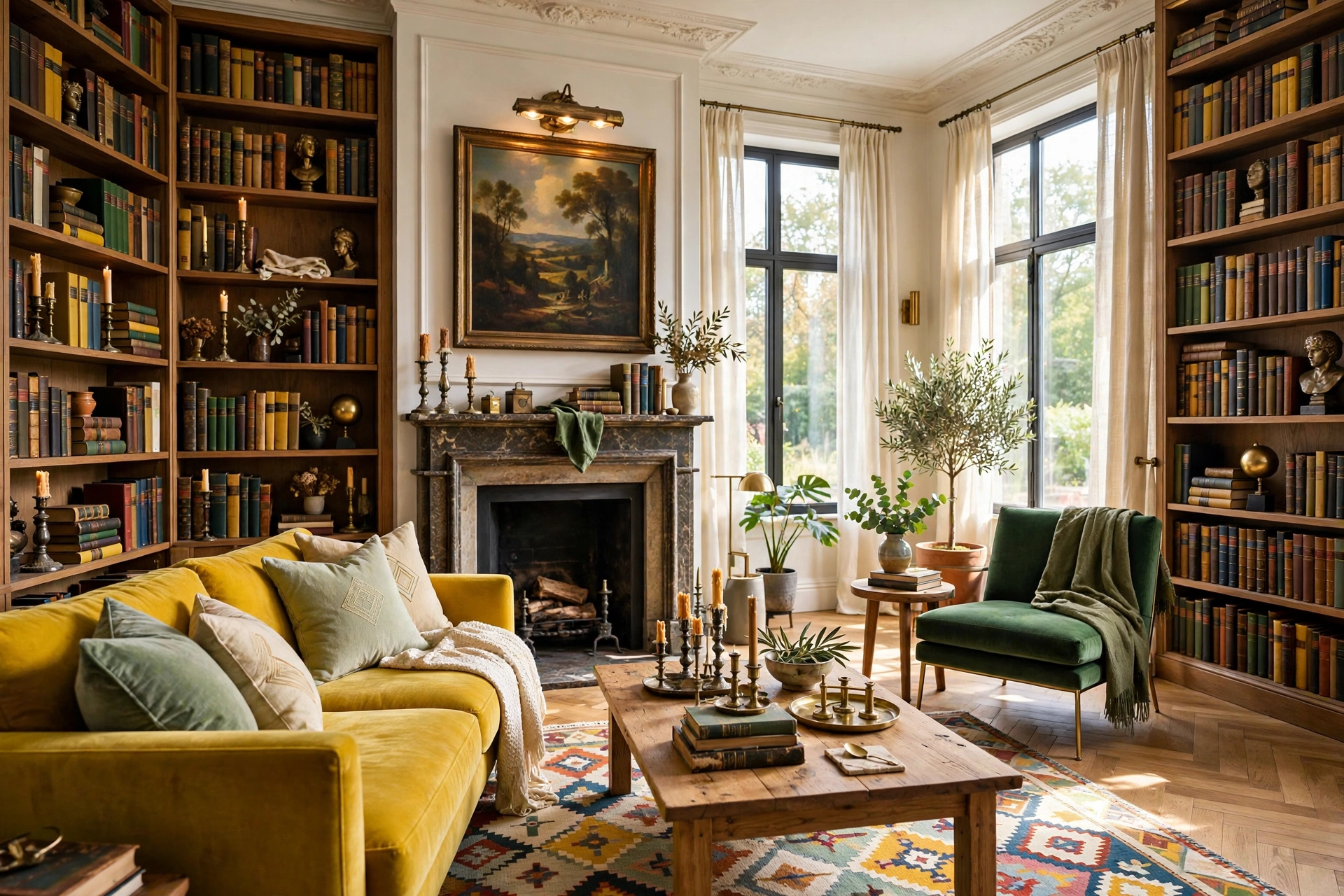
The final layer is metal and patina: aged brass picture lights over the art, antique-style drawer pulls, a brass fireplace screen, tarnished candlesticks, an old skeleton key displayed on the shelf. These small aged details are what separate a dark room from a dark academia room.
Repeat brass at least three times around the room — lamp, frames, hardware — so it reads as a scheme. Let it tarnish; polished chrome-bright brass belongs to a different style. The goal is the glow of a library at closing time: everything a little worn, everything exactly where a scholar would want it.
Quick Comparison: Dark Academia Living Room Elements by Cost and Effort
Dark Academia Living Room Quick-Start Checklist
- ✅ Paint walls a deep moody color (forest, oxblood, charcoal) in a matte finish
- ✅ Add one leather armchair as the room’s gravitational center
- ✅ Build or style floor-to-ceiling bookshelves, filled like a real library
- ✅ Layer a Persian or Oriental-style rug under the seating
- ✅ Replace overhead light with warm lamps and candles at three heights
- ✅ Hang gilt-framed classical art, one large piece plus a salon cluster
- ✅ Finish with brass, velvet, and one classical sculpture for gravitas
Common Dark Academia Living Room Mistakes
Mistake 1: Going Dark Without Enough Light Sources
Dark walls plus one ceiling light equals a cave. The most common dark academia failure is forgetting that moody does not mean dim everywhere — it means controlled pools of warm light. Before you paint, plan three to four lamp positions plus candles. A dark room with layered warm lighting feels like a library; the same room with one overhead feels like a basement.
Mistake 2: Buying Everything New
Dark academia is a collected style, and a room furnished entirely from one new collection reads as a theme restaurant. The patina — the worn leather, the foxed pages, the tarnished brass — cannot be rushed. Mix genuine vintage finds with new basics, and let the room accumulate. Thrift stores, estate sales, and family attics are this style’s true retailers.
Mistake 3: Using Cool White Bulbs
Cool daylight bulbs in brass lamps destroy the aesthetic instantly, turning scholarly warmth into office glare. Every bulb in a dark academia room should be 2700K or warmer, and dimmers should be standard. Check the bulbs you already own — most “daylight” LEDs people install are the single biggest reason a moody room never feels right.
Mistake 4: Forgetting Texture Variety
Dark rooms flatten fast when everything is smooth. If the walls are matte, the sofa is flat-weave, and the rug is low-pile, the room reads as one dark blob. Mix velvet, leather, wool, brass, wood grain, and paper — the style’s richness comes from materials catching light differently. Run your hand across the room’s surfaces; if everything feels the same, add a contrasting texture.
Mistake 5: Overdoing the Skull-and-Candle Theme
One classical bust is scholarly; five skulls, a raven statue, and a Ouija board is a Halloween store. Dark academia flirts with the macabre but stays on the scholarly side. Let the books, art, and furniture carry the mood, and keep the overtly gothic objects to one or two well-placed pieces.
Frequently Asked Questions
1. What is the dark academia living room aesthetic?
Dark academia is an interior style inspired by old universities, libraries, and classical scholarship. It combines deep moody colors, vintage furniture, overflowing bookshelves, classical art, candlelight, and aged materials like leather, brass, and dark wood to create a room that feels scholarly, romantic, and steeped in history.
2. What colors work best for a dark academia living room?
The core palette is deep and desaturated: forest green, oxblood or burgundy, espresso brown, charcoal, and black, warmed with brass, candlelit gold, and aged ivory. Walls carry the darkest tones while textiles and art add mid-tone richness. Avoid bright primaries and cool grays, which break the old-world spell.
3. Can I get the dark academia look in a rental?
Absolutely. Skip the paint and build the look through furniture and objects instead: a leather chair, dark bookshelves, a Persian-style rug, velvet curtains, gilt-framed art, and warm lamps all travel with you. Peel-and-stick dark wallpaper on one wall can fake the painted effect without touching the lease.
4. How do I keep a dark living room from feeling gloomy?
Layer warm lighting at multiple heights, keep ceilings and trim a warm white, add mirrors in brass frames to bounce lamplight, and make sure at least a third of your textiles and objects are in warm mid-tones rather than near-black. The goal is candlelit richness, not darkness for its own sake.
5. Where do I find affordable dark academia furniture?
Estate sales, thrift stores, antique malls, and online secondhand marketplaces are the best sources — this style actually benefits from wear. Look for solid wood case goods, leather seating with good bones, and brass objects. A worn $80 leather chair beats a new $400 one here, because patina is the point.
6. Does dark academia work in a small living room?
Yes — dark colors blur wall edges and can make small rooms feel larger at night. Keep the furniture scaled to the room, use one large rug to unify the floor, and rely on layered warm lighting rather than a single overhead. Our small living room ideas for apartments guide covers right-sizing every piece.
7. What is the difference between dark academia and gothic decor?
Dark academia is scholarly and romantic — libraries, classical art, old books, warm candlelight. Gothic decor leans darker and more dramatic: heavier black, religious or macabre imagery, and a more theatrical mood. Dark academia can borrow gothic accents, but its heart is the life of the mind, not the macabre.
Conclusion
The dark academia living room aesthetic is not really about darkness — it is about depth. Depth of color, depth of texture, depth of story in every object. A room that looks collected over decades will always out-charm a room that was bought in a weekend, and this style gives you permission to hunt, gather, and layer at your own pace.
Start with the two moves that change everything: the deep wall color and the warm layered lighting. Then let the room grow — a bookshelf this month, a leather chair when the right one appears, a gilt frame whenever the thrift store cooperates. Some day you will light the candles, sink into the chair, and realize the room finally feels like the opening page of a very good book.