
Best Mirrors for Small Spaces That Make Rooms Look Bigger
Introduction
A mirror is the only decorating item that literally adds square footage — at least, square footage your eyes believe in. Designers have leaned on this trick for decades because it works on the one metric that matters: perception. Where the gaze can travel, the brain counts as space, and a well-placed mirror gives the eye a second room to travel through. In a small apartment or a cramped bedroom, that can be the difference between feeling boxed in and feeling like you have room to breathe.
What makes mirrors different from other small-space upgrades is the combination of impact and cost. A single large mirror often outperforms a new paint job or a furniture swap for perceived spaciousness, and it can cost less than a dinner out. Renters love them because the best placements need no drilling at all — lean, hang over a door, or set one on a dresser and the room transforms the same afternoon.
This guide rounds up fifteen of the best mirrors for small spaces — the sizes, shapes, styles, and placements that actually make rooms look bigger — plus the mistakes to avoid and honest answers to the questions people ask before buying. Whether you are styling a studio, a narrow hallway, or a dark entryway, you will find a mirror move here that fits your space and your lease. Pair these placements with proven ways to how to make a small room look bigger and your whole home will start to feel noticeably larger.
1. Choose One Large Mirror Over a Cluster of Small Ones
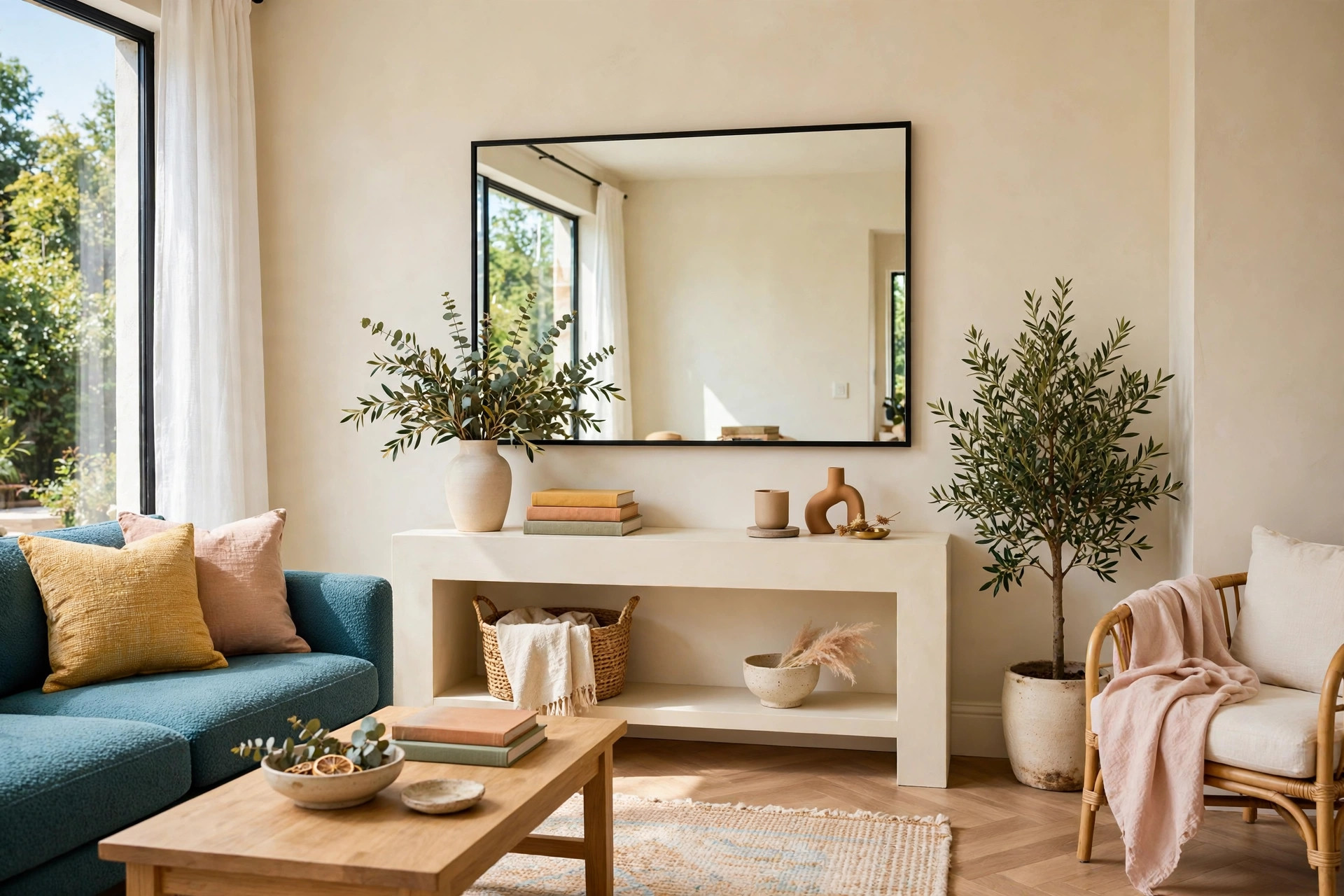
The single biggest mirror mistake in small spaces is going too small. A dainty round mirror above the dresser reads as decoration — pretty, but it adds nothing to the room’s sense of scale. A single oversized mirror, running most of the wall’s height or spanning half its width, reads as architecture: a window that happens to be silver instead of clear. When the reflected image is big enough to walk into visually, the brain files it as additional room rather than as an object on the wall.
Scale your mirror to the wall, not the furniture. A good rule is to cover at least two-thirds of the width of whatever sits beneath it — the console, the dresser, the mantel. In a truly tiny room, push further: a mirror that runs from a few inches off the floor to near the ceiling doubles as a doorway effect, especially when it catches the brightest part of the room. One confident large piece always beats three timid ones in a small space.
2. Hang a Mirror Opposite or Beside the Window
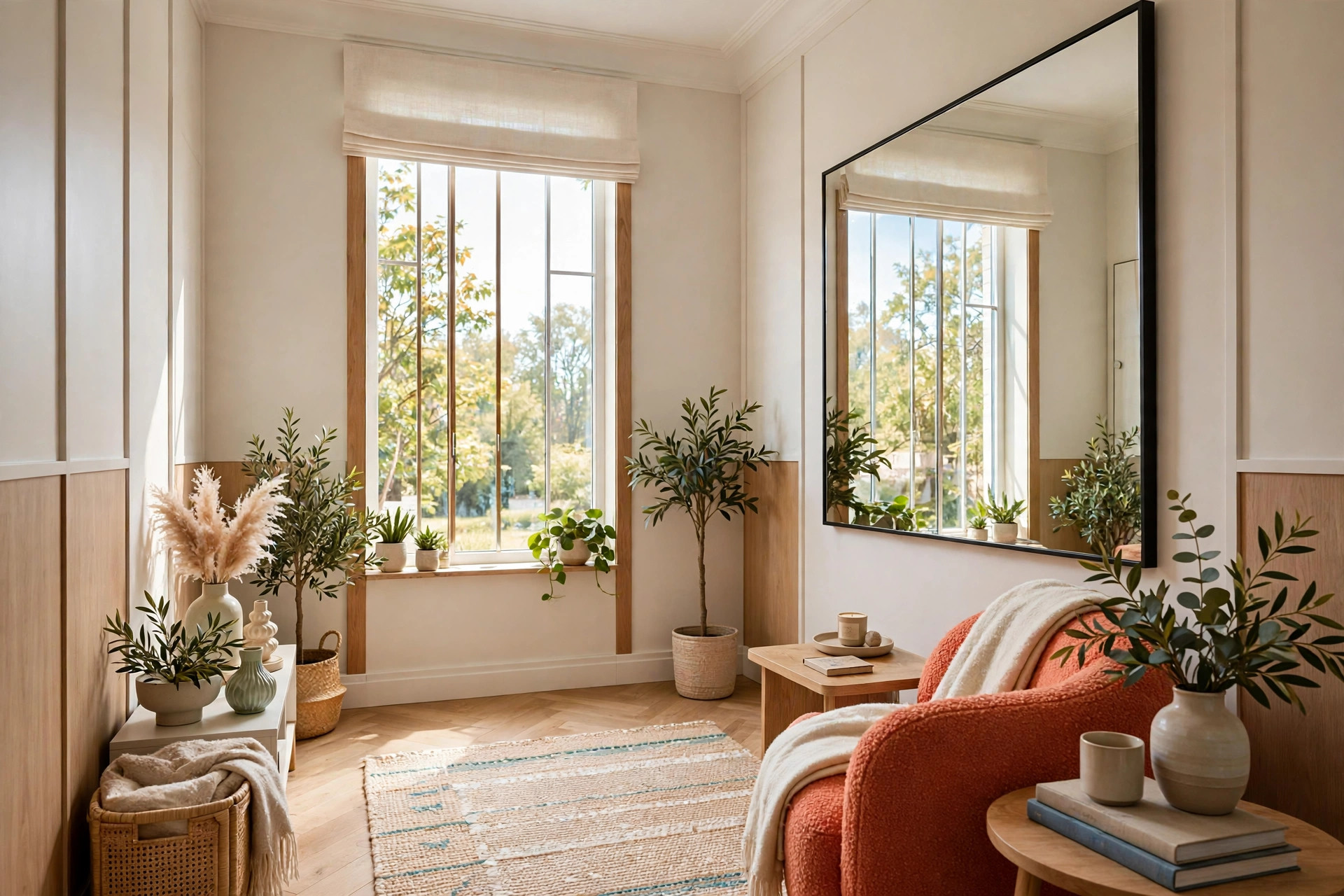
Placement is where most of the magic happens. A mirror hung on the wall directly across from the window does two jobs at once: it bounces daylight deep into the room, and it reflects the outdoors, creating the convincing illusion of a second window. A room with two “windows” feels dramatically bigger than a room with one, even when one of them is silvered glass.
If the opposite wall has no good spot — blocked by furniture or a door — the adjacent wall works too. A mirror perpendicular to the window catches the daylight at an angle and throws it across the room, lighting corners that otherwise go dim. What you must avoid is hanging the mirror where it reflects a dark wall, a blank corner, or the back of the door: a mirror that reflects nothing worth seeing just adds another boundary instead of erasing one.
📌 Important: Before you commit to a spot, hold the mirror in place and check the reflection from the doorway — the view a visitor gets first. If the reflection shows the window, a styled corner, or greenery, you have the right wall. If it shows clutter, the television, or a messy desk, move it before you hang anything.
3. Use Floor-to-Ceiling Mirror Panels for Maximum Depth
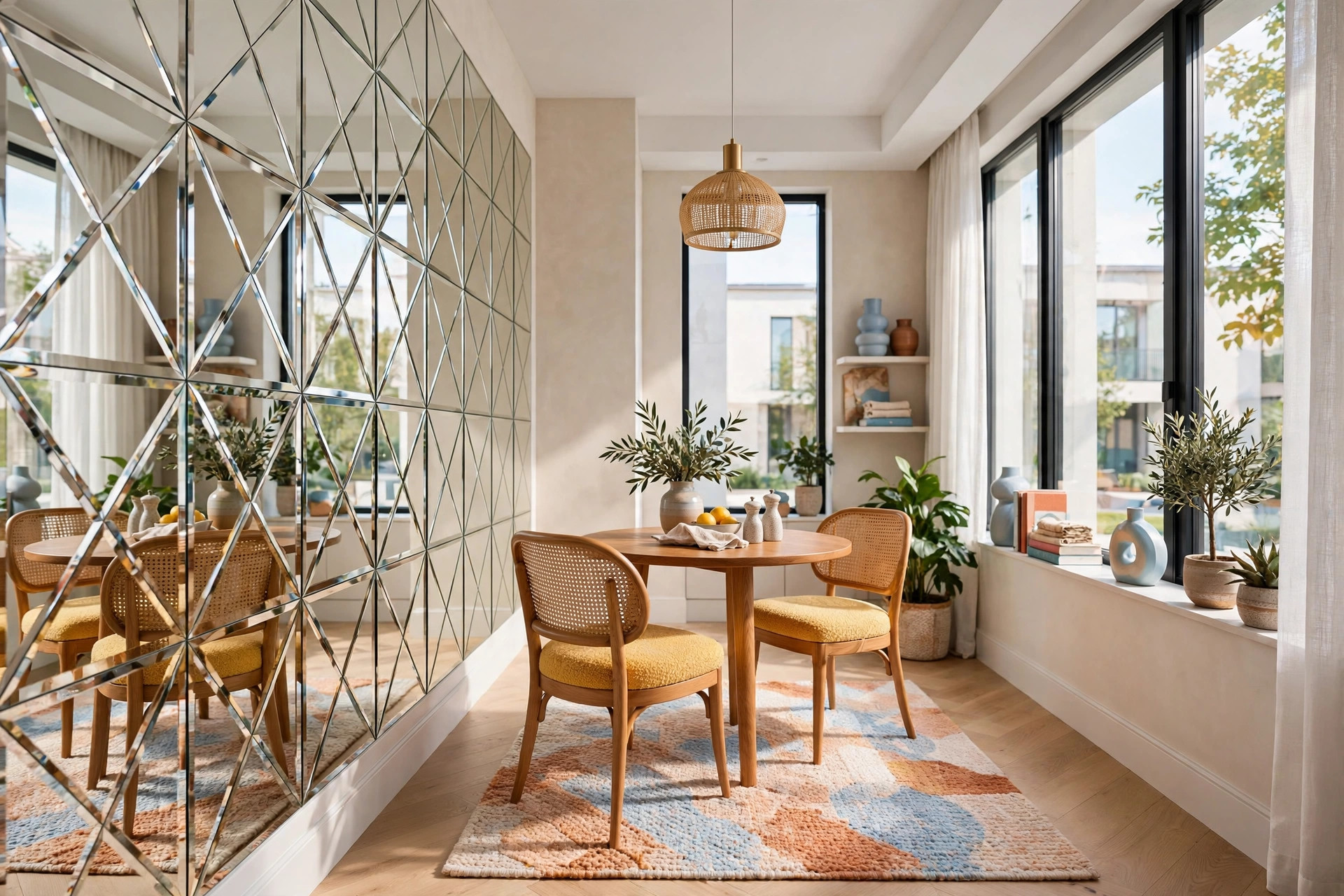
When you want the strongest possible effect, stop thinking of mirrors as framed decor and start thinking of them as wall finish. A section of wall covered in floor-to-ceiling mirror panels visually doubles the room’s depth, because the reflection has no frame to remind the eye where the room stops. In a narrow galley bedroom, a dark hallway, or a boxy dining nook, one mirrored wall can make the space feel nearly twice as wide.
You do not need a single giant sheet of glass. A grid of large square mirror panels — the peel-and-stick or thin framed kind — installs panel by panel and is far easier to handle, especially in rentals where adhesive options avoid drilling. Beveled-edge panels give the grid a tailored, intentional look rather than a commercial feel, and lightly smoked or antique finishes soften the reflection if a perfect mirror feels too stark. Cover one wall fully rather than scattering mirror patches: the illusion needs continuity to convince the eye.
4. Lean a Full-Length Mirror Instead of Drilling
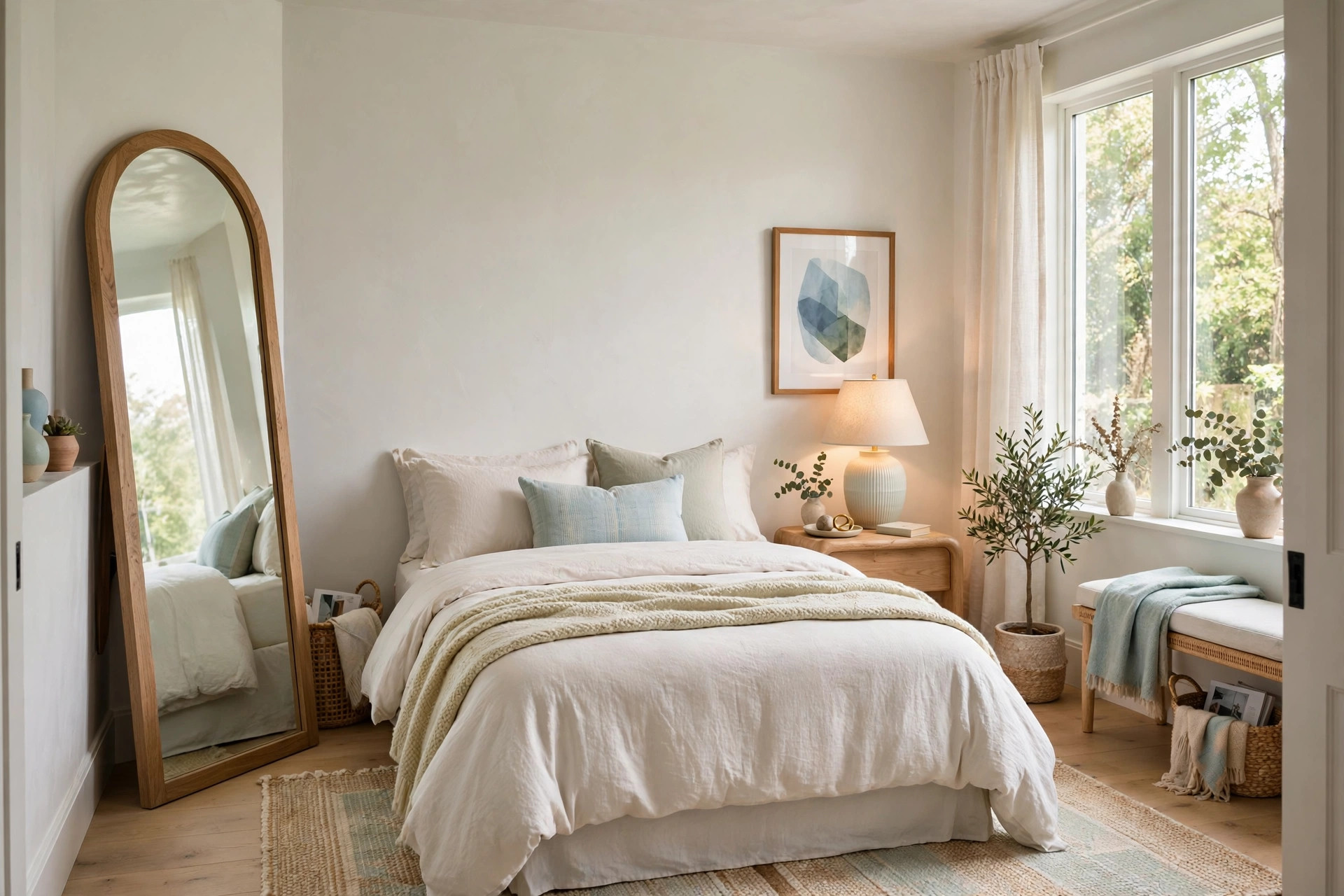
Renters, this is your move. A tall full-length mirror leaned against the wall delivers nearly all the space-doubling effect of a mounted mirror with zero holes, zero hardware, and zero lease anxiety. The slight backward angle even helps: it tilts the reflection up toward the window and the ceiling, pulling in more light than a flat-mounted mirror would.
Choose a mirror that is tall enough to matter — at least two-thirds of your wall height, ideally closer to full height. A small lean-to mirror reads as a dressing accessory; a tall one reads as another doorway. Arched tops are particularly flattering in small bedrooms because the curve softens the room’s boxiness while the height stretches the perceived ceiling. Anchor the top to the wall with a removable adhesive strip for safety, since a tall mirror that slides on a hard floor is a hazard, not decor.
5. Pick Mirrored Furniture That Reflects Without a Wall Commitment
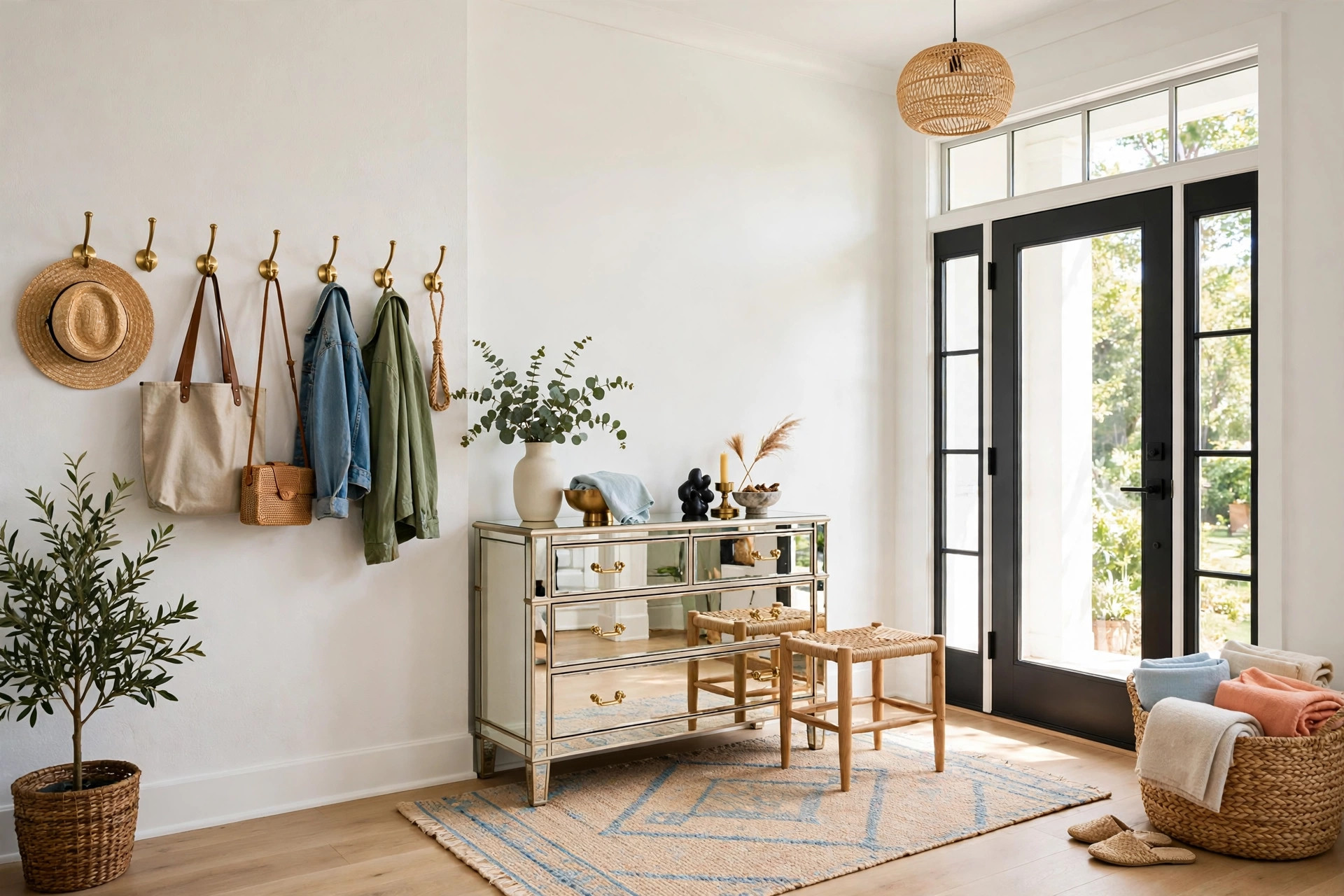
Sometimes the wall is not available — it is covered in windows, a gallery wall, or a lease you cannot negotiate with. Mirrored furniture carries the trick into the furniture plan itself: a mirrored console, chest, or side table reflects the room around it, so the piece adds function while staying visually light. In a cramped entryway or a tight bedroom, a mirrored dresser can hold everything a wooden one would while seeming to occupy half the visual space.
Use mirrored furniture the way you would any accent: one or two pieces, not a matching set. A mirrored nightstand beside the bed or a mirrored console under a hallway mirror doubles down on the effect without tipping into the funhouse look. Pair the reflective piece with softer materials around it — wood, linen, a woven basket — so the room stays warm and lived-in. For whole-room plans built on this kind of double-duty thinking, these small space furniture ideas pair naturally with reflective surfaces.
⚠️ Warning: Mirrored furniture shows every fingerprint, dust mote, and water spot. In a high-traffic spot like an entryway console or a dining-sideboard top, budget for a weekly wipe-down, or the “extra space” effect gets buried under visible smudges.
6. Soften the Room With a Round Mirror
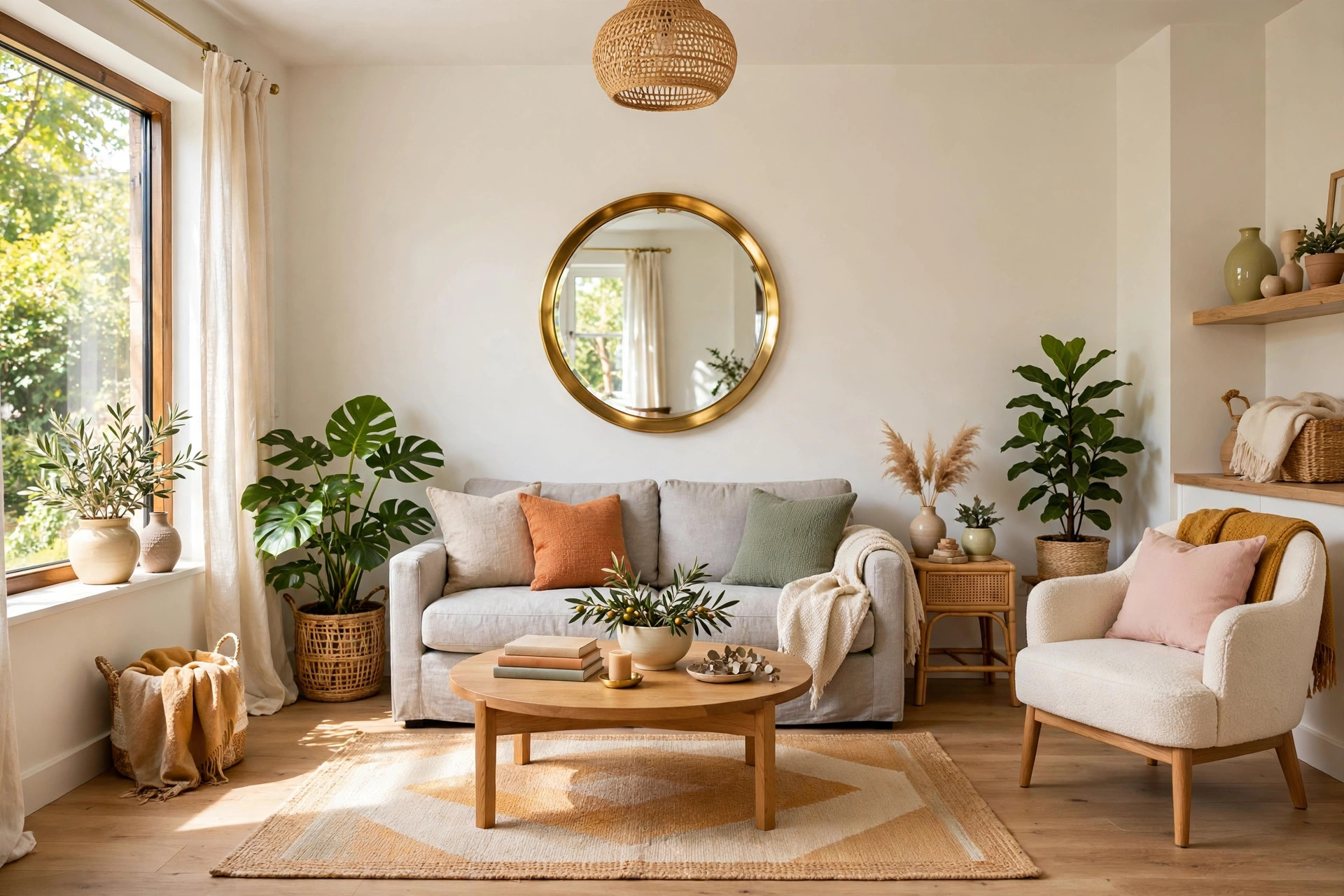
Small rooms are full of rectangles — the bed, the dresser, the rug, the windows — and all those corners press in on the eye. A round mirror breaks the grid. Its curve softens the wall it hangs on, gives the eye a resting place with no edges to stop at, and adds a sculptural quality that rectangular rooms desperately need. Designers reach for round mirrors in small bathrooms, entryways, and bedrooms for exactly this reason.
Size still matters: a round mirror over a console or dresser should span roughly two-thirds of the furniture’s width, and in a living area the sweet spot is often larger than people expect — a 36-inch round mirror makes a statement that a 24-inch one cannot. Hang it at true eye level, centered on the furniture beneath it, with the bottom edge low enough that it reflects the room’s best features rather than just the ceiling. Brass or thin black frames keep the look current; chunky ornate frames suit a more traditional small space.
7. Try Antique or Smoked Mirrors for a Softer Glow
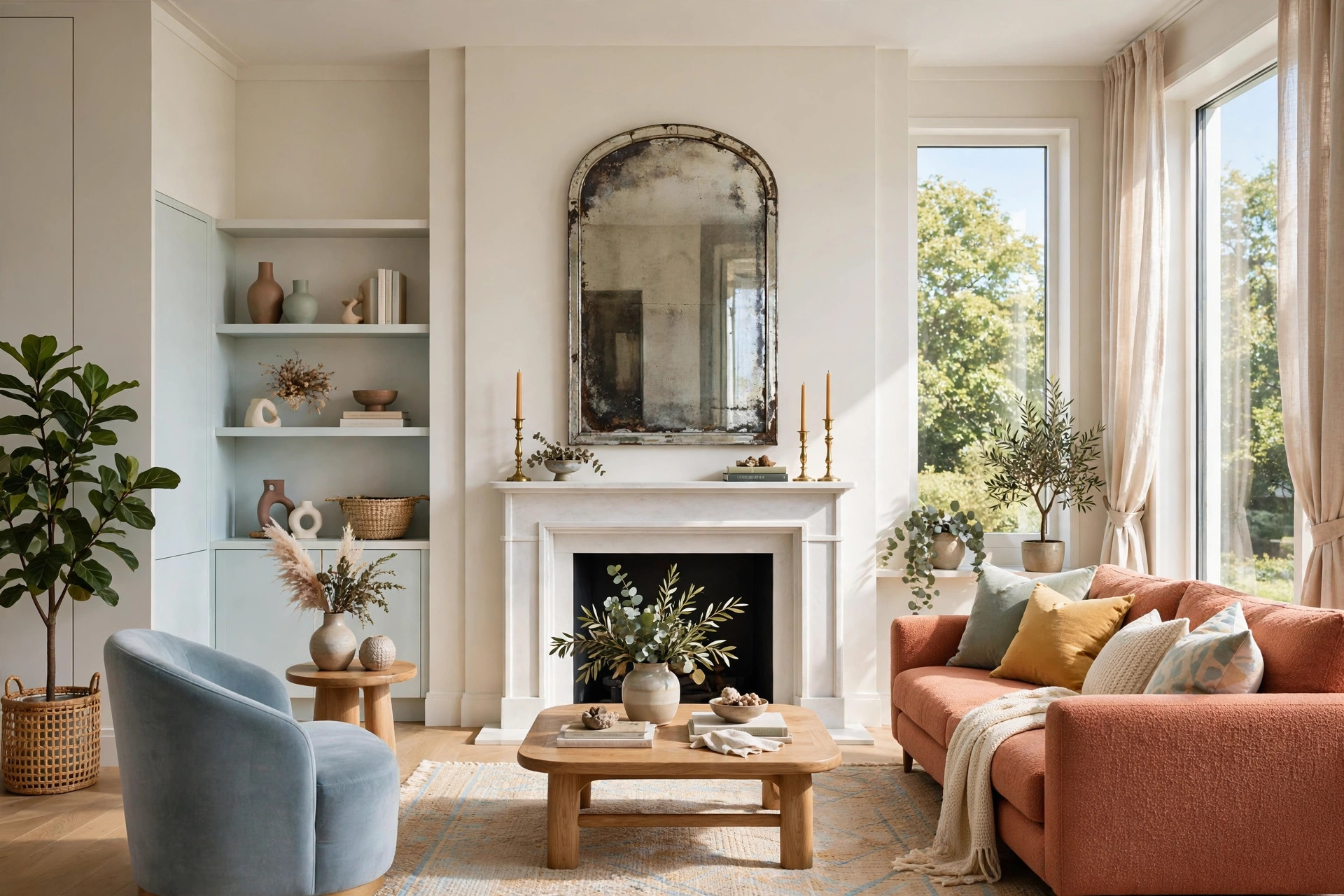
Not every room wants a perfect, razor-sharp reflection. Antique mirrors — with their softly foxed, mottled silvering — and lightly smoked bronze or gray mirrors trade a little brightness for a lot of atmosphere. They still bounce light and double visual depth, but the reflection feels like candlelight instead of a showroom, which can be exactly right for a cozy small bedroom or a moody dining corner.
This style is also practical camouflage. A slightly imperfect mirror is far more forgiving of a less-than-perfect room behind the camera: it flatters, softens, and hides in a way a crystal-clear mirror never will. Use antique-finish panels for a feature wall, or choose a single statement piece with a patinated frame over the mantel or sideboard. The finish reads as intentional design rather than aging — and in a small space, the warm glow adds depth without adding a single object.
8. Place Mirrors Behind or Beside Lighting
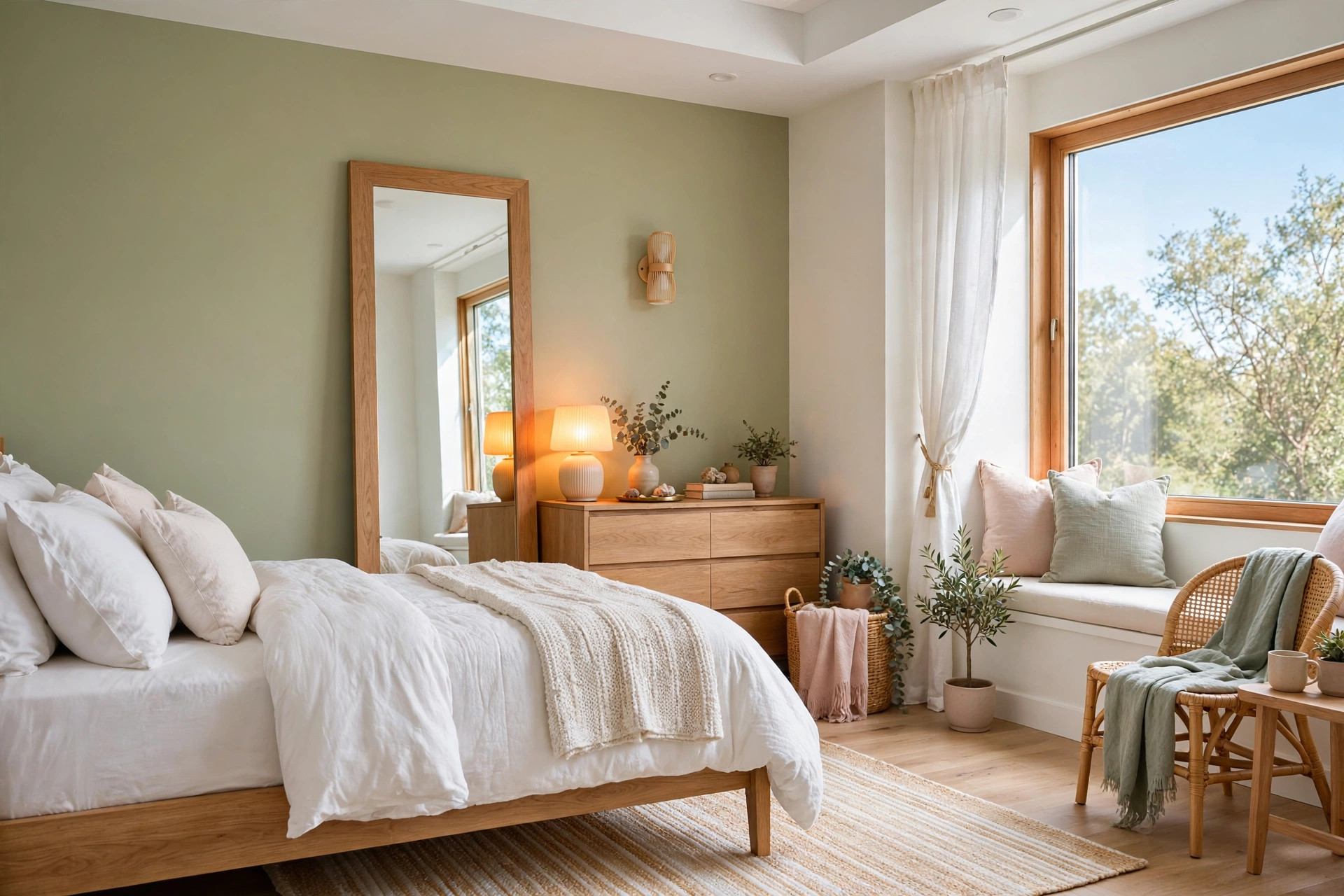
A mirror behind a table lamp, a floor lamp, or a pair of sconces does not just reflect light — it appears to double the number of light sources in the room. One glowing lamp in the reflection reads as two, and that doubled warmth fills corners that a single fixture would leave dim. In a small living room or bedroom, this is the cheapest way to make the lighting feel layered and generous.
The trick works best with warm bulbs, which read as candlelight in the reflection, and with lamps that sit at the mirror’s edge rather than dead center — an off-center glow feels natural, a centered one can feel staged. Try it on a console table: one lamp in front of a tall mirror, and the vignette suddenly looks like a boutique hotel’s. Candles in front of a mirror work the same way at a fraction of the cost, and on a mirrored tray they become a centerpiece that seems to glow from within.
💡 Pro Tip: In a dark hallway or entryway with no outlet for a lamp, hang a mirror where it catches the glow from an adjacent room’s lighting. The borrowed light effect brightens the dead zone for free — and the mirror then bounces it even deeper.
9. Open Up the Entryway With a Mirror
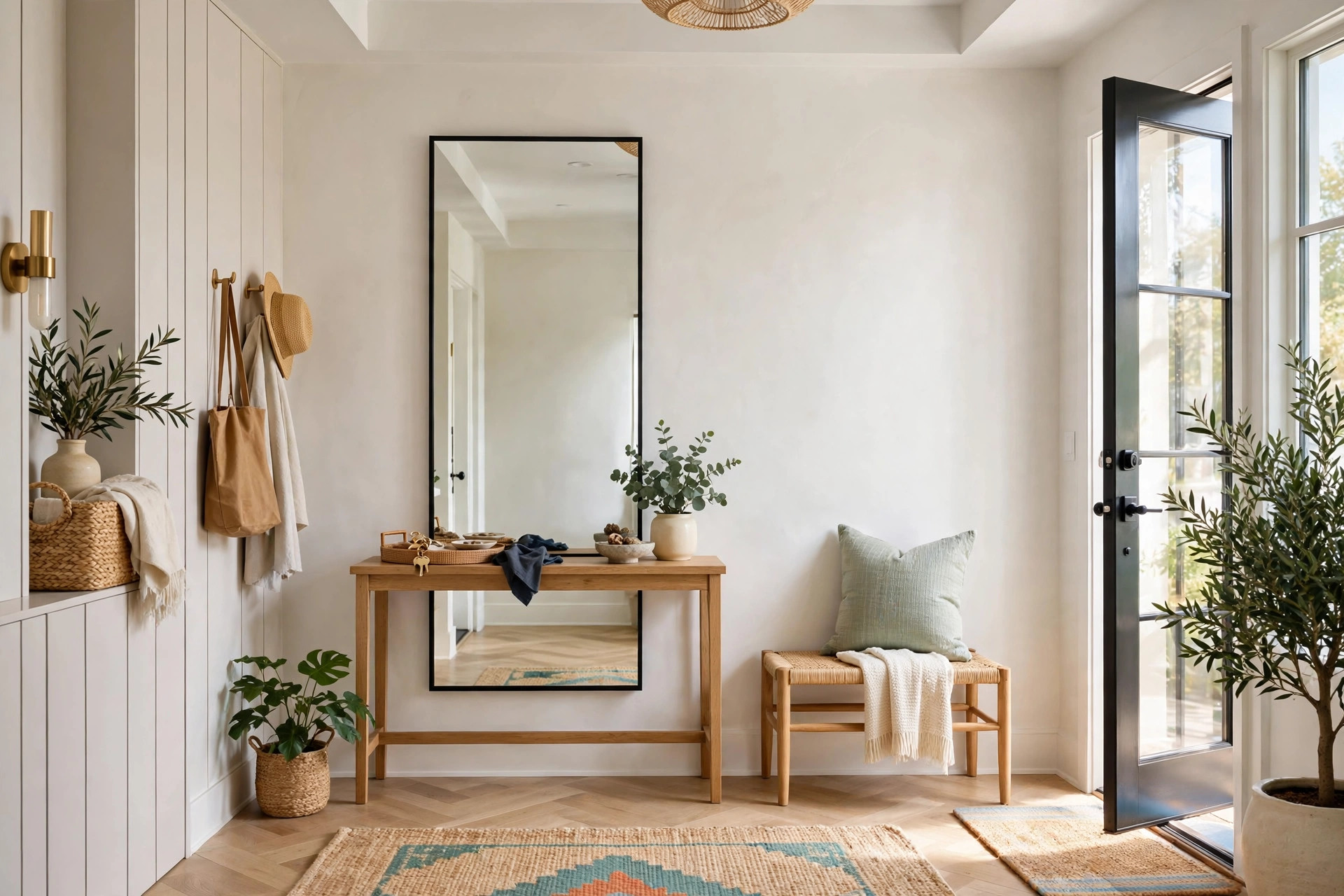
The entryway sets the verdict on your whole home: it is the first space a visitor sees, and in most small apartments it is also the darkest and narrowest. A mirror here pays off instantly. Hung above the console or opposite the front door, it doubles the perceived width of the corridor and catches light from the living room or a sidelight window, so the entry stops feeling like a tunnel.
Choose a shape that suits the wall: a tall rectangular or arched mirror for a narrow entry stretches the ceiling line, while a round mirror over a slim console softens a wider foyer. Keep the reflection honest — aim it at something styled, not at the coat pile or the shoe rack, because the mirror will broadcast whatever it faces. One mirror, one console, one small tray for keys: an entry styled this simply always looks bigger than one crowded with furniture.
10. Line a Narrow Hallway With Mirrors
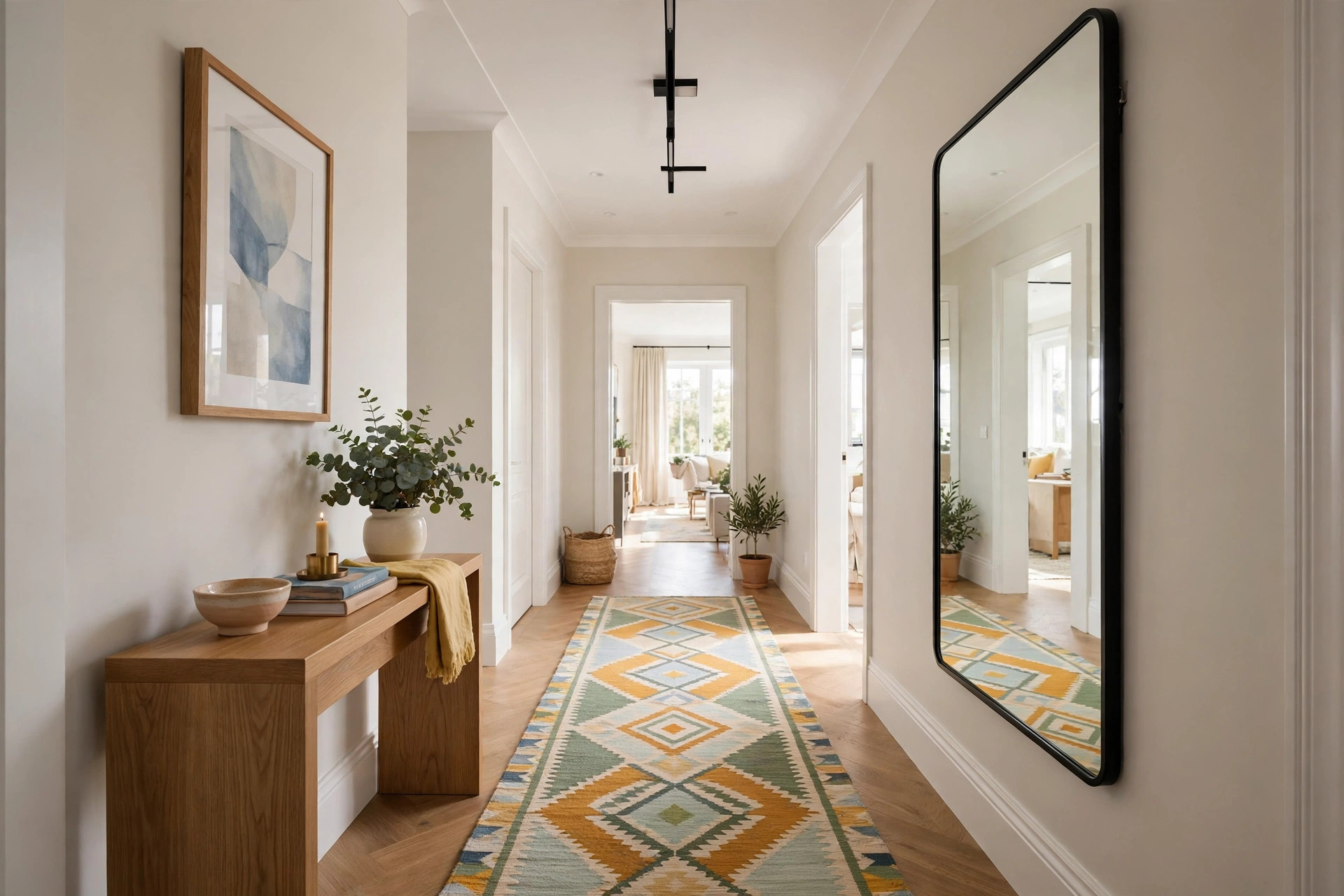
Hallways are the hardest small space of all — long, dark, and single-purpose — and they are where mirrors earn their reputation. A mirror on one wall of a narrow hallway visually doubles its width, turning a corridor into something that feels like a gallery. If the hallway has a window or light source at one end, place the mirror to catch it; the light will seem to travel the hallway’s full length in the reflection.
One large mirror beats a row of small ones here: continuity is what sells the illusion, and a single generous panel reads as an opening rather than decor. For very dark hallways, pair the mirror with a slim picture light or an LED strip above it — the light bounces off the glass and washes the whole corridor in a glow that makes it feel wider and far more welcoming. Keep the opposite wall simple so the eye has one clean line to follow.
📌 Important: In a hallway, the mirror’s reflection will be seen while walking — moving reflections can feel unsettling if the glass is enormous and perfectly clear. A lightly antiqued finish or a mirror placed above eye level keeps the widening effect without the startle factor.
11. Use Mirrored Closet or Cabinet Doors
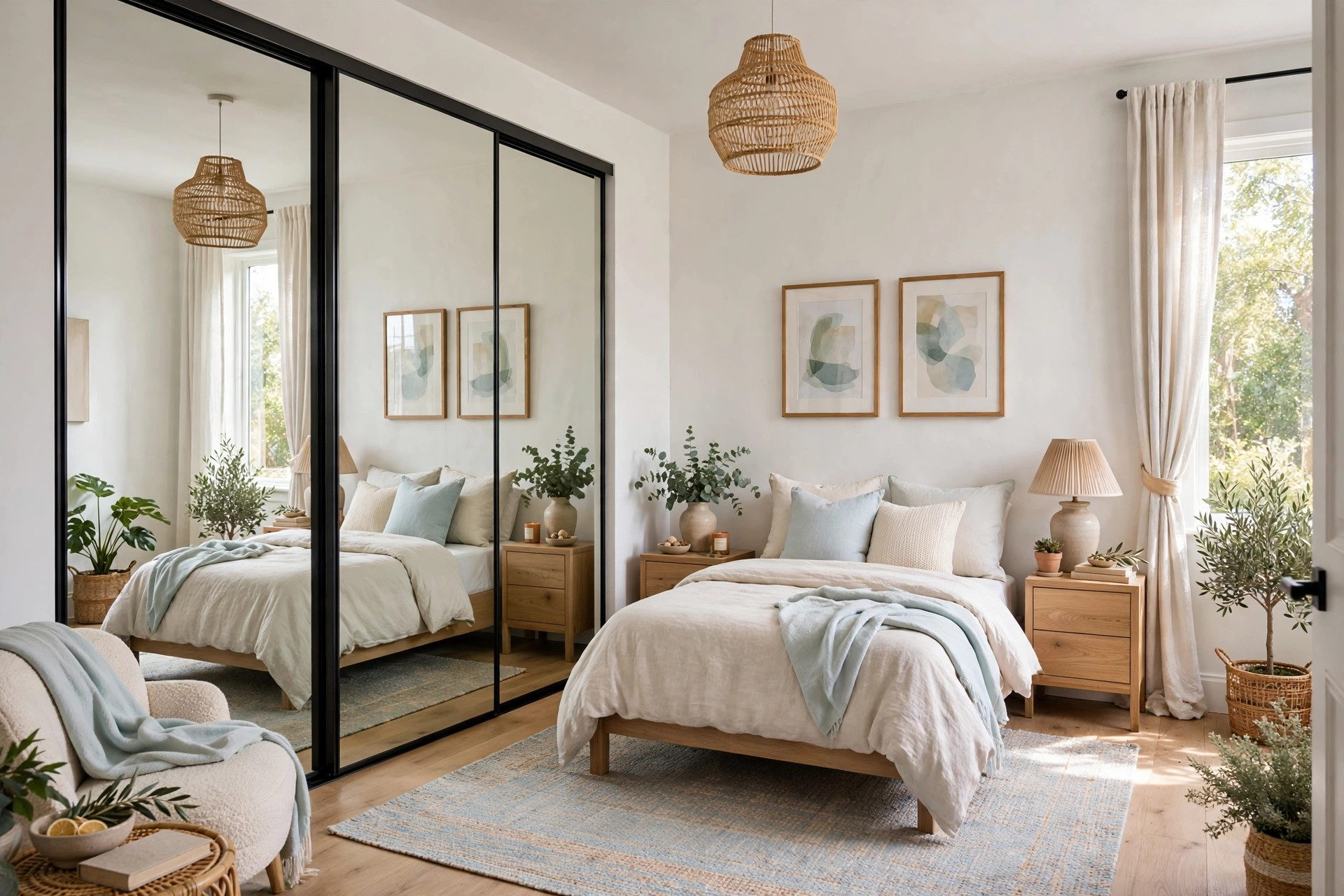
Closet doors are some of the largest uninterrupted surfaces in a bedroom, and covering them in mirror turns dead wall into a room-doubling engine. A full wall of mirrored closet doors reflects the entire bedroom — the window, the bedding, the light — so the room feels twice its size from every angle. It is the closest most homes come to the floor-to-ceiling panel effect without a custom installation.
If replacing doors is too much, mirror-film or adhesive mirror panels applied to existing flat closet doors capture most of the effect for a fraction of the cost, and they come off at move-out. Sliding mirrored doors have a bonus: they need no swing clearance, so the floor in front of the closet stays usable — a genuine space gain, not just a visual one. Keep the reflected side of the room styled, since the mirror broadcasts the whole bedroom; an unmade bed reflected at double scale is not the spacious look you want.
12. Double Your Best Focal Point With a Mirror Behind It
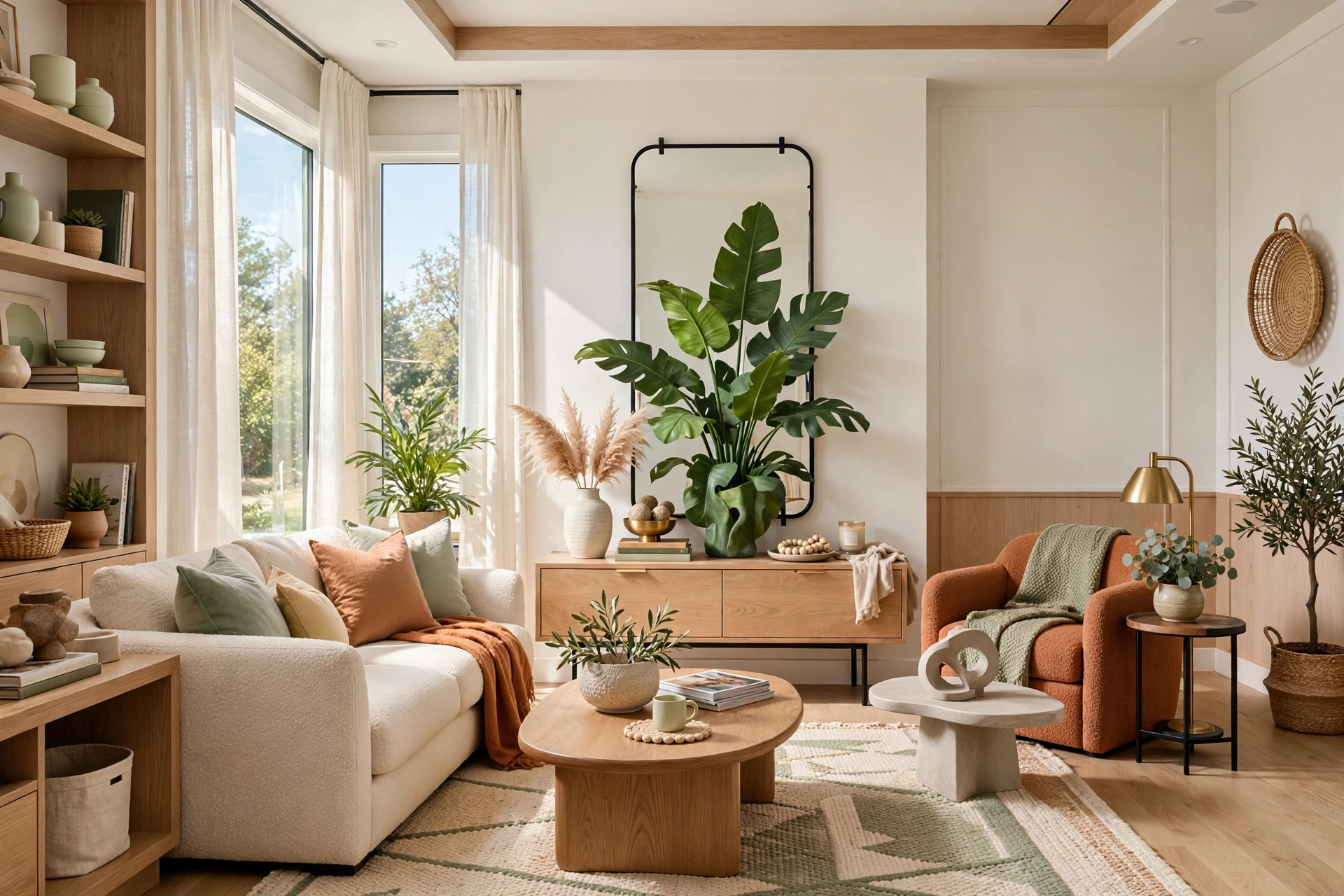
Mirrors are at their most powerful when they reflect something beautiful. Placing a mirror directly behind a favorite object — a sculptural plant, a vase of branches, a striking piece of art — visually doubles it, creating a sense of abundance that a small room rarely achieves on its own. The reflected focal point becomes a destination for the eye, and rooms with a clear destination always feel larger than rooms where the gaze wanders and stops.
Try it on a mantel, a console, or a dining sideboard: one bold arrangement in front of a tall mirror, and the vignette gains the depth of a stage set. Plants are the ideal subject because the reflection doubles the greenery, and green reads as life and airiness — two things small rooms are always short on. Just make sure the plant is healthy and the arrangement is intentional; a mirror doubles the good and the neglected alike.
💡 Pro Tip: A mirror behind open shelving — in a kitchen, a bar nook, or a bookcase — doubles the displayed objects and makes the shelf feel twice as deep. Line just the back panel with mirror for the effect without a full renovation.
13. Hang a Thoughtful Gallery of Mixed Mirrors
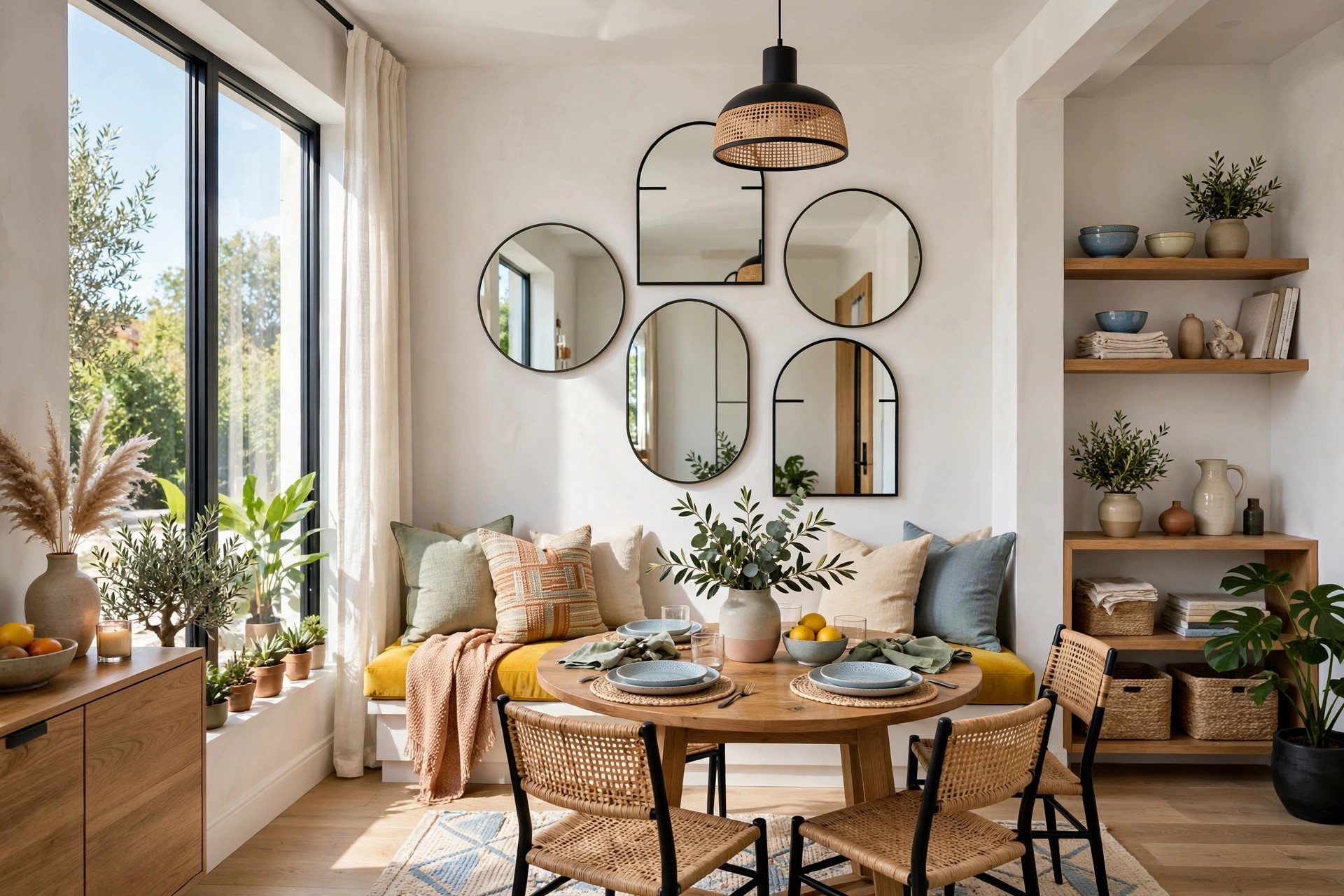
A gallery wall does not have to be art. A curated cluster of mirrors in mixed shapes — round, arched, oval, a small rectangle — turns one wall into a sparkling focal point that scatters light in every direction. Done well, it reads as a single art installation; the variety of shapes keeps the eye moving across the whole wall, which makes the wall feel larger than a single framed piece would.
Restraint is everything here. Keep the frames in one finish family — all brass, all black, all natural wood — so the collection reads as curated rather than random, and leave generous breathing room between pieces. Three to five mirrors is the sweet spot for a small space; more than that tips into clutter, which shrinks a room faster than any mirror can expand it. This is a strong move for a dining nook or a stairwell landing, where one decorated wall can carry the whole zone. For more ways to define those small zones, these affordable room dividers for open-plan small apartments pair well with a mirror gallery as an anchor.
14. Angle a Mirror to “Borrow” the View
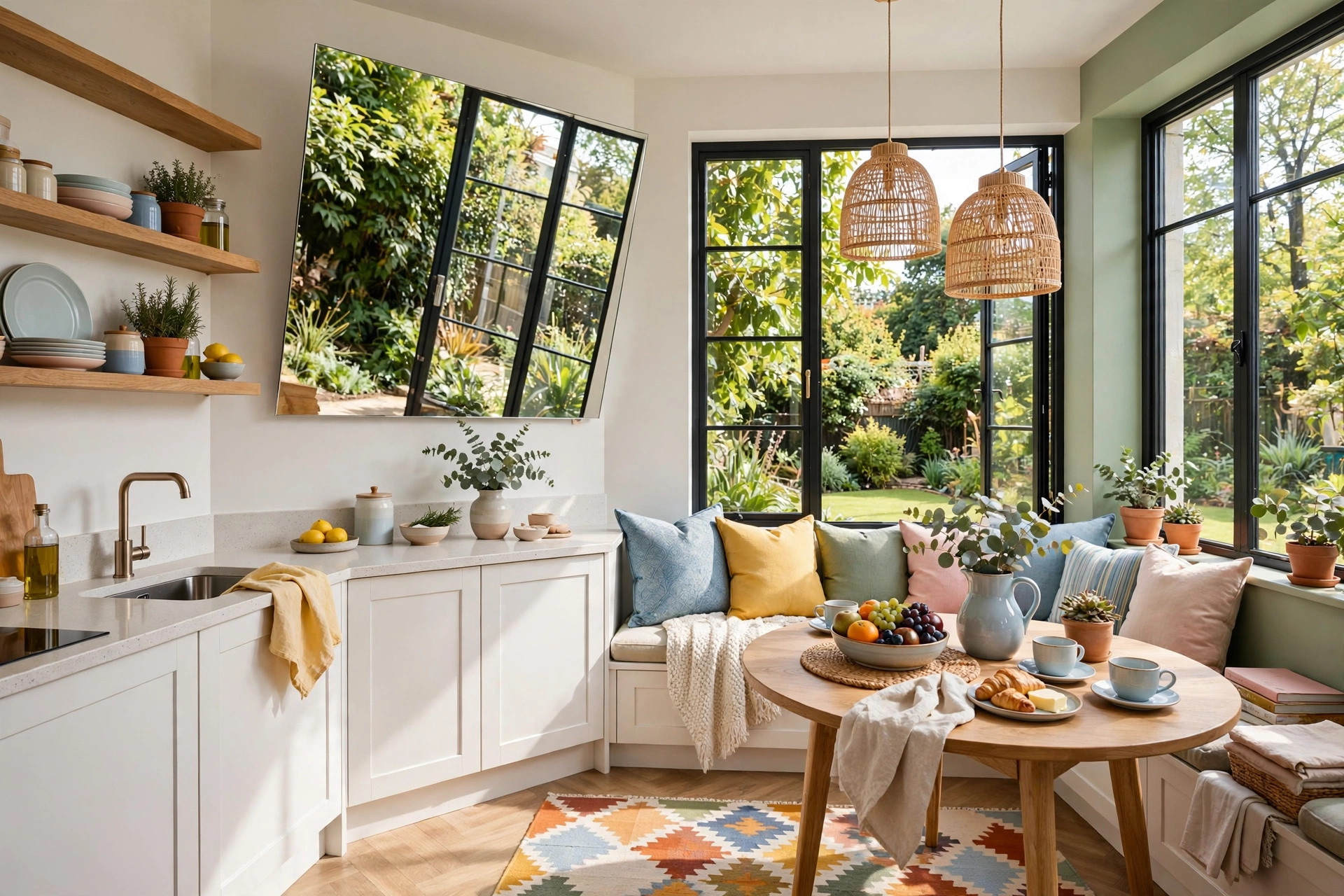
The cheapest square footage you will ever add is the view outside your window — and a mirror can steal it for a wall that has no window at all. Angle a large mirror so it catches the trees, the sky, or the skyline visible through the glass, and the reflection brings that outdoor depth deep into the room. Designers call it borrowed landscape, and in a small apartment it can make a windowless wall feel like it opens to the outside.
This works in any room with a decent view: a living room mirror angled toward the balcony doors, a kitchen mirror catching the garden window, a bedroom mirror borrowing the treetops. If the view is a brick wall or an air shaft, borrow light instead — angle the mirror to catch the brightest patch of sky. Keep the mirror itself simple and frameless or thin-framed so the reflection reads as a window, not as decor, and the borrowed depth does the rest.
⚠️ Warning: A mirror that borrows a view also borrows the sun’s path. Check the angle at different times of day — a placement that is perfect at noon can throw a blinding glare across the room at 4 p.m. If the glare hits seating or the television, shift the mirror a few degrees or choose a lightly smoked finish.
15. Keep Every Mirror Spotless and Its Reflection Styled
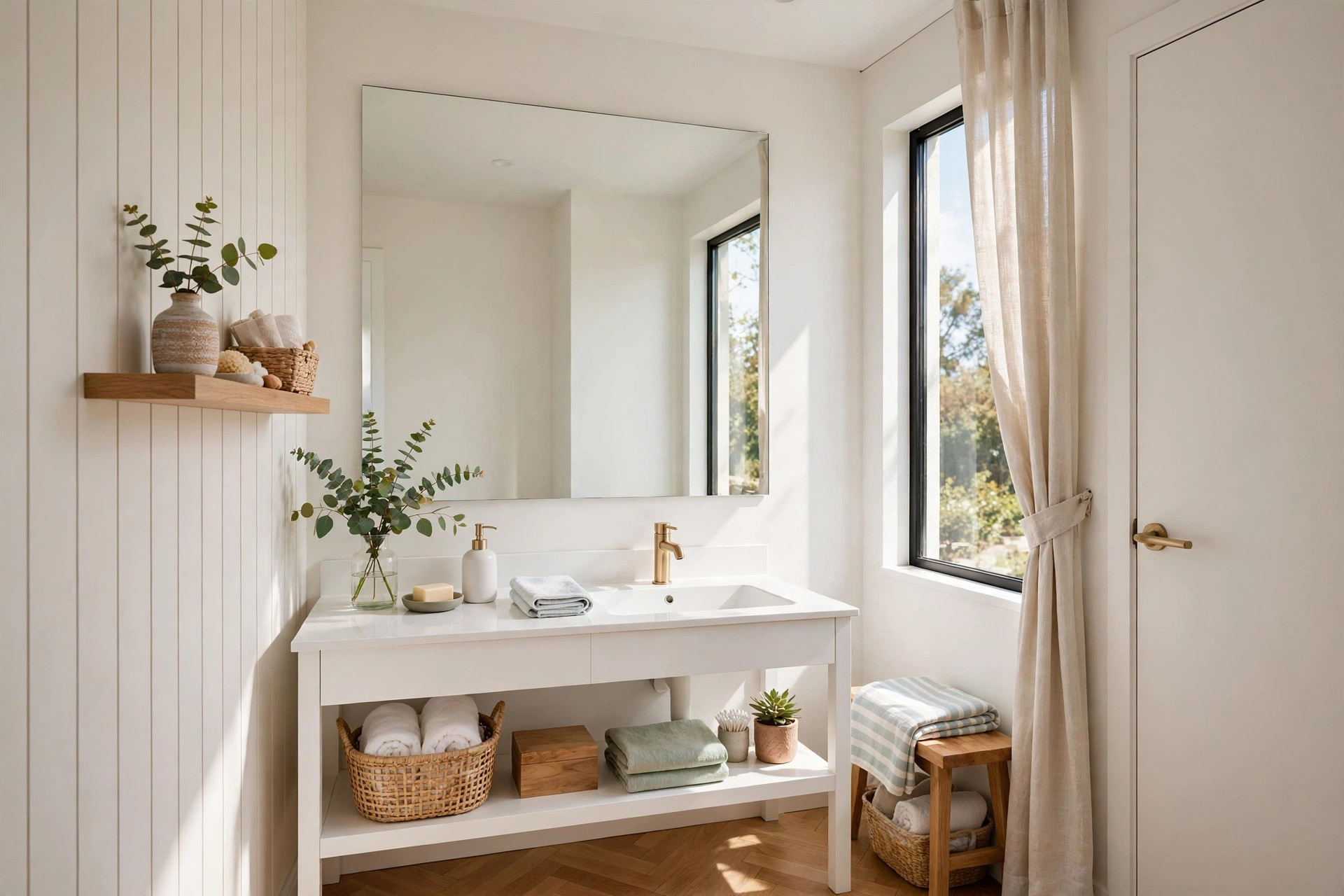
The final trick is not a purchase but a habit. A mirror only expands a room if the reflection is worth looking at — and a dusty, streaked mirror reflecting a cluttered corner actively shrinks the space. It adds a layer of visual noise and broadcasts the mess at double scale. Clean glass and a styled reflection are what separate the mirror trick from a mirror mistake.
Make it a two-minute routine: a weekly wipe with glass cleaner and a microfiber cloth keeps every mirror invisible in the best way, and a monthly check of what each mirror faces catches the slow creep of clutter into the reflection. When you rearrange a room, re-check each mirror’s sightline the way you would a photograph’s framing. Mirrors are the hardest-working item in a small home — and like anything that works hard, they reward a little maintenance. Combined with a room that is already styled for spaciousness, as in these tiny apartment decorating ideas, clean well-aimed mirrors are the finishing move that makes it all believable.
Quick Comparison: Best Mirrors for Small Spaces by Cost and Effort
Mirror Quick-Start Checklist
- ✅ Start with one oversized mirror, not several small ones — scale is the whole trick
- ✅ Hang it opposite or beside the window so it catches daylight, not a blank wall
- ✅ Check the reflection from the doorway before you commit to a spot
- ✅ Keep the mirror’s reflection styled — it doubles whatever it faces
- ✅ Try the lean-first approach: no drilling, full effect, zero lease risk
- ✅ Wipe glass weekly; a streaked mirror shrinks the room it should expand
- ✅ Repeat one frame finish across the room so mirrors read as a decision, not clutter
Common Mirror Mistakes
Mistake 1: Buying mirrors that are too small
The most common error is timidity: a 20-inch mirror in a 12-foot room. Small mirrors decorate; only large ones re-architect. If the reflection is not big enough to step into visually, the brain files it as an object on the wall and the room gains nothing. Measure the wall, then buy the largest mirror your budget and lease allow — in small spaces, mirror size should make you slightly nervous at checkout.
Mistake 2: Reflecting the wrong thing
A mirror doubles everything it faces, including the laundry chair, the open closet, and the television. Before hanging, stand where the mirror will go and look at what you see — that is roughly what the room will see doubled. Aim mirrors at windows, styled corners, plants, and art. If the only available wall faces clutter, fix the clutter first; a mirror is a multiplier, not a concealer.
Mistake 3: Scattering mirrors randomly around the room
Five small mirrors on five different walls do not add up to one big effect — they read as visual noise, and noise shrinks a room. Mirrors work through scale and intention: one generous mirror in the right spot, or one deliberate composition like a gallery wall. Every mirror should have a job — catch the window light, double the focal point, widen the hallway — and if it has no job, it does not earn its wall.
Mistake 4: Forgetting the frame in a small space
A bulky ornate frame on a large mirror eats several inches of reflective surface on every side and adds visual weight exactly where you want lightness. In small rooms, thin frames — or no frame at all — maximize the glass and keep the mirror feeling like an opening rather than an object. Save the chunky statement frames for rooms with space to carry them; in a small space, the glass is the star.
Mistake 5: Hanging mirrors in direct harsh sunlight
A mirror placed where it catches direct midday sun can throw a blinding beam across the room — onto the sofa, the desk, or straight into someone’s eyes. It can also fade fabrics and overheat a spot over time. Angle mirrors to catch bright indirect light or the view rather than the sun’s direct path, and test the placement at the sunniest hour before finalizing it.
Frequently Asked Questions
1. What size mirror makes a small room look bigger?
Go as large as the wall and your budget allow — a mirror should cover at least two-thirds of the width of the furniture beneath it, and floor mirrors should reach at least two-thirds of the wall height. Small mirrors read as decor and add nothing to perceived space; oversized mirrors read as windows and doorways, which is where the expansion effect comes from. When in doubt, size up.
2. Where is the best place to hang a mirror in a small living room?
Opposite or beside the largest window is the highest-impact spot, because the mirror doubles both daylight and the view. The second-best spot is behind or above the room’s focal point — the sofa console, the mantel, a favorite plant — so the mirror doubles something beautiful. Avoid walls that face the television, an open closet, or a cluttered desk, since the mirror will broadcast those at double scale.
3. Do mirrors really make a room look bigger, or is it just a trick?
It is a genuine perceptual effect, not just a saying. The brain judges room size by how far the eye can travel and how much light the space holds; a well-placed mirror extends both, so the room is experienced as larger. It will not change your floor plan, but in how a room feels — which is what you live in — the difference is real and immediate. It is also one of the core moves in any guide to how to make a small bedroom feel bigger.
4. Are leaning mirrors safe in homes with kids or pets?
They can be, with precautions: anchor the top of the mirror to the wall with a removable adhesive strip or a discreet bracket, keep the base a few inches from the wall at a stable lean angle, and place it where it will not be bumped in daily traffic. For households with very young children or large energetic pets, a wall-mounted mirror with proper anchors is the safer choice — the space-doubling effect is identical.
5. What mirror shape is best for a small space?
Round and arched mirrors are the most flattering in small rooms because their curves break up the boxiness of walls, doors, and furniture. Large rectangles and floor-to-ceiling panels give the strongest space-doubling effect because they maximize reflective area. The honest answer: shape is secondary to size and placement — a big mirror in the right spot beats a perfectly shaped mirror in the wrong one every time.
6. Can I use mirrors in a rental without drilling?
Absolutely — this is one of the most renter-friendly upgrades there is. Lean full-length mirrors against the wall, use adhesive mirror panels or mirror film on closet doors, hang lighter mirrors with removable adhesive strips rated for the weight, and choose mirrored furniture that needs no mounting at all. Always check the weight rating on adhesive products and test a small patch behind a door before committing to a full wall.
7. How do I stop mirrors from showing clutter?
Style the reflection, not just the room: before finalizing a mirror’s position, check what it faces from the doorway and tidy that sightline. Aim mirrors at windows, art, plants, and styled corners rather than storage zones. Keep surfaces in the reflection’s path clear, and remember that closed storage — baskets, cabinets, lidded boxes — photographs (and reflects) far calmer than open piles.
Conclusion
The best mirrors for small spaces are not really about the mirror at all — they are about what the mirror lets your eye do. Give the gaze somewhere to travel, double the light the room already has, and reflect something worth looking at, and even the most compact apartment starts to feel generous. One oversized mirror in the right spot will outperform a dozen small decorating tweaks, and it does it for the price of a single purchase and an afternoon of hanging.
Start with the highest-leverage move for your room: a tall mirror opposite the window in a dark living room, a leaning full-length mirror in a cramped bedroom, a wide mirror over the entryway console. Get the size right, aim the reflection with intention, and keep the glass clean. Do that, and the room will not just look bigger in photographs — it will feel bigger every time you walk in.