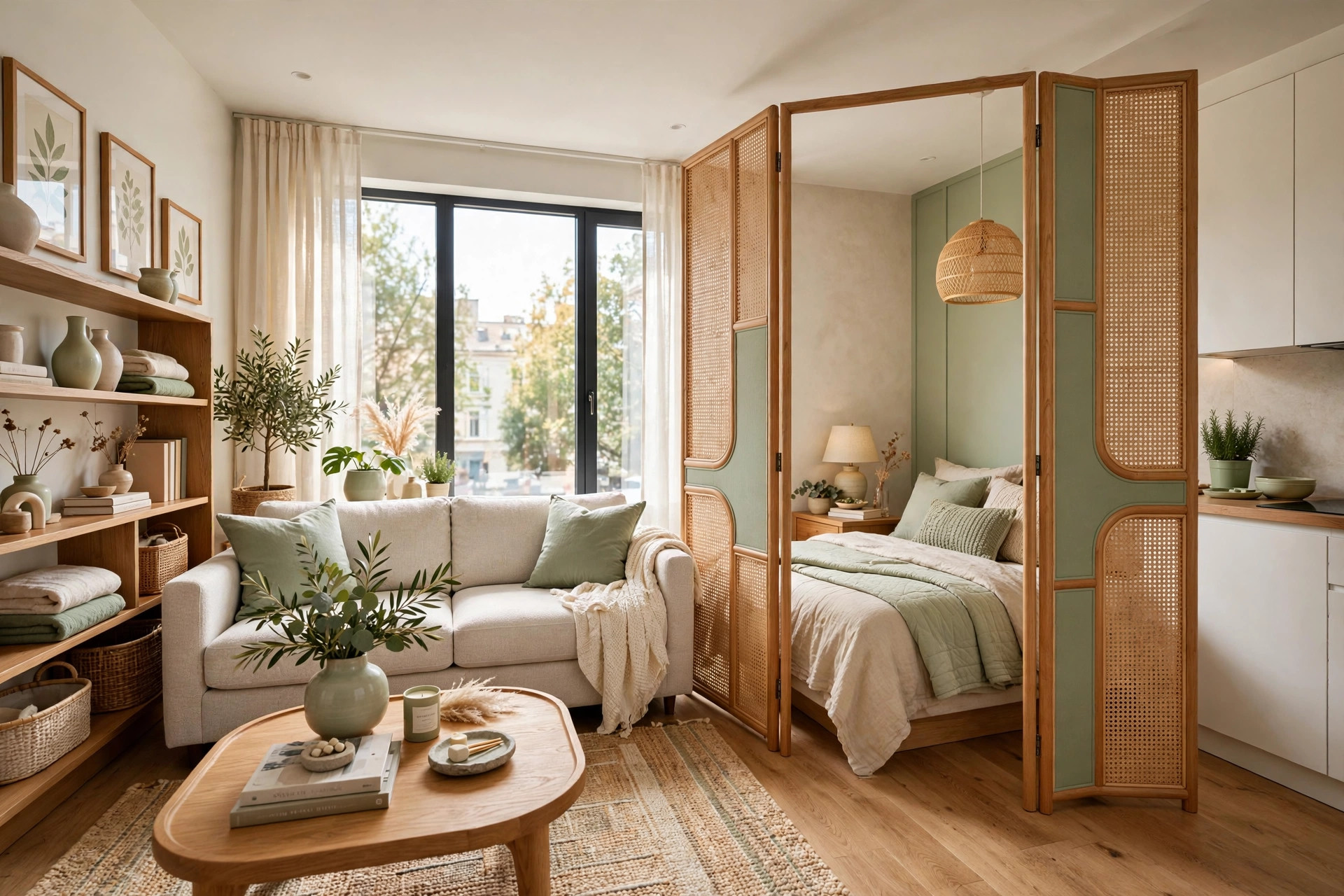
10 Affordable Room Dividers for Open-Plan Small Apartments
Introduction
Open-plan small apartments give you light, air, and flow — and absolutely nowhere to hide. The bed stares at the dining table, the work desk watches you eat dinner, and every Zoom call becomes a broadcast from your bedroom. You don’t need a contractor or a lease-breaking renovation to fix that. You need a room divider: one affordable piece that draws a line between “this is the living room” and “this is where I sleep.”
Room dividers are the budget renter’s best friend because they create zones without walls, permits, or drilling. A folding screen, a curtain track, or a bookshelf turned sideways can give you a private sleeping nook, a hidden work corner, or a dressing area — and most of the options on this list cost less than a night out. They move with you to the next apartment, which makes them one of the smartest small-space investments you can make.
Below are ten affordable room divider ideas for open-plan small apartments, each with honest guidance on what to buy, what to watch out for, and where it works best. Along the way you’ll pick up tips on how to divide a studio apartment into zones so every corner of your one room earns its purpose. Let’s carve your open floor plan into rooms that actually feel like rooms.
1. Folding Panel Screens
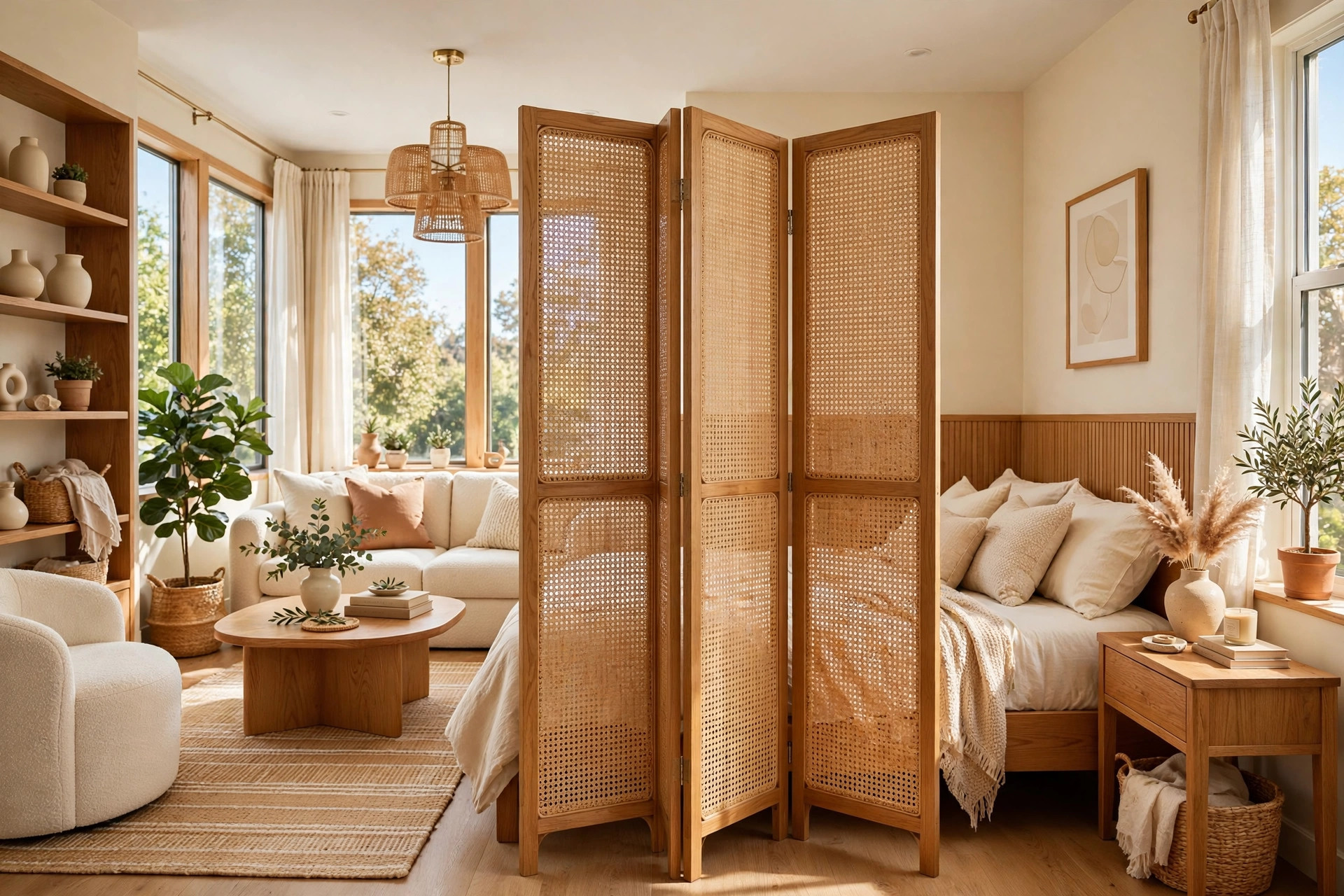
The folding panel screen is the classic room divider for a reason: it stands up in seconds, folds flat when you don’t need it, and needs no installation whatsoever. Three or four hinged panels unfold into a zigzag wall that visually separates a sleeping area from the living zone, hides a cluttered corner, or gives you a backdrop for video calls. Fabric-covered panels soften a room and dampen sound slightly; wooden or rattan panels read more structured and let slivers of light through.
Stability is the main thing to get right. Cheap screens are light and tip-prone, especially near doorways where drafts and pets push through. Look for a wide zigzag stance rather than a nearly straight line — the angles are what keep it standing. Hinges should hold their position without flopping. For a small apartment, a screen around five to six feet tall is the sweet spot: tall enough to block sightlines when you’re seated or lying down, short enough to let light and air move over the top so the room doesn’t feel boxed in.
💡 Pro Tip: Place a folding screen perpendicular to the main wall, not floating in the middle of the room. It reads as architecture instead of clutter, divides the space more convincingly, and one end braced near the wall makes the whole thing far more stable.
2. Open-Back Bookshelf Dividers
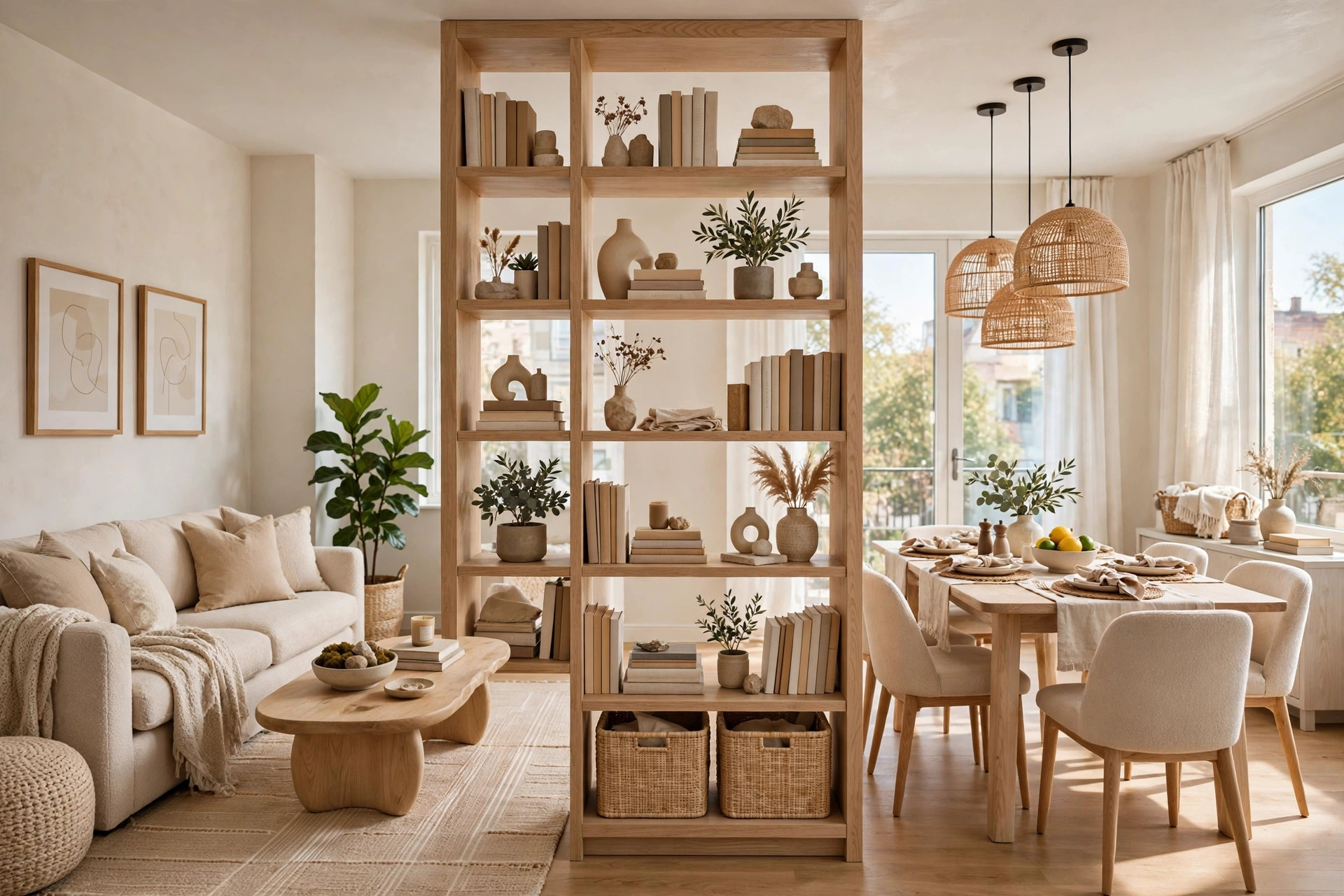
A tall open-back bookshelf is a divider that pays rent twice: it splits the room and stores your stuff. Turned perpendicular to the wall, it separates a bedroom nook from the living area while light passes through the open shelves, so both zones stay bright. Books, baskets, and a few plants styled on both faces make it look intentional from every angle — and unlike a curtain, it gives you a library, display shelf, and media console in one footprint.
Because a loaded bookshelf is top-heavy, anchoring matters more here than with any other freestanding divider. Check whether your lease allows wall brackets; if not, choose a wider, lower unit (under five feet) with a deep base, which is far less tippy than a tall narrow tower. Keep both faces styled deliberately — the “back” faces one of your zones, so finish it with books or closed baskets rather than leaving it as bare backing board. This is also one of the best apartment storage ideas for renters who can’t drill, since every shelf is storage you didn’t have before.
3. Ceiling-Mounted Curtain Tracks
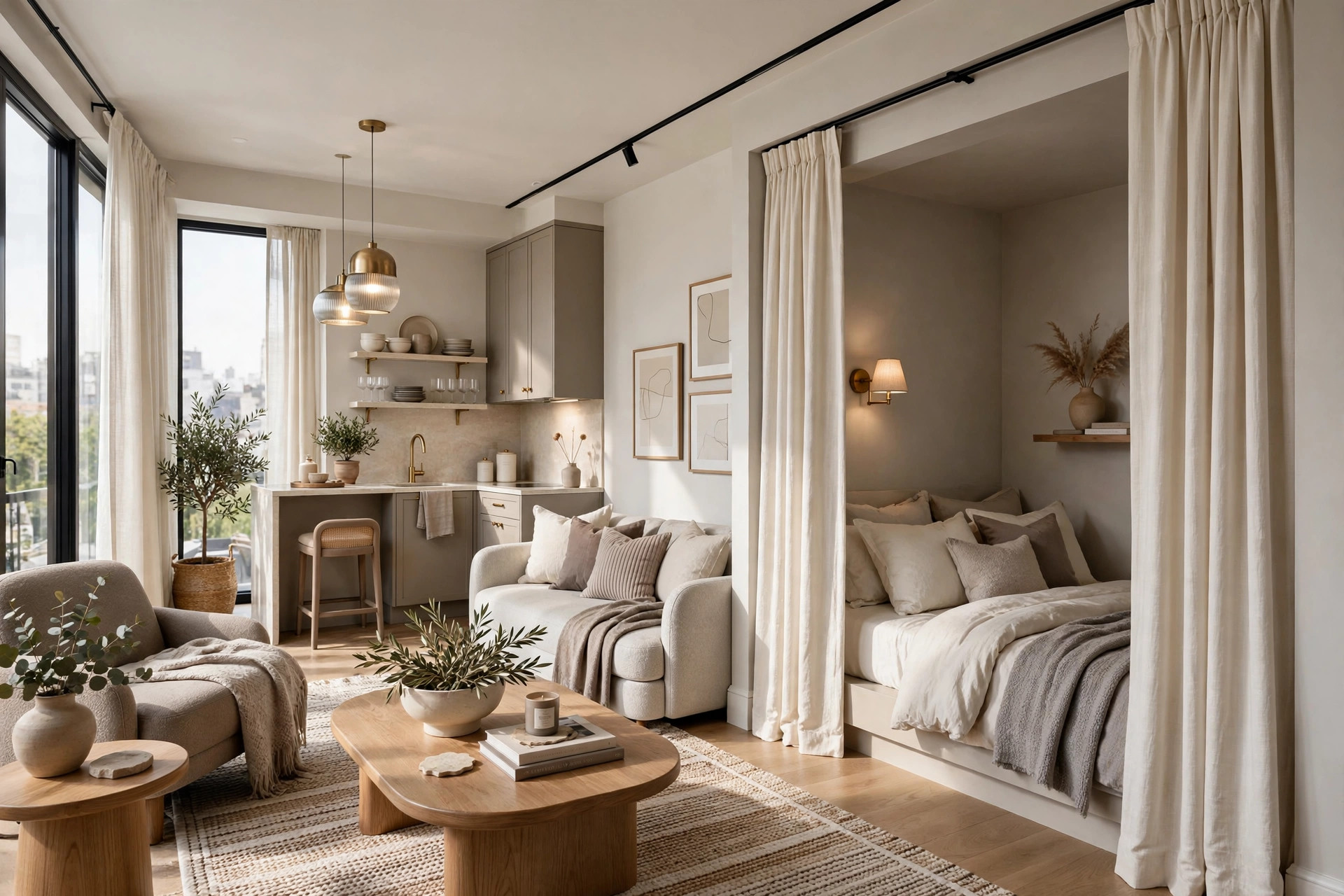
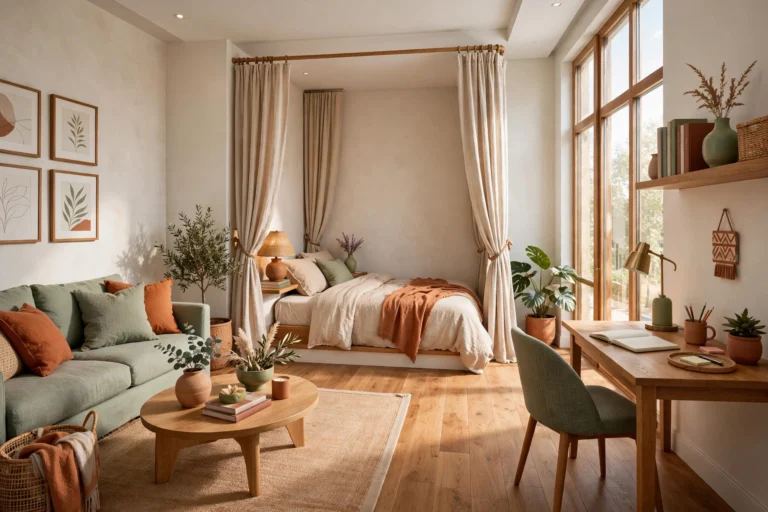
Nothing divides a room as softly — or as cheaply — as a curtain. A ceiling-mounted track with floor-length curtains turns any corner of your apartment into a private room: a sleeping alcove, a dressing area, a hidden workspace. When you want the open plan back, the curtains glide aside in seconds. It’s the closest thing to a real wall you can get without construction, and the fabric absorbs sound far better than a hard screen.
The track itself is the honest trade-off. True ceiling-mounted tracks usually need screws, so check your lease before drilling. If drilling is off the table, tension-wire kits that stretch wall to wall need no holes but sag under heavy fabric — use them with lightweight sheers or voile. Choose curtains that reach the floor for the full room illusion; too-short curtains read as a window treatment that got lost. Opaque fabric gives real privacy for a sleeping zone, while sheer panels keep light flowing and are perfect for simply softening a boundary.
⚠️ Warning: Ceiling tracks carry real weight — track, hardware, and yards of fabric. If your ceiling is plaster or drywall, the track must screw into joists or solid backing, never just drywall anchors. When in doubt, use a wall-to-wall tension wire with light fabric instead of risking a midnight curtain collapse.
4. Freestanding Fabric/Woven Room Dividers

Between the hard folding screen and the full curtain sits the freestanding fabric divider: a lightweight frame wrapped in stretched fabric or woven textile that stands on its own feet. These are the gentlest dividers visually — they filter light, mute sound, and add a soft, upholstered feel to a room that might otherwise be all hard edges. Many fold or roll for storage, and fabric panels can be swapped or re-covered when your style changes.
Fabric choice decides both the look and the light. A tightly woven or lined panel gives genuine privacy and blocks lamplight from the other zone; a loose weave or sheer panel just suggests a boundary while keeping the room bright. Check the base design — models with wide feet or a slight A-frame stance resist tipping far better than single-post designs. And think about cleaning: in a small apartment the divider sits in your daily traffic zone, so machine-washable or wipeable fabric covers will look good years longer than delicate weaves.
5. Bamboo or Rattan Roll-Up Screens
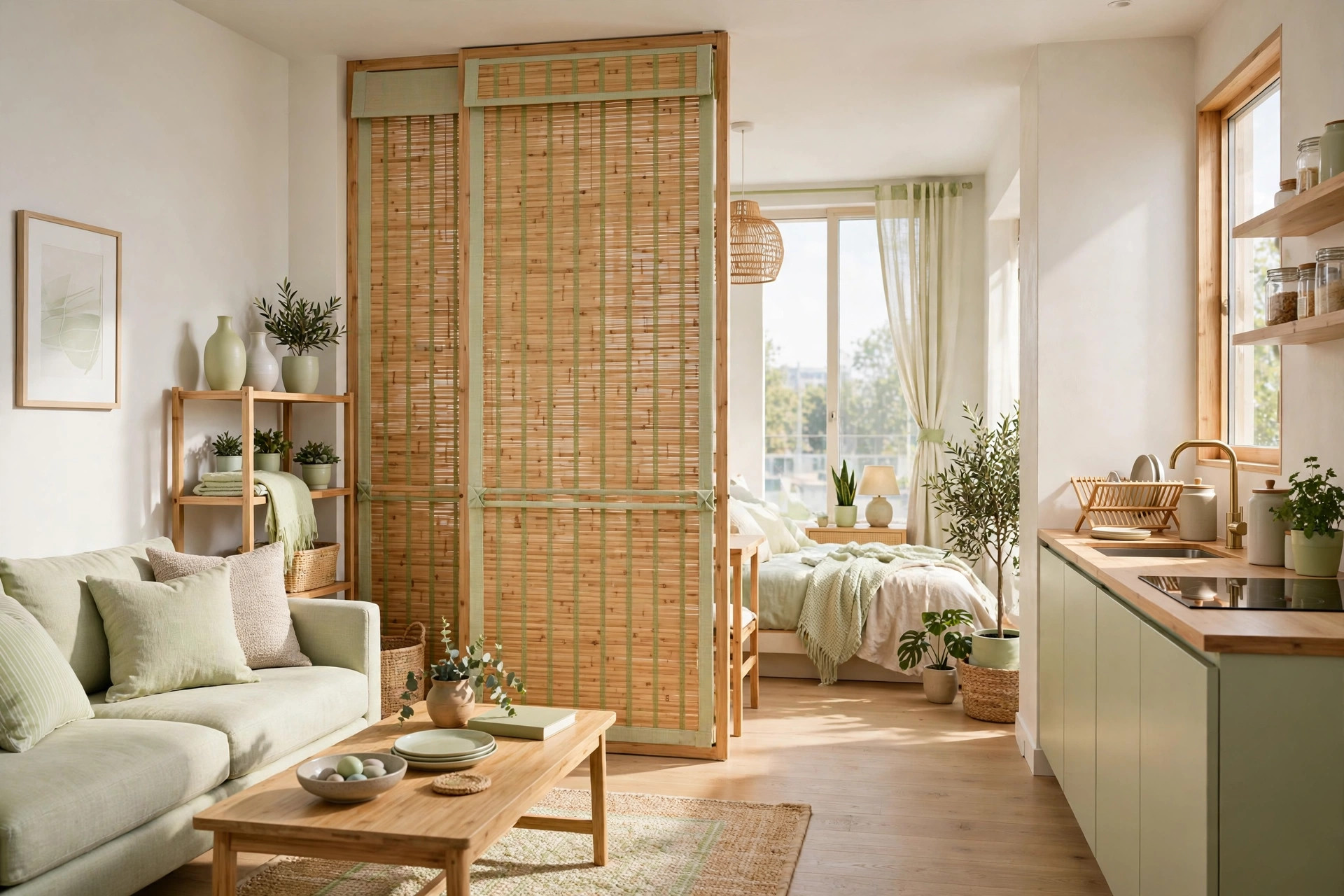
A bamboo roll-up screen is the divider you can carry with one hand. Hung from two hooks (or a tension rod) it unrolls into a warm, textured partition; rolled up, it disappears to the thickness of a poster tube. The natural material adds instant warmth and texture to a room, and the slatted construction lets dappled light through, so the divided zones never feel dark or closed off. It’s also one of the cheapest options on this list — often under $50.
Because it hangs rather than stands, mounting is the whole question. Adhesive hooks work on smooth walls for the lightest screens, but anything wider than three feet deserves real hooks in studs or solid anchors — check your lease first. The screen needs a top support across its full width, so it works best in a doorway, a wide cased opening, or between two walls where you can bridge the gap. Keep it away from radiators and stovetops; dried bamboo is flammable, and a small apartment puts everything close together.
6. Tall Plant Clusters as Living Dividers
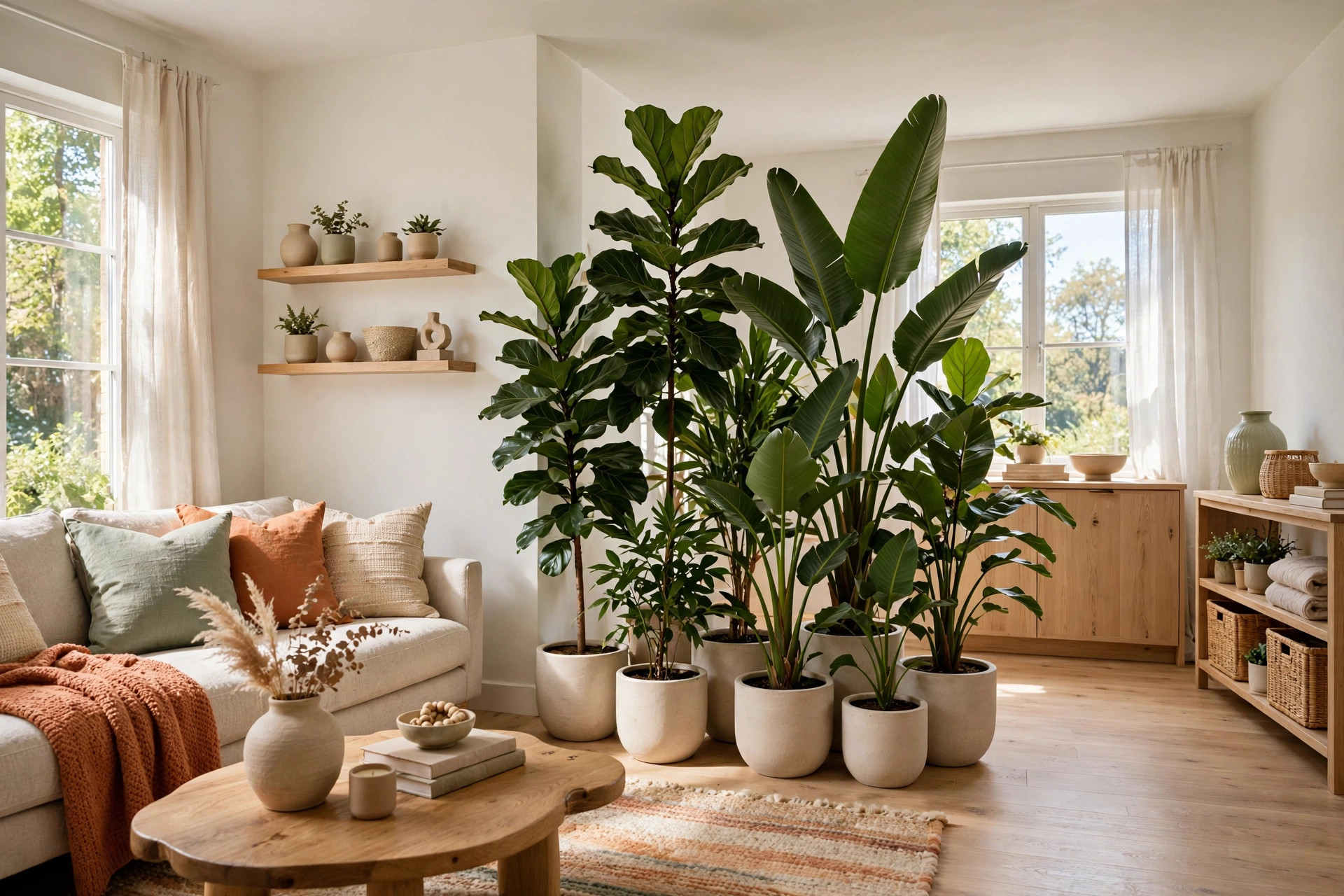
A divider doesn’t have to be furniture at all. A cluster of tall plants — a fiddle-leaf fig, a few snake plants in large pots, a bamboo palm — creates a living screen that divides zones while purifying the air and adding life to the room. Grouped tightly in a row or a staggered cluster, large plants block sightlines surprisingly well at seated and standing height. It’s the only divider on this list that gets better looking over time.
The trick is density and height. One lonely plant is decor, not a divider — you need three to five large plants, or tall plants in raised planters, to form a real visual barrier. Choose low-maintenance varieties if you’re new to plants: snake plants, ZZ plants, and pothos on tall moss poles forgive neglect. Factor in light — the divider needs to sit where plants thrive, ideally near the window side, so plan your zones around the plants’ needs, not just yours. And use large, matching pots; a row of mismatched small pots reads as clutter rather than architecture.
📌 Important: Plants and pets don’t always mix. Many popular tall houseplants — including fiddle-leaf figs, ZZ plants, and snake plants — are toxic to cats and dogs. If you share your small apartment with a pet, verify every plant in your living divider is pet-safe before you buy.
7. Open Cube Storage Shelving Units
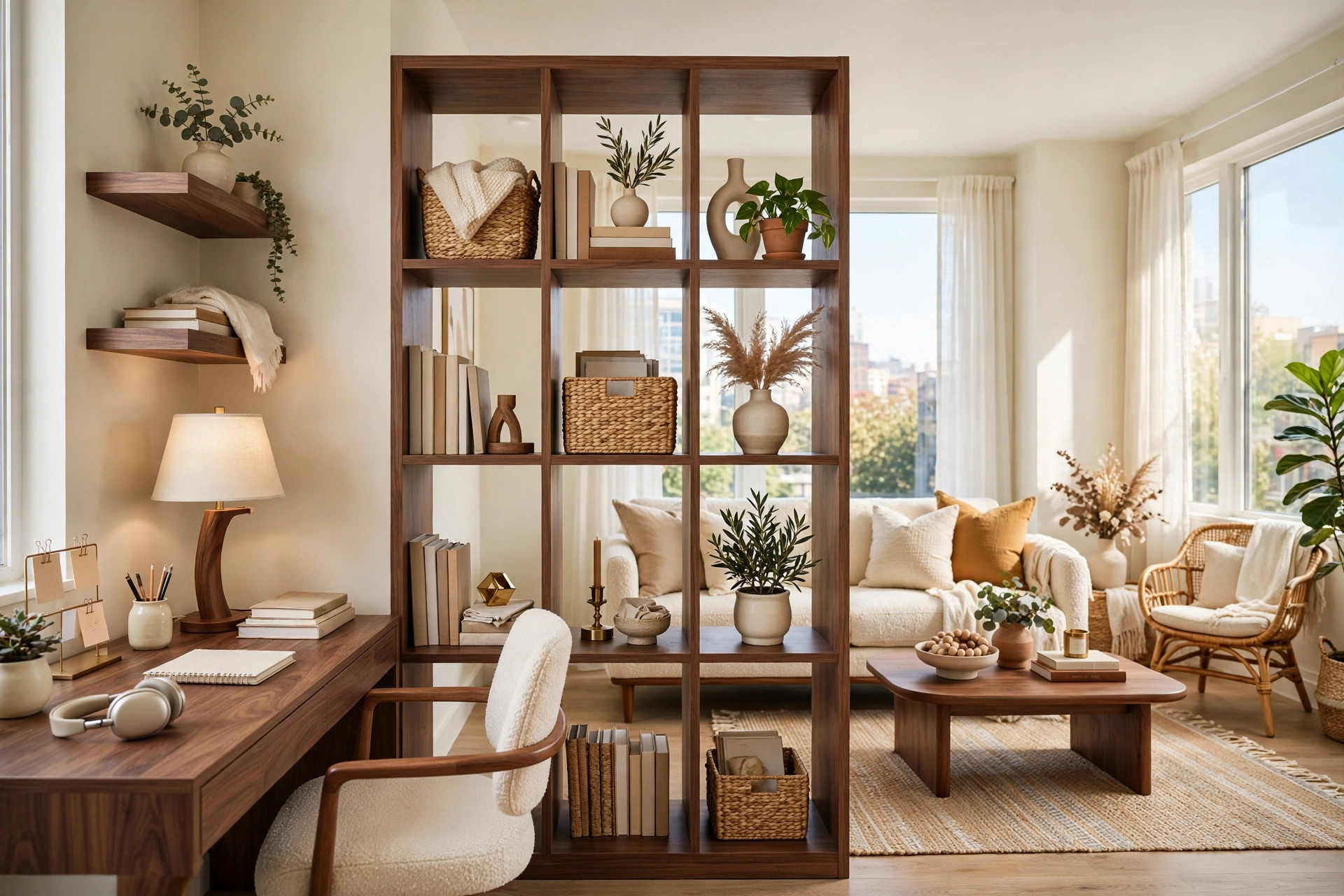
Cube storage shelves — the familiar square-grid units — make brilliant low dividers. At three to four feet tall they split a room without blocking sightlines or light, define a boundary you can see over, and swallow an enormous amount of clutter in fabric bins. Place one between the sofa and the bed, and the living zone suddenly has a console-height edge while the bedroom side gains a nightstand-height shelf. It’s zoning plus storage for the price of one flat-pack box.
Styling decides whether it looks like a divider or a dorm room. Mix closed bins (for the mess) with open cubes (for books and decor) in roughly a two-to-one ratio — all open cubes look chaotic, all closed bins look like a filing cabinet. Face the finished side toward your main living zone and keep the bin labels hidden. If you need more privacy than a low unit gives, stack two units or top it with tall plants or baskets — but anchor stacked units to the wall, because a loaded double-stack is genuinely tippy.
8. Hanging Macramé or Beaded Curtains
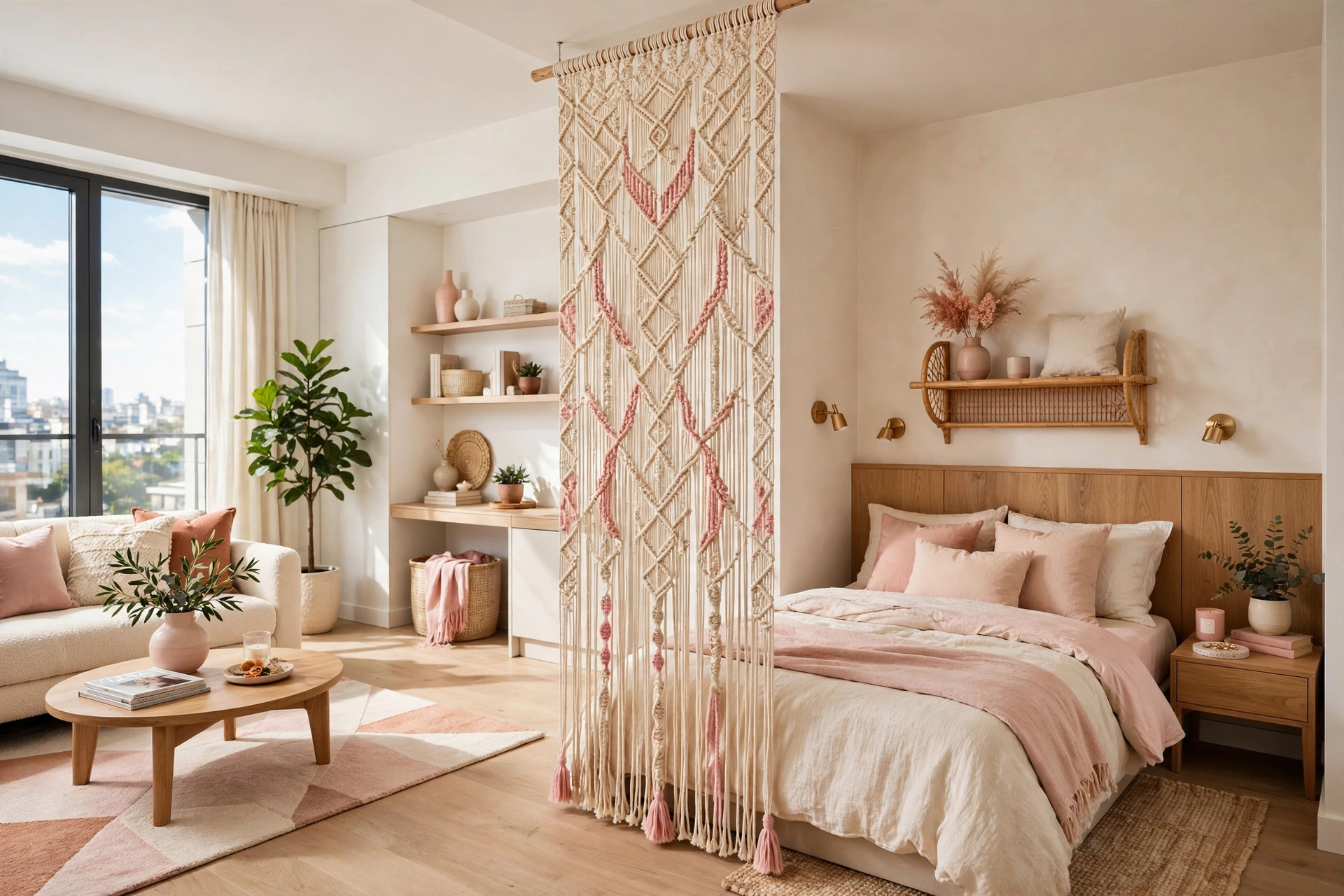
For a divider that’s pure atmosphere, hanging macramé or beaded curtains turn a doorway or zone boundary into a textural moment. They don’t block much — they’re suggestion, not separation — but in a small apartment, suggestion is often enough. A macramé hanging across a sleeping nook says “bedroom” to your brain without closing off a single ray of light, and beaded curtains add gentle movement and sound-softening to a threshold.
These shine in openings rather than open floor. Hang them in a doorway, across a wide cased opening, or from a tension rod between two walls — they need a top span to hang from and look best where traffic passes through them. They’re also the easiest DIY-adjacent option: a simple macramé panel or a strand curtain needs no tools beyond a rod and hooks. Just be realistic about privacy — these divide visually and acoustically only at the lightest level, so pair them with a real screen behind if the zone needs actual seclusion.
9. DIY Pallet-Wood or Shutter Partitions
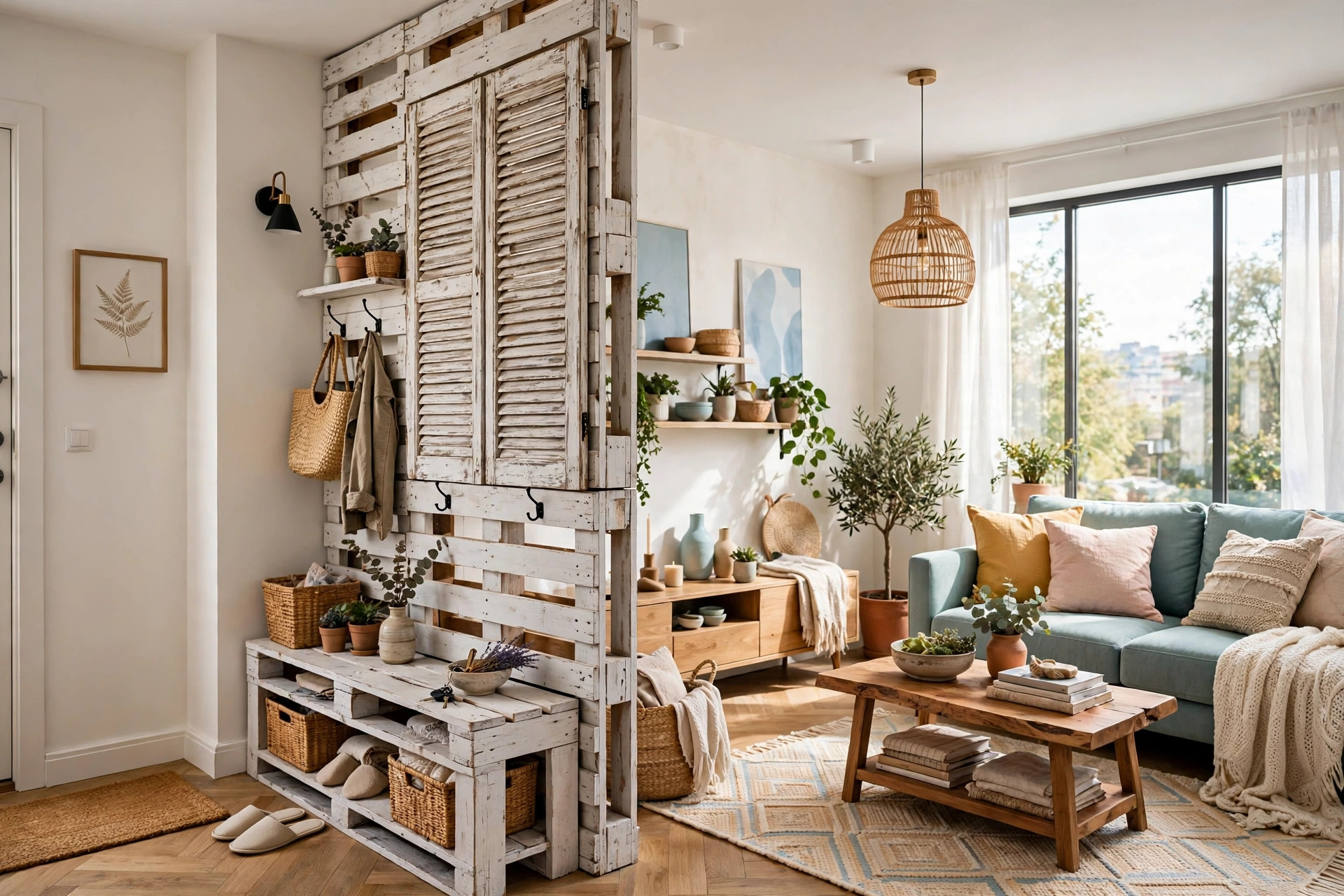
If you like your dividers with character, a DIY partition built from pallet wood, old shutters, or salvaged doors delivers a look no flat-pack can match. Hinged together with basic hardware, reclaimed boards become a rustic folding screen with real presence — the kind of piece that anchors a room’s style. Shutters are especially clever: the louvers adjust to control light and sightlines, open for air and brightness, closed for privacy.
The honest cost here is time, not money — materials are often free or nearly so, but sanding, sealing, and hinging take a weekend. Sand reclaimed wood thoroughly and seal it; pallet wood can harbor splinters, nails, and chemicals, so wear gloves and check each board. Build it as a zigzag of three or more panels so it stands on its own, and keep the height around five feet so it stays stable and lets light over the top. This is the most personal divider on the list — no two turn out alike — and it pairs beautifully with multi-functional furniture for studio apartments when you want the whole room to feel intentional.
💡 Pro Tip: Check local marketplace listings and curbside pickup days for free shutters and doors before buying new lumber. One person’s renovation castoff is a nearly finished divider — shutters especially need little more than cleaning and hinges to become a beautiful louvered partition.
10. Tension-Rod Fabric Panels
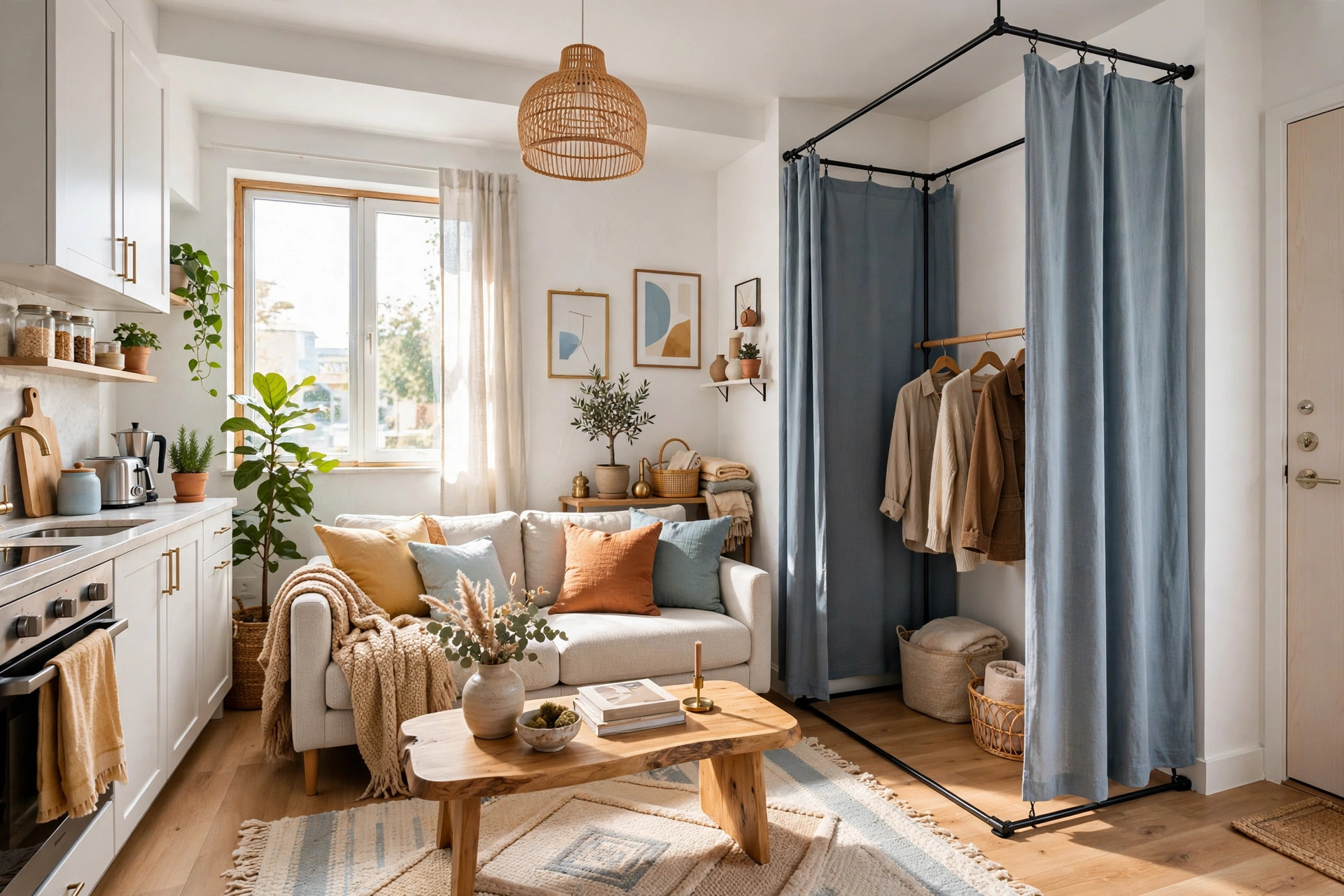
The tension-rod fabric panel is the renter’s secret weapon: a spring-loaded rod wedged between two walls (or inside a door frame) with fabric panels hung from it — zero holes, zero tools, zero lease violations. Slide the panels to open the “wall,” close them for privacy. It’s the fastest divider on this list to install and remove, which makes it perfect for renters who move often or want to test a layout before committing to anything permanent.
Rod strength is everything. Cheap thin rods bow and slip under the weight of real curtains — buy a heavy-duty rod rated well above your fabric’s weight, and twist it tight. The span matters too: tension rods hold best under about five feet; wider spans need a center support or lighter sheers. This works brilliantly inside wide doorways, between a bedroom nook’s walls, or across an alcove — anywhere two solid surfaces face each other. For a polished look, hem the fabric panels to just kiss the floor and use clip rings so they glide smoothly.
Quick Comparison: Affordable Room Dividers by Cost and Ease
Room Divider Quick-Start Checklist
- ✅ Measure the zone first: tape the divider’s footprint on the floor before buying anything.
- ✅ Decide what you need most — privacy, storage, light, or just a visual boundary — and buy for that.
- ✅ Check your lease before anything that drills, mounts, or anchors to walls or ceilings.
- ✅ Keep dividers around five to six feet tall so light and air still move over the top.
- ✅ Style both faces of any divider — the “back” is someone’s view too.
- ✅ Anchor tall or top-heavy dividers; a loaded bookshelf must never wobble.
- ✅ Leave one clear walkway through the apartment no matter how zones are divided.
Common Room Divider Mistakes
Mistake 1: Dividing the room into pieces too small to use
The most common error is over-zoning: a screen here, a curtain there, until the apartment is a maze of four-foot “rooms” none of which fits furniture. Two well-defined zones beat four cramped ones. Divide only where a real function changes — sleeping, working, lounging — and let the rest flow.
Mistake 2: Blocking the light with a tall solid divider
A floor-to-ceiling solid panel in a one-window apartment turns half the room into a cave. Light is a small apartment’s most valuable asset — protect it. Keep dividers under six feet, choose open or translucent designs for the window side, and never put a solid wall between your main living zone and its only natural light.
Mistake 3: Buying a divider that needs drilling in a no-drill rental
Ceiling tracks, wall-mounted screens, and anchored shelving all assume you can put holes in the place. Plenty of leases forbid it. Confirm what’s allowed before you fall in love with a mounted design — freestanding screens, tension rods, bookshelves, and plants divide beautifully with zero holes.
Mistake 4: Forgetting that both sides are visible
Every divider has two faces, and in a small apartment you see both daily. The styled front and the raw back of a bookshelf, the pretty curtain and its bare reverse side — an unfinished back reads as clutter from the other zone. Finish, style, or face both sides deliberately, because there is no “behind” in one room.
Mistake 5: Choosing a divider that fights your layout
A curtain track that crosses the path to the kitchen, a folding screen that blocks the closet door, a bookshelf that narrows the only walkway — dividers must respect traffic flow. Walk your daily routes before placing anything, and confirm doors, drawers, and closet doors still open fully with the divider in place.
Frequently Asked Questions
1. What’s the cheapest way to divide a room in a small apartment?
A tension-rod fabric panel or a bamboo roll-up screen — both often land under $50 and need no tools or drilling. A cluster of tall plants you may already own costs nothing extra. Start with the cheapest option that meets your privacy need; you can always upgrade to a sturdier divider later once the layout proves itself.
2. How can I divide a studio apartment without drilling holes?
Lean on freestanding and tension-based options: folding panel screens, open bookshelf dividers, fabric dividers on feet, tension-rod curtains, and tall plant clusters all divide a room with zero holes. These are also the easiest to take with you when you move, which makes them ideal for renters. Our guide to no-drill storage ideas covers more renter-friendly strategies for small rentals.
3. Will a room divider make my small apartment feel smaller?
Only if it’s too tall, too solid, or poorly placed. Dividers under six feet that let light pass over or through them — open shelves, sheer curtains, slatted screens — actually make a room feel larger by giving it defined, purposeful zones instead of one undefined box. Pair them with the tricks in our guide on how to make a small room look bigger for the full effect.
4. What height should a room divider be?
Five to six feet is the sweet spot for most small apartments: tall enough to block sightlines when you’re sitting or lying down, short enough to let light and air circulate over the top. Go taller only where you need genuine privacy, like a sleeping nook, and keep at least a foot of clearance to the ceiling so the room doesn’t feel sealed.
5. Can a bookshelf really work as a room divider?
Yes — it’s one of the most effective dividers because it earns its floor space twice as storage and architecture. Use an open-back unit placed perpendicular to the wall so light passes through, style both faces, and anchor it if it’s tall or loaded. A low cube unit works too, giving you a boundary you can see over plus hidden storage in bins.
6. How do I divide a sleeping area from the living room in a studio?
Use your highest-privacy option for the bed zone: a ceiling-mounted curtain track with opaque fabric, a tall folding screen, or a bookshelf divider all create a genuine sense of a separate bedroom. Keep the sleeping nook near the least-trafficked corner and make sure the divider doesn’t block your path to the bathroom at night. For layout help, see our guide to furniture arrangement in a small living room.
7. Are room dividers stable enough around kids and pets?
Freestanding screens and light dividers can tip if climbed on or charged into, so choose wide-stance or anchored designs in busy households — wall-anchored bookshelves and ceiling-mounted curtains are the most secure. Keep plant dividers pet-safe, skip beaded curtains where toddlers can pull them down, and always anchor anything tall and top-heavy regardless of who lives there.
Conclusion
The right affordable room divider does something remarkable: it turns one room into several without a single wall. Whether you choose a folding screen that sets up in seconds, a bookshelf that stores your life while it divides it, or a curtain that glides closed at bedtime, each option on this list gives your open-plan apartment something it was missing — a bedroom that feels like a bedroom, a workspace that feels like an office, a living room that feels finished.
Start with your biggest need — usually the sleeping zone — and choose the divider that solves it with the least fuss and the least money. Measure first, check the lease before anything mounts to a wall, and style both faces. Do that, and your small apartment stops feeling like one exposed box and starts feeling like a home with rooms, each with its own purpose and its own quiet.