
15 Best Drawer Organizers for Kitchen Utensils: Top Picks Under $30
Introduction
Open any kitchen drawer and you will learn the truth about how a kitchen really works. The drawer that should hold spatulas, whisks, and tongs in neat rows usually holds a tangled pile instead, and every meal starts with five minutes of digging. It is not a lack of effort that causes the mess. Most kitchen drawers are deep, wide, and completely undivided, which means every utensil you own slides around freely and ends up in one noisy heap. The fix is not a bigger kitchen or a full remodel. It is a set of organizers that cost less than a takeaway dinner and change how the drawer behaves every single day.
The fifteen organizers below are all under $30, and each one solves a different drawer problem, from knives rattling loose to long-handled tools that fit nowhere and spice jars rolling around like loose change. They are ordered from the most universal fixes to the clever specialists, so the first few picks alone will transform the average utensil drawer. Every pick works in a standard kitchen drawer without tools, without drilling, and without any permanent change, which matters just as much in a rental as in a home you own. Like the best kitchen organizers on Amazon, the best drawer organizers are the ones that survive daily use, not the ones that only look tidy on the day you install them.
Before you buy anything, measure your drawer. Note the inside width, depth, and height, and check whether the drawer has a lip or a frame that steals a centimetre on each side. A beautiful organizer that is half a centimetre too wide is a return, not a solution, and a tall knife block that stops the drawer closing is worse than no organizer at all. Measure twice, buy once, and start with the drawer you open most. Once that drawer works, the rest of the kitchen usually follows, because you finally know what organized actually feels like.
1. Expandable Bamboo Drawer Dividers
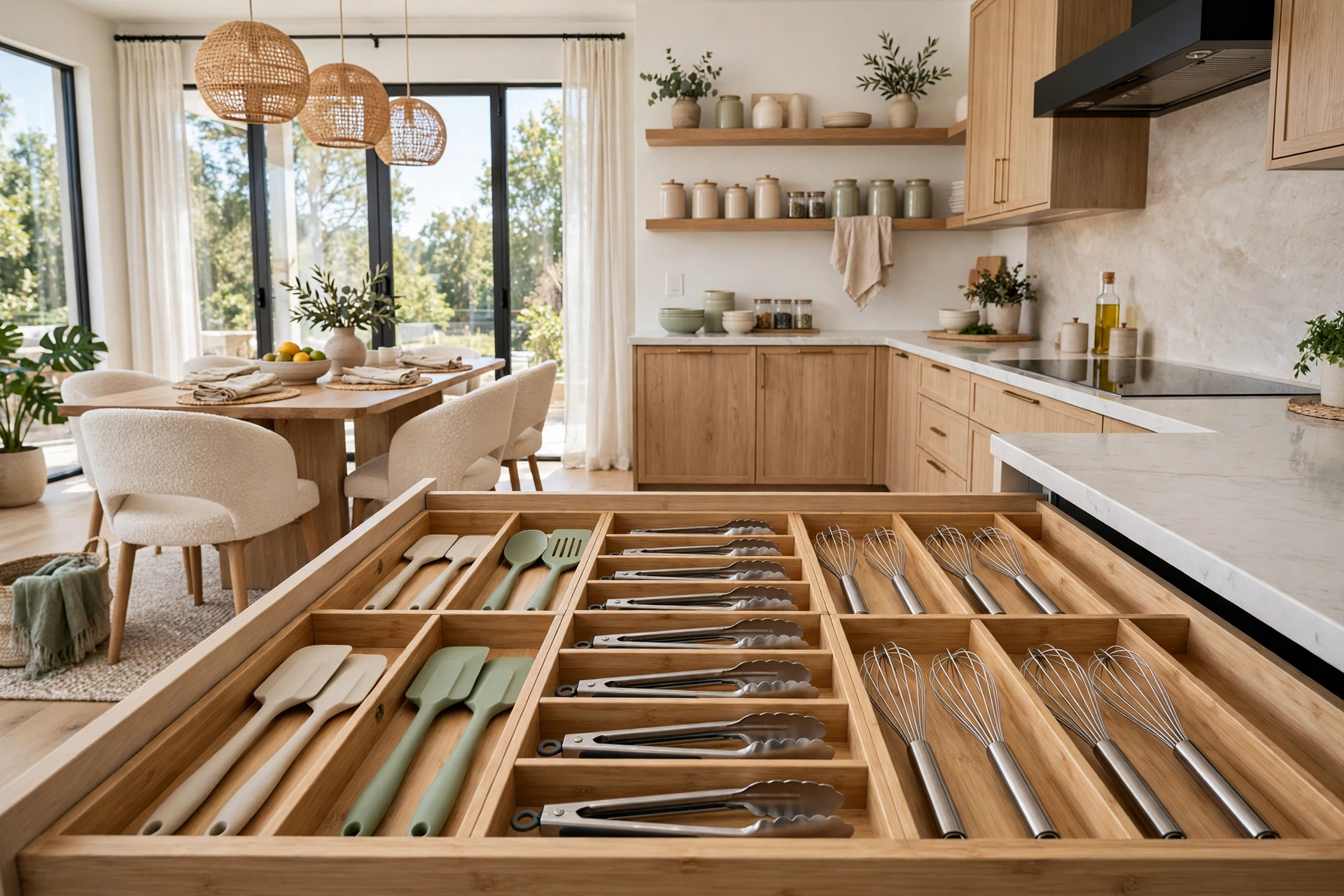
Expandable bamboo dividers are the single most useful drawer organizer you can buy, because they fit almost any drawer and divide it exactly the way your utensils need. Two or three spring-loaded bamboo rails slide to match the drawer’s width, splitting one chaotic space into clean lanes for spatulas, tongs, whisks, and serving spoons. Bamboo looks warm and natural, it is sturdy enough to hold heavy tools without bending, and it wipes clean with a damp cloth. Unlike a fixed tray, dividers adapt when your collection changes, which it will, because kitchens grow one gadget at a time.
The real advantage is that dividers respect how you actually cook. Long tools get a long lane, everyday tools get the front lane where your hand lands first, and the rarely used gadgets go to the back without getting lost underneath everything else. Choose dividers with a non-slip base or add a thin liner underneath so the rails stay put when the drawer opens and closes. For a first purchase, this is the one to buy before anything else, because it turns any drawer into an organized drawer in under a minute, and it costs less than most single-purpose trays.
2. Deep Divided Utensil Tray
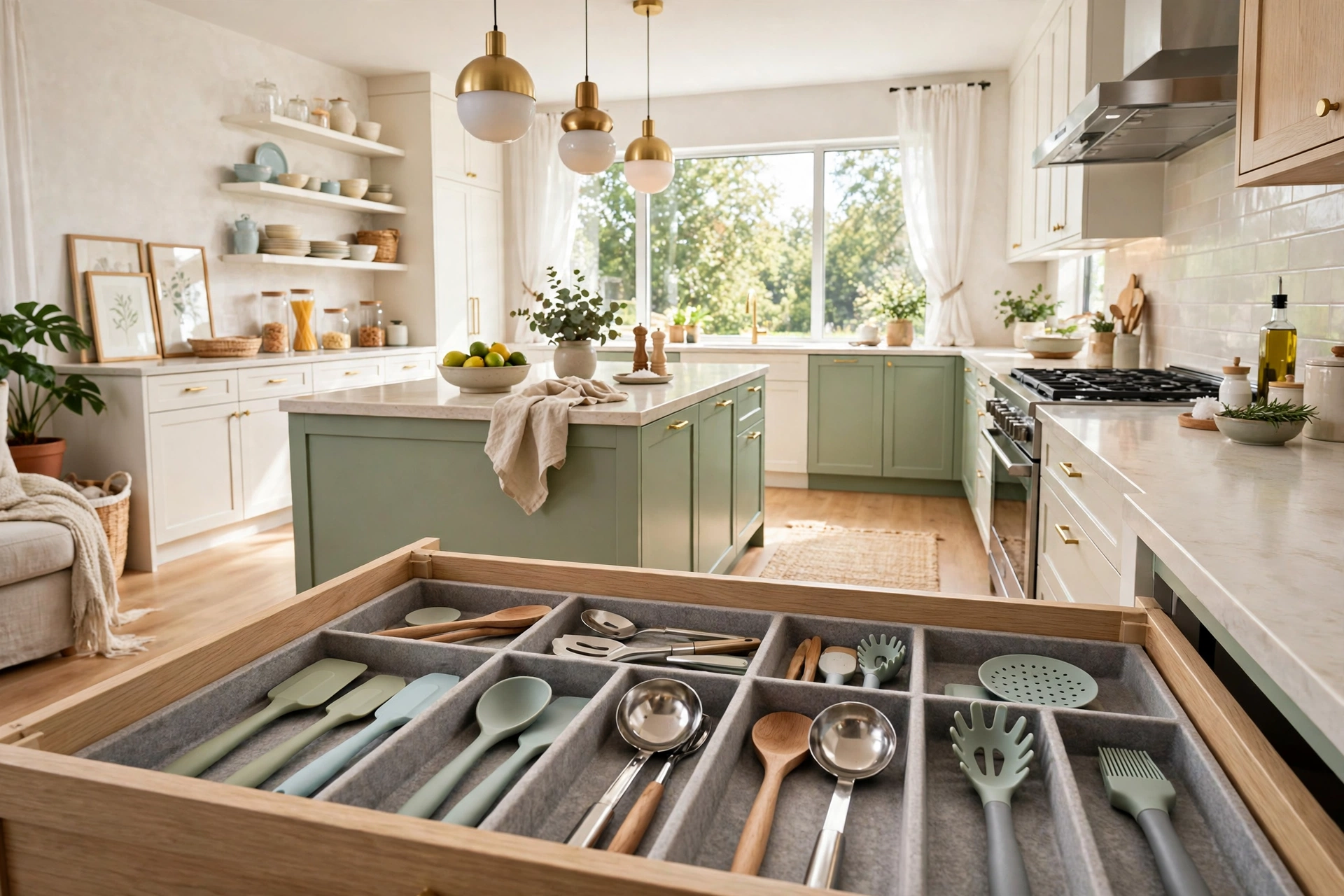
A deep divided utensil tray is the workhorse of the organized kitchen, and it earns its place by giving every everyday tool a compartment of its own. Look for a tray with at least five compartments of different widths, deep enough that spatulas and ladles sit below the rim instead of poking out and catching the drawer frame. The best trays are made from sturdy plastic or bamboo, wash easily, and have a shape that leaves no wasted corners. When each tool has a home, putting things away stops being a chore and starts being automatic, because there is only one place each thing fits.
Size the tray to your drawer, not to your ambition. A tray that fills the drawer wall to wall looks satisfying but leaves nowhere for the odd-shaped tools, so leave a small gap at one side for a long-handled whisk or a meat thermometer. If your drawer is shallow, check the tray’s depth before ordering, because a tray that is too tall will stop the drawer closing and turn a good idea into a daily annoyance. For most kitchens, a deep divided tray plus one expandable divider is the whole system, and it costs well under $30 combined, which leaves the visible work to how to style kitchen counters once the drawer itself is sorted.
3. In-Drawer Knife Block

An in-drawer knife block is the safest way to store kitchen knives, and it frees up the counter space a knife block or magnetic strip used to take. Knives lie flat in angled slots, blades protected and edges kept sharp, instead of rattling loose in a drawer where they dull each other and cut the hand reaching for a peeler. A good block holds five to seven knives plus kitchen shears, fits a standard drawer, and has a non-slip base so it does not slide when the drawer moves. For households with children, it is also the responsible choice, because sharp blades are covered rather than loose.
Measure your drawer height carefully before buying, because knife blocks are the one organizer most likely to be too tall. The drawer must close with the tallest knife handle in place, with a little clearance to spare. If your drawer is shallow, look for a low-profile block designed for drawers rather than a countertop block laid on its side, which wastes space and slides around. This is the same safety-first thinking behind how to organize a small kitchen with zero extra storage space: the safest storage is the storage that is actually used, every day, without thinking.
💡 Pro Tip: Store knives with the blade facing away from the front of the drawer and the handles toward you. You will grab a handle, never a blade, and the edges will stay sharp far longer than knives tossed loose in a pile.
Best Drawer Organizers for Kitchen Utensils Quick-Start Checklist
- ✅ Measure the inside width, depth, and height of your drawer before ordering anything
- ✅ Empty the drawer completely and discard duplicates, broken tools, and gadgets you never use
- ✅ Put everyday tools in the front compartments and rarely used tools at the back
- ✅ Keep knives in a covered block or sheath, never loose in a drawer
- ✅ Line the drawer first so organizers grip and utensils stop sliding
- ✅ Leave one small gap for long or odd-shaped tools instead of forcing a perfect fit
- ✅ Re-check the layout after two weeks and move anything you keep reaching past
4. Expandable Cutlery Tray
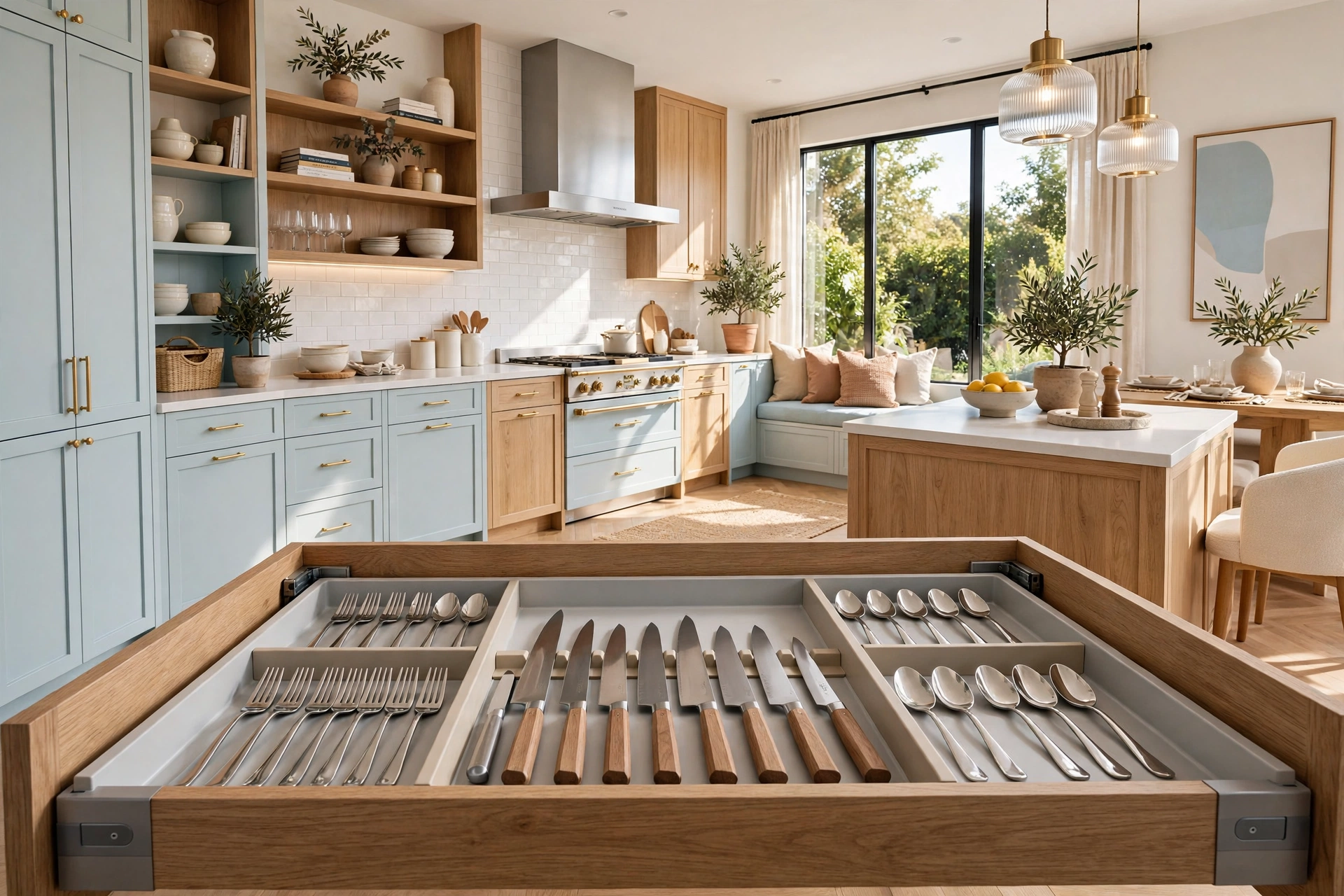
An expandable cutlery tray solves the problem that fixed trays create: drawers are never quite the size the tray expects. Side panels slide out to fill the drawer exactly, so forks, knives, and spoons each get a compartment and no space is wasted at the edges. The best trays have a deeper section for serving spoons and a narrow slot for chopsticks or steak knives, and they are made from material that survives daily washing without warping. Because the tray expands, it also survives a move to a new kitchen, which fixed trays rarely do.
The trick with cutlery trays is to stop overfilling them. A tray that holds exactly your everyday cutlery, plus a few serving pieces, stays tidy. A tray stuffed with every piece you own, including the novelty forks from a holiday home, goes back to chaos within a week. Keep the everyday set in the tray and the occasion set in a separate box elsewhere. That single habit does more for drawer tidiness than any product, and the expandable tray makes it easy, because everything you use daily has one obvious home.
5. Diagonal Divider for Long Utensils
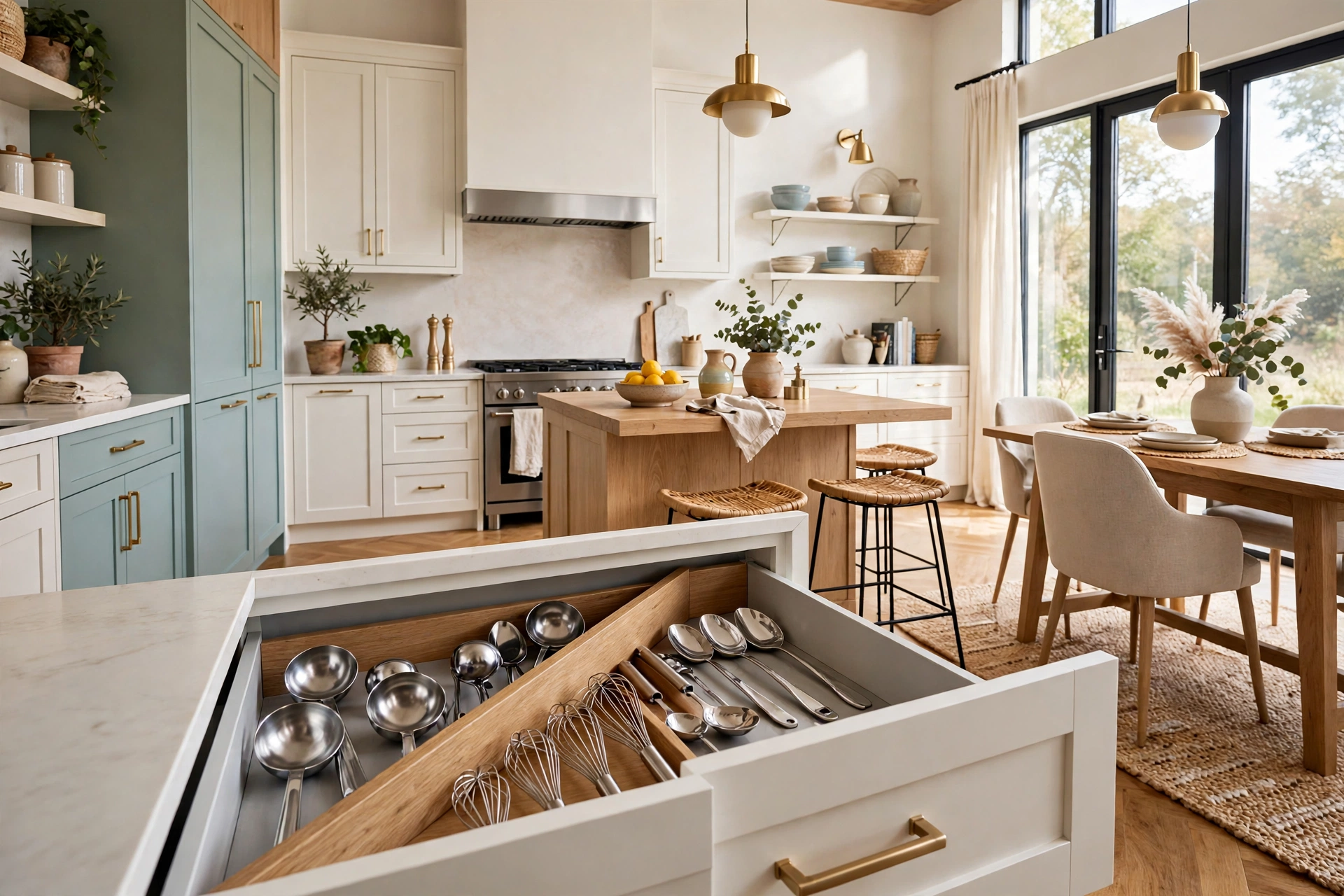
Long utensils are the hardest tools to store, because they do not fit the neat rectangles that most trays offer. Ladles, long spatulas, whisks, and serving spoons end up diagonal across the drawer, blocking everything else and getting tangled. A diagonal divider fixes this by running a divider at an angle across the drawer, creating one long diagonal lane that matches the tools’ actual shape. It sounds like a small change, but it turns the most frustrating corner of the drawer into the most satisfying one, because the long tools finally have a lane of their own.
Diagonal dividers work best as part of a pair: one diagonal lane for long tools, plus a standard tray or a set of dividers for everything else. Some are adjustable, which matters because drawer sizes vary so much, and some are simply a long bamboo rail placed at an angle. Either way, check that the divider is tall enough to keep tools in their lane but low enough that the drawer still closes. This is the organizer people buy last and wish they had bought first, because it solves the problem that no rectangular tray ever will.
📌 Important: Never force a drawer closed over tall utensils or a knife block that is too high. Forcing it damages the drawer runners over time and can chip knife edges against the drawer frame. If the drawer will not close smoothly, the organizer is the wrong size, not the drawer.
Quick Comparison: Drawer Organizers by Cost and Effort
6. Stackable Mini Bins for Small Gadgets
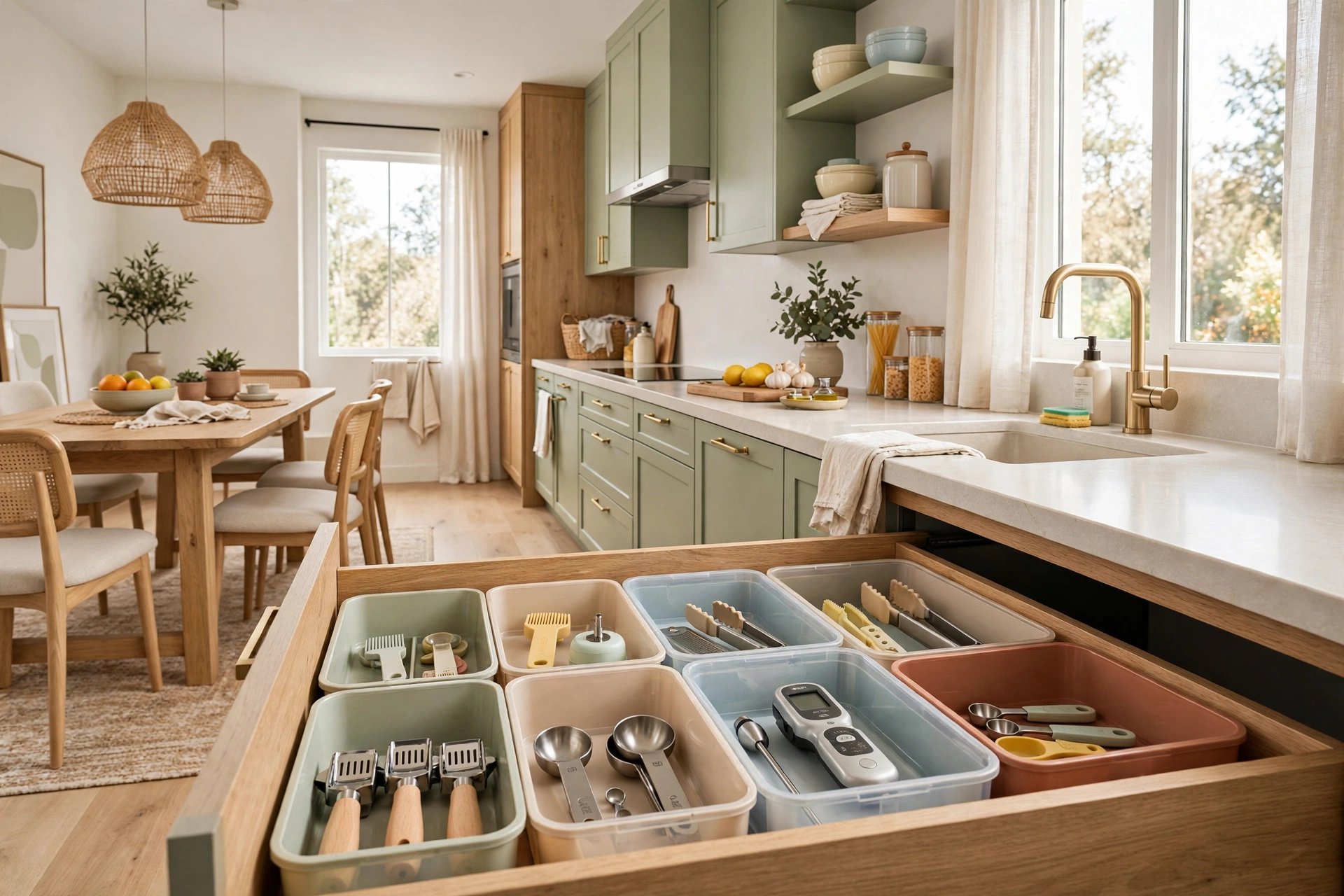
Small gadgets are the true enemy of drawer order. Peelers, thermometers, corn holders, bottle openers, and clips are all too small for a big compartment and too useful to throw away, so they gather in a rattling pile at the front of the drawer. Stackable mini bins solve this by giving small things small homes: little open-top bins that sit inside a larger drawer, one per category, so you can see everything at a glance. Because they stack, they also work in deep drawers, where a single layer would waste half the height.
Label the bins if your household shares the kitchen, because a bin labelled for peelers stays a peeler bin, while an unlabelled bin becomes a junk bin within a month. Choose bins with a low profile so they do not block the drawer, and a size that lets you lift one out without disturbing the others. The payoff is in the small moments: finding the thermometer in two seconds instead of two minutes, every time you cook, which is exactly the kind of daily friction an organized drawer removes.
7. Flat Spice Jar Drawer Insert
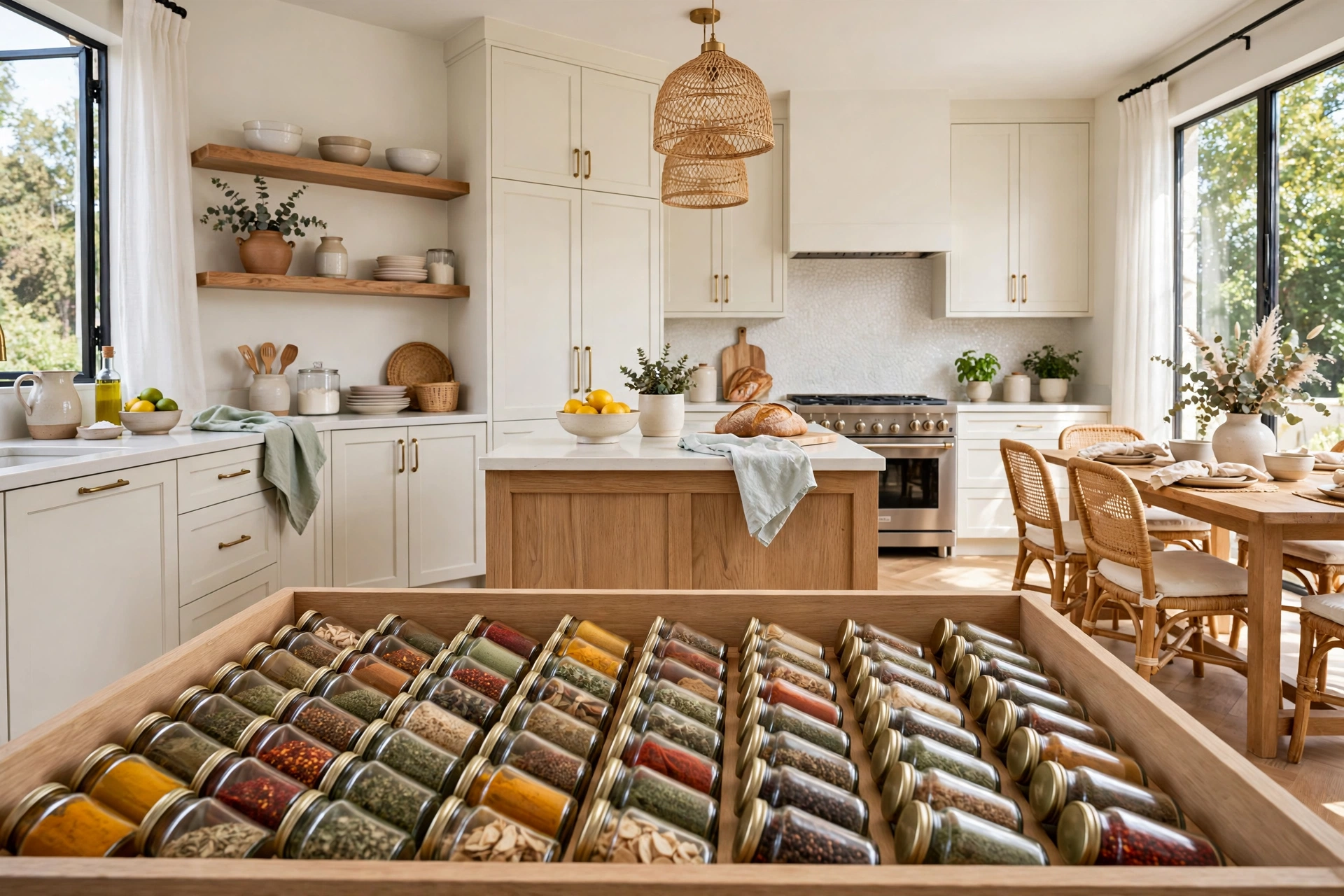
Spice jars belong in a drawer more often than people realise, because a drawer insert lays them flat with their labels facing up, so you can read every spice without pulling jars off a shelf. A flat insert holds ten to twenty standard jars in tilted rows, fits a wide drawer near the stove, and turns spice hunting from a shuffle into a glance. It also protects jars from light, which keeps spices fresher for longer than a rack beside the stove, and it frees a whole shelf or a chunk of counter for something else.
Check your jar sizes before buying, because inserts are made for standard spice jars and oversized jars will not sit flat. If your jars vary wildly, decant the most-used spices into matching jars, which sounds fussy but pays off every time you cook, because uniform jars sit neatly and labels stay readable. Keep the insert in the drawer nearest the stove, not across the kitchen, because a spice drawer that is far from the cooking zone is a spice drawer that does not get used. Like pantry organization ideas, the principle is simple: store things where you use them, in a form you can read at a glance.
8. Adjustable Spring-Loaded Dividers
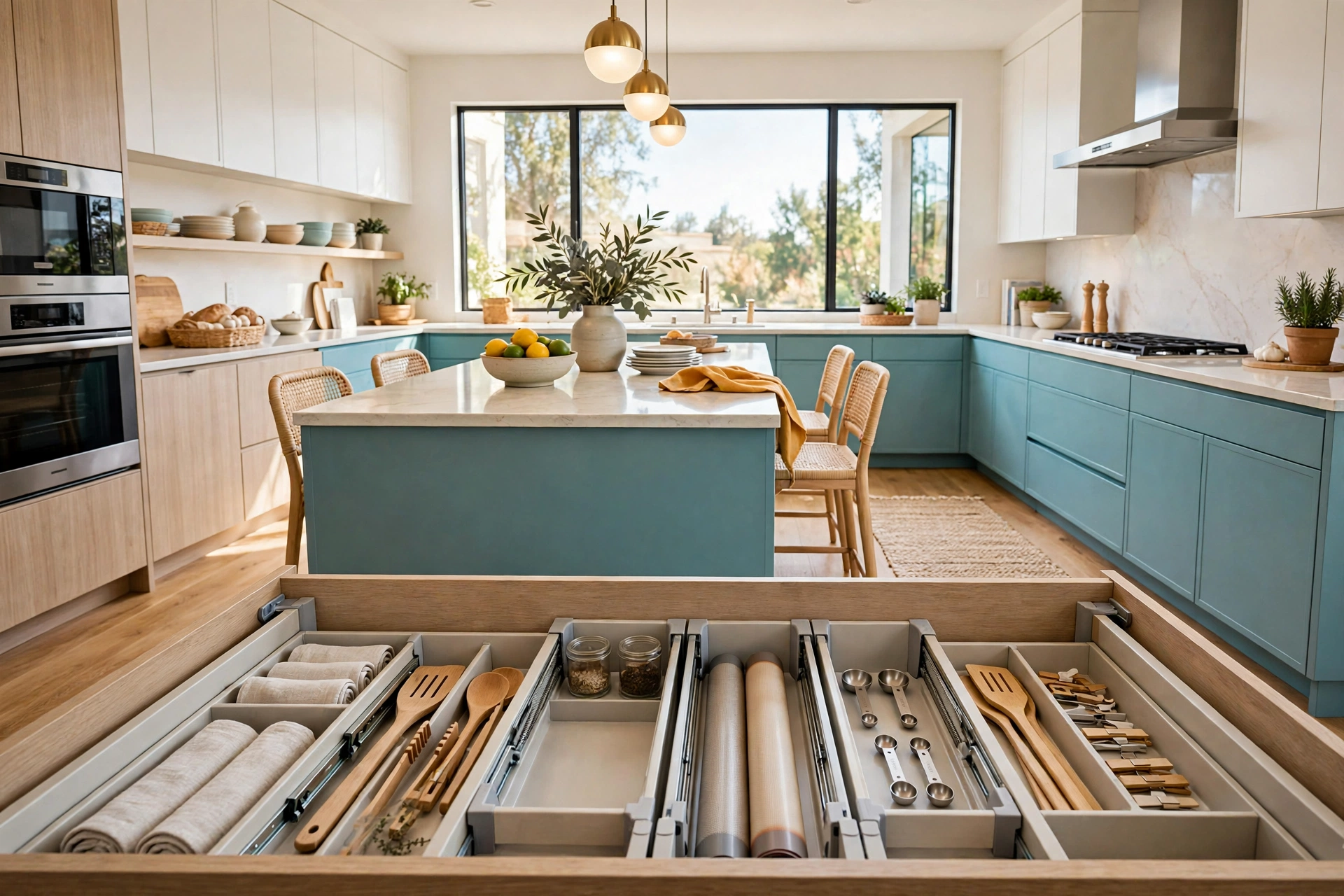
Adjustable spring-loaded dividers are the renter’s best friend, because they install in seconds, need no screws, and leave no marks when you move out. A spring holds each divider firmly against the drawer walls, so the divider stays put through years of opening and closing, and you can reposition it whenever your collection changes. They are ideal for drawers with awkward widths, for dividing a deep drawer into zones, or for adding one extra lane to a drawer that already has a tray.
The limitation is that spring dividers work best in drawers with straight, smooth sides, because a curved or bevelled drawer wall gives the spring less to grip. Test one divider before buying a full set, and check that the spring tension is strong enough to hold against a drawer full of heavy tools. Used well, two or three spring dividers plus a cutlery tray are a complete drawer system for under $20, which is remarkable value for a change you will notice every single day.
9. Two-Tier Expandable Utensil Tray
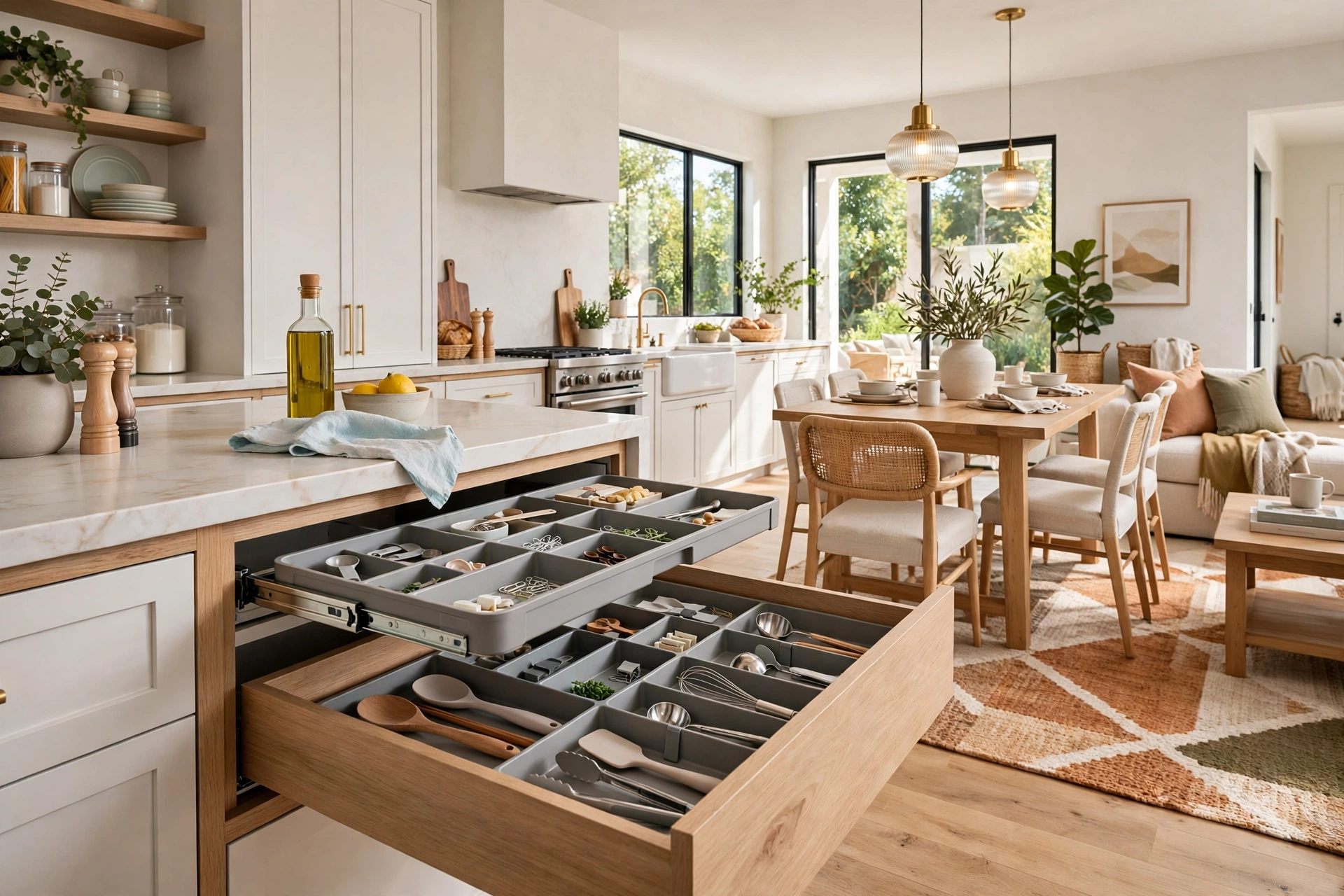
A two-tier utensil tray doubles the usable space in a drawer without doubling its footprint, by adding a sliding upper tier for smaller items above the main compartments. The lower tier holds spatulas, ladles, and tongs, while the upper tier slides to reveal them and holds cutlery, small gadgets, or measuring spoons. For shallow drawers it is a poor fit, because two tiers need height, but for a standard or deep drawer it is one of the smartest space wins available under $30.
The sliding tier must move smoothly when the drawer is full, so check reviews for sticking before buying, and avoid overloading the upper tier with heavy tools that make it hard to slide. Keep the upper tier for light, small items and the lower tier for the heavy work horses, and the whole system glides. This is the organizer to buy when a single tray feels almost enough but not quite, because that second tier is often the difference between a drawer that works and a drawer that overflows.
10. Non-Slip Drawer Liner and Divider Combo
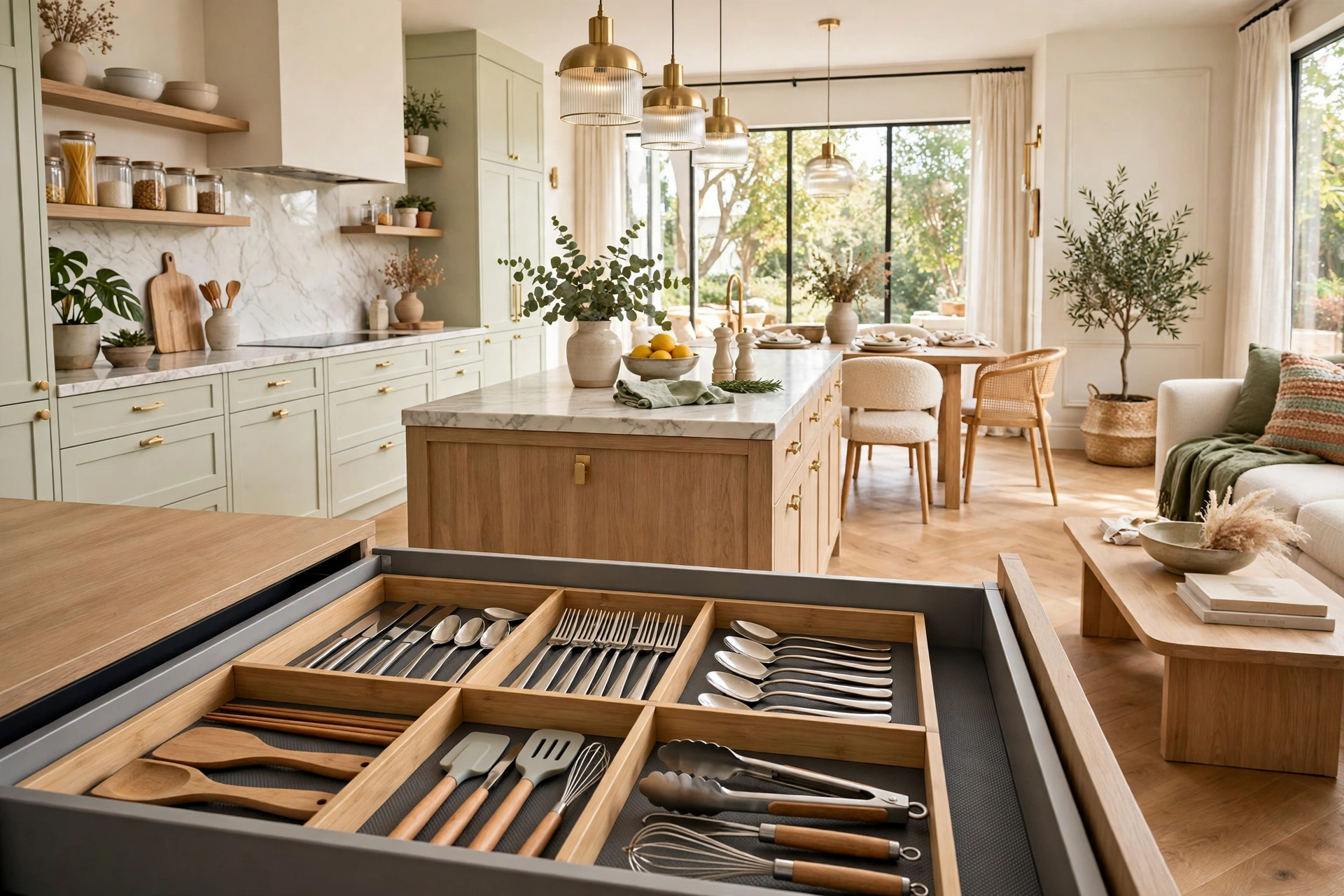
Every other organizer on this list works better on a non-slip liner, and buying the liner and dividers as a combo is the cheapest way to get both. The liner stops organizers sliding when the drawer opens, stops utensils rattling, protects the drawer base from scratches and spills, and can be cut to fit any drawer exactly. It also makes cleaning easier, because a stained liner lifts out and washes, while a stained drawer base does not. Some combos pair a roll of liner with a set of bamboo dividers, which is a complete starter kit for a first organized drawer.
Cut the liner slightly smaller than the drawer base so it lies flat without bunching at the edges, and replace it once a year or when it starts to curl. Avoid liners with a strong smell when new, and air them out before installing if needed. This is the least glamorous pick on the list and one of the most important, because an organizer that slides around is barely an organizer at all. Like the thinking behind vertical kitchen storage ideas, the win is not more space, it is the right foundation in the right place, used without friction.
💡 Pro Tip: Cut the liner first and lay it in the empty drawer before placing any organizer. Test the drawer by opening and closing it sharply a few times: if nothing moves, the system will hold up to real daily use.
11. Small-Compartment Grid for the Junk Drawer
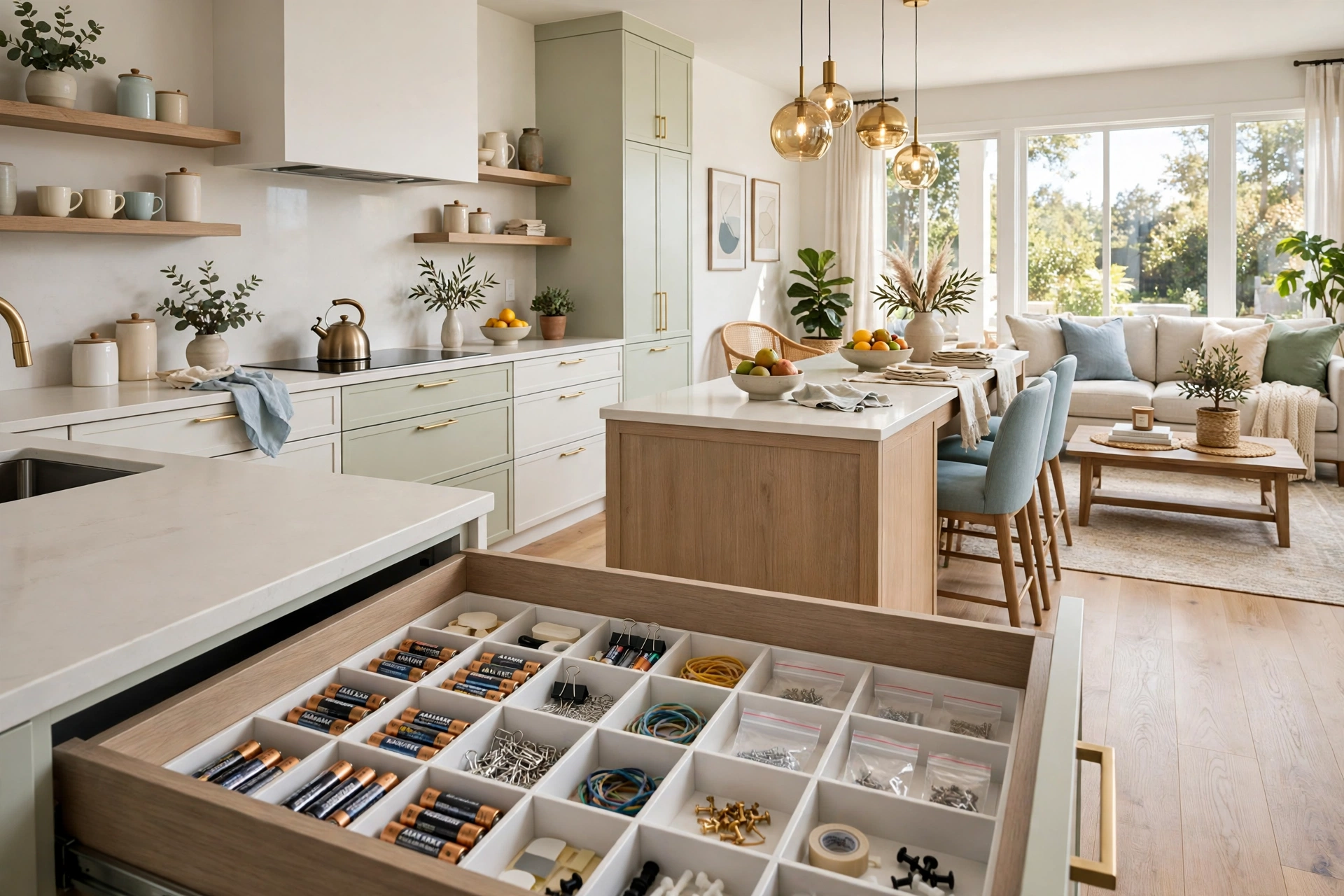
Every kitchen has a junk drawer, and pretending otherwise is why junk drawers stay chaotic. A small-compartment grid organizer accepts the reality and tames it: a tray divided into many small compartments, each one just big enough for batteries, clips, twist ties, takeaway menus, or a spare key. The grid stops small things migrating into one pile, and because each compartment is visible, you can finally see what is actually in the drawer instead of guessing. It will not make the junk drawer beautiful, but it will make it usable, which is the honest goal.
The rule for a junk drawer grid is one category per compartment and a ruthless clear-out first. If a compartment holds three unrelated things, it is not a category, it is a smaller junk pile. Empty the drawer, throw away what is broken or expired, relocate what belongs elsewhere, and only then install the grid. Revisit it every few months, because junk drawers refill by nature, and a five-minute tidy four times a year keeps the grid working instead of letting it slide back into chaos.
12. Measuring Cup and Spoon Drawer Tray
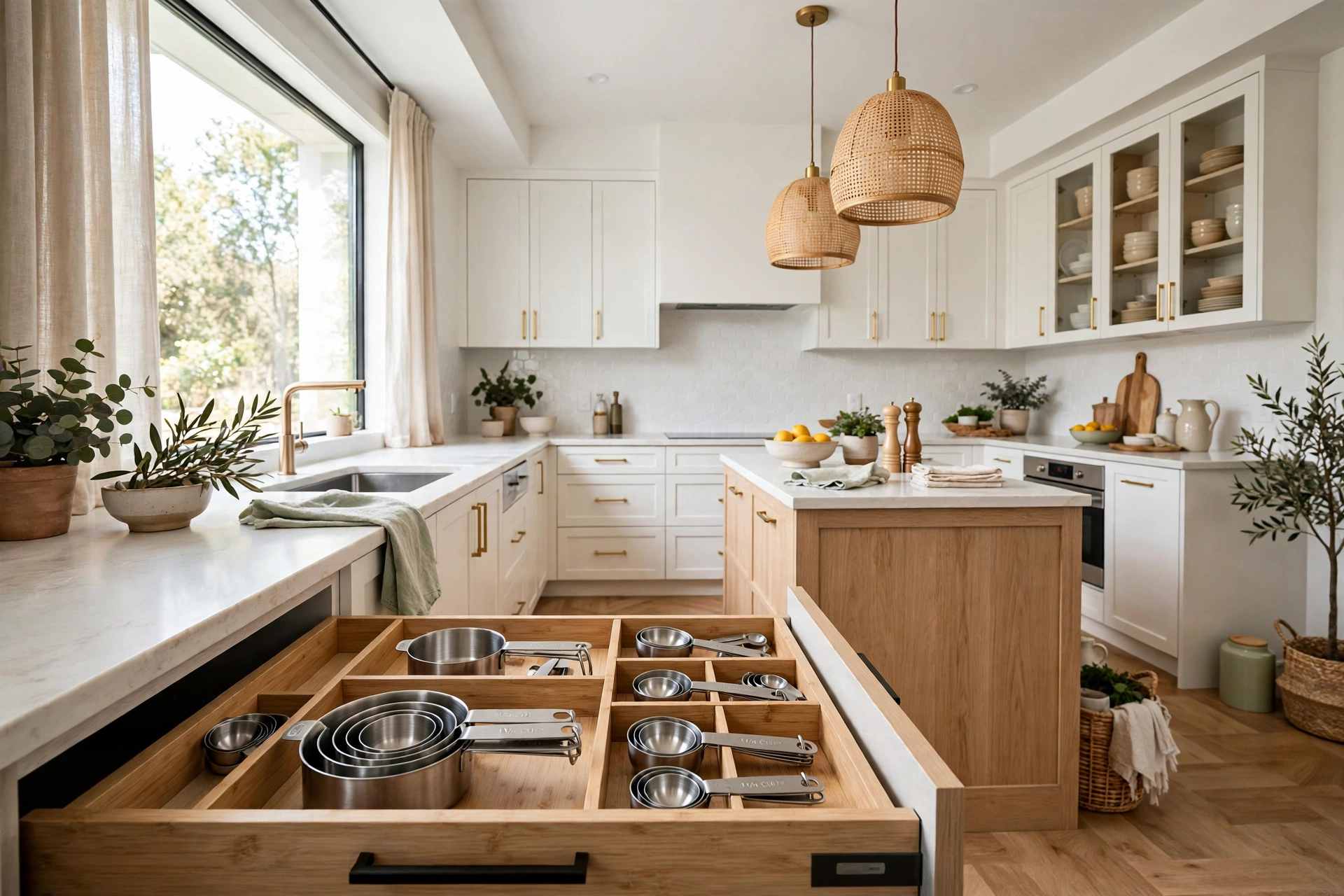
Measuring cups and spoons are small, oddly shaped, and impossible to stack neatly, which is why they usually end up loose in a drawer or hanging from a hook that slowly empties itself. A dedicated measuring tray gives them a home: shallow compartments sized for nested cups and spoons, so the set stays together and each piece is easy to grab with floury hands. Some trays are designed to sit inside a larger utensil tray, while others are standalone inserts for a narrow drawer, and both work well as long as the compartments match your set’s size.
If your measuring set is unusually large or includes novelty shapes, measure the biggest cup before ordering, because a tray made for standard sets will frustrate rather than help. Keep the tray in the drawer nearest your baking zone, beside the mixing bowls, so measuring becomes part of the baking flow instead of a hunt through three drawers. It is a small, cheap organizer, but bakers notice it immediately, because measuring is a task you do dozens of times in a single bake.
13. Drawer Organizer for Baking Tools
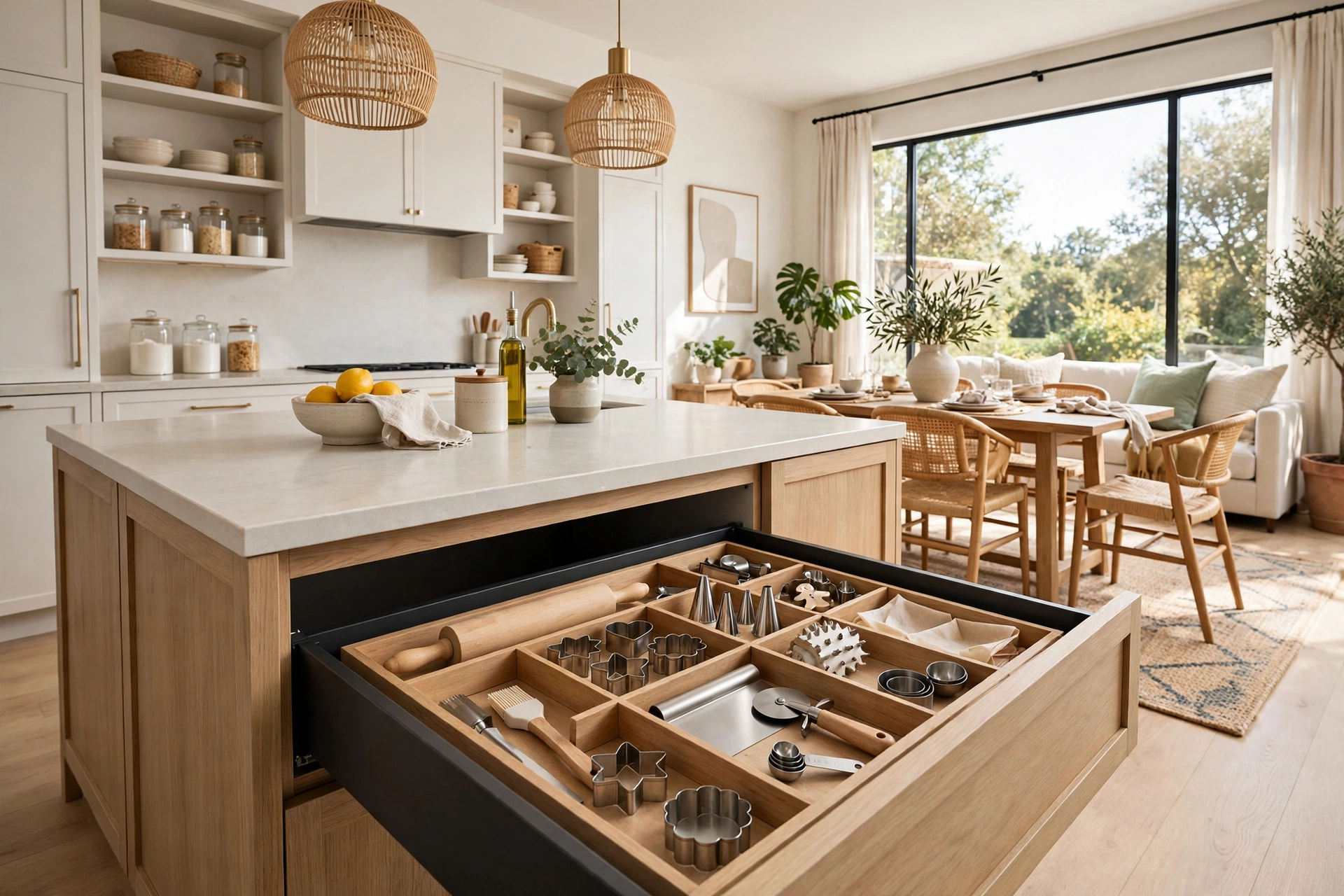
Baking tools are the long, the flat, and the awkward: rolling pins, pastry brushes, cookie cutters, piping tips, and spatulas that do not fit a standard cutlery tray. A baking-tool drawer organizer uses a mix of long lanes and small compartments to hold them all in one drawer, so baking does not start with a search through the utensil drawer, the junk drawer, and a cupboard. Rolling pins lie in a long lane, cutters stack in a bin, and piping tips sit in a small compartment where they cannot scatter.
Keep this drawer near the oven or the baking counter, not beside the stove, because baking tools are used in a different zone from cooking tools and mixing the two zones is how both drawers get messy. If you bake rarely, a single long-lane divider may be enough, and the full organizer can wait. If you bake weekly, the dedicated drawer pays for itself in saved time and in cutters that stay in sets instead of vanishing one by one. Like small kitchen decor ideas, the best baking storage is the storage that matches how the room is actually used, zone by zone.
14. Deep Drawer Organizer for Cooking Tools
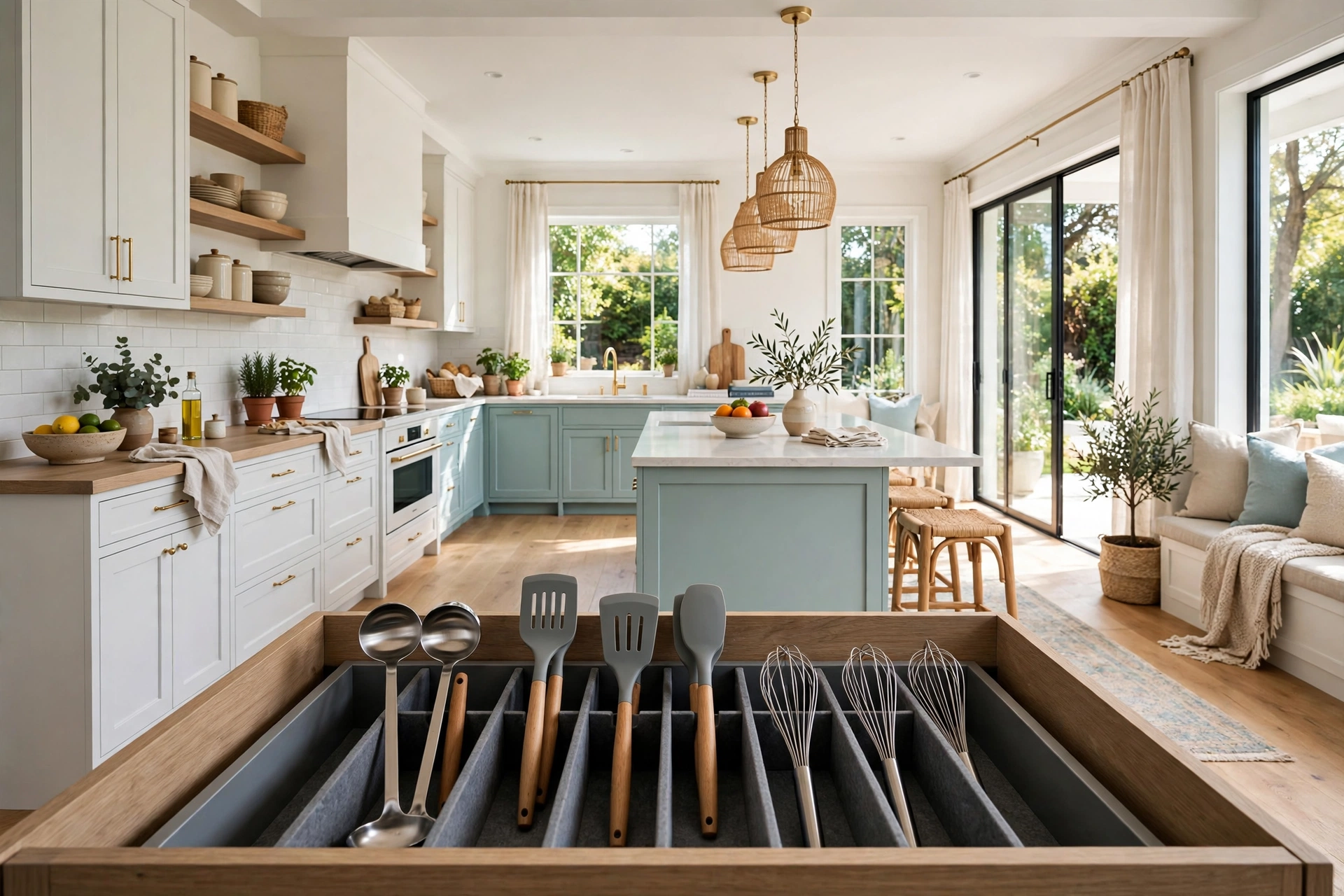
A deep drawer organizer is built for the big cooking tools that shallow trays cannot hold: ladles, slotted spoons, turners, pasta servers, and whisks, all standing in deep compartments rather than lying flat. Depth matters here, because a deep compartment keeps tall tools upright and visible, while a shallow tray lets them slide and tangle. Look for compartments of different widths, sturdy walls that do not bow under weight, and a size that leaves a little breathing room at the drawer edges so the organizer lifts out for cleaning.
This organizer pairs well with a knife block in the same drawer, because both are deep, heavy items that benefit from a stable base. Put the cooking tools at the front, where you reach while standing at the stove, and the less-used tools at the back. If your drawer is very deep, add a liner underneath so the organizer does not slide, and check that the drawer runners handle the weight of a full drawer of metal tools without sagging. Done right, this is the drawer that makes weeknight cooking feel effortless, because every tool is visible, upright, and one reach away.
⚠️ Warning: Keep sharp tools like graters and peelers in a compartment of their own, with blades facing down or covered. A grater loose among spatulas will nick handles, dull its own edge, and cut the hand that reaches for it in a hurry.
15. Pegboard Drawer Organizer System
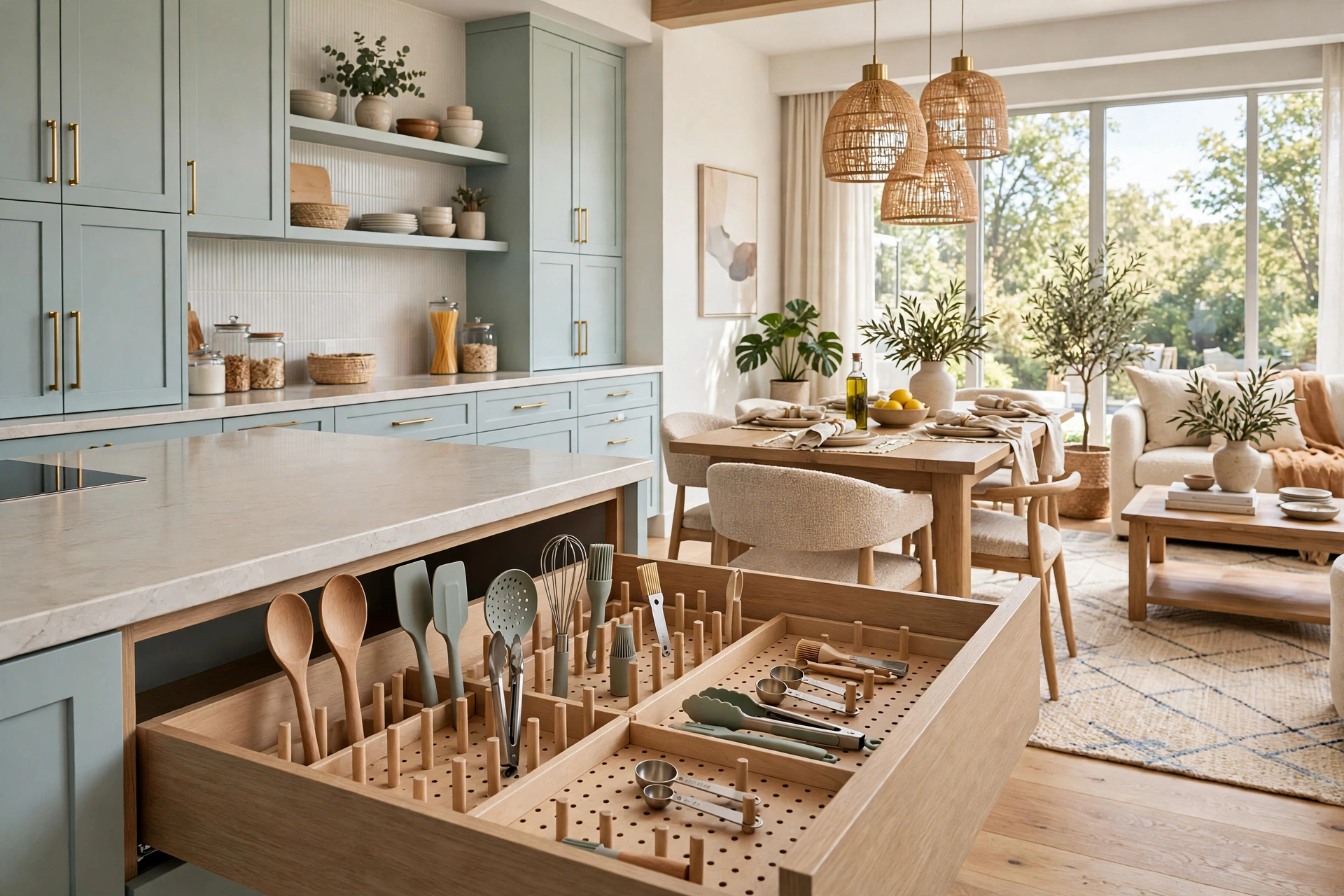
A pegboard drawer organizer is the most flexible system on this list, and the best choice for a drawer that needs to change often. A flat pegboard base sits in the drawer, and short pegs slot into holes to create custom compartments of any size and shape. When your collection changes, you move the pegs, not the organizer, so the drawer adapts in seconds without buying anything new. It works brilliantly for mixed drawers holding utensils, gadgets, and small tools together, because no two households own the same mix.
The trade-off is that pegboards need a drawer with a flat base and enough depth for the pegs plus the tools, and very small items can slip between pegs if the compartments are too roomy. Pair the pegboard with a couple of mini bins for the smallest gadgets, and it handles almost anything. For anyone who rearranges often, or who is still figuring out what their ideal drawer looks like, the pegboard is the organizer that grows with you instead of locking you into one layout. It is a fitting final pick, because the best drawer system is the one you keep using, and a system that adapts is a system that lasts.
Common Drawer Organizer Mistakes
Mistake 1: Buying Before Measuring
The most common drawer organizer mistake is ordering a beautiful tray that does not fit. Drawer inside dimensions are always smaller than the outside, and lips, frames, and runners steal space on every side. Measure the inside width, depth, and height, write the numbers down, and compare them with the product dimensions before you buy. A tray that is half a centimetre too wide is not a minor problem, it is a return, and a drawer full of almost-fitting organizers is worse than a drawer with none.
Mistake 2: Keeping Everything You Own
No organizer can fix a drawer that holds twice what it should. Before installing anything, empty the drawer completely and be honest about duplicates, broken tools, and gadgets you have not used in a year. Most kitchens can lose a third of a utensil drawer without anyone noticing, and the remaining tools suddenly fit beautifully. Organizing is mostly editing, and the product is only the second step, not the first.
Mistake 3: Storing Knives Loose
Loose knives dull each other, damage other tools, and cut hands. It is the one drawer mistake with a safety consequence, not just a tidiness one. Every knife needs a slot, a sheath, or a block, even the cheap ones, because a dull knife is more dangerous than a sharp one and a loose knife is the fastest way to get a dull one. Fix knife storage before anything else in the drawer, and keep it fixed.
Mistake 4: One Organizer for Every Drawer
Different drawers need different organizers, because a cutlery drawer, a cooking-tool drawer, and a junk drawer hold different things. Buying the same tray for all three wastes money and leaves each drawer half-solved. Match the organizer to the drawer: cutlery trays for cutlery, deep compartments for cooking tools, small grids for junk. The system that works is the system built drawer by drawer, not bought in bulk.
Mistake 5: Never Revisiting the Layout
A drawer layout that worked in January may not work in June, because kitchens evolve with seasons, new gadgets, and changing habits. Revisit each drawer every few months, move what you keep reaching past, and retire what you no longer use. A five-minute reshuffle four times a year keeps the system working, while a layout left untouched for years slowly slides back into the chaos it replaced. The best drawer organizers are the ones you keep adjusting, not the ones you install and forget.
Frequently Asked Questions
1. What is the best drawer organizer for kitchen utensils?
An expandable bamboo divider set is the best starting point for most kitchens, because it fits almost any drawer and divides it exactly how your tools need. Pair it with a deep divided tray for everyday tools and an in-drawer knife block for safety, and most drawers are solved for under $30 in total.
2. How do I measure a kitchen drawer for an organizer?
Measure the inside width, depth, and height with a tape measure, not the outside of the drawer front. Note any lip, frame, or runner that reduces the usable space, and check the height with the drawer closed, because a tall organizer that stops the drawer closing is the wrong size.
3. Can I organize kitchen drawers without drilling or permanent changes?
Yes, every organizer on this list installs without tools, screws, or drilling, which makes them ideal for rentals. Spring dividers, expandable trays, and pegboard systems all lift out cleanly, leaving the drawer exactly as you found it.
4. How do I stop drawer organizers sliding around?
Line the drawer with a non-slip liner first, then place the organizer on top. The liner grips both the drawer base and the organizer, so nothing moves when the drawer opens and closes. If an organizer still slides, it is probably too small for the drawer, and an expandable version will fit better.
5. Where should knives go in a kitchen drawer?
Knives belong in an in-drawer knife block or in individual sheaths, with blades covered and handles facing you. Never store knives loose in a drawer, because they dull each other, damage other tools, and cut the hand reaching for something else.
6. What size drawer organizer do I need for a standard kitchen drawer?
Most kitchen drawers are between 30 and 60 centimetres wide inside, but sizes vary enormously, so there is no truly standard size. Measure your drawer and choose an expandable organizer, which adjusts to fit, rather than guessing at a fixed size that may not match.
7. How do I organize a deep kitchen drawer?
Use deep compartments for tall tools, stackable bins or a two-tier tray to use the height, and a liner underneath so nothing slides. Keep everyday tools on top or at the front, and rarely used tools underneath or at the back, so the depth helps instead of hiding things.
8. Are bamboo drawer organizers better than plastic ones?
Bamboo looks warmer, feels sturdier, and suits kitchens where the drawer is visible, while plastic is cheaper, lighter, and easier to wash. Both work well under $30, so choose bamboo for the drawers you open most and plastic for utility drawers where washing matters more than looks.
Conclusion
A kitchen drawer does not need a remodel to work well. It needs measuring, a little editing, and a few organizers that cost less than $30 each and solve one problem each. Start with the drawer you open most, fit expandable dividers and a deep tray, fix knife storage properly, and add the specialists for long tools, spices, and small gadgets only where they earn their place. The result is a drawer that opens to order instead of chaos, and a kitchen that feels calmer every time you cook.
The real test of any drawer organizer is not how it looks on installation day, but how it looks after a month of real cooking. The fifteen picks above are chosen for that test: they stay put, they adapt when your collection changes, and they make putting things away as easy as taking them out. Measure your drawer, pick the two or three that solve your biggest frustrations, and enjoy the small daily pleasure of a drawer that finally works. Like the best drawer organizers kitchen cooks actually keep using, the right system is the one that survives everyday life, not the one that only photographs well.