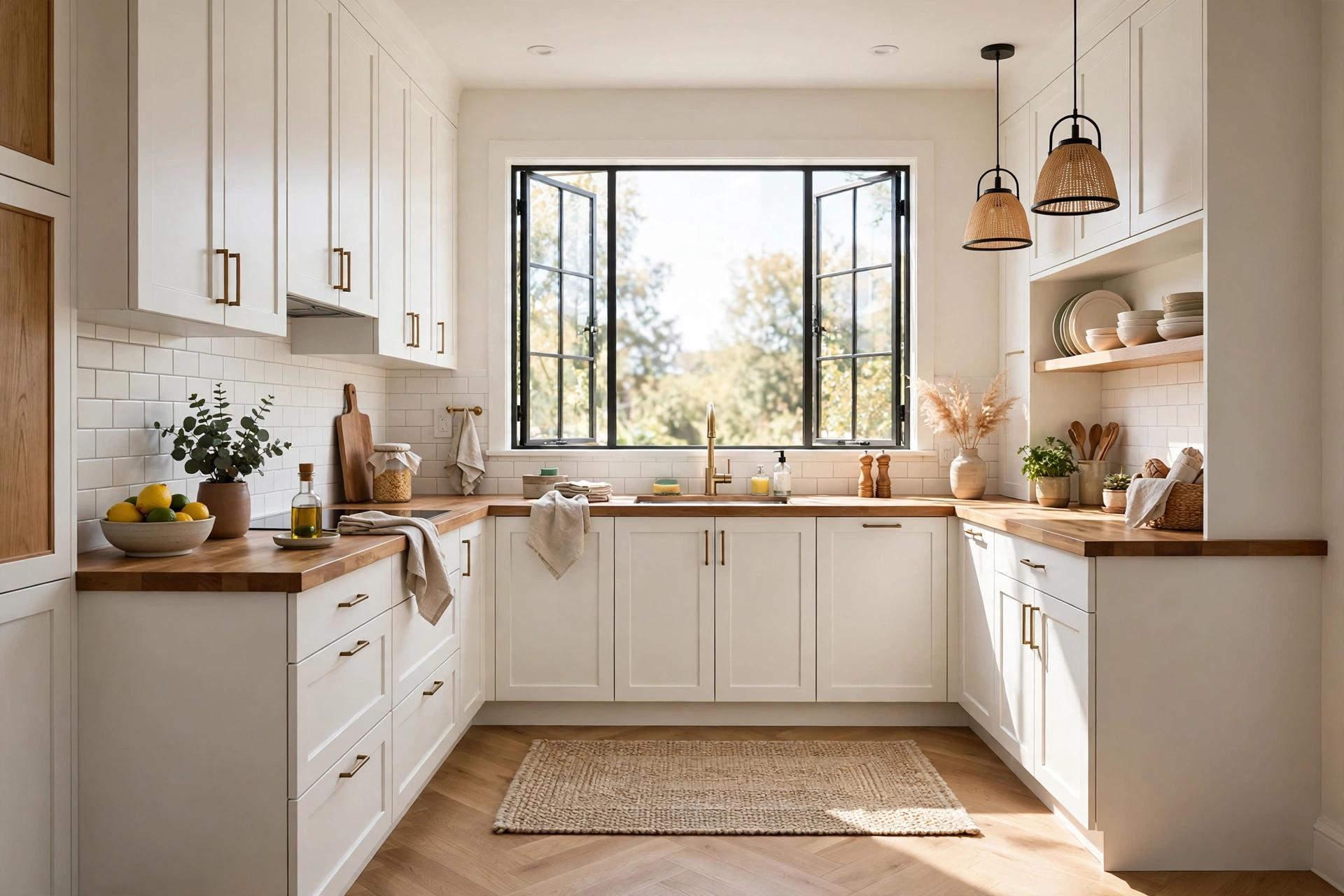
20 Small Kitchen Decor Ideas That Make Cooking Actually Enjoyable
Introduction
A small kitchen gets judged more harshly than any other room in the house, because it has to work the hardest in the least space. It is where you chop, stir, store, wash up, and — if you are honest — dump the mail, the keys, and everything else that has nowhere else to go. When a small kitchen looks tired and feels cramped, cooking stops being enjoyable and starts feeling like a chore you put off until the takeaway menu comes out.
The good news is that small kitchens respond to decorating faster than big ones do. One coat of paint, one better light, one smarter storage move, and the whole room changes character, because every change is visible from everywhere in the room. You do not need a renovation, a new layout, or a big budget to get there. Most of the ideas below cost little, take a weekend or less, and work in rentals too.
Below are twenty small kitchen decor ideas that make cooking genuinely enjoyable again, from colour and lighting to storage that finally makes sense — the same small-space thinking behind our tiny apartment decorating ideas, applied to the hardest-working room in the house. Pick the three or four that solve your kitchen’s worst problem — darkness, clutter, or dead counter space — and start there. A kitchen that looks good is a kitchen you will actually want to cook in.
1. Paint the Cabinets a Light, Bright Colour

Paint is the single highest-impact change you can make in a small kitchen, and cabinets are where it pays off most. Dark, dated, or mismatched cabinets close a small kitchen in, while a light, bright colour — warm white, soft sage, pale butter yellow, or light greige — bounces light around the room and makes the walls feel further apart. A full cabinet repaint costs a fraction of replacement doors and transforms the room in a single weekend.
Preparation is what separates a paint job that looks professional from one that chips by spring. Remove the doors and hardware, clean every surface with a degreaser (kitchens collect an invisible film of cooking grease), sand lightly, prime, and apply two thin coats rather than one thick one. Label each door as you remove it so rehanging takes minutes. If you are renting and paint is off the table, removable vinyl wraps on flat cabinet fronts give you most of the same transformation and peel off at move-out.
2. Try Open Shelving for Everyday Dishes
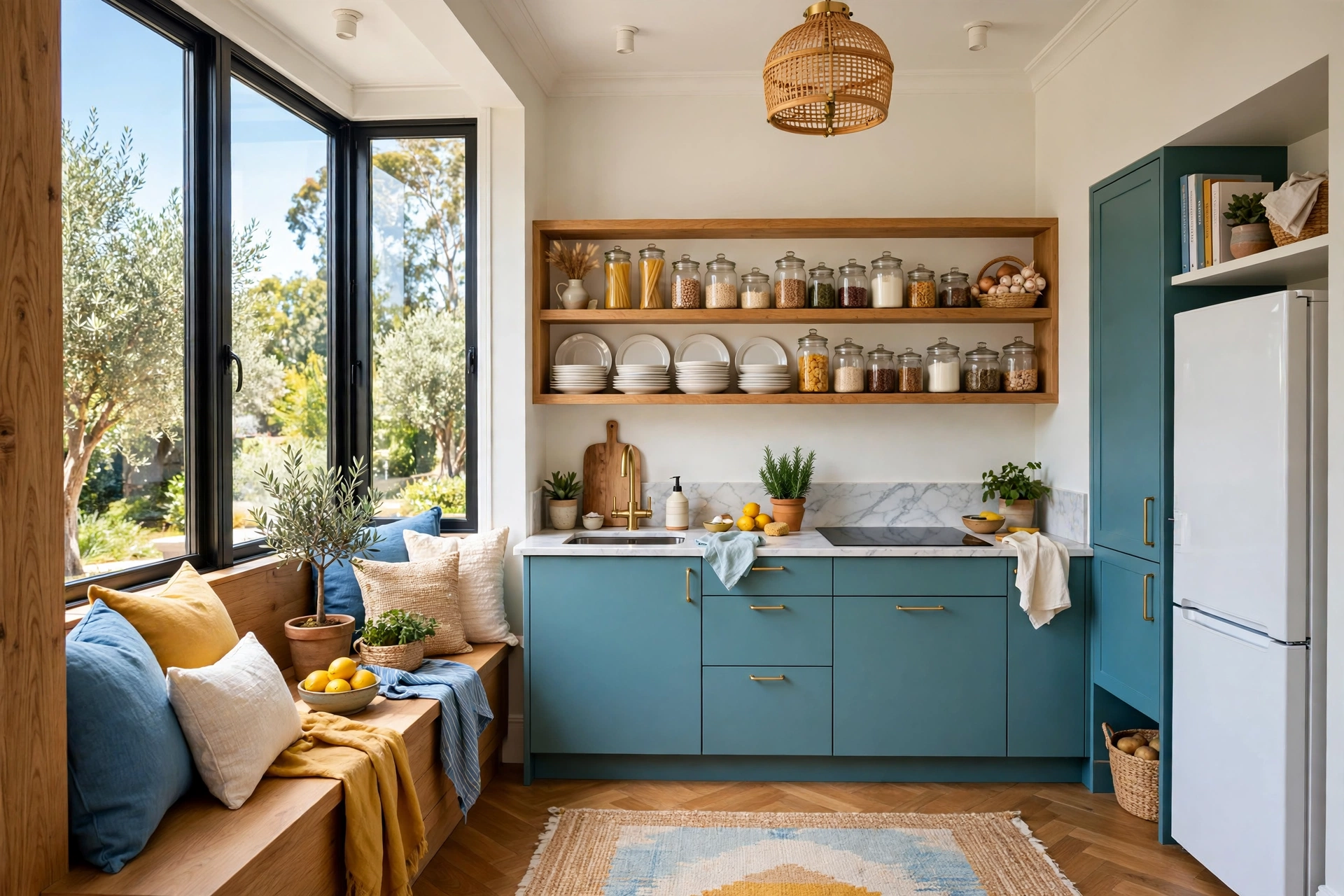
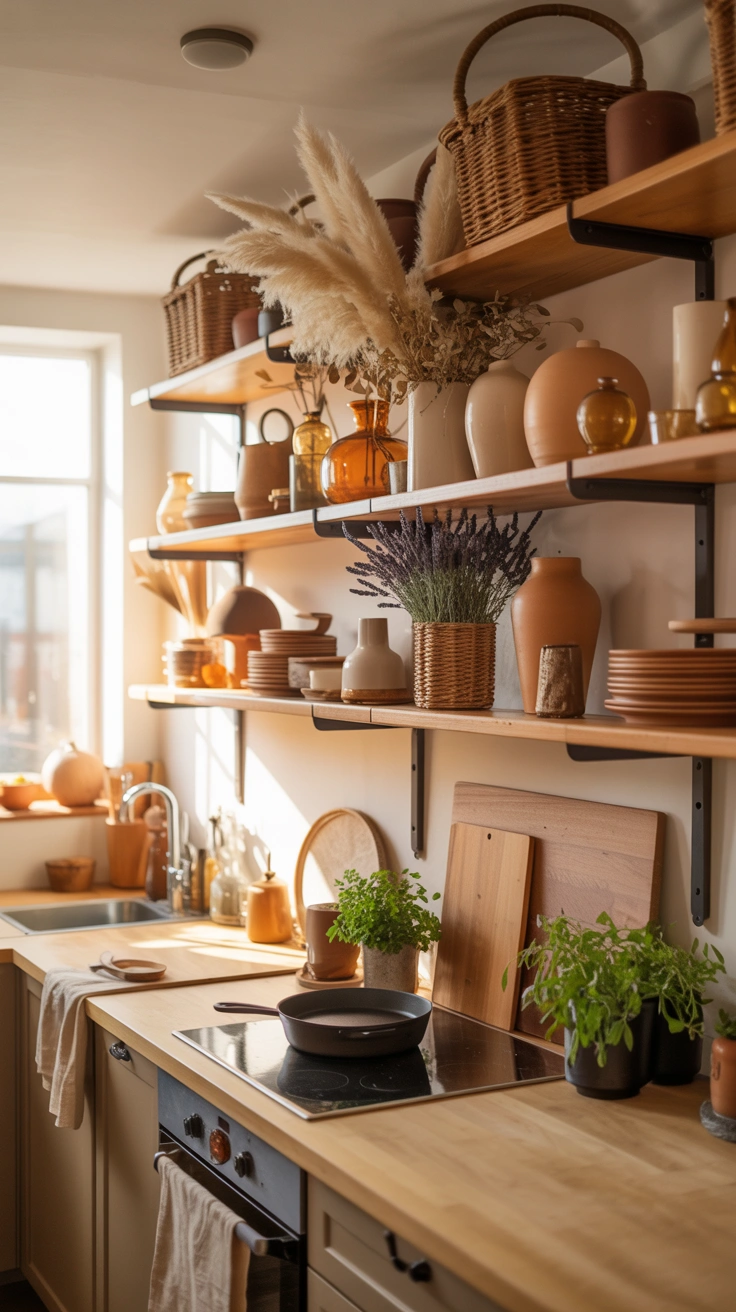
Open shelving is the small-kitchen move that divides opinion, but done right it makes a tiny kitchen feel airy and inviting instead of boxed in by wall-to-wall cabinets. Replacing one run of upper cabinets — or simply removing the doors from one cabinet — opens up the wall, lets light travel, and turns your everyday dishes into part of the decor. White plates, wooden boards, and glass jars look genuinely beautiful when they are styled with a little restraint.
The discipline is keeping shelves about two-thirds full and grouping by colour or material so each shelf reads as one calm composition. Everyday plates and bowls go lowest, where they are easy to grab; pretty but rarely used pieces go higher. Keep a small step stool nearby if your shelves run high, and be honest with yourself: if maintaining a styled shelf sounds exhausting, keep the open shelves to one short run and leave the rest closed. A little open shelving goes a long way.
💡 Pro Tip: Style open shelves the way you would a bookshelf: group in odd numbers, vary heights, and leave breathing room between groups. A shelf that is styled but not stuffed is what makes a small kitchen feel curated rather than cluttered.
3. Add a Rolling Kitchen Island or Cart

Counter space is the scarcest resource in a small kitchen, and a rolling island or cart is the cheapest way to buy more of it. A slim cart with a butcher-block top adds a prep surface, a lower shelf for pots or cookbooks, and — because it is on wheels — it can move to where the work is and park in a gap when dinner is done. Some carts even add a towel bar, a knife slot, or a wine rack in the same footprint.
Choose the size honestly: measure your walkways first, and leave at least 90 centimetres of clear passage around the cart when it is in use, so you are not squeezing past it with a hot pan. Lockable casters matter — lock at least two wheels whenever you chop on it. A cart in a warm wood tone or a painted colour that matches your cabinets looks like furniture, not an appliance, and it is one of the few kitchen upgrades you can take with you when you move.
Small Kitchen Decor Ideas Quick-Start Checklist
- ✅ Paint or refresh the cabinets in a light, bright colour
- ✅ Clear one full counter run so you have a real prep zone
- ✅ Add one rolling cart or island for extra counter space
- ✅ Swap in warm under-cabinet lighting for evening cooking
- ✅ Decant dry goods into matching clear jars
- ✅ Hang one rail or strip to get utensils off the counter
- ✅ Put a living herb pot on the windowsill
4. Hang Pots, Pans, and Utensils on a Wall Rail

Every pot, pan, and utensil stored in a drawer or a deep cabinet is a pot you have to dig for, and deep cabinets are where small kitchens lose the most usable space. A wall rail with S-hooks — mounted on the backsplash, beside the stove, or on an empty stretch of wall — gets your most-used tools out of the pile and onto display, where they are easy to grab and genuinely attractive. Copper pans, cast iron, and wooden spoons look like a cook’s kitchen, because they are.
Mount the rail where you actually cook, not where it looks best in a photo: beside the stove for spatulas and ladles, above the prep zone for pans. Keep the rail to one row so it reads as intentional rather than chaotic, and hang only what you use weekly — the rest can live in a cabinet. For renters, no-drill storage ideas like adhesive rails and tension rods inside cabinet doors give you the same grab-and-go convenience without a single hole in the wall.
5. Decant Dry Goods Into Clear, Matching Jars

Few changes make a small kitchen look instantly more expensive than decanting. A jumble of half-empty bags, boxes, and mismatched packets reads as chaos, while a row of clear, matching jars reads as a pantry that belongs in a magazine — and it is also far more practical. You can see at a glance what is running low, ingredients stay fresher in sealed jars, and pouring from a jar is easier than wrestling with a torn bag.
Start with the five things you reach for most: flour, sugar, rice, pasta, and oats, then add coffee, lentils, and baking supplies as the habit sticks. Label every jar on the side that faces out, and keep the jars on the shelf or counter where you actually cook rather than in a high cabinet you never open. Glass jars are cheapest bought in sets, and square jars waste less shelf space than round ones — a small detail that matters a lot on a narrow pantry shelf.
Quick Comparison: Small Kitchen Decor Ideas by Cost and Effort
6. Light Under the Cabinets and Over the Work

Small kitchens are almost always under-lit, because a single ceiling fixture throws light onto the top of your head and leaves the counters in shadow. Under-cabinet lighting fixes the exact problem: a slim LED strip or puck light mounted beneath the upper cabinets washes the counter in bright, even light, so chopping, reading recipes, and cleaning up all get easier and safer. It also makes the kitchen glow beautifully in the evening, when a single overhead light makes everything look flat and tired.
Battery-operated LED strips with adhesive backing need no wiring at all, which makes them fully renter-friendly, and warm-white (2700–3000K) bulbs keep the glow feeling like evening sun rather than a laboratory. Run the strip the full length of the counter, not just above the sink, so there are no dark gaps. If your kitchen has no upper cabinets, a plug-in picture light or a slim wall-mounted bar over the prep zone does the same job.
7. Swap the Cabinet Hardware for Something Better

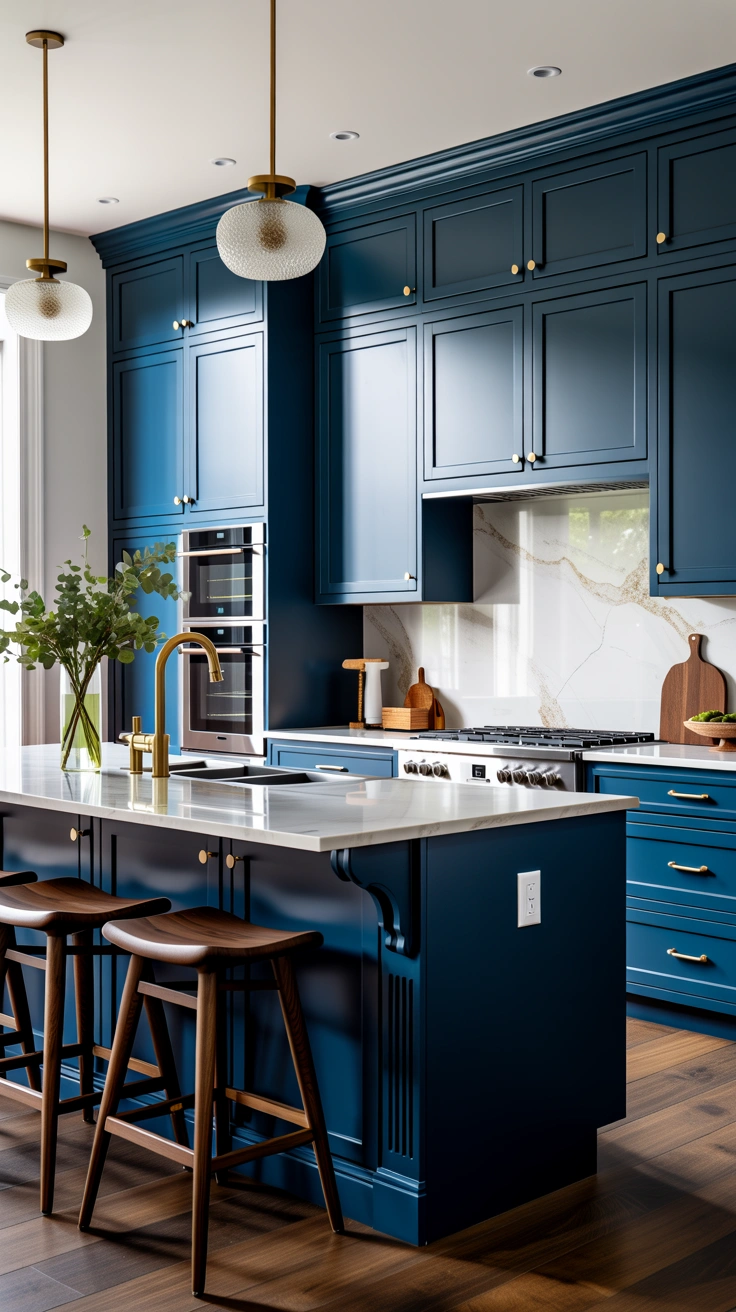
Cabinet hardware is the jewellery of the kitchen: small, inexpensive, and wildly disproportionate in its effect. Dated brass knobs, mismatched pulls, or the builder-grade handles that came with the flat-pack can drag a whole kitchen down, while a set of matching pulls in matte black, brushed brass, or warm wood instantly makes the same cabinets look considered and current. It is a one-afternoon job that costs less than a dinner out.
Measure the hole spacing on your existing pulls before ordering — the standard is usually 96 millimetres or 128 millimetres — so the new hardware fits the old holes and no drilling is needed. Keep one finish consistent across the whole kitchen, and match it to the faucet and light fixtures where you can, so the room reads as one calm composition. If you are renting, keep the original hardware in a labelled bag and refit it at move-out; landlords rarely object to a reversible upgrade.
8. Lay Down a Colourful, Washable Runner Rug
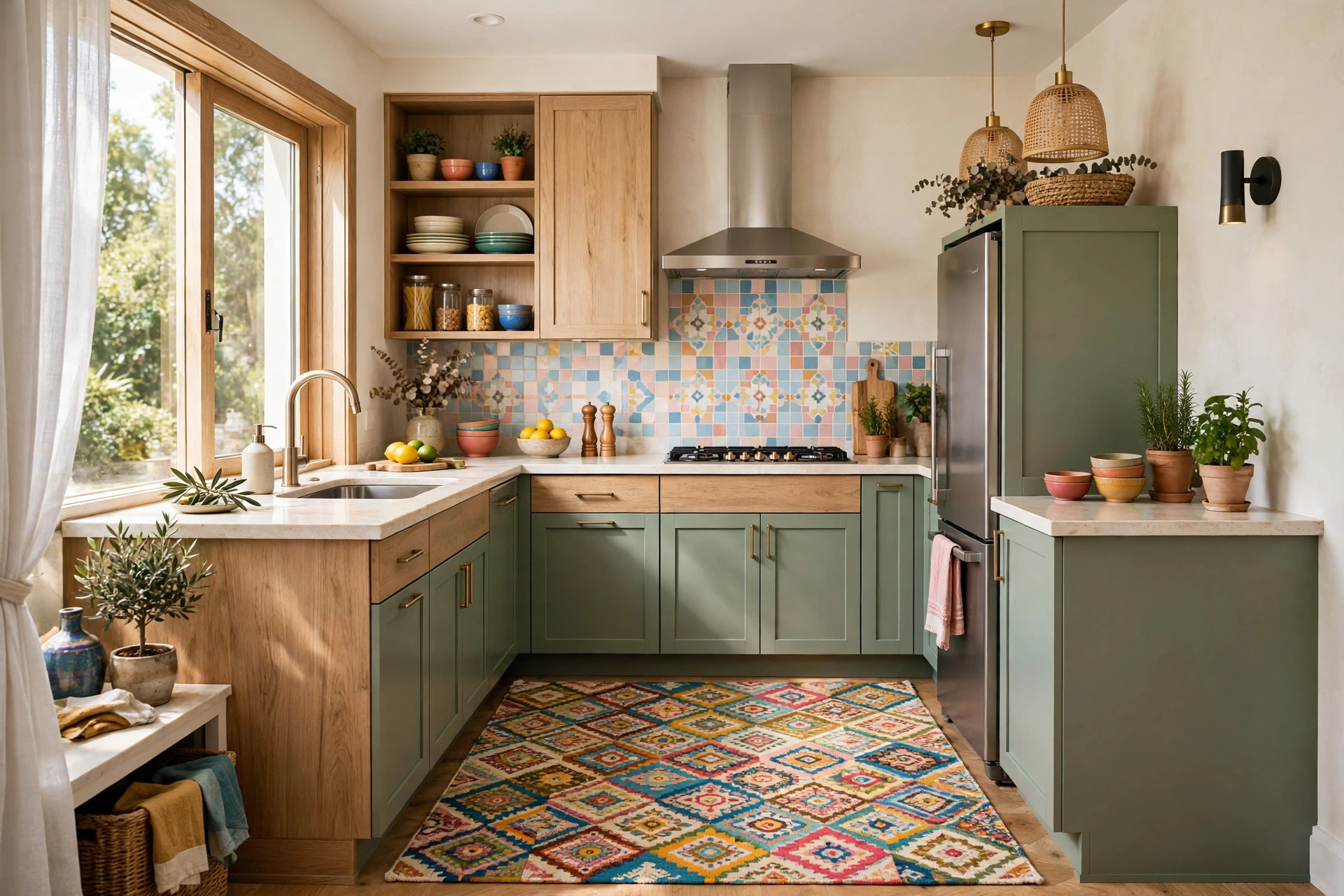
A bare kitchen floor is a missed opportunity, especially in a small kitchen where the floor is one of the largest visible surfaces. A colourful, washable runner rug adds warmth, pattern, and personality underfoot, defines the cooking zone, and softens a hard tile or vinyl floor. Because kitchens are spill zones, choose a rug that is genuinely machine-washable, not just spot-cleanable, and back it with a non-slip pad so it stays put on smooth floors.
Pattern is your friend here: a vintage-style print or a bold stripe hides crumbs and splashes far better than a plain light rug, and it pulls the kitchen’s colour scheme together in one move. Size it to run the length of the main counter, not just in front of the sink, so the zone feels generous rather than token. A runner is also the easiest kitchen decor to change seasonally — swap a bright one in for summer and a deeper tone for winter, and the room gets a refresh for the price of a wash.
📌 Important: Never put a thick, high-pile rug in a kitchen. It traps spills, trips feet, and blocks doors. Flat-weave, low-profile runners are the only safe choice where people carry hot pans and sharp knives.
9. Grow Herbs on the Windowsill

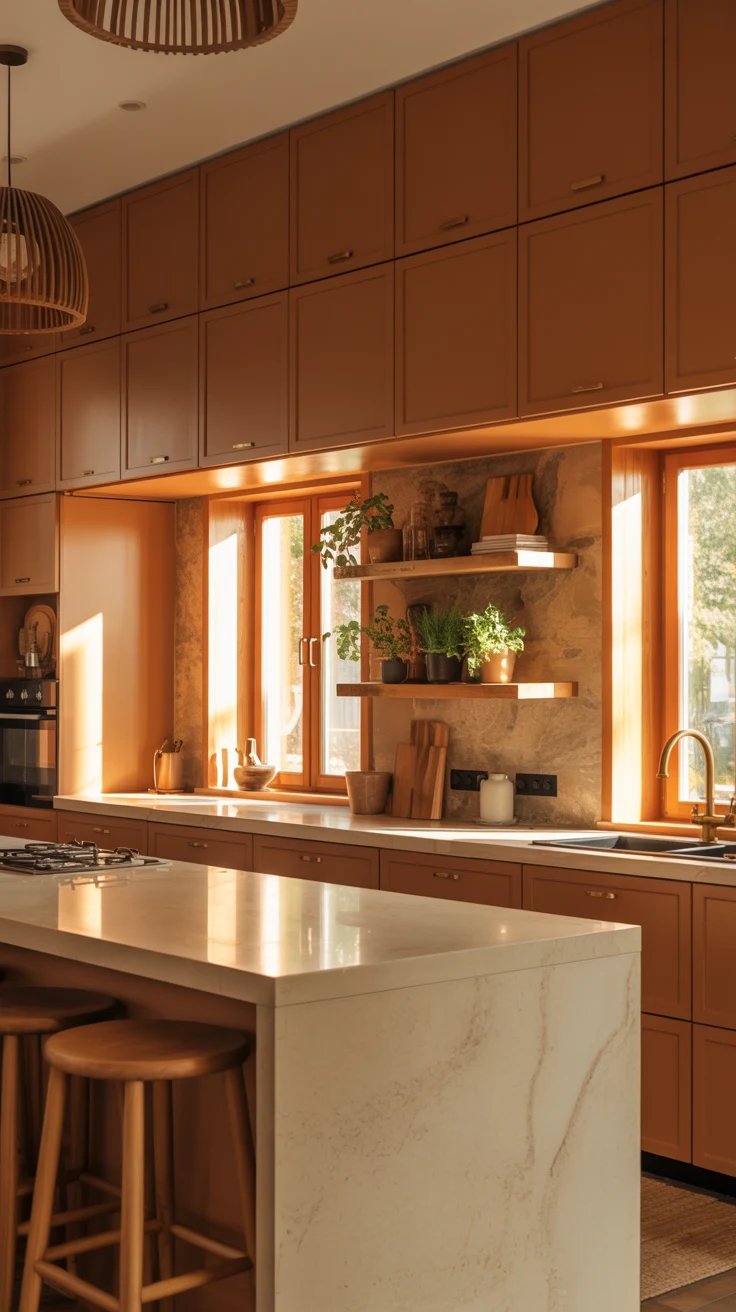
A pot of basil, a trailing rosemary, and a mint plant on the windowsill do three jobs at once: they decorate the kitchen with living green, they put fresh flavour within arm’s reach while you cook, and they make the room smell like a kitchen that is actually used. Few small-kitchen decorations earn their counter space as honestly as herbs do, because they are both decor and ingredient.
Give herbs the brightest windowsill you have — most need several hours of direct sun — and water only when the top of the soil feels dry, since overwatering kills more kitchen herbs than neglect does. Grow mint in its own pot, because it spreads aggressively and will take over anything planted beside it. If your windowsill is too narrow, a wall-mounted rail with hanging pots or a slim shelf above the sink keeps the greenery off the counter entirely, which is exactly what a small kitchen needs.
10. Hang Art, a Chalkboard, or a Menu Board

Kitchens get treated as purely functional rooms, which is why so many of them feel cold. One piece of art, a framed vintage food print, or a chalkboard menu on an empty wall instantly makes a small kitchen feel like a room people enjoy being in, not just a workstation. A weekly menu board is doubly useful: it looks charming, and it ends the daily “what’s for dinner” negotiation before it starts.
Hang art at eye level and keep it away from direct splashes beside the stove, where steam and grease will ruin it quickly. A framed print above a small dining spot, a chalkboard on the wall by the fridge, or a leaning art print on an open shelf all work without a single new hole if you use adhesive strips. Choose art with warm colours that echo the kitchen’s palette — a food print in the same tones as your runner rug ties the whole room together for almost no money.
11. Free the Counter With a Magnetic Knife Strip

Knife blocks eat a surprising amount of counter space, and a drawer full of loose knives is both blunt and dangerous. A magnetic knife strip mounted on the wall beside the prep zone solves both problems at once: the knives are visible, easy to grab, safely stored, and the counter gains a whole stretch of usable space. It also looks like a serious cook’s kitchen, which is a nice bonus when the rest of the room is small.
Mount the strip at a height where the longest blade clears the counter but you are not reaching above shoulder height, and keep it away from the stove’s heat. Wood-faced magnetic strips look warmer than bare metal and suit almost any kitchen style. If drilling is not allowed, heavy-duty adhesive magnetic strips hold a set of everyday knives on tile or a smooth backsplash, and they come off cleanly at move-out.
12. Carve Out a Tiny Breakfast Nook

Even the smallest kitchen usually has one underused corner — a window end, a short wall, a gap beside the fridge — and turning it into a breakfast nook makes the kitchen feel like a place to linger, not just to cook. A small round table with two chairs, a bench tucked against the wall, or even a fold-down wall table with two stools creates a spot for morning coffee, homework, or a slow weekend breakfast, and it makes the whole kitchen feel larger because it gains a second purpose.
Round tables work best in tight corners because they have no sharp edges jutting into walkways, and a bench against the wall saves the space a pulled-out chair would need. Keep the nook’s styling simple — a small vase, a placemat, one cushion — so it stays inviting rather than cluttered. If there is genuinely no floor space, a wide windowsill shelf or a counter overhang with two stools gives you the same lingering spot without a table at all.
13. Layer in Baskets and Natural Texture

Small kitchens can feel hard and cold — tile, metal, laminate, glass — and natural texture is the fastest way to warm them up. Woven baskets on top of cabinets, a wooden bread box, a rattan tray for oils and vinegars, linen tea towels, and a wooden chopping board left out on the counter all add warmth and tactility that make the room feel like a home rather than a showroom. Texture is also forgiving: it hides wear and makes a budget kitchen look collected rather than cheap.
Use baskets with a job, not just as decoration: one for onions and garlic, one for bread, one for cleaning cloths under the sink. Open baskets on top of cabinets are perfect for rarely used items like picnic gear or bulk supplies, since they keep the clutter contained and look intentional from below. Keep the palette of your textures consistent — warm wood, natural rattan, cream linen — so the room reads as calm, not as a jumble of unrelated objects.
14. Upgrade the Faucet and Add a Filter Tap

The faucet is the most-touched object in the kitchen, and an old, dripping, or dated one drags the whole sink area down. A new faucet in a finish that matches your cabinet hardware — matte black, brushed brass, or classic chrome — is a one-afternoon upgrade that makes the sink feel new, and a pull-down spray head makes washing large pots and rinsing the sink dramatically easier. If your budget stretches, a filtered-water tap or a countertop filter jug beside the sink means better-tasting water without a single plastic bottle.
Check your sink’s hole configuration before ordering: most kitchen sinks have one or three holes, and the faucet must match. Turn the water off at the shut-off valves before you start, and keep a towel and a small bucket handy for the water left in the old lines. For renters, keep the original faucet in a box and refit it at move-out; a faucet swap is one of the most reversible upgrades a kitchen can have.
15. Build a Dedicated Coffee or Tea Station

A small kitchen feels chaotic when coffee gear, tea boxes, mugs, and filters are scattered across every surface. Gathering them into one dedicated station — a tray or a small shelf beside the kettle, with mugs hung on hooks below and jars of coffee and tea lined up behind — turns the morning routine into a ritual and frees the rest of the counter in one move. It also looks wonderful: a styled coffee corner is the kitchen equivalent of a reading nook.
Keep the station to one tray or one shelf so it stays contained, and put it near the kettle and the water source so the routine flows in one spot. Hang mugs on a rail or hooks underneath a shelf rather than stacking them in a cabinet, since a mug you can see is a mug you will actually use. A small plant or a framed print beside the station keeps it from feeling like a utility shelf and makes the morning coffee feel like a treat, which is the whole point.
💡 Pro Tip: Keep the coffee station stocked for one week at a time, not one month. A small, freshly stocked station looks inviting; an overflowing one looks like storage, and the kitchen loses the calm it just gained.
16. Divide Baking Sheets and Boards Vertically

Baking sheets, chopping boards, and muffin tins stacked flat in a deep cabinet are the worst storage in a small kitchen: you need the one at the bottom, so everything comes out. Storing them vertically — in a narrow tension-rod divider, a file organiser, or a purpose-made vertical rack inside a cabinet — turns a pile into a filing system where every sheet slides out without disturbing the rest. It is a five-minute change that ends one of the kitchen’s most annoying daily frictions.
A pair of tension rods inside a deep cabinet creates instant vertical slots for almost no money, and a cheap file organiser does the same job on a shelf. Put the most-used boards at the front and the seasonal baking trays at the back, and keep lids in a separate vertical slot beside them. This is the same thinking behind the best apartment storage ideas no drilling requires for the rest of the home: use the space you already have, vertically, before buying anything new.
17. Brighten the Room With a Reflective Backsplash

A small kitchen’s backsplash is a large, highly visible surface, and a reflective one — glossy subway tile, a mirrored panel, or a light, glossy paint — bounces light around the room the way a mirror does in a small bedroom. A glossy white or pale sage backsplash makes the wall behind the counter glow, makes the kitchen feel wider, and is far easier to wipe clean than matte paint after a cooking session. The effect is subtle but real, especially in a kitchen with only one window.
If retiling is out of reach, peel-and-stick glossy tiles over the existing backsplash give you most of the same brightness for very little money, and they come off at move-out. Keep the backsplash colour close to the wall colour so the room reads as one continuous surface rather than a striped band. The same mirror logic that makes best mirrors for small spaces so effective applies here: wherever the eye can travel and light can bounce, the room feels bigger.
18. Soften Cabinets With Curtains or a Sink Skirt

Not every cabinet needs a door, and not every open space needs to look unfinished. A simple fabric curtain on a tension rod — under the sink, over an open shelf, or across a gap where a door is missing — softens a small kitchen instantly, hides the cleaning supplies or the awkward plumbing, and adds a touch of cottage charm that hard cabinet doors never will. A sink skirt in a pretty ticking stripe or a simple linen is the classic version, and it costs almost nothing.
Choose a washable fabric, since kitchen curtains collect cooking film, and hang the rod so the curtain just skims the floor or the cabinet base without dragging. Keep the fabric light in colour and simple in pattern so it reads as intentional rather than as a cover-up. For a modern kitchen, a flat linen panel in a solid colour works just as well as a gathered country curtain — the softening effect is the same, and the room instantly feels less boxy.
19. Choose Bar Stools With Personality

If your kitchen has a counter, a peninsula, or an island, the stools are the most visible furniture in the room, and boring ones waste that opportunity. A pair of stools with personality — woven rattan seats, a painted wood finish, a leather pad, or a sculptural metal frame — turns the counter into a destination and gives the whole kitchen a focal point. Because stools are small, they are also one of the cheapest ways to introduce a new material or colour into the room.
Check the height first: counter-height stools suit a 90-centimetre counter, bar-height suits a 105-centimetre bar, and the seat should sit about 25 centimetres below the counter top so legs fit comfortably. Backless stools tuck fully under the counter and save floor space, which matters in a tight kitchen, while low-back stools are more comfortable for long sits. Buy two, not four, if space is tight — two beautiful stools beat four cramped ones every time.
⚠️ Warning: Never buy stools without measuring the counter height and the tuck-under clearance first. Stools that are too tall or too wide turn a breakfast counter into an obstacle course, and returns on furniture are rarely free.
20. Keep Counters Clear and Let One Focal Point Shine

The final idea is the one that makes all the others work: keep the counters mostly clear. A small kitchen with clear counters looks bigger, calmer, and more expensive than the same kitchen with every gadget on display, no matter how nice the gadgets are. Aim to leave roughly three-quarters of every counter clear, with only the daily essentials — the kettle, a board, a jar of utensils — earning a permanent spot, and everything else stored away after use.
Then give the room one beautiful focal point to look at: a bowl of lemons, a vase of eucalyptus, a wooden board with olive oil and bread, or a single piece of art on the open wall. One confident focal point gives the eye somewhere to land, which is what makes a room feel designed rather than merely tidy. A kitchen that follows this rule — clear counters, one focal point — will look good even on the days when cooking feels like a chore, and on the good days, it will make cooking feel like the pleasure it should be.
Common Small Kitchen Decor Mistakes
Mistake 1: Filling every wall with cabinets
Wall-to-wall upper cabinets maximise storage but make a small kitchen feel like a box. Leave at least one stretch of wall open — a shelf, a window, or bare wall with art — so the eye has somewhere to rest and light has somewhere to travel.
Mistake 2: Choosing dark colours to hide wear
Dark cabinets and counters hide stains, but they also absorb light and shrink the room visually. Light, bright colours with a washable finish hide just as much wear while keeping the kitchen feeling open, which is the better trade in a small space.
Mistake 3: Buying gadgets before fixing storage
A new air fryer or stand mixer will not fix a kitchen whose storage does not work. Fix the storage first — vertical dividers, a rail, matching jars — and only then buy the gadget, once you know exactly where it will live.
Mistake 4: Ignoring the lighting
One overhead light is the most common small-kitchen mistake of all. Layer the light: under-cabinet strips for work, a pendant over the sink or island for warmth, and natural light kept unblocked at the window. Good light makes every other decor choice look better.
Mistake 5: Letting the counter become the dumping ground
Mail, keys, bags, and school papers migrate to the kitchen counter because it is the first flat surface inside the door. Give those things a home elsewhere — a tray by the door, a hook for bags — or the counter will never stay clear no matter how often you tidy it.
Frequently Asked Questions
1. What is the cheapest way to make a small kitchen look better?
Clear the counters, paint the cabinets or swap the hardware, and add under-cabinet lighting. Those three moves cost little, take a weekend, and change how the whole room feels more than any single purchase.
2. How do I decorate a small kitchen on a budget?
Start with the free moves — decluttering, rearranging, and cleaning — then spend on paint, hardware, and lighting in that order. Each one is cheap and reversible, and together they transform the room. Readers planning a wider home refresh can borrow the same spend-where-it-shows logic from our budget living room makeover guide.
3. What colours make a small kitchen look bigger?
Light, warm colours: warm white, pale sage, soft butter yellow, and light greige, used consistently on walls and cabinets so the room reads as one volume. Keep contrast low between the major surfaces, and let colour live in smaller things like the rug, art, and tea towels.
4. How can I add storage to a small kitchen without renovating?
Use vertical space and the walls: a rail for utensils, a magnetic knife strip, vertical dividers for baking sheets, a rolling cart, and matching jars on open shelves. For the wider small-space picture, our guide on small space decorating for beginners covers the same vertical-storage thinking room by room.
5. Is open shelving a good idea in a small kitchen?
Yes, in moderation. One short run of open shelves makes a small kitchen feel airy and lets you display pretty everyday dishes, but keep it to one run and keep shelves two-thirds full. The rest of the kitchen should stay closed, so the room reads as calm rather than cluttered.
6. How do I make a small kitchen feel cosy rather than cramped?
Layer warmth over the practical base: natural textures like wood and rattan, a washable runner rug, warm-white lighting, a living herb on the windowsill, and one piece of art. Cosy comes from texture and warm light, not from filling the room, so keep the counters clear while you add those layers.
7. What should I do first in a small kitchen makeover?
Start with layout and light: clear a real prep zone on the counter, fix the lighting so you can see what you are doing, and solve the single worst storage problem. Learning how to make a small room look bigger helps here too, since the same tricks — light colours, mirrors and reflective surfaces, and clear sightlines — work in kitchens just as well as in living rooms. Once those three are done, the decorative choices get much easier.
Conclusion
A small kitchen does not need more space to be enjoyable — it needs better decisions about the space it already has. Light colours, layered lighting, smart vertical storage, and clear counters do more for a tiny kitchen than any renovation, and most of them cost little and take a weekend. The twenty ideas above are not a checklist to complete in one go; they are a menu to pick from, three or four at a time, starting with whatever bothers you most when you walk in.
Start this weekend with the smallest win on the list: clear one counter, hang one rail, or put a herb on the windowsill. Cooking in a kitchen that looks good and works well stops feeling like a chore and starts feeling like the pleasure it is meant to be — and a small kitchen, decorated with intention, can do that just as well as a large one. Your tiny kitchen is not a compromise. Decorated well, it is the best room in the house.